Adapt.io vs LeadIQ: Data Enrichment Tool Comparison
Compare Adapt.io and LeadIQ side by side. See pricing, features, and integrations to choose the right data enrichment tool for your needs.
Adapt.io starts at $49 a month for 500 email credits but caps you at 50 contacts a day, rising to 100 on the $99 Basic tier. LeadIQ starts at $200 a month against a credit slider opening at 200, with no daily cap, an email at 1 credit and a phone number at 10.
Key takeaways
- Adapt.io publishes a hard daily contact cap on every tier, 25 on Free, 50 on Starter and 100 on Basic, which no monthly credit comparison shows.
- Adapt.io Basic grants 1,000 email credits, 100 phone credits and 1,000 enrichment credits, so the phone pool is a tenth the size of the email pool.
- LeadIQ prices an email at 1 credit and a phone number at 10, so phone-heavy work consumes a monthly allowance ten times faster.
- Both offer a free tier and neither sends email, so both hand a verified address to a sequencer you already own.
Reviewed and updated August 28, 2026
Adapt.io vs LeadIQ: Data Enrichment Tool Comparison
Adapt.io's Starter plan gives you 500 email credits a month and then refuses to let you spend more than 50 of them in a day. LeadIQ's Pro plan gives you a monthly credit pool and does not care whether you burn it on the first Tuesday or spread it over four weeks. That single difference decides which of these two suits a team more often than any feature list does.
Both tools find work email addresses and push them somewhere useful. They price the job in ways that reward opposite working styles, and the gap between $49 and $200 a month is not the interesting part of it.
The Short Answer
Adapt.io is the cheaper tool and the slower one: $49 a month for 500 email credits, released at no more than 50 contacts a day. LeadIQ costs more and releases everything at once, and its credit table charges 10 credits for a phone number against 1 for an email.
Choose Adapt.io for steady list accumulation on a small budget. Choose LeadIQ when the person finding the contact is the person writing the email, and speed on any given day matters more than the monthly rate.
What Each Tool Actually Is
Adapt.io is a lead-intelligence platform built around a Chrome extension and a lead builder, metering email credits, enrichment credits and a daily contact cap separately.
LeadIQ is a prospecting platform built around capture from LinkedIn Sales Navigator, with AI email drafting and champion tracking, metered on one credit pool.
The daily cap is the thing to plan around. Adapt.io publishes 25, 50 and 100 contacts per day on Free, Starter and Basic, so a team that wants a 2,000-name list built this week cannot get one on Starter at any price short of upgrading. That constraint is invisible on a monthly-credits comparison and it is the first thing a list builder hits.
LeadIQ has no daily cap and a much higher floor. Its Pro plan starts at $200 a month against a slider that opens at 200 credits, and a phone number costs ten of those credits against one for an email. So LeadIQ is priced for a small team doing considered, personalised outbound and Adapt.io is priced for someone filling a spreadsheet at a steady pace.
Pricing Comparison

Starter, 500 email credits, 50 a day
Pro, slider opening at 200 credits
Adapt.io Pricing
| Plan | Price | Credits | Daily cap |
|---|---|---|---|
| Free | $0/mo | 25 email credits, 25 enrichment credits | 25 contacts per day |
| Starter | $49/mo | 500 email credits, 500 enrichment credits | 50 contacts per day |
| Basic | $99/mo | 1,000 email credits, 100 phone credits, 1,000 enrichment credits | 100 contacts per day |
| Custom | Contact Sales | Custom | Custom |
Adapt.io's pricing page publishes three self-serve tiers and a quoted one, and it meters two things at once. Email credits and enrichment credits are separate pools, and every paid tier also carries a hard contacts-per-day cap: 50 a day on Starter, 100 a day on Basic. A month is not 500 credits you can spend on a Tuesday.
Phone credits arrive only on Basic, at 100 a month against that tier's 1,000 email credits, so the phone side of Adapt.io is a tenth the size of the email side by design. The page offers a 7-day free trial with no credit card and prices annual billing at 20 percent off the monthly rate.
Source: Adapt.io Pricing
LeadIQ Pricing
| Plan | Price | Credits | Users |
|---|---|---|---|
| Free | $0 | 50 credits | 1 user |
| Pro | $200/mo | Slider from 200 to 6,750 credits/month | Up to 5 users |
| Enterprise | Contact us | Custom | Custom, annual plan only |
LeadIQ's pricing page carries a slider rather than a ladder. Pro shows $200 a month against the slider's opening position of 200 credits a month, and the positions run 200, 500, 1,000, 1,500, 2,000, 2,500, 3,000, 3,500, 4,000, 4,500, 5,500 and 6,750 before handing over to Enterprise. Annual billing is priced at 25 percent off, Enterprise is annual only, and every plan carries a 30-day trial.
The credit table is where the real pricing lives. LeadIQ's page prices an email at 1 credit, a phone number at 10, an email and phone together at 11, and an account enrichment at 3. A phone number therefore costs ten times an email address on the same meter, so a team that dials is spending its allowance an order of magnitude faster than a team that only emails.
Source: LeadIQ Pricing
What 2,000 contacts costs on each
Here is an invented but arithmetically honest example, using each vendor's published units. It is illustrative only and no part of it comes from a customer.
Say you want 2,000 verified work emails this month, no phone numbers. On Adapt.io Basic that is 2,000 of the tier's 1,000 monthly email credits, so it is two months of Basic at $99, or $198, and the 100-per-day cap means the first month's thousand takes at least ten working days regardless. On LeadIQ, 2,000 emails is 2,000 credits, which sits at the slider's 2,000 position rather than its 200 opening position, so the $200 headline does not apply and the real number comes from the slider on the day.
Now add phone numbers to a fifth of them. Four hundred phone numbers on LeadIQ is 4,000 credits at 10 apiece, tripling the credit requirement of the whole job. On Adapt.io the same 400 needs Basic, which grants 100 phone credits a month, so it is four months of waiting or a conversation about a custom plan. Neither tool is cheap for phones; they are expensive in different directions.
Who Should Pick Which
Pick Adapt.io if list building is a background task with a predictable weekly rhythm and the output is a CSV that somebody else sends. Two features carry that use case: ABM list building against uploaded company lists, and technographic filters across 3,000+ tech sector classifications, which is a lot of targeting for $49.
Pick LeadIQ if the person finding the contact is the person writing to them. Capture from Sales Navigator, one-click push into Outreach or SalesLoft and AI drafting inside the same extension are worth the higher floor only when one human owns the whole motion. A team that hands lists over a wall gets none of that and pays for it anyway.
- No: You need more than 100 new contacts on any single day
- No: The person sourcing the contact also writes the email
- Depends: Phone numbers are a large share of what you need
- Yes: Your budget floor is closer to $49 than to $200
- Yes: You want ABM lists built from an uploaded company list
- Depends: You already pay for Sales Navigator
Feature Breakdown
- 250M+ business contacts
- 10M+ company profiles
- Prospector Chrome extension
- Data enrichment with 50+ attributes
- Lead builder with advanced filters
- ABM list building
- Scribe AI email personalization
- Champion tracking for job changes
- One-click CRM capture
- Verified work emails and mobile numbers
- Account and contact discovery
- LinkedIn Sales Navigator integration
Adapt.io Key Features
- 250M+ business contacts
- 10M+ company profiles
- Prospector Chrome extension
- Data enrichment with 50+ attributes
- Lead builder with advanced filters
- ABM list building
- 3,000+ tech sector classifications
- Saved searches
- CSV export
- API access
LeadIQ Key Features
- Scribe AI email personalization
- Champion tracking for job changes
- One-click CRM capture
- Verified work emails and mobile numbers
- Account and contact discovery
- LinkedIn Sales Navigator integration
- AI-powered account prioritization
- Salesforce and HubSpot data sync
- Sequence integration (Outreach, SalesLoft)
- 30-day free trial
Read the two lists as different jobs rather than different sizes. Adapt.io's are about assembling a list: a lead builder, saved searches, ABM list building, CSV export. LeadIQ's are about acting on one: Scribe drafting, champion tracking when a contact changes job, one-click capture into a CRM. Only one of them lists API access on a self-serve tier, and only one lists a 30-day trial.
Integration Ecosystem
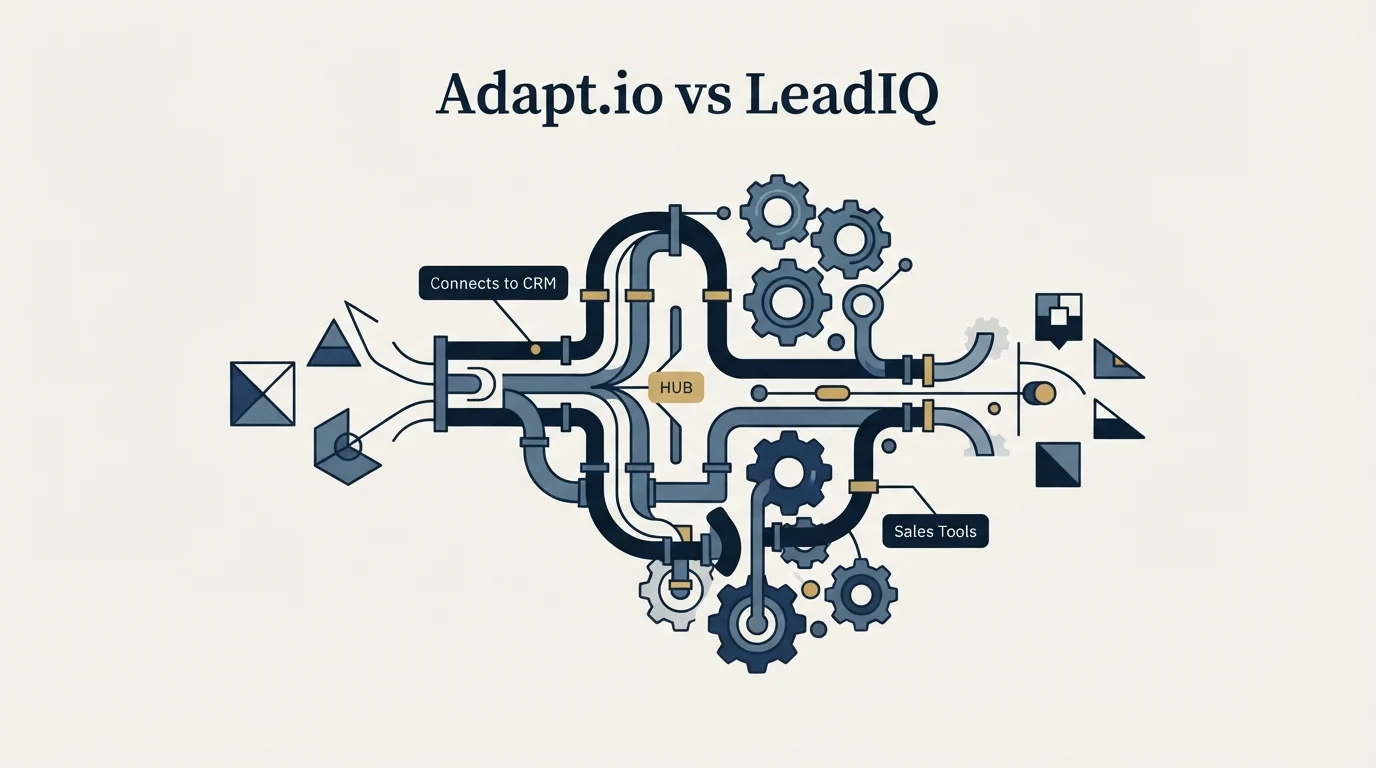
Adapt.io connects with: Salesforce, HubSpot, Zoho CRM, Marketo, Outreach, Zapier.
LeadIQ connects with: Salesforce, HubSpot, Outreach, SalesLoft, Gong, LinkedIn Sales Navigator, Gmail, Zapier.
The integration lists show the same split. Adapt.io connects to CRMs and to Zapier, which is what a list needs. LeadIQ connects to Gong, LinkedIn Sales Navigator and Gmail alongside the CRMs, which is what a rep in a browser needs. If your sequencer is Outreach or SalesLoft, both reach it, and LeadIQ reaches it natively rather than through an export step.
Where Each One Sits In A Cold Outbound Stack
Adapt.io is the cheap end of list building: a Chrome extension and a lead builder that fill a CSV, with no sending layer of its own. LeadIQ is a capture-and-personalise layer that sits between Sales Navigator and whatever sequencer you already run.
Neither tool sends anything, which is the first thing to plan around. Both hand a verified address to a sending layer you own, and the quality of that layer decides your reply rate far more than the choice between these two.
One house rule shapes how much data you need. We send one message per campaign and never bump a thread, so every contact gets exactly one shot and a wrong address is a wasted prospect rather than a retry. That pushes the decision toward whichever tool gives you the higher verified fill rate on your specific segment, which is a question only a trial answers.
Switching Between Them
Moving from Adapt.io to LeadIQ is mostly a habit change rather than a data migration. Export your saved searches as CSV first, because a saved search is a filter definition rather than a list and it does not travel. Then rebuild the highest-value two or three searches inside LeadIQ before cancelling, since LeadIQ's filters live behind capture rather than in front of it.
Going the other way, budget for the daily cap. A team used to spending a LeadIQ month in three days will hit Adapt.io's 100-a-day ceiling immediately and read it as a broken account. Plan the first month at a deliberate pace, and keep the LeadIQ subscription running for the fortnight it takes to find out whether the cap is a problem in practice.
Getting Started

- Take the same 25 target companies into both free tiers and compare fill rate, not feature lists.
- On Adapt.io, check how the daily contact cap behaves on your busiest planned day before you commit to Starter.
- On LeadIQ, move the credit slider to the volume you actually need and read the price there rather than the $200 headline.
- Count how many of your targets need a phone number, then multiply by 10 for LeadIQ credits or check Adapt.io Basic's 100 monthly phone credits.
- Verify a sample of 50 addresses from each before any of them reach a sending tool.
Final Thoughts
The honest summary is that these two tools are priced for different tempos. Adapt.io is the cheaper way to accumulate a list steadily; LeadIQ is the better way to work a small list carefully, and it charges accordingly.
Both free tiers are real, so the cheapest experiment is to build the same 25-contact list in each and time how long it takes to get from a company name to a sent email.
Related Reading
- Best Adapt.io Alternatives in 2026
- Best LeadIQ Alternatives in 2026
- Apollo.io vs LeadIQ: Data Enrichment Tool Comparison
- LeadIQ vs UpLead: Data Enrichment Tool Comparison
- Waterfall Enrichment: The Provider Order That Follows From the Unit Costs
- Cold Email Bounce Rate Benchmarks: 2026 Performance Data
If you would rather have this run for you, RevenueFlow books qualified meetings on a pay-per-meeting basis and publishes client results.
Pricing and features are taken from the vendors' own pages. Verify current terms with the vendor before relying on them.
Frequently asked questions.
Frequently asked questions- Which one is actually cheaper?
- Adapt.io, at almost any volume its tiers can serve. Starter is $49 a month against LeadIQ Pro from $200. The caveat is that Adapt.io Basic tops out at 1,000 email credits and 100 contacts a day, so past that ceiling the comparison stops being about price and becomes about whether the tool can serve the volume at all.
- What is the daily cap and does it really matter?
- Adapt.io publishes a contacts-per-day limit on every tier: 25 on Free, 50 on Starter, 100 on Basic. It matters whenever list building is bursty. A team that wants 1,000 names before Friday cannot get them on Starter at any price, and that constraint is invisible if you only compare monthly credit counts.
- How much do phone numbers cost on each?
- LeadIQ charges 10 credits for a phone number against 1 for an email, so 400 mobiles is 4,000 credits. Adapt.io grants 100 phone credits a month, and only on the $99 Basic tier. Neither is cheap for phone-heavy work; they are expensive in different ways and neither publishes a bulk phone tier.
- Can either one send the emails too?
- No. Both find and enrich contacts and stop there, so you still need a sequencer or mailbox tool underneath. That is worth remembering when comparing them against all-in-one platforms, because the total stack cost includes a sending layer that neither of these two provides.
About the author.

Tim Carden is CMO / CTO at RevenueFlow, which builds and operates outbound revenue engines for B2B companies. Studied at McGill University.
Tim Carden · CMO / CTO
Connect on LinkedIn →Explore more.
Ready to scale your outreach?
We build GTM engines that book real meetings. See the receipts.
Related articles.
11x vs Adapt.io: Sales Engagement Platform vs Data Enrichment Tool Comparison
Compare 11x (sales engagement platform) and Adapt.io (data enrichment tool). See pricing, features, and integrations to decide which one, or both, your stack needs.
Agile CRM vs LeadIQ: CRM Platform vs Data Enrichment Tool Comparison
Compare Agile CRM (CRM platform) and LeadIQ (data enrichment tool) side by side. See pricing, features, and integrations to decide which one, or both, your stack needs.
Apollo.io vs Proofy: Data Enrichment Tool Comparison
Compare Apollo.io and Proofy side by side. See pricing, features, and integrations to choose the right data enrichment tool for your needs.
AroundDeal vs Leadspicker: Data Enrichment Tool vs Sales Engagement Platform Comparison
Compare AroundDeal (data enrichment tool) and Leadspicker (sales engagement platform) side by side. See pricing, features, and integrations to decide which one, or both, your stack needs.
AroundDeal vs Salesflare: Data Enrichment Tool vs CRM Platform Comparison
Compare AroundDeal (data enrichment tool) and Salesflare (CRM platform) side by side. See pricing, features, and integrations to decide which one, or both, your stack needs.
Gong vs NeverBounce: Sales Engagement Platform vs Data Enrichment Tool Comparison
Gong vs NeverBounce: what Gong's own pages say about enrichment, what NeverBounce's API returns about an address, and how each vendor prices.