Apollo.io vs Pipedrive: Cross-Category Comparison
Compare Apollo.io (data enrichment tool) and Pipedrive (crm platform) side by side. Understand how these tools fit different stages of your sales workflow.
Apollo.io finds and verifies people before a campaign sends. Pipedrive holds the account and pipeline after a reply. Buy the CRM first when there is no record of what was said to an account, and the enrichment tool first when the list is the constraint. Together they run about $2,016 a year at five seats on published list prices.
Key takeaways
- Apollo.io publishes Basic at $49 per seat per month billed annually, carrying 30,000 credits per seat per year, granted upfront.
- Pipedrive lists Lite at $14 per seat per month billed annually, a figure carried forward rather than re-read for this update because the pricing page refused every route tried from this egress, plain and headless alike.
- At five CRM seats and two prospecting seats the pair works out around $2,016 a year on published list prices, which is arithmetic on an invented team rather than a quote.
- Buy the CRM first when nothing records what has already been said to an account, and the enrichment tool first when campaigns stall for want of people to contact.
Reviewed and updated August 29, 2026
Apollo.io vs Pipedrive: Cross-Category Comparison
The tell that a stack is missing one of these is rarely a missing feature. It is a rep pasting a name off LinkedIn into a deal record by hand, or a spreadsheet of verified contacts nobody has written to because there is nowhere to log the reply. Apollo.io answers the first of those and Pipedrive answers the second, so comparing them as rivals goes nowhere. Apollo.io is a contact database with campaign tooling and pipeline boards attached. Pipedrive is a deal-pipeline CRM built around activity-based selling, deliberately narrower than a platform. The useful question is which gap is costing more right now.
The Short Answer
Buy the CRM first if nothing reliably records what has already been said to an account, because every other improvement gets lost without one. Buy the enrichment tool first if the CRM is already in daily use and the bottleneck is finding enough of the right people to put into it. Teams doing outbound at volume end up with both. Run together at the illustrative team size below, the pair works out around $2,016 a year on published list prices.
Why Compare These Two Tools?
Data enrichment tools find and verify contact information, while CRMs organize and track those contacts through the sales process. Teams evaluate whether their CRM's built-in data features are sufficient or if a dedicated enrichment tool delivers better data quality.
Apollo.io is a data enrichment tool focused on B2B lead data and contact enrichment. All-in-one sales intelligence platform with 240M+ contacts, AI-powered campaigns, and built-in email sequencing.
Pipedrive is a CRM platform focused on customer relationship management. A sales-focused CRM designed by salespeople for salespeople, built around a visual deal pipeline. Pipedrive emphasizes simplicity and ease of use with powerful automation features, AI-powered sales assistance, and activity-based selling methodology.
Where Each Tool Fits in Your Workflow
- Step 1Lead sourcing and data
Apollo.io covers B2B lead data and contact enrichment, on a free entry plan.
- Step 2Pipeline and deal tracking
Pipedrive covers customer relationship management, from $14/mo billed annually.
| Aspect | Apollo.io | Pipedrive |
|---|---|---|
| Category | Data Enrichment Tool | CRM Platform |
| Workflow Stage | Lead sourcing and data | Pipeline and deal tracking |
| Primary Focus | B2B lead data and contact enrichment | Customer relationship management |
| Starting Price | Free | $14/mo billed annually |
| Features Listed | 10 | 8 |
| Integrations | 7 | 8 |
What Each Side Does in a Cold Outbound Run
A cold outbound run happens in a fixed order and these two sit at opposite ends of it. Apollo.io works before anything is sent: finding the people, checking the addresses, filling in the firmographic data that decides who is worth writing to. Pipedrive works after somebody answers, holding the account, the thread and whatever the deal turns into.
That order carries more weight here than on most stacks, because RevenueFlow runs one message per campaign, a single send per prospect. There are no bump sequences and no thread replies, on the view that a second message landing under the one somebody ignored reads as a bump whatever the campaign structure calls it. Re-contacting a non-replier happens later as a fresh single-message campaign. A team working that way gets one attempt per contact, so a stale job title is the whole contact rather than a wasted step in a cadence. Bad records also cost more than the send: a dead address produces a hard bounce, bounces damage sender reputation, and sending domains are shared across campaigns, so one careless list degrades placement for unrelated work. That is the real argument for the enrichment side, and it is about list hygiene rather than database size.
The CRM earns its place after the reply, where meetings are qualified against criteria agreed in writing before launch and that agreement becomes a record anybody can check. Neither tool sends cold volume, though: both can put mail in an inbox and neither runs a warmed rotation of sending mailboxes, so a sending platform sits between them on any real programme.
Pricing Comparison
Apollo.io Pricing
| Plan | Price | Credits | Seats |
|---|---|---|---|
| Free | Free | 900 credits per seat/year, granted monthly | 1 or more |
| Basic | $49/mo | 30,000 credits per seat/year, granted upfront | 1 or more |
| Professional | $79/mo | 48,000 credits per seat/year, granted upfront | 1 or more |
| Organization | $119/mo | 72,000 credits per seat/year, granted upfront | 3 minimum |
Every paid price above is the per seat per month rate billed annually, and the Organization tier carries a three seat minimum, as published mid-2026.
Source: Apollo.io Pricing
Pipedrive Pricing
| Plan | Price |
|---|---|
| Lite | $14/mo |
| Growth | $39/mo |
| Premium | $59/mo |
| Ultimate | $79/mo |
Every price above is the per seat per month rate billed annually, which Pipedrive also publishes as one payment of $168, $468, $708 and $948 per seat per year, as published mid-2026.
These figures were carried forward rather than re-read for this update: the pricing page refused every route tried from this egress, plain and headless alike.
Source: Pipedrive Pricing
Pricing Context
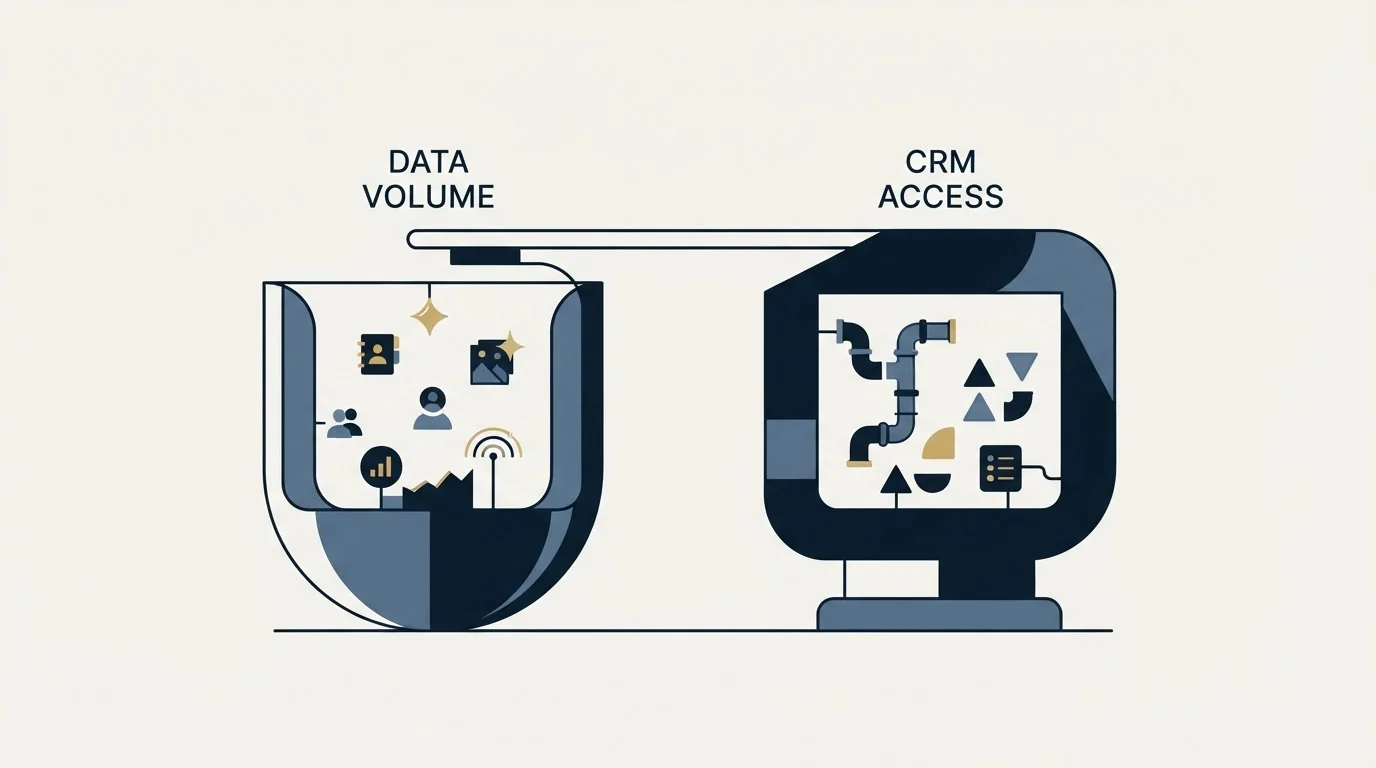
Putting the two starting prices side by side is the least useful thing these tables can be used for, because the meters underneath them count different things. Apollo.io prices per seat and grants credits per seat per year, so the bill moves with headcount rather than with how much enrichment anyone actually does. The Organization tier carries a three-seat minimum.
Pipedrive charges per seat per month, so its bill tracks headcount and keeps tracking it after the outbound programme stops growing. The Pipedrive figures were carried forward rather than re-read for this update, because the pricing page refused every route tried from this egress, plain and headless alike. Treat them as a starting point and confirm the current terms with the vendor. The comparison that matters is the annual total at the shape of team you have.
What the Pair Costs at a Realistic Team Size
List prices decide very little on their own. What a stack costs is the list price multiplied by the people who need a login, multiplied by twelve, and the ranking between two tools moves at that step more often than a comparison page admits. Take a five-person sales team, two of whom do the prospecting. That team is invented for the arithmetic and is not a measurement of anybody.
Pipedrive is billed per seat, so all five need one: Lite at $14 per seat per month billed annually is $840 a year. Only the two prospectors touch Apollo.io, and Apollo.io Basic at $49 per seat per month billed annually, for two prospecting seats, is $1,176 a year, carrying 30,000 credits per seat per year, granted upfront.
| Line | Illustrative annual cost |
|---|---|
| Pipedrive Lite, five seats, billed annually | $840 |
| Apollo.io Basic, two prospecting seats | $1,176 |
| Both | $2,016 |
Every number in that table is arithmetic on published list prices for an invented team, not a quote. Two things move it in practice: Apollo.io credits run out mid-month when campaigns outgrow the tier, and CRM seats get added for people who only read reports.
The Pipedrive half of that arithmetic rests on figures carried forward rather than re-read, because the pricing page refused every route tried from this egress, plain and headless alike, so treat the total as directional.
Feature Highlights
Apollo.io Key Capabilities (Data Enrichment Tool)
- 240M+ contacts database
- 30M+ companies
- AI-powered multichannel campaigns
- Email deliverability guardrails
- Anonymous visitor identification
- Real-time form enrichment
- Contact and company enrichment
- Advanced filtering
- CRM data cleansing
- Pipeline boards
Pipedrive Key Capabilities (CRM Platform)
- Visual deal pipeline management
- Activity-based selling methodology
- Email sync with templates and tracking
- Workflow automation builder
- AI-powered sales assistant
- Revenue forecasting and reporting
- Customizable web forms and chatbot
- Mobile app with caller ID and call logging
Feature Overlap
The overlap really is small, and the exception is worth stating precisely. The two lists above are what each vendor publishes about itself, in its own wording, so a capability both offer can appear on one list and not the other purely because they name it differently. A list difference supports the claim that one vendor lists something and the other does not. It never supports a claim that only one of them can do it.
It runs the other way too. Apollo.io lists pipeline boards and CRM data cleansing on its own feature list, which is territory Pipedrive treats as the whole product. That does not make it a CRM replacement for anyone who needs deal history, reporting and permissions, and it does mean a very small team can postpone the CRM purchase for a while.
Everywhere else the two lists describe different work, which is why record matching between them matters more than any feature either one adds.
Integration Ecosystem
Apollo.io Integrations
Apollo.io connects with: Salesforce, HubSpot, Outreach, SalesLoft, Marketo, SendGrid, LinkedIn.
Pipedrive Integrations
Pipedrive connects with: Google Workspace, Microsoft Outlook, Slack, Zoom, Zapier, Mailchimp, Trello, Asana.
When to Choose Apollo.io
Apollo.io is the right first purchase when the pipeline is thin at the top rather than leaky at the bottom.

When to Choose Pipedrive
Pipedrive is the right first purchase when the opposite holds and the deals that already exist are the ones going missing. The split below puts the two cases side by side.
- Your biggest gap is in lead sourcing and data
- You already have a solid CRM platform and need specialized B2B lead data and contact enrichment capabilities
- You want an affordable entry point ($0/mo)
- Your team's primary bottleneck is B2B lead data and contact enrichment
- Your biggest gap is in pipeline and deal tracking
- You already have a data enrichment tool and need better customer relationship management
- You want an affordable entry point ($14/mo billed annually)
- Your team's primary bottleneck is customer relationship management
Do You Need Both, and in Which Order?
A team running outbound at volume usually ends up with both, and the order is not a coin toss.
The CRM comes first when there is no system of record, because everything else becomes unmeasurable without one. Enriched contacts with nowhere to land turn into a spreadsheet that goes stale, replies get handled in personal inboxes, and nobody can say which accounts were already approached. Note also that on the illustrative arithmetic above the CRM is the larger and more permanent line, at $840 against $1,176 a year.
The enrichment tool comes first when the CRM is already busy and the list is the constraint. The signal is specific: hours a week of manual research, campaigns pausing for want of anyone to write to, or bounce rates climbing because addresses are being guessed. No CRM tier fixes those.
Neither is the right first purchase for some teams. A company with a few hundred target accounts, all known by name, is buying tooling for a research problem it does not have. The work there is the offer.
- Yes: Somewhere every account, thread and meeting is recorded
- Yes: Written qualification criteria agreed before a campaign launches
- Yes: Authenticated sending domains and warmed mailboxes
- Depends: A repeatable way to find and verify new contacts
- Depends: Enrichment writing back into the CRM automatically
- No: A second enrichment provider held as a fallback
Using Both Together
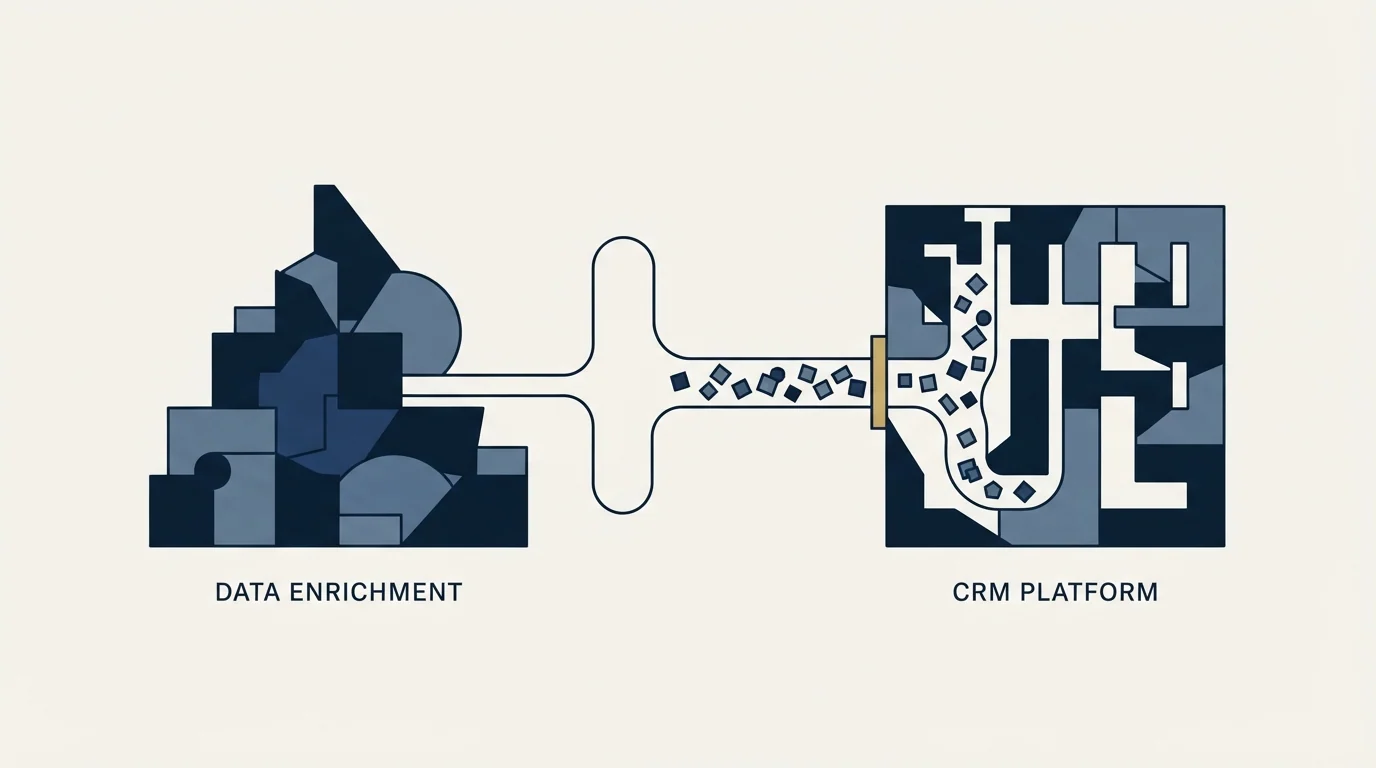
Many sales teams use both a data enrichment tool and a CRM platform as part of their complete workflow. Apollo.io handles lead sourcing and data while Pipedrive covers pipeline and deal tracking.
Check each tool's integration documentation to see how they connect in your specific tech stack.
Rolling the Second Tool In Without Breaking the First
The join between an enrichment tool and a CRM is where these projects go wrong, and it goes wrong quietly. The failure is a field that used to be right and is now something else, rather than an error message.
Decide field ownership before the first sync. For every field both tools can write, one is authoritative. Job title and company name are the usual casualties: Apollo.io refreshes them from its own data, a rep corrects one by hand after a call, and the next sync puts the old value back.
Set the dedupe rule first as well. CRM enrichment against a database already holding the same person twice produces three records rather than one, and cleaning that up costs more than the run did.
Enrich one segment before the whole database, and test coverage on your own accounts rather than the vendor's numbers. Take fifty accounts you already know, pull them through the trial or free tier, and score them on the fields the campaigns actually use. Coverage varies far more by geography, company size and job function than any headline total suggests.
- Before buyingSample fifty of your own accounts
Score a trial pull on the fields the campaigns use, not on database size.
- Week 1Agree field ownership and dedupe rules
Name the authoritative source for every field both tools can write.
- Week 2Sync one segment
One territory or list, so a bad mapping stays a cleanup.
- Week 3Read a sample back
Check updated records against the source and confirm no human edit was lost.
- Week 4Widen it
Open the sync to the rest of the database once the rules have survived a real week.
The Decision Shortcut
If replies are already arriving and the problem is that nobody can say what was promised on the last call, the gap is Pipedrive and the enrichment tool can wait a quarter.
If the CRM is open all day and campaigns keep stalling for want of people to contact, the gap is Apollo.io and a bigger CRM tier will not touch it.
If both are true at once, buy the CRM first anyway, because the enrichment tool's output has to land somewhere that survives the person who ran it. For budgeting, the pair runs about $2,016 a year at five seats and two prospectors on published list prices.
How These Figures Were Checked
Every price, plan name and tier detail here comes from the vendor's own pricing page rather than a review site, matched against a dated copy of that page's rendered text. Where a page splits a price across elements or serves a different currency by region, that is handled rather than guessed at. The Pipedrive page could not be read for this update, because the pricing page refused every route tried from this egress, plain and headless alike. Its figures are carried forward from the last successful read and are presented as exactly that, rather than filled in from a third-party roundup.
Nothing here is a test result. Neither tool was run against a campaign for this comparison, so neither is ranked by measured reply rate or qualified appointment volume. Those outcomes belong to the list, the offer and the sending infrastructure far more than to either product.
Related Reading
- Best Apollo.io Alternatives in 2026
- Best Pipedrive Alternatives in 2026
- Apollo.io vs ZoomInfo: Which B2B Data Platform Should You Choose?
- Apollo vs Clay: Choosing the Right Data Enrichment Tool for B2B Sales
- Pipedrive vs Salesforce: CRM Platform Comparison
If you would rather have this run for you, RevenueFlow books qualified meetings on a pay-per-meeting basis and publishes client results.
Pricing and features are taken from the vendors' own pages. Verify current terms with the vendor before relying on them.
Frequently asked questions.
Frequently asked questions- Is Apollo.io a CRM like Pipedrive?
- No. Apollo.io is a data enrichment tool, so it works before anything is sent, finding people and checking their details. Pipedrive is a CRM and works after somebody replies, holding the account, the thread and the deal. They sit at opposite ends of one outbound run, which is why most teams doing volume end up running both.
- How much does Apollo.io cost?
- Apollo.io publishes Basic at $49 a month billed annually, carrying 30,000 credits per seat per year, granted upfront. For two prospecting seats that is $1,176 a year on list prices. There is also a free tier carrying 900 credits per seat per year, granted monthly, which is enough to test coverage on your own accounts before paying for anything.
- What does it cost to run Apollo.io and Pipedrive together?
- At an invented five-person team with two prospectors, five seats of Lite at $14 per seat per month billed annually is $840 a year and Apollo.io Basic for two prospecting seats is $1,176, so the pair is about $2,016. That is arithmetic on published list prices rather than a quote for anybody.
- Which should a team buy first, Apollo.io or Pipedrive?
- The CRM, when there is no reliable record of what has already been said to an account, because everything else becomes unmeasurable without one. Apollo.io first when the CRM is already in daily use and campaigns keep stalling for want of people to write to. When both are true, the CRM still goes first, because enrichment output has to land somewhere durable.
About the author.

Tim Carden is CMO / CTO at RevenueFlow, which builds and operates outbound revenue engines for B2B companies. Studied at McGill University.
Tim Carden · CMO / CTO
Connect on LinkedIn →Explore more.
Ready to scale your outreach?
We build GTM engines that book real meetings. See the receipts.
Related articles.
AroundDeal vs Salesflare: Data Enrichment Tool vs CRM Platform Comparison
Compare AroundDeal (data enrichment tool) and Salesflare (CRM platform) side by side. See pricing, features, and integrations to decide which one, or both, your stack needs.
Evaboot vs Microsoft Dynamics 365 Sales: Data Enrichment Tool vs CRM Platform Comparison
Compare Evaboot (data enrichment tool) and Microsoft Dynamics 365 Sales (CRM platform) side by side. See pricing, features, and integrations to decide which one, or both, your stack needs.
Agile CRM vs LeadIQ: CRM Platform vs Data Enrichment Tool Comparison
Compare Agile CRM (CRM platform) and LeadIQ (data enrichment tool) side by side. See pricing, features, and integrations to decide which one, or both, your stack needs.
Anymail Finder vs Pipeline CRM: Data Enrichment Tool vs CRM Platform Comparison
Compare Anymail Finder (data enrichment tool) and Pipeline CRM (CRM platform) side by side. See pricing, features, and integrations to decide which one, or both, your stack needs.
AroundDeal vs Maximizer: Data Enrichment Tool vs CRM Platform Comparison
Compare AroundDeal (data enrichment tool) and Maximizer (CRM platform) side by side. See pricing, features, and integrations to decide which one, or both, your stack needs.
Breakcold vs Bulk Email Checker: CRM Platform vs Data Enrichment Tool Comparison
Compare Breakcold (CRM platform) and Bulk Email Checker (data enrichment tool) side by side. See pricing, features, and integrations to decide which one, or both, your stack needs.