Cold Calling With a Virtual Assistant: The Judgement Line
A VA agency verifies that a defined task was completed, and cold calling has no such definition. The work on either side of the call is where the model earns its money.
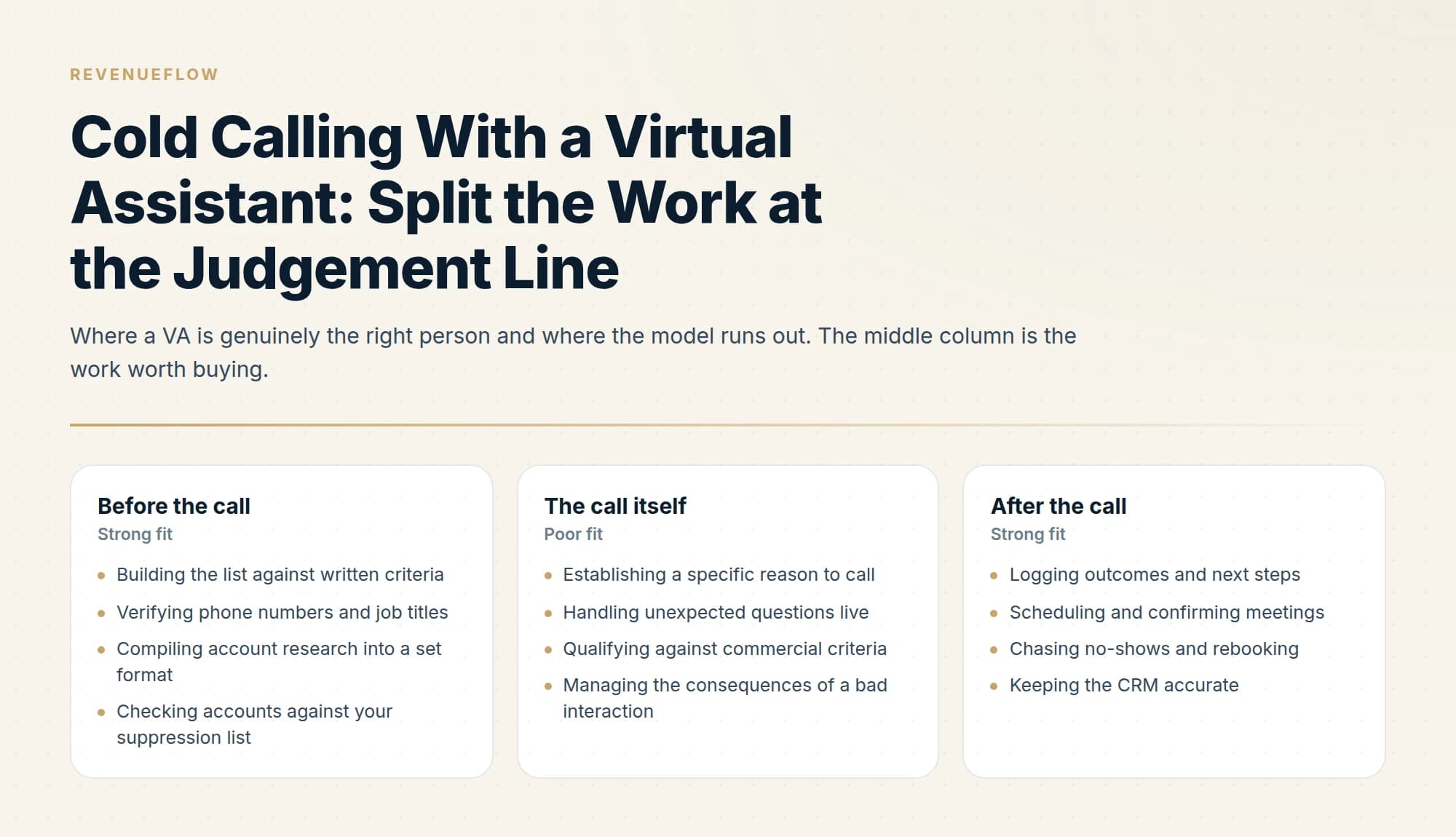
A virtual assistant is well suited to everything around a cold call and poorly suited to the call itself, because a coordinator cannot verify judgement about an unfamiliar market. Have the VA build and verify the list, compile research and handle scheduling and logging, while somebody who knows the market makes the calls.
Key takeaways
- A cold call needs a reason to phone this account today, live judgement when the conversation goes off script, and accountable handling of what comes back.
- The list and research work is the bulk of the hours and the smallest part of the judgement, which is what makes the split economical.
- Accountability for outbound calling generally sits with the company whose product is sold, so a VA dialling without a recorded suppression process is a risk the client carries.
- Warm contacts such as event attendees, trial signups and lapsed customers give a VA a self-evident reason to call and a far smaller downside.
Reviewed and updated September 1, 2026
Hiring a virtual assistant to make your cold calls is a reasonable-sounding idea that fails for one structural reason: a VA agency's quality control is a coordinator confirming that a defined task was completed, and cold calling has no such definition. Nobody can verify from the outside that the right accounts were called or that what was said was worth saying.
That does not make the underlying instinct wrong. There is real, valuable work here that a VA does better and cheaper than anyone else. It sits either side of the call rather than on it.
What the arrangement usually looks like
Someone has a target list and no time. A VA costs a fraction of a salesperson per hour, dialling looks procedural, and there are agencies that advertise exactly this.
The first weeks generally go fine. Calls happen, a few conversations occur, activity reports arrive. The problems surface later and in a specific order: the meetings that get booked are with the wrong people, the connect rate is poor because the phone data was never verified, and somewhere around week six somebody notices that a chunk of the target list has been called and produced nothing, which means those accounts are spent.
None of that is a criticism of the person. It is the predictable result of asking someone to make judgement calls about a market they were never given context for.
The three things a cold call needs that the model cannot supply
A reason to call this account today. Cold calling lives or dies on whether the opening establishes a specific, checkable reason. Producing that requires knowing the market well enough to recognise what matters. A VA can be handed a reason; they cannot generate one for an unfamiliar industry, and a generic opener converts badly enough to make the whole exercise unprofitable.
Real-time judgement. Cold calls go off-script immediately. The person asks something unexpected, mentions a competitor, or raises an objection that needs a considered answer. There is no time to check, so whatever the caller knows is what the prospect gets.
Accountable handling of what comes back. Someone will get annoyed. Someone will ask to be removed from the list. Someone will ask a question that becomes a commitment. The consequences of all three land on your company.
- Building the list against written criteria
- Verifying phone numbers and job titles
- Compiling account research into a set format
- Checking accounts against your suppression list
- Establishing a specific reason to call
- Handling unexpected questions live
- Qualifying against commercial criteria
- Managing the consequences of a bad interaction
- Logging outcomes and next steps
- Scheduling and confirming meetings
- Chasing no-shows and rebooking
- Keeping the CRM accurate
The compliance point, which is not optional

Outbound calling sits inside a real regulatory perimeter covering do-not-call suppression, permitted calling hours, recording disclosure and consent, and it varies by jurisdiction.
The accountability generally sits with the company whose product is being sold, not with the individual dialling or the agency supplying them. That means a VA calling on your behalf without a clear suppression process is a risk you carry.
At minimum, before anyone dials: a written suppression list including anyone who has previously asked not to be contacted, a rule for what to do when someone asks to be removed, and a record of it being applied. This is straightforward to set up and genuinely awkward to reconstruct afterwards.
The version that works
Split the work at the judgement line, which is the same principle that governs any VA engagement around sales.
- Step 1VA builds and verifies the list
Companies and contacts against written criteria, with phone numbers verified rather than collected.
- Step 2VA compiles the research
The specific facts per account, in a fixed format, ready for someone to use.
- Step 3Someone who knows the market calls
A rep, the founder, or a specialist provider. This is the step that needs judgement.
- Step 4VA handles the aftermath
Logging, scheduling, confirming, rebooking, keeping the record accurate.
That division is genuinely economical, because the list and research work is the bulk of the hours and the smallest part of the judgement. A rep whose accounts arrive pre-researched with verified numbers spends their day on conversations rather than preparation, which is the actual goal behind hiring a VA in the first place.
- Yes: Phone numbers verified before any dialling
- Yes: A written suppression list, applied and recorded
- Yes: A named person who handles escalations within the hour
- Yes: A defined reason to call, supplied per account rather than invented
- Yes: Call recordings you actually listen to, at least weekly
- No: Payment per appointment booked
- Depends: Whether your list is finite enough that burned accounts matter
The last row is the one that decides how much of this matters. On a very large addressable market, a mediocre calling programme wastes money. On a finite named list, it wastes the market, and that is not recoverable at any budget.
If you are determined to try it anyway

Plenty of people will read the above and try it regardless, often because the alternative is nobody calling at all. That is a legitimate position, and there is a version that is much less likely to end badly.
Start with warm before cold. Have the VA call people who have already interacted with you: event attendees, trial signups, lapsed customers, inbound enquiries that went quiet. The reason to call is self-evident, no market judgement is required to establish it, and the downside of a clumsy call is far smaller. If that works, you have learned something. If it does not, cold calling was never going to.
Give them a script and the reasoning behind it. Not just the words. A caller who understands why the opening says what it says can adapt when the conversation moves, which it always does. A caller with only the words reads them faster when they get nervous.
Cap the daily volume deliberately low at first. Twenty calls a day reviewed properly teaches you more than a hundred unreviewed, and it consumes a twentieth of the list while you find out whether this works.
Listen to five recordings in the first week. Not a sample of the metrics, the actual calls. This is non-negotiable and it is the step people skip. You will learn within twenty minutes whether the arrangement is viable, and that is the cheapest information available anywhere in the process.
Have an internal escalation path with a real response time. When something unexpected happens, the caller needs an answer that day rather than a note in a weekly report.
The honest expectation to set: this arrangement can work acceptably for warm follow-up and simple qualification into a large market. It rarely works for cold outreach into a finite named list, and the reason is structural rather than a matter of finding a better VA.
The honest cost comparison
The hourly saving is real and it compares two things that are not producing the same output.
A VA doing list building, verification, research and scheduling saves a rep's time at a genuine discount, and that comparison is strongly favourable. A VA making the calls is being compared against a trained caller, and the differences show up as connect rate, conversation rate and the quality of what gets booked, none of which appear in an hourly rate.
The reasonable approach is to price them separately: buy the support hours on their own merits, and price the calling against the alternatives, which are a trained rep, an agency, or not calling at all and putting the budget into channels that scale differently. The channel arithmetic is in outbound channel mix by deal size, and the broader VA scoping question is in virtual assistant agencies.
For what the calling job actually involves when done well, cold-call appointment setting covers the mechanics, and call-centre appointment setting covers the volume version of the same model.
Setting the VA up to succeed at the part that fits
Assuming you take the split above, the support half still needs to be specified properly or it produces the same quiet failure in a cheaper place.
Define a correct row. For list building, state which fields must be populated, what counts as a verified phone number, and what to do with an account that half fits. An example of a good output and a bad one resolves more ambiguity than a page of instruction.
Batch the questions. Ask for clarifications once a day at a fixed time rather than as they arise. It makes the interruption load predictable on your side and stops the VA guessing when you are unavailable.
Sample the output weekly. Ten rows, read properly. This takes minutes and catches drift before it propagates into a campaign and a report.
Watch one downstream number. Connect rate is the honest measure of phone-data quality. If it falls, the verification step has slipped, whatever the delivery reports say.
Done this way the arrangement is genuinely good value, and it addresses the real problem that drove the idea in the first place, which was that a salesperson was spending their day on preparation instead of conversations.
The short version
A VA is excellent at everything around a cold call and poorly suited to the call itself, because the model's quality control cannot verify judgement about an unfamiliar market. Split the work at the judgement line: the VA builds and verifies the list, compiles research and handles scheduling and logging, while someone who knows the market makes the calls. If you have a VA dial anyway, verify the phone data, put a written suppression process in place before the first call, listen to recordings weekly, and never pay per appointment booked.
If the calls themselves are what you need covered, we book attended qualified meetings against criteria agreed in writing beforehand, and you can see what a campaign would look like for your market.
Frequently asked questions.
Frequently asked questions- Can a virtual assistant make your cold calls?
- They can dial, and the arrangement rarely produces what the buyer wanted. Cold calling needs a specific reason to phone this account, real-time judgement when the conversation moves, and somebody accountable for the consequences of a poor interaction. None of those can be checked by a coordinator confirming that a defined task was completed, which is how the VA model controls quality.
- What sales work do virtual assistants do well?
- Everything with a checkable right answer. Building the list against written criteria, verifying phone numbers and job titles, compiling account research into a fixed format, and checking accounts against your suppression list. Afterwards: logging outcomes, scheduling and confirming meetings, chasing no-shows and keeping the CRM accurate. That is most of the hours and very little of the judgement.
- What safeguards matter if a VA is going to dial anyway?
- Verify phone numbers before any dialling. Put a written suppression list in place, apply it and record that you did. Name somebody who handles escalations within the hour. Supply a defined reason to call per account rather than expecting one to be invented. Listen to recordings weekly. And never pay per appointment booked.
- Is the hourly saving real?
- For support work, yes, and the comparison is strongly favourable. For calling, the VA is being measured against a trained caller, and the differences appear as connect rate, conversation rate and the quality of what gets booked, none of which show up in an hourly rate. Price the support hours and the calling separately against their own alternatives.
About the author.

B2B cold email experts helping companies generate qualified leads through done-for-you outreach campaigns.
RevenueFlow Team
Explore more.
Ready to scale your outreach?
We build GTM engines that book real meetings. See the receipts.
Related articles.
LinkedIn Lead Generation Services: What Is Safe to Outsource
LinkedIn prohibits third-party automation and the enforcement risk lands on the account owner. What can be outsourced with no exposure, and what to ask before agreeing.
Readymode Pricing: The Seat Is Dear for What Is Inside It
Readymode publishes $199 and $249 per licence per month, near the top of the dialer range. What the seat includes that others bill separately, and when that pays.
PhoneBurner Pricing: What the Seat Price Covers
PhoneBurner publishes all three seat prices in both billing states. The metered resource is contact imports, not minutes, and the spam layer is an add-on at every tier.
Koncert Dialers: Line Counts Published, Price Is Not
Koncert publishes the parallel line ceiling on every tier, which most of this category will not. It publishes no price. What its pages state, and what the quote decides.
Sales Tonality: The 38 Percent Figure and Its Author
Almost every guide to sales tonality opens with the same statistic. Its author published a scope note saying it does not apply, and the genre never carried it.
The Nooks Dialer: A Calling Floor With a Platform Attached
The distinctive thing Nooks sells is the room the dialer sits in. That decides whether it fits your team far more than the dialing does.