Virtual Assistant Agencies and Sales: Where the Model Holds
A VA agency executes defined tasks reliably, which is a real skill and a strong buy around a sales team. Prospecting is where the quality control runs out.
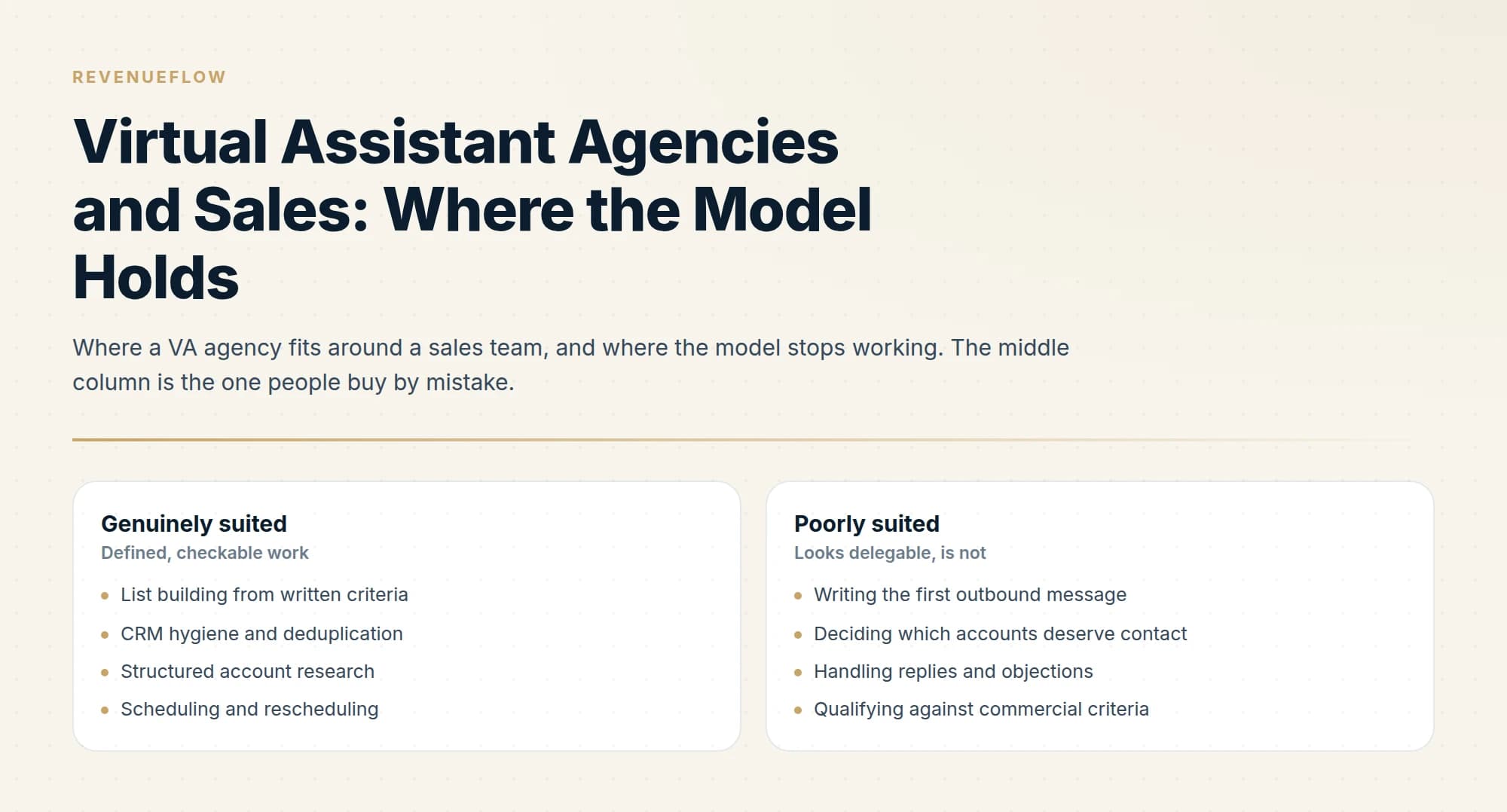
A virtual assistant agency supplies remote administrative staff with a coordinator managing quality and cover. Its core competence is executing defined tasks reliably, which makes it a strong buy for list building, CRM hygiene, research compilation, scheduling and document production around a sales team.
Key takeaways
- The agency's quality control is a coordinator checking that a defined task was completed, and prospecting has no such definition anyone outside your market can apply.
- Cold outbound needs separate sending domains, warmed inboxes and deliverability monitoring, and damage to a sending domain persists long after the engagement ends.
- Unverified contact data produces bounces, and bounces damage the same sending reputation the programme depends on.
- The spread between agencies in how well they hold a standard is wider than the spread in hourly rate, so a cheap agency needing constant correction costs more.
Reviewed and updated August 28, 2026
A virtual assistant agency will happily take on your prospecting. Several advertise it. The work looks delegable, the hourly rate is a fraction of an SDR's, and the arithmetic seems obvious.
It usually does not work, and the reasons are specific rather than snobbish. They are worth understanding before you spend a quarter finding out, and they also point clearly at what a VA agency genuinely is excellent for, which is a real and undersold list.
What you outsource to a virtual assistant should be work with a completion test somebody else can check, which is why the list above holds and prospecting does not.
A lead generation virtual assistant is sold as one role and contains two: list building, which has a completion test, and the judgement about who is worth contacting, which does not.
An inside sales virtual assistant is the same purchase under a title that implies more: the work that holds up is the defined, checkable part of the seat, and the prospecting judgement is the part that does not transfer.
What a VA agency actually is
A virtual assistant agency supplies remote administrative staff on an hourly or retained basis, typically with a coordinator managing quality and cover. The model's strengths are real: fast to start, cheap per hour relative to specialist hires, flexible in volume, and covered when someone is ill or leaves.
The core competence is executing defined tasks reliably. That is a genuine skill and it is what you are buying. Where engagements go wrong is when the task turns out not to be defined, or when correctness cannot be checked by someone without domain knowledge.
What VAs are genuinely excellent at in a sales context
There is a real overlap with sales work, and it is the support layer rather than the selling.
List building against written criteria. Given an explicit definition of the target company and the right titles, this is checkable, rule-driven work that a VA can do well and cheaply.
CRM hygiene. Deduplication, field completion, logging, tidying the orphaned records that quietly break account-level reporting.
Research compilation. Gathering specific facts about target accounts into a structured format for a rep to use, provided what to gather is specified.
Scheduling and coordination. Booking, confirming and rescheduling, chasing no-shows, managing calendar friction.
Document production. Formatting proposals, keeping templates current, chasing signature.
That is a meaningful share of a sales team's non-selling time, and the case for buying it is strong. It is the same purchase as outsourced sales support, covered in more depth in outsourced sales support.
- List building from written criteria
- CRM hygiene and deduplication
- Structured account research
- Scheduling and rescheduling
- Proposal formatting
- Writing the first outbound message
- Deciding which accounts deserve contact
- Handling replies and objections
- Qualifying against commercial criteria
- Anything where a wrong answer costs a relationship
Why prospecting specifically goes wrong
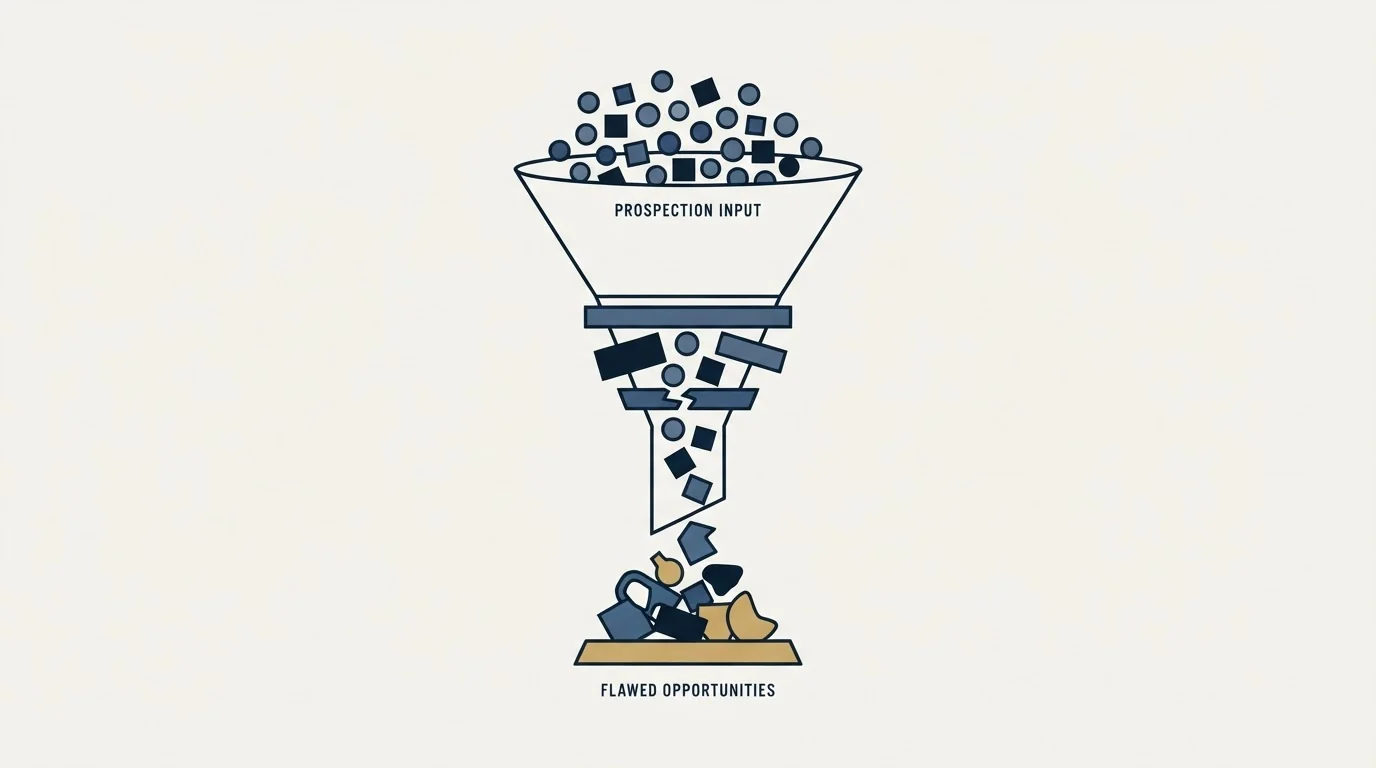
Four reasons, and none of them is about the capability of the individual.
The infrastructure problem. Cold outbound at any volume requires separate sending domains, warmed inboxes and deliverability monitoring, kept away from your primary company domain so a reputation problem cannot reach your invoices and contracts. A VA sending from your main domain, or from a hastily created one, can damage an asset worth far more than the engagement saves. This is the failure that costs the most and shows up latest.
The data problem. Prospecting needs verified contact data, which requires a stack and a budget. Without it a VA works from whatever they can find, and unverified addresses produce bounces, and bounces damage the same sending reputation.
The judgement problem. Deciding which company deserves contact this week, and what specifically to say to them, is the part of prospecting that determines whether it works. It requires knowing your market. This is exactly the class of work the VA model is not built for, because correctness is not checkable by the coordinator.
The compliance problem. Cold outreach sits inside a real regulatory perimeter that varies by jurisdiction, and the accountability lands on you rather than on the agency.
Underneath all four is one structural point. A VA agency's quality control is a coordinator checking that a defined task was completed correctly. Prospecting has no such definition: nobody can check that the right accounts were chosen or that a message was worth sending without knowing the market as well as you do.
The version that does work
There is an arrangement that captures most of the saving without the failure modes, and it is worth stating because the instinct behind hiring a VA for prospecting is not wrong.
Split the work at the judgement line. The VA builds the list against your written criteria, enriches and verifies against your stack, and prepares the research. A person who knows your market decides who to contact and writes the message. Sending runs on properly configured infrastructure that you or a specialist provider own. Replies come to someone who can have the conversation.
- Step 1VA: build the list
Companies and contacts against explicit written criteria, delivered in a defined format.
- Step 2VA: enrich and verify
Run the records through your verification stack and flag what failed.
- Step 3You: choose and write
Decide which accounts get contacted this week and what the message says.
- Step 4You or a provider: send and reply
Configured infrastructure, and a person who can handle whatever comes back.
That division is genuinely economical. The list and data work is the bulk of the hours and the smallest part of the judgement.
What to ask a VA agency about sales work

If you are considering it anyway, four questions surface the risk quickly.
Whose domains and inboxes will be used? If the answer is your primary company domain, stop there.
What contact data source will they use, and who pays for it? No credible answer means the data will be scraped and unverified.
Who checks the output, and against what standard? For list work there should be a written definition of a correct row. For message writing there usually is no standard, which tells you the task does not fit the model.
What happens if a prospect replies angrily or raises a compliance objection? The answer reveals whether anyone in the chain can handle the consequences of the work.
- Yes: Tasks have a written definition of correct output
- Yes: A named person who knows your market chooses the accounts
- Yes: Sending infrastructure is separate from your primary domain
- Yes: Contact data comes from a verification stack you pay for
- No: The VA writes and sends cold messages unsupervised
- No: The VA qualifies replies against commercial criteria
- Depends: Whether the volume you need justifies proper infrastructure at all
Choosing a VA agency for the work it does suit
If you are buying support rather than selling, the evaluation is straightforward and differs from picking a sales vendor.
Ask about cover, not just the person. The agency model's genuine advantage over hiring a freelancer is that illness and departure are handled. Ask who covers, how the handover works, and whether cover is billed.
Ask how tasks are specified. Good agencies push you to define work precisely, because that is what makes it deliverable. An agency that accepts vague instructions cheerfully will produce vague output and you will discover it late.
Ask who checks the work. A coordinator reviewing against a written standard is the model working. No review layer means you are the quality control, which is fine if you planned for it and expensive if you did not.
Ask about tools and access. Whether they work in your systems or their own, and what access they need. Scope it narrowly, use named individual accounts rather than a shared login, and keep write access to the specific objects the task requires.
Start with a defined pilot task. Something with an inspectable output and a clear definition of correct, run for two weeks. The pilot tests specification discipline on both sides, which is the actual risk in these engagements.
The thing not to optimise for is the hourly rate. The spread between agencies is smaller than the spread in how well they hold a standard, and a cheap agency that needs constant correction costs more in your time than the difference.
Unlike hourly VA pricing, RevOps agencies typically sell capacity through fixed retainers, a structure examined in RevOps agency pricing.
The honest cost comparison
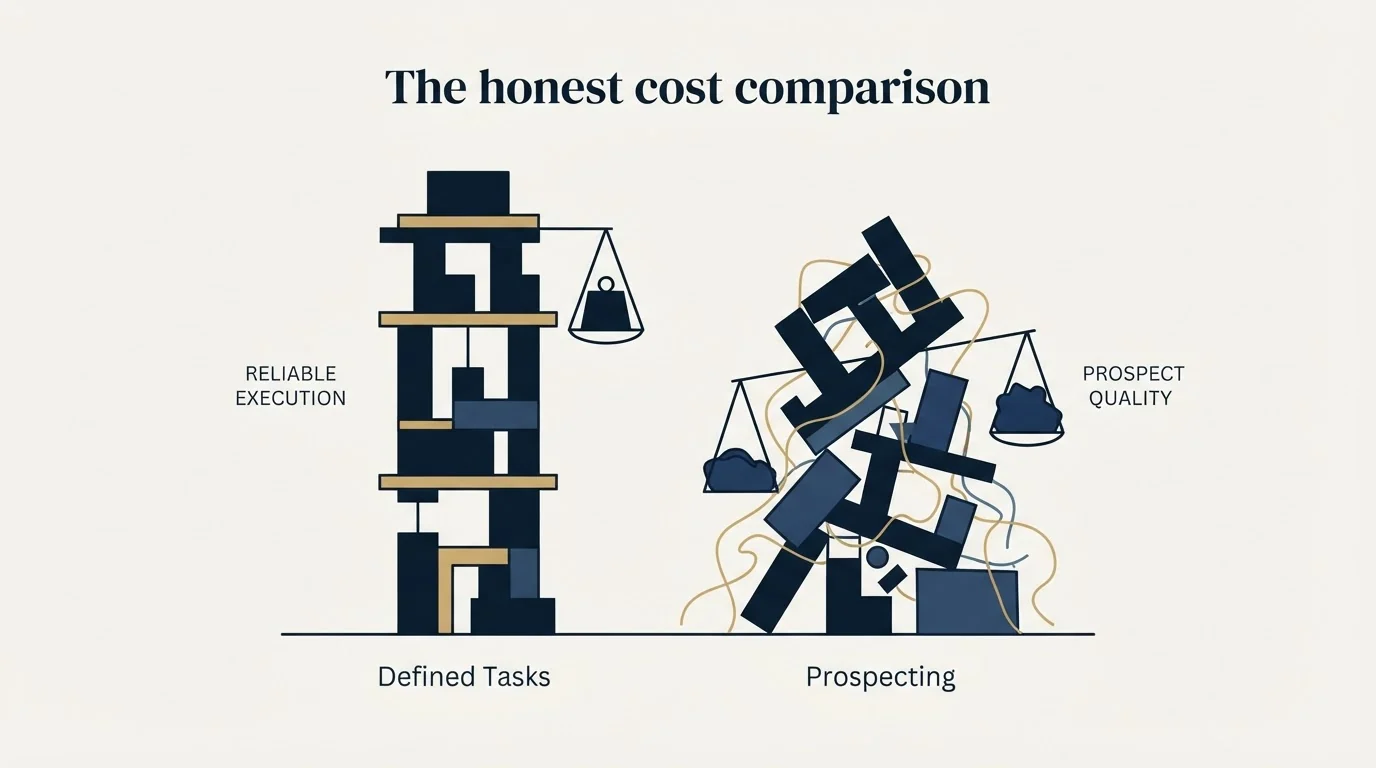
The hourly saving is real and it is not the whole picture, because the two options are not producing the same thing.
A VA doing list and data work saves a rep's time at a genuine discount, and that comparison is favourable. A VA doing prospecting is being compared against an SDR, and the output differs in quality in ways an hourly rate does not capture: meetings booked with the wrong people cost more than they save, and a damaged sending domain is expensive to replace.
The reasonable way to run the numbers is to price the VA against the support work they will genuinely do well, and to price prospecting separately against the alternatives. Those are covered in outbound sales outsourcing and, for the in-house comparison method, outsourced SDR versus in-house.
There is also a hidden cost in the version that fails, which is the reason to think about this before rather than after. Sending domain reputation is slow to build and slow to repair, so the damage from a few weeks of poorly configured outbound persists long after the engagement ends and affects whatever you do next. That asymmetry, cheap to avoid and expensive to fix, is what makes this worth getting right at the scoping stage rather than treating as something to correct if it goes wrong.
The short version
A virtual assistant agency is excellent at defined, checkable work and is a strong buy for list building, CRM hygiene, research compilation and scheduling. It is a poor fit for prospecting itself, because cold outbound needs separate sending infrastructure, verified data, market judgement and someone accountable for compliance, and none of those are things a coordinator can quality-check. Split the work at the judgement line: VAs build and verify the list, someone who knows your market decides who to contact and what to say.
If the part you actually need is the conversations rather than the admin, we book attended qualified meetings against criteria agreed in writing beforehand, and you can see what a campaign would look like for your market.
Frequently asked questions.
Frequently asked questions- What should a virtual assistant agency do for a sales team?
- List building against written criteria, which is checkable rule-driven work. CRM hygiene, including deduplication, field completion and tidying orphaned records. Research compilation into a structured format, provided what to gather is specified. Scheduling, confirming, rescheduling and chasing no-shows. And document production such as formatting proposals and keeping templates current.
- Why does VA-run prospecting go wrong?
- Four reasons, none about individual capability. Cold outbound needs separate sending infrastructure kept away from your primary domain. It needs verified contact data, which requires a stack and a budget. It needs judgement about which company deserves contact this week, which requires knowing your market. And compliance accountability lands on you rather than on the agency.
- What should you ask a VA agency about sales work?
- Whose domains and inboxes will be used, and stop there if the answer is your primary company domain. What contact data source they will use and who pays for it, since no credible answer means scraped and unverified data. Who checks the output and against what standard. And what happens if a prospect replies angrily or raises a compliance objection.
- How should you choose a VA agency for support work?
- Ask about cover rather than only the person, since handling illness and departure is the model's genuine advantage over a freelancer. Ask how tasks are specified, because good agencies push you to define work precisely. Ask who reviews the work against a written standard. Scope tool access narrowly with named accounts. And start with a two-week pilot task that has an inspectable output.
About the author.

B2B cold email experts helping companies generate qualified leads through done-for-you outreach campaigns.
RevenueFlow Team
Explore more.
Ready to scale your outreach?
We build GTM engines that book real meetings. See the receipts.
Related articles.
B2B Lead Lists for POS Companies: Two Products, One Phrase
Three things are sold under this phrase and only one is a list. What a merchant row must carry, which public record holds each field, and what to verify.
Lead Generation for Field Service Software Companies
Your market is a set of separately licensed trades, not one industry. Where each can be enumerated, what the credential says, and the rule on calling mobiles.
B2B Lead Lists for Collection Agencies: Fields and Sources
What a creditor prospect list needs for a collection agency: the fields that matter, the FDIC, NCUA, CMS and court sources behind them, and the rules that apply.
B2B Lead Lists for Aviation Companies: Build or Buy
Aviation is one of the few industries whose accounts are published by its regulator, which changes what is worth buying and what is worth downloading yourself.
Cold Calling for Food and Beverage Companies: Three Doors
Cold calling for a food or beverage company: who picks up at a chain, a distributor and an independent grocer, where each publishes its door, and when the phone is wrong.
Win Rate Benchmarks: Which Figures State a Population
A catalogue of the published average sales win rates, sorted by whether the page names the population behind its own number. Most do not.