Cold Email for Marketing Agencies: Winning New Clients
Marketing agencies face a unique challenge: pitching marketing services via marketing channels. Here's how to approach cold email outreach effectively.
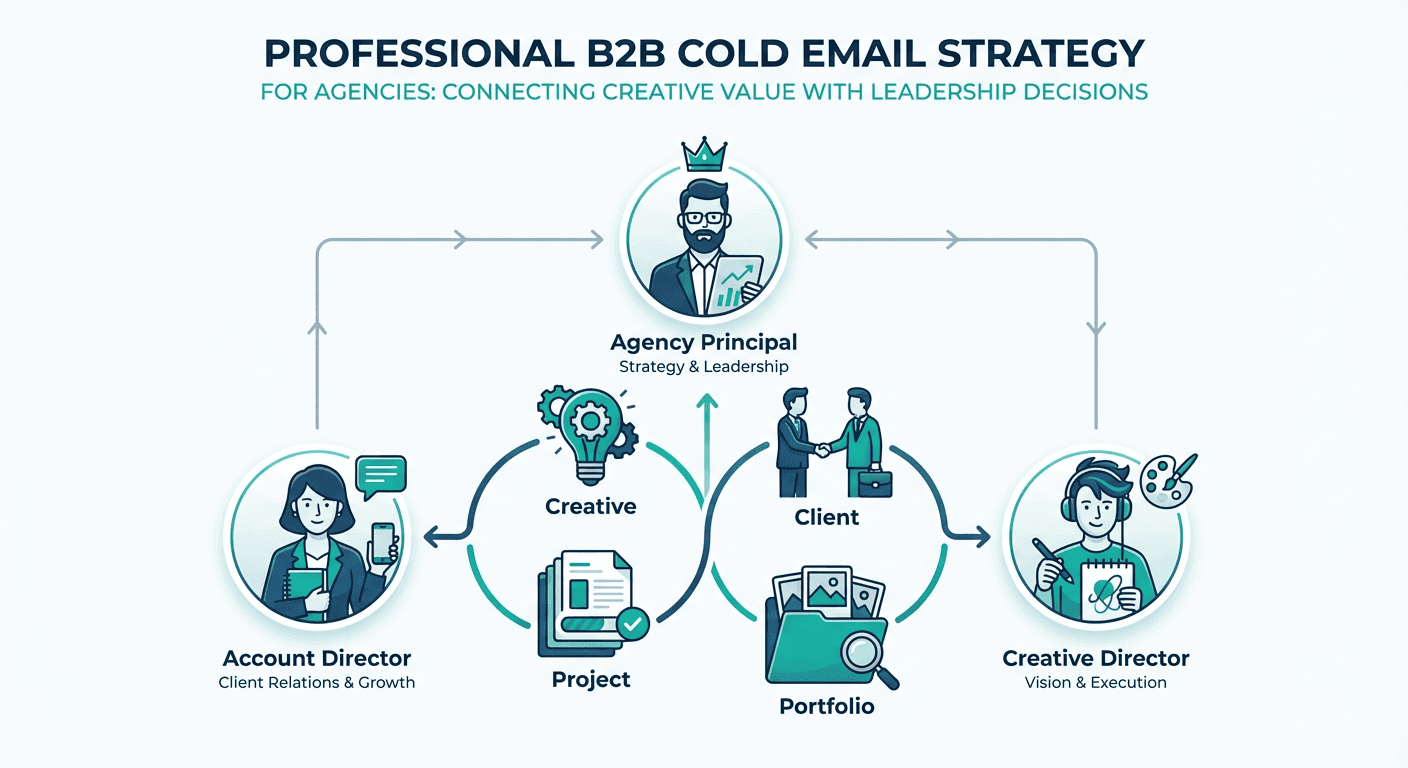
A marketing agency wins clients by cold email when it picks one narrow client type, writes one message naming a specific outcome with one proof point, and sends it to whoever owns the agency budget while that budget is being set. To hire a cold email marketing agency instead is a different purchase with its own guide.
Key takeaways
- Narrow positioning is what makes agency outreach specific: who you serve, what outcome you deliver and how you deliver it differently.
- The decision maker changes with company size: founders under roughly $10M revenue, Marketing Directors at $10M to $100M, CMOs above that.
- For calendar-year companies October to December is the planning window, January and February is deployment, and June or July brings a mid-year review.
- An agency email has four working parts: a researched opening line, an outcome-led value proposition, one proof point and one specific ask.
Reviewed and updated October 15, 2026
A marketing agency that sends cold email is selling marketing through a marketing channel, so every message is a pitch and a work sample at the same time. This guide is for that reader: the agency owner or new business lead who wants to run cold email outreach for their own agency and win clients with it. If you searched for a cold email marketing agency because you want someone to run outbound for you, that is a different purchase, and the section below points you to the right page before the guide starts.
Looking for a cold email agency to run outreach for you?
This page teaches agencies to prospect for themselves. If you want to hire one instead, read our guide to what a cold email agency delivers and what it costs, which covers retainer, per meeting and hybrid pricing and when hiring one is the wrong call. In contrast, agencies weighing whether to outsource their own outreach can compare how cold email agencies disclose pricing terms.
How should a marketing agency run cold email outreach?
Pick one narrow client type, write one message that proves you understand that client's numbers, and send it to the person who owns the agency budget at the moment that budget is being set. An agency's cold email fails when it describes services. It works when it names a specific outcome for a specific kind of company, carries one relevant proof point, and asks for one small thing.
The rest of this guide takes those parts in order: positioning, the decision maker, differentiation, the offer, timing, and the email itself.
The Agency Positioning Challenge
Most marketing agencies send emails that sound identical to their competitors. "We help businesses grow through digital marketing." "Our team delivers results-driven campaigns." These messages blend into the noise because they are generic by design. The sender hopes vague language will appeal to everyone, and in practice it resonates with no one.
Effective agency outreach starts with a positioning that answers three questions:
- Who do you serve? Industry, company size, geography, business model.
- What specific outcome do you deliver? Revenue, qualified leads, a lower acquisition cost.
- How do you deliver it differently? Methodology, specialization, technology.
The narrower the positioning, the stronger the email. An agency that helps e-commerce brands in a stated revenue band scale paid social profitably can write far more compelling outreach than an agency that "does digital marketing", because it can reference the challenges, metrics and vocabulary its prospects actually use. A CMO at a SaaS company hears from marketing agencies constantly. The pitches that stand out talk about CAC payback, expansion revenue or product-led growth. The ones that promise to "help you grow" get deleted.
Finding the Right Decision Makers
Who owns the agency decision depends on company size, and the pitch changes with the owner.
Under $10M revenue
Founder or CEO
When: no dedicated marketing leader, or spend needs owner approval.
Pitch: business results and return. Short, direct, what you will do.
$10M to $100M revenue
Marketing Director or Manager
When: a specific service that sits in their remit, and no CMO above them.
Pitch: deliverables, process and results that help them hit their metrics.
Larger companies
CMO or VP of Marketing
When: strategic engagements, large retainers, new initiatives needing executive buy-in.
Pitch: market position, revenue contribution, competitive advantage.
At smaller companies, under roughly $10M in revenue, founders and CEOs often make marketing decisions directly and may be the only person who can approve agency spending. They are time constrained and care about revenue, efficiency and growth. At mid-market companies, $10M to $100M in revenue, Marketing Directors and Marketing Managers usually handle agency relationships and hold budget authority up to a threshold. They are judging whether you make their job easier. At larger companies the CMO or VP of Marketing owns agency partnerships and budget allocation, and thinks in market position rather than tactics.
Reaching a second stakeholder
Writing to more than one person at a company can work, and it goes wrong when the organisation receives the same message several times. Treat a second stakeholder as a separate campaign with its own premise. The CMO gets a strategic angle, the Marketing Director gets a tactical one, and neither message is a reminder of the other. If the first contact does not answer, that is information about the premise, and the next message to that company should carry a different one.
Differentiating from Competitors
Every company considering an agency has options. Your email only needs to create enough differentiation to earn a conversation.
Generic claims such as "award-winning" and "results-driven" differentiate nothing because every agency uses them. Specificity is what demonstrates expertise:
Weak: "We help companies improve their SEO."
Stronger: "We help B2B SaaS companies build organic traffic through programmatic SEO, targeting bottom-of-funnel comparison and integration keywords."
The second version names a tactic and a keyword strategy. Someone who knows SEO wrote it, and the reader can tell.
Case studies work the same way. "We've worked with Fortune 500 companies" is unverifiable and tells the prospect nothing. Naming clients in the prospect's own industry, sharing one real metric from comparable work, or commenting on a campaign the prospect is visibly running all carry more signal, because relevance is the whole point of proof. Use only results you can evidence if asked.
Prospects also want to know why you in particular. Useful angles are specialization ("we work only with professional services firms, so we understand long, relationship-driven sales cycles"), methodology ("you pay on pipeline generated rather than hours logged"), and speed to launch. The goal is a reason to learn more, which is a smaller job than proving you are the best choice for everyone.
Retainer vs. Project Pitches
How you sell changes what you write. A retainer is an ongoing partnership, so the prospect is weighing strategic fit, communication cadence, flexibility and who will be on the account, and the email should use partnership language. A project has a defined scope, timeline and deliverable, so the prospect is weighing price boundaries, relevant experience and what happens if it goes off track, and the email should be more transactional.
Many agencies use a project as the entry point to a retainer, and the cold email can say so plainly: "We typically start with a 90-day pilot engagement focused on [specific outcome]. This gives us time to understand your business deeply while delivering measurable results. Most clients extend into ongoing partnerships, but there's no obligation." That lowers the barrier to a first conversation while positioning for the larger relationship.
Timing Around Budget Cycles
Agency spending follows budget cycles, and a good message in the wrong month goes nowhere. Most companies run calendar-year or fiscal-year budgets, and planning typically happens two to four months before the new year begins.
For calendar-year companies, October through December is the prime window, because marketing leaders are finalizing next year's plans and allocating budget to agency partners. Many companies then finalize agency decisions in January and February, once budgets are officially approved. Larger organizations often run a mid-year review in June or July, which frees budget from underperforming initiatives. For fiscal-year companies, find the year end, which public companies publish on their investor relations pages, and shift the same pattern.
Trigger Events
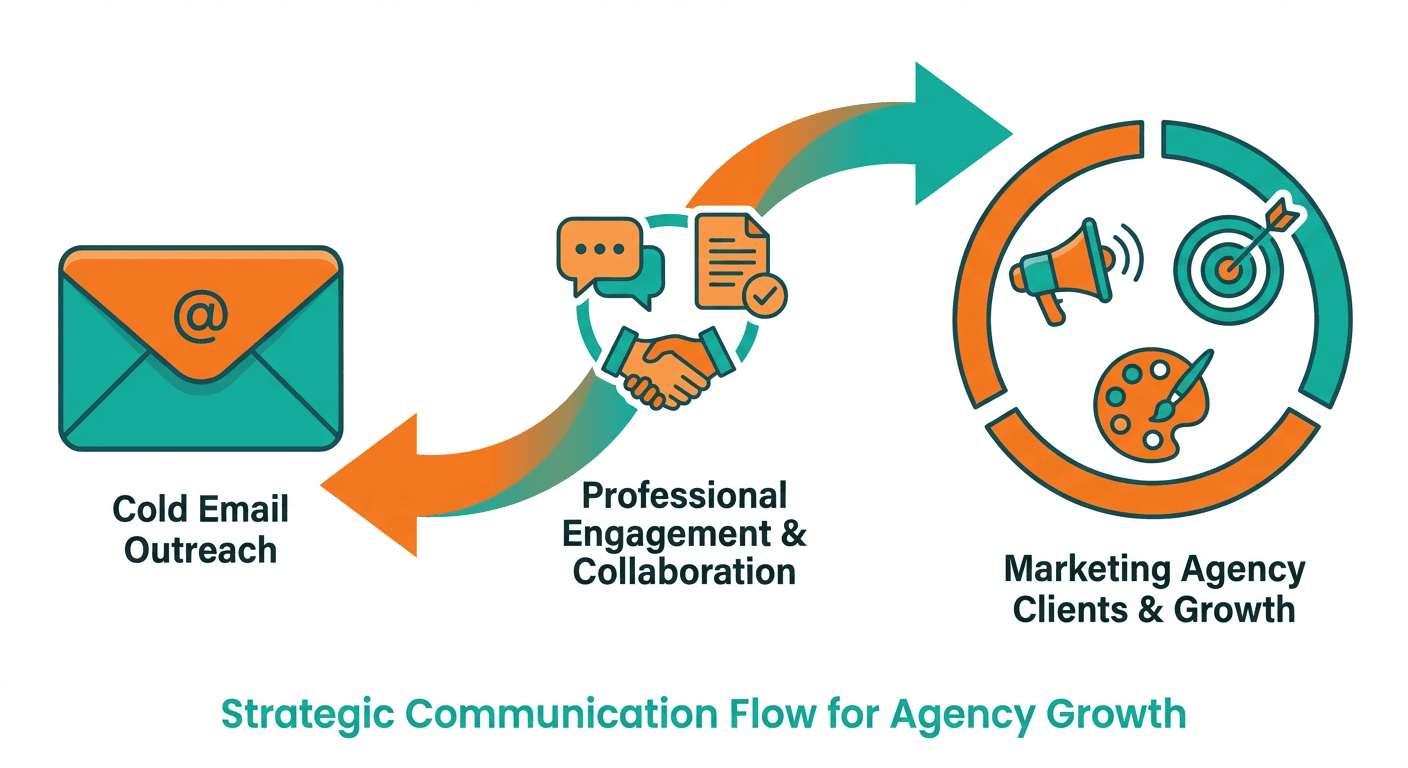
Outside the regular cycle, specific events open an evaluation window: new marketing leadership, a funding round, an acquisition or merger, a product launch, geographic expansion, or a missed target that creates urgency for change. News alerts, LinkedIn and company databases such as Crunchbase surface these, and an email that arrives inside the window has a reason to exist that the prospect already understands.
Working those same windows on the platform rather than by email, and the platform rules an agency meets when it does, are in LinkedIn outreach for marketing agencies.
Crafting Effective Agency Emails
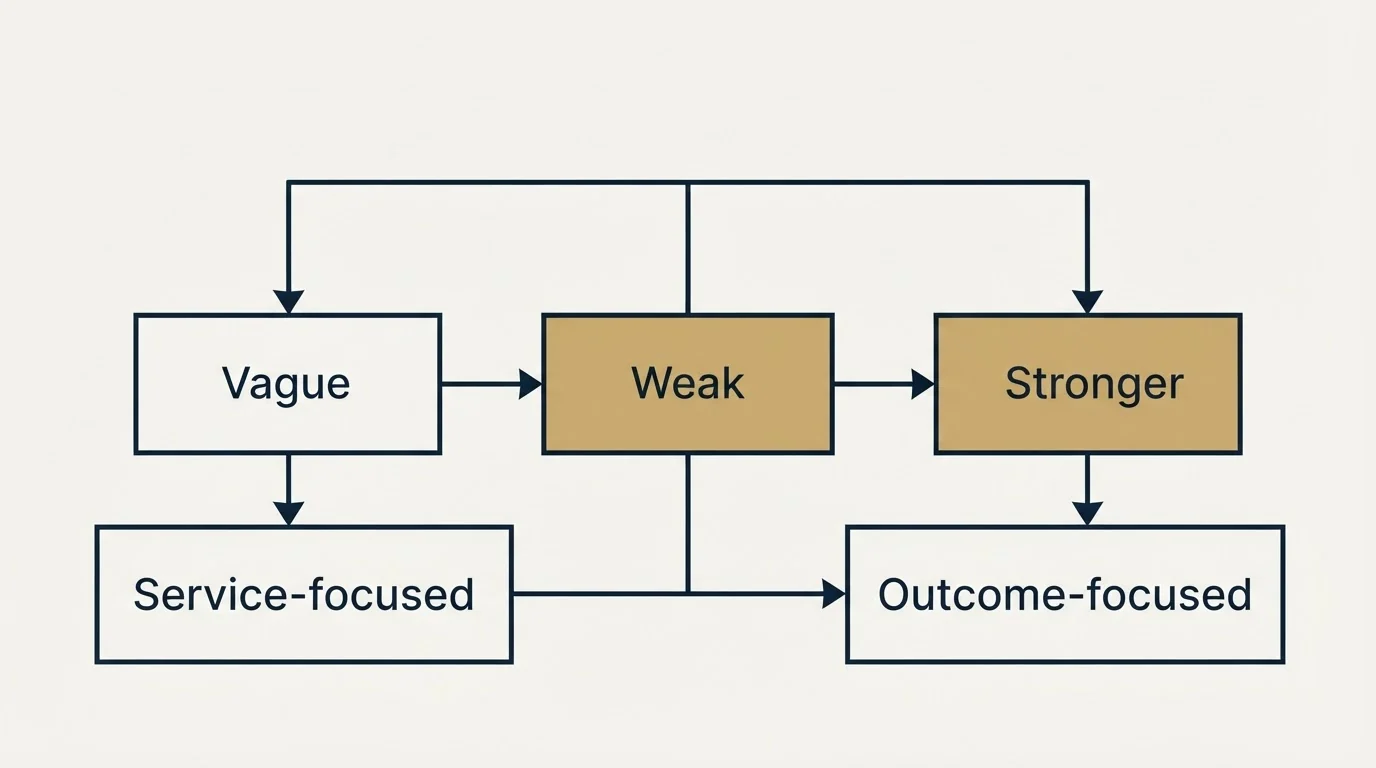
An agency email has four working parts, and each one has a weak and a strong version.
The opening line shows research or offers an insight about their situation. "I'm reaching out from [Agency] to see if you're interested in improving your marketing" does neither. "Noticed [Company] just expanded into the European market" does, and connects to experience in the next breath.
The value proposition describes what changes for them rather than what you do. "We provide comprehensive SEO services including technical audits, content optimization, and link building" is a service list. The prospect cares about leads and pipeline, and the tactics matter only as the mechanism. If your opening offer is an audit of the prospect's own channel, cold email for audits covers how to frame it.
The proof point is one relevant client, metric or example, kept short. You are creating enough credibility for a conversation, which is a much smaller job than closing.
The call to action asks for something specific and low commitment. "Let me know if you'd like to discuss further" gives the reader nothing to decide. "Worth a 15-minute call next week to walk through how we approached this for [Similar Company]?" does.
Subject: Congrats on the Series B
Congratulations on the Series B close. Based on the growth targets that typically come with a round that size, I'd guess demand gen infrastructure is becoming a priority. 1
We help post-Series A and B SaaS companies build the paid and organic pipelines needed to hit ambitious revenue targets. 2
[Client A] brought us on right after their Series B, and we built a pipeline that drove [your real figure] of their closed-won revenue in year one. 3
Worth connecting to share how we typically approach this stage? 4
- 1Opening line: a trigger event the prospect already knows about, and what it usually means.
- 2Value proposition: an outcome for a named kind of company, with no service list.
- 3Proof point: one client at the same stage, one metric. Use a result you can evidence.
- 4Call to action: one specific, low commitment ask.
Example Email Templates
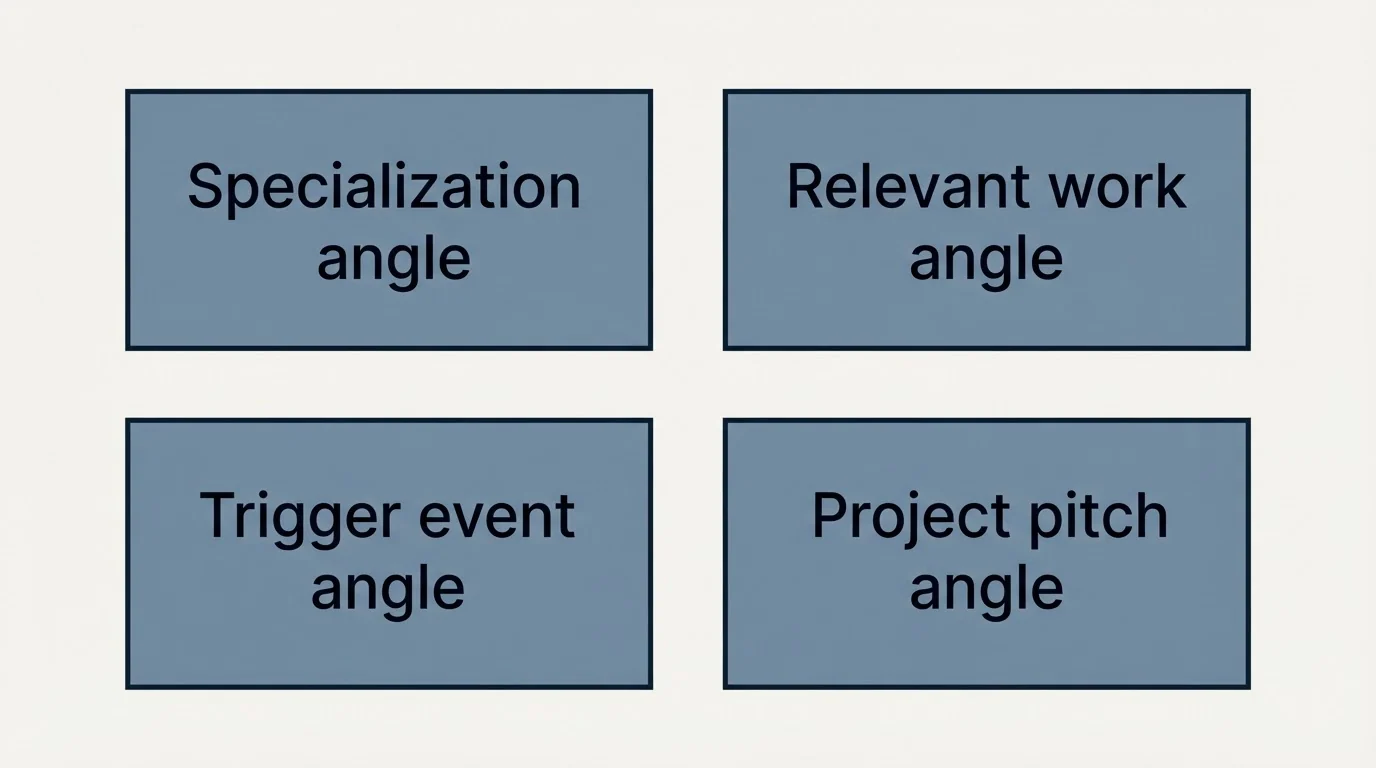
Each template is a single message built on one angle. Bracketed text and every figure are placeholders: replace them with your own clients and results you can evidence, and cut any line you cannot stand behind.
Template 1: Specialization Angle
Subject: [Company]'s European expansion
Hi [Name],
Saw that [Company] announced expansion into Germany and France last month. The localization challenges that surface around month 3, especially compliance messaging and local competitive positioning, catch a lot of US SaaS companies off guard.
We've helped [Company A], [Company B], and [Company C] navigate European market entry, specifically around adapting brand positioning for local buying behavior without losing the core value prop.
Worth a 15-minute conversation about what we're seeing work for localization in your space?
Best, [Your name]
Template 2: Relevant Work Angle
Subject: Paid social for [Industry] companies
Hi [Name],
We run paid social programs for [Industry] companies including [Client A] and [Client B]. The challenge we keep solving is reducing CPL while maintaining lead quality when targeting [specific audience].
We've built audience models specific to [Industry], and for [Client A] that brought acquisition cost down by [your real figure] against their previous agency.
Open to seeing what the approach looks like in practice?
Best, [Your name]
Template 3: Trigger Event Angle
The annotated email above is this template in full. Its strength is timing: it arrives inside an evaluation window the prospect has just opened.
Template 4: Project Pitch Angle
Subject: Q1 rebrand timing
Hi [Name],
If [Company] is planning brand work in Q1, which is common timing for companies that just hit [milestone or growth stage], our 6-week brand sprint might be worth a look.
Deliverables include brand positioning, a messaging framework, and visual identity guidelines. Past clients include [Company A], [Company B], and [Company C].
Would it be useful to see a sample of what the final deliverables look like?
Best, [Your name]
Common Mistakes to Avoid
Overselling in the first email. The goal is a conversation. Emails stuffed with capabilities and accolades read as marketing collateral. One angle, one proof point, one ask.
Being too vague. "We help companies with their marketing" tells the prospect nothing. Name the industry, the outcome, the metric, the timeline.
Ignoring your own brand. Your email is your work. Typos, poor formatting and weak subject lines raise questions about what you would deliver as a client. Treat every cold email as portfolio work.
Sending identical emails to everyone. Personalization means demonstrating that you understand the prospect's situation, which a first name token does not do. A few minutes of research per prospect shows in the replies.
Measuring Success
Track the chain from send to signed client, because each link diagnoses a different problem. Reply rate tells you whether the targeting and the message are right. The share of positive replies that become meetings tells you whether the ask was clear. The share of meetings that become qualified opportunities measures how well your targeting matches actual fit. Win rate is the measure that matters, so record which campaign and which angle produced each closed client.
Judge your numbers against like for like: the same kind of agency, selling to the same size of client, on a list built the same way. A benchmark quoted without its source and its method is a number, and tells you nothing about whether your own campaign is working.
Where we differ from standard practice
Most outbound programmes send a sequence of messages to each prospect over several weeks. We send one message per campaign, and since this page sits on our site it is worth saying what that costs us.
Standard practice
- A sequence of messages to each prospect over several weeks
- A distracted reader gets another chance
- Later messages reach only people who did not answer the first
- The reputation cost lands on the sending domain
What we do
- One message, then that campaign is finished for that contact
- No thread replies and no bumps
- We reach each contact less often, and we accept that cost
The reasoning is mechanical rather than moral. A follow-up arrives underneath a message the recipient has already seen and chosen not to answer, so it is delivered to the population most likely to mark it as spam, and the reputation cost of that lands on the sending domain across every campaign running on it. We set that cost against the replies a sequence recovers and decided the trade was not worth it. The full argument, with the numbers from our own campaigns, is in why we stopped using follow-ups. For an agency the point has an extra edge: the domain you burn with reminders is the one your own new business depends on.
Final Thoughts
Cold email for marketing agencies is a preview of the work you will do for clients, so the fundamentals are the pitch: specific positioning, the right decision maker, a clear outcome, one proof point and good timing. Start with a narrow list where you have real expertise and relevant proof. Send emails you would be proud to have a prospect screenshot and share, then iterate on what produces conversations.
Related Reading
- Cold Email for Staffing Agencies: The Complete Guide
- Cold Email for SaaS Companies: The Complete Guide to B2B Outreach
If you would rather have this run for you, RevenueFlow books qualified meetings on a pay-per-meeting basis and publishes client results. The outbound sales agency page covers the whole engine, and how pay per meeting works covers the billing definition.
This guide focuses on strategic approach and tactical execution. Individual results vary based on targeting, positioning, and market conditions.
Frequently asked questions.
Frequently asked questions- How should a marketing agency use cold email to get clients?
- Choose one narrow client type, write one message that names a specific outcome for that kind of company with a single relevant proof point, and send it to the person who owns the agency budget while it is being set. Emails that list services fail. Emails that show understanding of the prospect's numbers and ask for one small thing earn replies.
- I want to hire a cold email marketing agency, is this the right guide?
- No. This guide teaches marketing agencies to prospect for their own clients. If you want a cold email outreach agency to run campaigns for you, read the separate guide to what a cold email agency delivers and costs, which covers retainer, per meeting and hybrid pricing, the in-house comparison, and the situations where hiring an agency is the wrong choice.
- Who should an agency email at a target company?
- It depends on size. At companies under roughly $10M in revenue the founder or CEO usually decides. At mid-market companies between $10M and $100M, Marketing Directors and Managers handle agency relationships. At larger companies the CMO or VP of Marketing owns partnerships and budget. A second stakeholder should get a separate campaign with its own premise, never a reminder.
- When is the best time of year to pitch agency services?
- For companies on a calendar-year budget, October through December is the prime window because next year's agency budget is being allocated. January and February follow, when approved budgets become decisions. Larger organizations often review budgets in June or July. Trigger events such as new marketing leadership, a funding round or a product launch open a window at any time.
About the author.

Fernando Cao is CEO at RevenueFlow, which builds and operates outbound revenue engines for B2B companies. Previously at Accenture Strategy. Studied at University of Bath.
Fernando Cao · CEO
Connect on LinkedIn →Explore more.
Ready to scale your outreach?
We build GTM engines that book real meetings. See the receipts.
Related articles.
Cold Email for Telecom: Reaching Carriers and MSPs
Telecom companies face rapid technology changes and competitive pressures. Here's how to approach cold email outreach to carriers, MSPs, and UCaaS providers.
Cold Email for Architecture Firms: 2026 Strategy Guide
Architecture firms buy on project phases rather than fiscal quarters. How to build a list, time the spec window, and write cold emails principals answer.
Cold Email for Trucking and Fleet Companies: 2026 Guide
How to reach carriers, fleet operators, and safety buyers with cold email: FMCSA-driven list building, trigger timing, four templates, and compliance.
Cold Email for Cannabis Companies: 2026 Strategy Guide
The April 2026 rescheduling order split cannabis buyers into two tax realities. Here is how to segment, list-build, and write cold email for each.
Cold Email for Private Equity Firms: 2026 Strategy Guide
How to run cold email into private equity: mapping fund-level and portfolio-level buyers, list sources, four templates, and PE-specific deliverability rules.
Cold Email for Wealth Management Firms: 2026 Strategy Guide
RIAs are 16,500+ mostly small firms with public Form ADV data, small buying committees, and a compliance gate. How to run cold email into wealth management.