Cold Email for Backlink Outreach: Complete Strategy Guide
Learn how to use cold email to acquire high-quality backlinks for SEO. Includes proven templates, personalization strategies, and best practices for link building outreach that actually works.
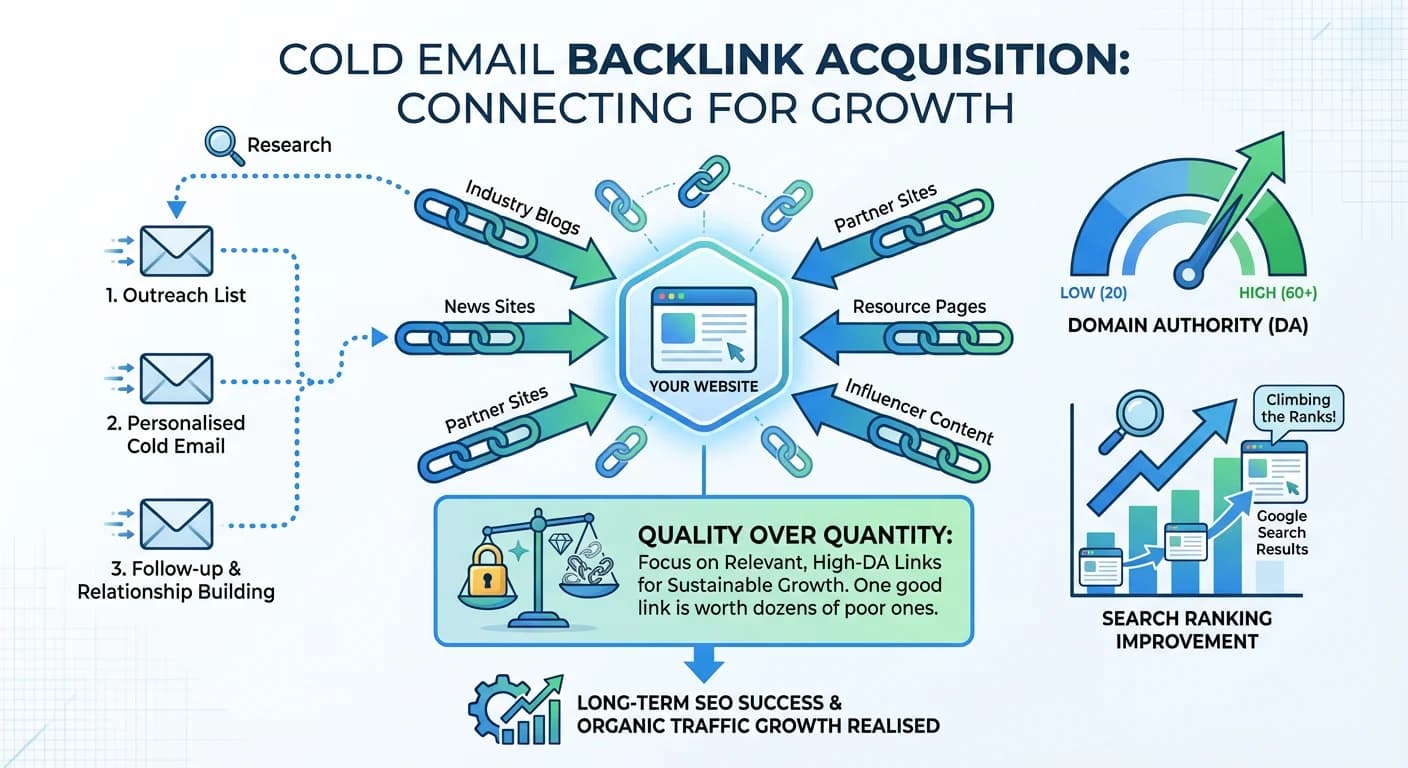
Cold email works for backlink acquisition by providing direct access to website owners who control link placement. Focus outreach on high-authority, relevant sites using strategies like resource page outreach, broken link building, and unlinked brand mention conversion. Personalization is essential: reference specific pages, explain mutual value, and avoid generic messaging. Successful campaigns track response rates and link acquisition rates, and prioritize relationship quality over volume.
Key takeaways
- Backlinks from high-authority, relevant sites improve both page-specific rankings and overall domain authority while driving referral traffic.
- Resource page link building and broken link building generate higher response rates because they offer immediate value to site owners.
- Personalized outreach that references specific content and explains mutual benefit significantly outperforms generic link request templates.
- Competitor backlink analysis using tools like Ahrefs or SEMrush reveals sites already linking to similar content in your niche.
- Follow links within editorial content provide more SEO value than footer, sidebar, or nofollow links.
Reviewed and updated September 15, 2026
Cold Email for Backlink Outreach: Complete Strategy Guide
Backlinks remain one of the most important ranking factors for search engines. High-quality links from authoritative websites signal trust and relevance, improving your search visibility and driving referral traffic. The challenge is that earning quality backlinks requires convincing other website owners to link to your content. Cold email provides the most direct and scalable channel for backlink outreach when executed properly.
Teams refining their outreach workflow often need to decide between tools, and this comparison of data enrichment versus sales engagement platforms clarifies how each one fits into a link building process.
Outreach's multi-channel scope contrasts sharply with lighter tools, as shown in this breakdown of GMass versus Outreach for cold email specialists.
This guide covers everything you need to know about using cold email to acquire backlinks, from identifying link opportunities to crafting outreach that generates positive responses.
Why Backlinks Matter for SEO
Search engines use backlinks as a primary signal of content quality and authority. When reputable websites link to your content, search engines interpret this as a vote of confidence.
Domain authority building. Each quality backlink contributes to your overall domain authority, improving rankings across your entire site.
Page-specific ranking boosts. Links pointing to specific pages help those pages rank higher for relevant search terms.
Referral traffic. Quality backlinks drive direct traffic from users who click through from linking sites.
Brand visibility. Appearing on relevant websites increases brand awareness within your target audience.
Indexing and crawling. Backlinks help search engines discover and index your content more quickly.
Why Cold Email Works for Link Building
While some backlinks occur naturally, proactive outreach accelerates link acquisition significantly.
Direct access to decision makers. Email reaches website owners, editors, and content managers who can add links to their content.
Scaling this kind of outreach often requires dedicated tooling, and this comparison of lead sourcing and sales engagement platforms explains how such tools complement each other in a link building workflow.
Choosing the right CRM alongside an outreach platform matters too, and this CRM versus sales engagement comparison breaks down how each supports a link building pipeline.
Scalable with personalization. You can systematically reach hundreds of prospects while maintaining message quality.
Measurable results. Email campaigns provide clear metrics (response rates, link acquisition rates) for optimization.
Relationship building. Successful outreach often leads to ongoing relationships and multiple link opportunities.
Cost-effective. Compared to paid link acquisition (which violates search engine guidelines), cold email outreach requires time rather than money.
Identifying Link Building Opportunities
Not all backlinks carry equal value. Focus your outreach on opportunities that provide genuine SEO benefit.
Evaluating Link Quality
Consider these factors when prioritizing outreach targets:
Domain authority. Higher domain authority sites pass more link equity. Use tools like Moz, Ahrefs, or SEMrush to assess this metric.
Relevance. Links from sites in your industry or niche carry more weight than random high-authority sites.
Traffic. Sites with real traffic provide both SEO value and referral traffic potential.
Link placement. Editorial links within content are more valuable than footer or sidebar links.
Follow vs. nofollow. Follow links pass link equity; nofollow links provide less direct SEO value but can still drive traffic.
Link Building Strategies for Outreach
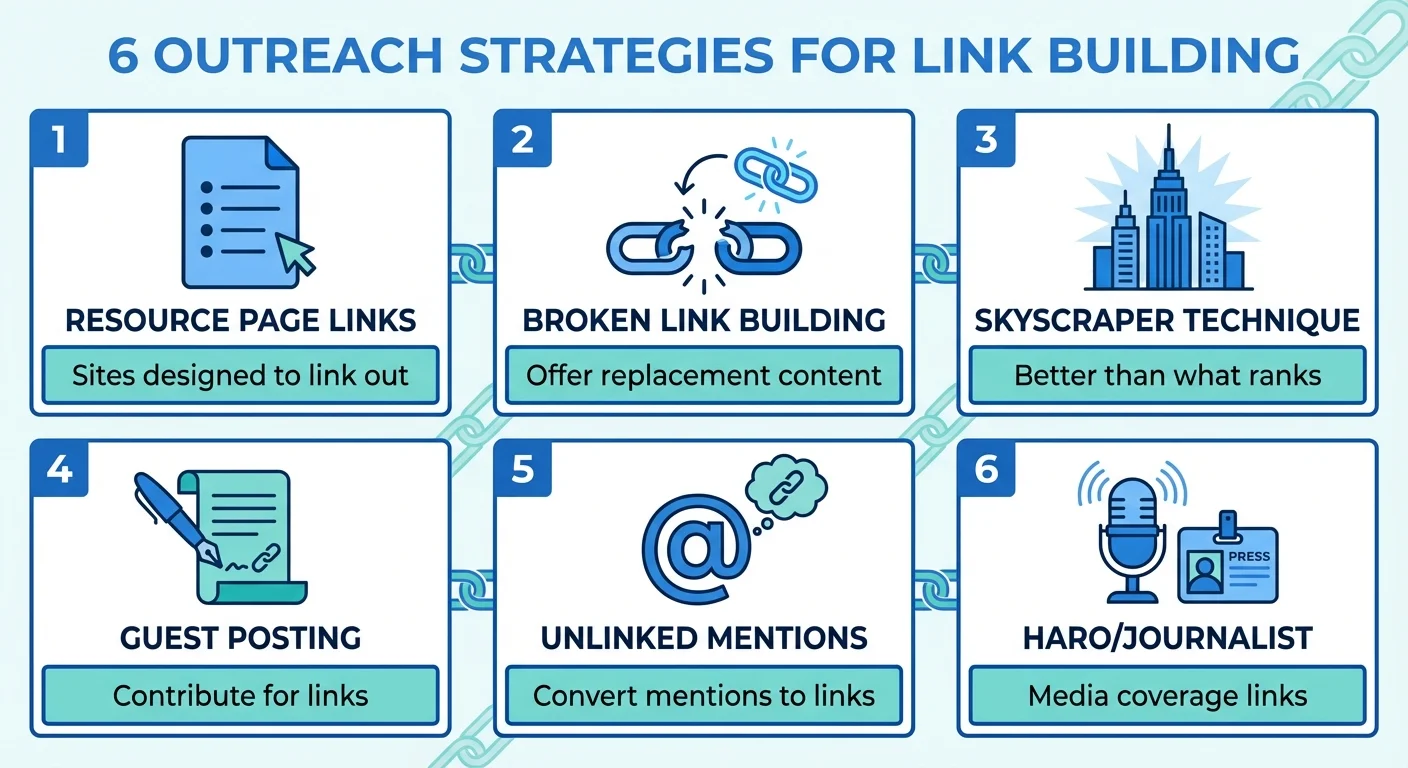
Resource page link building. Many sites maintain resource pages listing helpful tools, guides, and references. These pages are explicitly designed to link out, making owners more receptive to outreach.
Broken link building. Finding broken links on relevant sites and offering your content as a replacement provides value to site owners while earning links.
Skyscraper technique. Creating content better than what currently ranks well, then reaching out to sites linking to inferior content.
Guest posting. Contributing content to other sites in exchange for author bio links or contextual links within articles.
Unlinked brand mentions. Finding instances where your brand is mentioned without a link and requesting the addition.
HARO and journalist requests. Responding to journalist queries and earning links through media coverage.
Finding Outreach Targets
Competitor backlink analysis. Use SEO tools to identify who links to competitors. These sites may also link to you.
Resource page searches. Google queries like "[your topic] + resources" or "[your topic] + useful links" surface link opportunities.
Broken link identification. Tools like Ahrefs, Check My Links, or Broken Link Checker help identify broken links on target sites.
Brand monitoring. Tools like Google Alerts, Mention, or Ahrefs Alerts notify you of unlinked brand mentions.
Industry directories and roundups. Regular roundup posts and industry directories actively seek content to feature.
Personalization for Link Building Outreach
Generic link requests get ignored or marked as spam. Personalization distinguishes legitimate outreach from automated spam.
Research Requirements
Before reaching out to any prospect:
- Review the specific page where you want a link placed
- Understand the site's content focus and audience
- Note the author or site owner's name
- Identify why your content genuinely adds value
- Look for any existing relationship or common ground
Personalization Elements
Reference specific content. Mention the exact page where your link would fit and why.
Acknowledge their work. Brief, genuine recognition of their content shows you've actually visited their site.
Explain mutual benefit. Clarify what the linking site gains, not just what you want.
Customize your pitch. Different link opportunities require different approaches. A broken link pitch differs from a resource page request.
Avoiding Spam Signals
Website owners receive numerous link requests. Avoid these spam indicators:
- Generic greetings ("Dear Webmaster")
- No mention of specific pages or content
- Excessive flattery without substance
- Requests from unrelated or low-quality sites
- Multiple link requests in a single email
- Offers of payment for links (violates search engine guidelines)
Crafting Effective Link Building Emails
The structure and content of your outreach significantly impacts success rates.
Subject Lines for Link Outreach
Effective subject lines are:
- Clear about the purpose
- Specific enough to indicate relevance
- Free of spam trigger words
- Brief and professional
Examples:
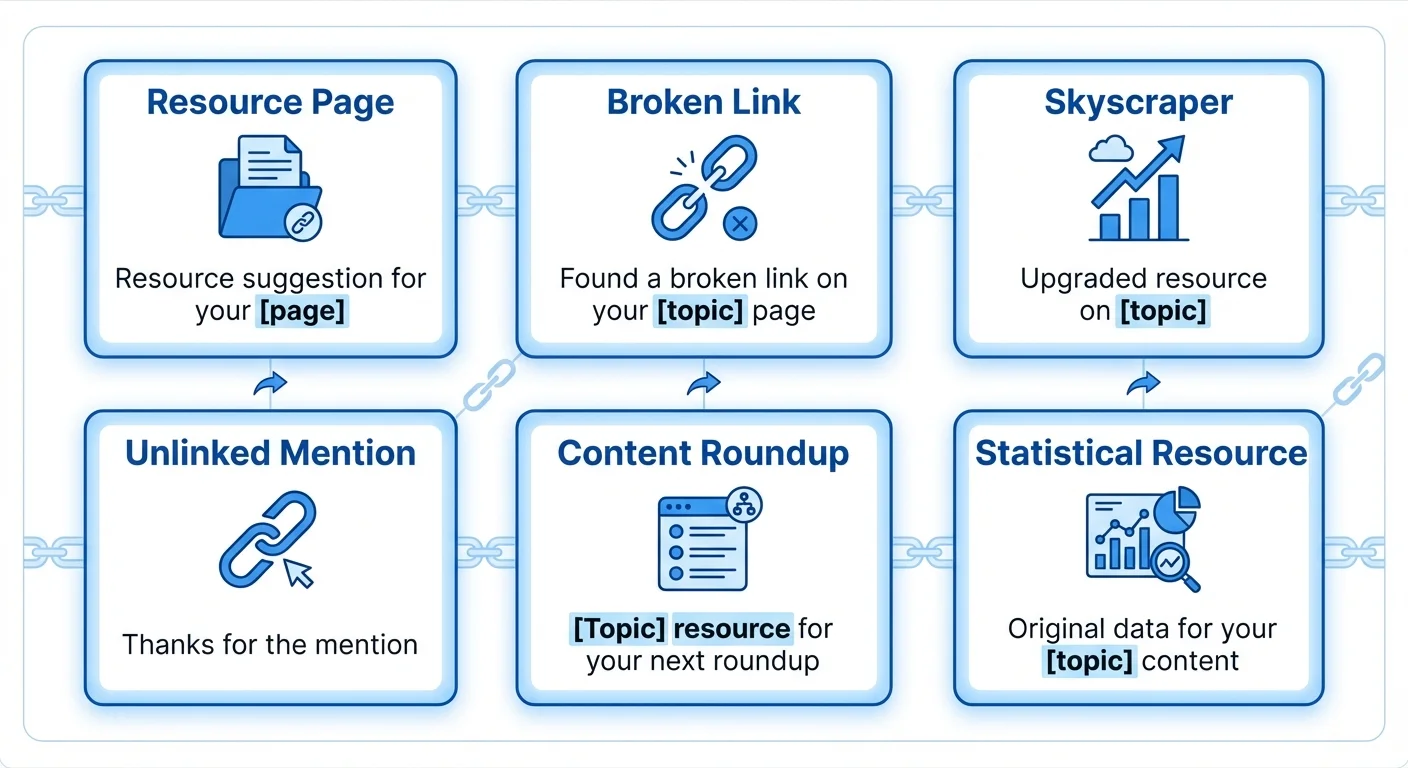
- "Resource suggestion for [their page title]"
- "Found a broken link on your [topic] page"
- "[Specific Topic] resource for your readers"
- "Quick question about [their article title]"
Avoid subject lines that:
- Promise reciprocal links
- Use excessive punctuation or caps
- Sound automated or templated
- Are vague or misleading
Email Structure
Opening (1-2 sentences): Reference the specific page and demonstrate you've actually visited their site.
Value proposition (2-3 sentences): Explain clearly what you're offering and why it benefits their audience.
The ask (1-2 sentences): Make a specific, easy-to-fulfill request.
Social proof (1 sentence, optional): Briefly mention if your content has been featured elsewhere.
Close (1 sentence): Thank them and make responding easy.
Total length: 100-150 words. Shorter emails typically perform better.
Tone Guidance
- Helpful, not pushy: You're offering value, not demanding action
- Professional and respectful: Treat site owners as peers
- Confident without arrogance: Your content is genuinely useful
- Direct and honest: Clear communication builds trust
Link Building Email Templates
Template 1: Resource Page Outreach
Subject: Resource suggestion for your [topic] page
Hi [Name],
I came across your resource page on [specific topic] while researching [related topic]. Great list. I especially found the section on [specific aspect] helpful.
I recently published a comprehensive guide on [your topic]: [Title]. It covers [brief description of content and unique value].
I thought it might be a useful addition for your readers who are interested in [specific benefit].
Either way, thanks for putting together such a helpful resource.
[Your Name] [URL]
Template 2: Broken Link Building
Subject: Found a broken link on your [topic] page
Hi [Name],
I was reading your article on [topic] and noticed that the link to [description of broken link] appears to be broken. It's in the section about [specific section].
I actually have a resource that covers similar ground: [Your Page Title]. It includes [brief description of what your content covers].
If you're updating the page, feel free to use it as a replacement. If not, no worries. Just wanted to give you a heads up about the broken link.
[Your Name] [URL]
Template 3: Skyscraper Outreach
Subject: Upgraded resource on [topic]
Hi [Name],
I noticed you linked to [competing content] in your article about [topic]. It's a solid piece, but some of the information is now outdated.
I recently published an updated guide on [topic] that includes:
- [Specific improvement 1]
- [Specific improvement 2]
- [Specific improvement 3]
Here it is: [URL]
If you think it would be helpful for your readers, feel free to swap out the old link or add it as an additional resource.
Thanks, [Your Name]
Template 4: Unlinked Brand Mention
Subject: Thanks for the mention
Hi [Name],
I saw that you mentioned [Your Brand/Your Content] in your recent article about [topic]. Thank you. We appreciate the recognition.
I noticed the mention doesn't include a link to [specific page]. Would you mind adding one? It helps our readers find the resource you're referencing and gives your readers easy access to more information.
The URL is: [URL]
Thanks again for including us.
[Your Name]
Template 5: Content Roundup Pitch
Subject: [Topic] resource for your next roundup
Hi [Name],
I've been following your [weekly/monthly] roundups on [topic]. Great curation. The piece you featured last [timeframe] on [specific topic] was particularly useful.
I recently published [Your Content Title], which covers [brief description and unique angle]. I thought it might be a good fit for an upcoming roundup.
Here's the link: [URL]
Let me know if you'd like any additional information about the piece.
[Your Name]
Template 6: Statistical Resource Outreach
Subject: Original data for your [topic] content
Hi [Name],
Your article on [topic] is one of the more comprehensive pieces I've found on the subject. I noticed you referenced statistics in the section about [specific section].
We recently compiled original research on [topic] with data from [source/methodology]. It includes findings like:
- [Specific statistic 1]
- [Specific statistic 2]
If you're ever updating the piece or writing about [related topic], feel free to reference our data: [URL]
[Your Name]
Where we differ from standard practice

Much of the advice on this page reflects how outbound is commonly run. We run it differently, and since this page sits on our site it is worth saying where the difference is and what it costs us.
- A sequence of messages to each prospect over several weeks
- Later messages often land in the same email thread
- Every contact is reached more than once, so a distracted reader gets another chance
- The later messages go only to people who did not answer the first
- Reputation cost accrues on the sending domain across everything else it sends
- One message, then that campaign is finished for that contact
- No thread replies and no bumps
- A non-responding audience becomes a new campaign with a genuinely different premise, not a reminder
- More of the work moves into targeting and into the one message
- We reach each contact less often, and that is the cost we accept
The reasoning is mechanical rather than moral. A follow-up arrives underneath a message the recipient has already seen and chosen not to answer, so it is delivered to the population most likely to mark it as spam, and the reputation cost of that lands on the sending domain across every campaign running on it. We set that cost against the replies a sequence recovers and decided the trade was not worth it. The full argument, with the numbers from our own campaigns, is in why we stopped using follow-ups.
Follow-Up Strategy
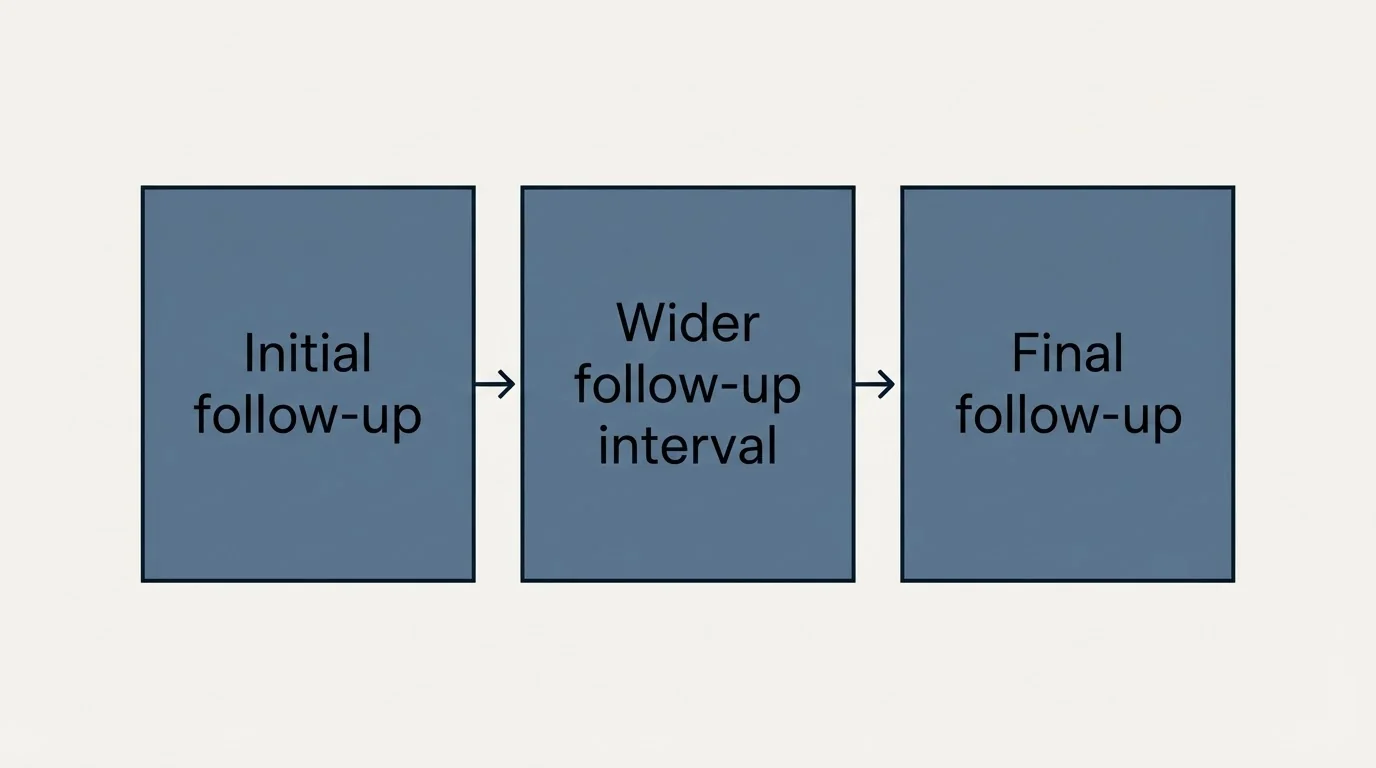
Follow-ups significantly increase link acquisition rates. Most website owners are busy, and your initial email may get overlooked.
Follow-Up Timing
- Follow-up 1: 5-7 days after initial email
- Follow-up 2: 7-10 days after first follow-up
- Final follow-up: 10-14 days after second follow-up
Follow-Up Examples
Follow-up 1:
Hi [Name],
I wanted to follow up on my note about [specific content/resource]. I understand you're busy, but I wanted to make sure my email didn't get lost.
Let me know if you have any questions about [the resource/the broken link/etc.].
[Your Name]
Follow-up 2:
Hi [Name],
One last follow-up about [specific pitch]. If [topic] isn't relevant for your content right now, no worries at all.
If there's a different type of resource that would be more helpful for your readers, I'd be happy to hear what you're looking for.
[Your Name]
Final follow-up:
Hi [Name],
Final note on this. If the timing isn't right or [resource] isn't a fit for [their page], I completely understand.
If anything changes or you're looking for resources on [topic] in the future, feel free to reach out.
[Your Name]
Tracking and Measuring Success
Effective link building requires systematic tracking and optimization.
Key Metrics to Track
Outreach volume. Number of emails sent per day/week/month.
Response rate. Percentage of emails that receive any response.
Link acquisition rate. Percentage of outreach that results in a placed link.
Link quality metrics. Average domain authority of acquired links.
Time to link. Average time from outreach to link placement.
Tools for Tracking
- Spreadsheets for outreach tracking and follow-up scheduling
- SEO tools (Ahrefs, Moz, SEMrush) for monitoring new backlinks
- Email tracking tools for open and click rates
- CRM systems for managing larger outreach campaigns
Optimization Approaches
A/B test subject lines. Small changes can significantly impact open rates.
Test different angles. Try various value propositions to see what resonates.
Analyze response patterns. Identify which types of sites and pitches convert best.
Refine targeting. Focus on site types with highest conversion rates.
Avoiding Common Link Building Mistakes
Spammy Practices to Avoid
Bulk automated outreach. Mass emails with no personalization damage your reputation and effectiveness.
Paid links. Buying links violates search engine guidelines and risks penalties.
Reciprocal link schemes. "I'll link to you if you link to me" arrangements are devalued by search engines.
Private blog networks (PBNs). Links from networks of low-quality sites created solely for links can result in penalties.
Comment and forum spam. Dropping links in comments and forums without adding value is ineffective and damages reputation.
Quality Over Quantity
Acquiring one high-quality link from an authoritative, relevant site delivers more value than dozens of low-quality links. Focus your outreach on opportunities that matter.
Long-Term Relationship Building
The best link building isn't transactional. Building genuine relationships with content creators and site owners creates ongoing opportunities. Someone who links to you once and has a positive experience is likely to link again.
Your Link Building Outreach Checklist
Preparation
- Identified target pages and sites with clear link opportunity
- Verified domain authority and relevance
- Found correct contact information
- Created linkable content worth promoting
- Researched each prospect's site and content
Email Quality
- Subject line is specific and professional
- Opening references specific content on their site
- Value proposition is clear and genuine
- Ask is specific and easy to fulfill
- Total email is under 150 words
- Proofread for errors
Process
- Tracking system in place
- Results being measured
- Approach being optimized based on data
Building a Sustainable Link Building Program
Cold email outreach for link building works best as an ongoing program rather than a one-time campaign. Consistent, quality outreach builds your backlink profile over time while establishing relationships that generate future opportunities.
Focus on creating genuinely valuable content worth linking to, then systematically reaching out to relevant sites that would benefit from sharing that content with their audiences. This approach creates sustainable link growth while building genuine industry relationships.
If you're looking to scale your link building outreach while maintaining personalization and quality, RevenueFlow can help. Our done-for-you cold email campaigns apply these principles to systematically acquire high-quality backlinks for your site.
Get Your Free Campaign and see how targeted cold email can accelerate your link building results.
Related Reading
Frequently asked questions.
Frequently asked questions- Why does cold email work better than other methods for building backlinks?
- Cold email provides direct access to website owners, editors, and content managers who have the authority to add links to their content. It scales effectively while maintaining personalization quality, produces measurable metrics like response and conversion rates, and costs only time rather than money. Unlike paid link acquisition which violates search engine guidelines, email outreach builds genuine relationships that often lead to multiple link opportunities over time.
- What makes a backlink high-quality for SEO purposes?
- High-quality backlinks come from sites with strong domain authority, relevance to your industry or niche, and real traffic. The link placement matters significantly: editorial links within content carry more weight than footer or sidebar links. Follow links pass direct link equity to your site, while nofollow links provide less SEO value but can still drive referral traffic. Links from sites that search engines trust signal content quality and improve rankings.
- How do I find websites to target for backlink outreach?
- Start with competitor backlink analysis using SEO tools to identify sites linking to competitors in your space. Search for resource pages using queries like '[your topic] + resources' to find sites explicitly designed to link out. Use broken link identification tools to discover replacement opportunities. Set up brand monitoring with Google Alerts or similar tools to catch unlinked mentions. Industry directories and regular roundup posts actively seek content to feature.
- What personalization is required to avoid looking like spam in link building emails?
- Research each prospect by reviewing the specific page where your link would fit, understanding their content focus, and noting the site owner's name. Reference specific content in your outreach and mention the exact page where your link adds value. Acknowledge their work genuinely, explain what the linking site gains rather than only what you want, and customize your pitch based on the opportunity type. Avoid generic greetings like 'Dear Webmaster' which signal automated spam.
- What link building strategies generate the best response rates?
- Resource page link building works well because these pages are explicitly designed to link out, making owners more receptive. Broken link building provides clear value by helping site owners fix problems while offering your content as a replacement. The skyscraper technique involves creating superior content and reaching out to sites linking to inferior versions. Unlinked brand mentions convert easily since the site already references you. Each strategy requires different messaging but all emphasize mutual benefit over one-sided requests.
About the author.

Ben Carden is CRO at RevenueFlow, which builds and operates outbound revenue engines for B2B companies. Previously at Gartner Enterprise. Studied at London School of Economics.
Ben Carden · CRO
Connect on LinkedIn →Explore more.
Ready to scale your outreach?
We build GTM engines that book real meetings. See the receipts.
Related articles.
Cold Email for Link Building: How to Get Quality Backlinks
Learn how to use cold email outreach to build high-quality backlinks that improve your SEO rankings, with proven templates and strategies that get responses.
Cold Email for Influencer Outreach: Partner with Creators
Learn how to use cold email to build authentic influencer partnerships that drive real results for your brand, with proven templates and strategies.
Cold Email for Product Feedback: Complete Strategy Guide
Learn how to use cold email to gather valuable product feedback from users and prospects. Includes proven templates, feedback frameworks, and response optimization techniques.
Cold Email for PR: How to Pitch Journalists and Get Coverage
Learn how to craft cold emails that get journalists to open, read, and respond to your pitches. Includes real templates, timing strategies, and a complete PR outreach checklist.
Cold Email for Reviews: Complete Strategy Guide
Learn how to use cold email to generate authentic product reviews on G2, Capterra, and other platforms. Includes proven templates, compliance guidelines, and review generation frameworks.
Cold Email for Focus Groups: Complete Strategy Guide
Learn how to use cold email to recruit qualified participants for focus groups. Includes proven templates, screening strategies, and group composition frameworks.