Cold Email for Mobile Apps: The Complete Guide
Master cold email outreach for the mobile app development industry. Learn how to reach decision-makers at app development agencies, mobile-first companies, and enterprises building mobile experiences.

Cold email for mobile apps requires targeting specific buyer personas across mobile-first companies, enterprise mobile teams, development agencies, and gaming studios. Effective outreach addresses platform-specific challenges like device fragmentation, testing coverage, and release velocity while demonstrating fluency with frameworks, app store dynamics, and mobile-specific metrics. Success depends on technical credibility, precise timing around release cycles and platform updates, and differentiated messaging for iOS versus Android environments.
Key takeaways
- The mobile app market segments into five distinct categories: mobile-first companies, enterprise mobile development, app development agencies, cross-platform framework users, and mobile gaming studios.
- Key decision-makers include VPs of Engineering focused on architecture, Heads of Mobile prioritizing release velocity, Product Managers concerned with feature delivery, platform-specific developers, and QA managers addressing device fragmentation.
- Platform-specific messaging differentiates successful campaigns, requiring accurate terminology for iOS versus Android development, framework-specific challenges, and awareness of app store dynamics.
- Timing outreach around platform release cycles, app launches, app store seasonality, and major conferences increases response rates.
- Common mistakes include platform-agnostic messaging, ignoring framework context like React Native or Flutter, overlooking device fragmentation challenges, and making generic analytics claims without mobile-specific metrics.
Reviewed and updated August 3, 2025
Cold Email for Mobile Apps: The Complete Guide
Mobile applications have become essential touchpoints for businesses across every industry. Organizations are building native iOS and Android apps, cross-platform experiences, and mobile-first products that serve billions of users worldwide. The mobile ecosystem continues to evolve with new frameworks, platforms, and user expectations.
This growth creates substantial opportunities for vendors serving the mobile app ecosystem. Whether you offer development tools, analytics platforms, testing solutions, or consulting services, cold email can help you reach decision-makers who are actively building their mobile capabilities.
However, the mobile app market presents unique challenges. Buyers range from highly technical mobile engineers to product managers focused on user experience. The ecosystem spans native development, cross-platform frameworks, and mobile backend services. Breaking through requires targeted strategies that address specific mobile development challenges.
This guide covers everything you need to know about cold emailing mobile app companies effectively.
Understanding the Mobile App Market

The mobile app industry encompasses distinct segments with different needs and buying behaviors.
Mobile-First Companies
Mobile-first companies build products where mobile is the primary or only platform. They include consumer apps, mobile gaming companies, and mobile-only services.
These organizations focus on user experience, performance, and growth metrics. They evaluate vendors based on mobile-specific capabilities and scale support.
Enterprise Mobile Development
Large enterprises build mobile apps to serve customers and employees. They include banks, retailers, healthcare organizations, and industrial companies.
Enterprise teams focus on security, integration with existing systems, and supporting diverse device environments. They need proven solutions that work within organizational constraints.
Mobile App Development Agencies
Agencies build mobile apps for clients across industries. They include specialized mobile shops and full-service digital agencies.
Agencies focus on development efficiency, client delivery, and differentiation. They need tools that accelerate project delivery and improve quality.
Cross-Platform and Hybrid Development
Companies using cross-platform frameworks build for multiple platforms from shared codebases. They include React Native, Flutter, and other framework communities.
These teams focus on code sharing efficiency, native performance, and platform-specific capabilities. They evaluate tools based on framework compatibility.
Mobile Gaming
Gaming companies build entertainment experiences for mobile platforms. They include casual game developers, mid-core studios, and AAA mobile publishers.
Gaming teams focus on performance optimization, monetization, and user engagement. They have specialized needs around graphics, real-time networking, and in-app purchases.
Key Decision Makers in Mobile Apps
Mobile app purchasing decisions involve multiple stakeholders with different priorities.
VP of Engineering or CTO
What they care about: Technical architecture, development velocity, app quality, team productivity, and technology strategy.
Pain points: Release velocity, crash rates, technical debt, platform fragmentation, and talent acquisition.
Trigger events: Major app initiatives, architecture reviews, platform strategy decisions, and organizational growth.
Email angle: Focus on engineering outcomes and strategic value. Connect technical capabilities to business objectives.
Head of Mobile or Mobile Engineering Manager
What they care about: App quality, release cadence, team efficiency, platform coverage, and user experience.
Pain points: Testing coverage, release coordination, platform-specific issues, and development speed.
Trigger events: App launches, quality issues, team scaling, and platform expansions.
Email angle: Address mobile-specific challenges. Quantify improvements to release velocity, quality, or team productivity.
Mobile Product Manager
What they care about: User experience, feature delivery, app store performance, and competitive positioning.
Pain points: Release delays, user feedback integration, platform differences, and analytics gaps.
Trigger events: New feature initiatives, competitive pressure, and product roadmap planning.
Email angle: Focus on product delivery and user experience. Emphasize how your solution enables faster feature delivery.
iOS or Android Developer
What they care about: Development tools, debugging capabilities, code quality, and technical excellence.
Pain points: Build times, testing complexity, platform quirks, and tooling limitations.
Trigger events: New projects, tool evaluations, and workflow pain points.
Email angle: Lead with developer experience and technical capabilities. Offer resources like documentation and trials.
Director of Quality Assurance or QA Manager
What they care about: Test coverage, device compatibility, release quality, and testing efficiency.
Pain points: Device fragmentation, manual testing burden, regression management, and release timelines.
Trigger events: Quality issues, testing initiatives, and automation investments.
Email angle: Address testing and quality challenges. Emphasize coverage, automation, and efficiency improvements.
Growth or Marketing Manager
What they care about: User acquisition, retention, app store optimization, and attribution.
Pain points: Attribution accuracy, ASO competition, user churn, and campaign measurement.
Trigger events: Growth initiatives, user acquisition campaigns, and retention programs.
Email angle: Focus on growth metrics and user insights. Emphasize measurement and optimization capabilities.
Technical Considerations in Mobile Apps
Mobile app buyers are technically sophisticated. Your outreach must demonstrate genuine understanding of mobile development challenges.
Native vs. Cross-Platform Development
Understanding platform choices helps you position your solution appropriately.
Native iOS (Swift/Objective-C): Full platform capabilities, optimal performance, Apple ecosystem integration.
Native Android (Kotlin/Java): Full platform access, Google services integration, diverse device support.
React Native: JavaScript-based cross-platform with native components and large ecosystem.
Flutter: Dart-based cross-platform with custom rendering and growing adoption.
Xamarin/.NET MAUI: C#-based cross-platform for teams with Microsoft ecosystem.
Reference relevant platforms when reaching out to teams with specific technology choices.
Mobile App Architecture
Modern mobile apps follow specific architectural patterns.
MVVM and MVP: Presentation layer patterns for maintainable mobile code.
Clean architecture: Separation of concerns and testability in mobile apps.
Modular architecture: Breaking large apps into feature modules for team scaling.
Backend integration: API design, offline support, and data synchronization.
Understanding architectural approaches helps you address engineering team challenges.
Mobile Testing and Quality
Testing mobile apps presents unique challenges.
Device fragmentation: Supporting diverse screen sizes, OS versions, and hardware capabilities.
UI testing: Automated testing of user interfaces across platforms.
Performance testing: Ensuring app responsiveness and resource efficiency.
CI/CD for mobile: Build automation, signing, and distribution pipelines.
Testing and quality concerns drive many mobile purchasing decisions.
Mobile Analytics and Growth
Understanding how mobile teams measure success helps position your solution.
User analytics: Sessions, engagement, retention, and user behavior analysis.
Performance monitoring: Crash rates, ANRs, launch time, and resource usage.
Attribution: Understanding which channels drive installs and user value.
App store optimization: Rankings, conversion rates, and keyword performance.
Reference relevant metrics when reaching out to product and growth teams.
Industry Applications of Mobile Apps
Different industries build mobile apps for different purposes. Tailoring your messaging to specific applications improves response rates.
Consumer Mobile Apps
Applications include social networking, messaging, content consumption, and lifestyle apps.
Key concerns center on user engagement, growth, and performance optimization.
Messaging angle:
"Consumer app teams need [specific capability] to maintain engagement at scale. We help mobile teams achieve [specific outcome] while optimizing performance."
Mobile Banking and Finance
Applications include banking apps, trading platforms, payment solutions, and financial management tools.
Key concerns include security requirements, regulatory compliance, and transaction reliability.
Messaging angle:
"Financial services mobile teams need [specific capability] to meet security and compliance requirements. We help banking apps achieve [specific outcome] while maintaining regulatory compliance."
E-commerce and Retail Mobile
Applications include shopping apps, mobile commerce, and retail engagement platforms.
Key concerns center on conversion optimization, payment integration, and personalization.
Messaging angle:
"E-commerce mobile teams need [specific capability] to optimize conversion rates. We help retail apps achieve [specific outcome] while improving user experience."
Healthcare Mobile Apps
Applications include patient engagement, telehealth, wellness tracking, and clinical tools.
Key concerns include HIPAA compliance, data security, and accessibility requirements.
Messaging angle:
"Healthcare mobile teams need [specific capability] to maintain HIPAA compliance. We help health apps achieve [specific outcome] while meeting regulatory requirements."
Mobile Gaming
Applications include casual games, mid-core titles, and mobile-first gaming experiences.
Key concerns center on performance optimization, monetization, and player engagement.
Messaging angle:
"Mobile gaming teams need [specific capability] to maintain performance across devices. We help game developers achieve [specific outcome] while optimizing player experience."
Enterprise Mobile Apps
Applications include internal tools, field service apps, and employee productivity solutions.
Key concerns include device management, security, and integration with enterprise systems.
Messaging angle:
"Enterprise mobile teams need [specific capability] to support diverse device environments. We help organizations achieve [specific outcome] while maintaining security standards."
Building Credibility in Mobile App Outreach
Mobile app professionals evaluate vendors carefully. Building credibility requires demonstrating genuine mobile understanding.
Use Accurate Terminology
Mobile development has specific terminology. Using terms correctly signals expertise.
Correct usage examples:
- "SwiftUI" and "UIKit" for iOS development
- "Jetpack Compose" and "XML layouts" for Android
- "Hot reload" for Flutter/React Native development features
- "ANR" (Application Not Responding) for Android performance issues
- "TestFlight" and "Firebase App Distribution" for beta testing
Incorrect terminology immediately signals unfamiliarity with mobile development.
Reference Platform-Specific Challenges
Different platforms have different challenges. Showing awareness builds credibility.
iOS considerations: App Store review process, TestFlight limits, background execution restrictions.
Android considerations: Device fragmentation, Google Play policies, vendor-specific behaviors.
Cross-platform considerations: Native bridge performance, platform-specific code requirements, upgrade paths.
Reference relevant platform challenges when reaching out to mobile teams.
Include Relevant Metrics
Mobile teams measure success with specific metrics. Reference relevant metrics in your outreach.
Quality metrics: Crash-free rate, ANR rate, app start time, frame rate.
Business metrics: DAU/MAU, retention rates, conversion rates, lifetime value.
Development metrics: Build time, release frequency, test coverage, bug resolution time.
Including specific metrics demonstrates understanding of how mobile teams measure success.
Demonstrate Scale Awareness
Mobile apps can serve millions of users. Showing understanding of scale builds credibility.
Example:
"Our platform supports apps with 10M+ daily active users. Designed for high-volume analytics without impacting app performance."
Scale awareness signals experience with serious mobile applications.
Timing Your Outreach
Several factors affect timing in the mobile app industry.
Platform Release Cycles
Apple and Google release major OS versions annually, typically in fall. Teams preparing for new OS versions need updated tools and testing capabilities.
WWDC (Apple, June) and Google I/O (Google, May) announce platform changes that affect mobile development priorities.
App Store Seasonality
Consumer app activity often peaks during holiday seasons. Development teams prepare well in advance for peak periods.
Enterprise app activity may follow fiscal year planning cycles.
App Launch and Update Cycles
Teams launching new apps or major updates have concentrated tool needs. Identifying accounts preparing for launches creates timely outreach opportunities.
Conference and Event Timing
Major mobile events create natural conversation opportunities.
Relevant events:
- WWDC (Apple, June)
- Google I/O (May)
- Droidcon events
- Swift and iOS conferences
Reaching out before or after events with relevant context improves engagement.
Team Growth and Reorganization
Hiring activity signals investment in mobile capabilities. Teams adding mobile engineers or creating dedicated mobile teams are likely investing in tooling.
Email Templates for Mobile Apps
Here are templates adapted for different mobile app scenarios.
Template 1: Mobile Engineering Outreach
Subject: Mobile development at [Company]
Body:
[First Name],
Quick question: how is [Company] currently handling [specific mobile challenge, e.g., testing across device types, release coordination, crash monitoring]?
We work with mobile teams to improve [specific metric, e.g., crash-free rates, release velocity, test coverage].
Mobile teams using our platform typically see [specific outcome, e.g., 50% reduction in crash rates, 2x faster release cycles].
Worth a brief conversation to see if this applies to your mobile development?
[Your name]
Template 2: Mobile Testing Outreach
Subject: Mobile testing at [Company]
Body:
[First Name],
Mobile teams typically struggle with [specific testing challenge, e.g., device fragmentation coverage, automated UI testing, CI/CD pipeline integration].
We help mobile QA teams [specific capability] without slowing release velocity.
Currently supporting [X] mobile teams testing across [device count] device configurations.
Happy to provide documentation and a trial environment before any call.
[Your name]
Template 3: Cross-Platform Development Outreach
Subject: [Framework] development at [Company]
Body:
[First Name],
Teams building with [React Native/Flutter/etc.] often face challenges with [specific challenge, e.g., native module integration, performance optimization, platform-specific debugging].
We help cross-platform teams [specific capability] while maintaining native performance.
Currently used by [X] teams building [framework] apps.
Worth exploring if this applies to your [framework] development?
[Your name]
Template 4: Mobile Analytics Outreach
Subject: Mobile analytics at [Company]
Body:
[First Name],
Mobile product teams often lack visibility into [specific analytics gap, e.g., user journey analytics, conversion funnel analysis, cohort retention].
We help mobile teams understand [specific insight area] to drive product decisions.
Organizations using our platform typically improve [specific metric] by [percentage].
Is mobile analytics a priority for your product team?
[Your name]
Template 5: App Performance Outreach
Subject: App performance at [Company]
Body:
[First Name],
Users expect instant responsiveness from mobile apps. Slow launch times, frame drops, and ANRs directly impact retention and reviews.
We help mobile teams identify and resolve performance issues before they affect users.
Mobile teams using our platform typically improve app store ratings by [specific improvement] through performance optimization.
Worth a brief conversation about your app performance goals?
[Your name]
Common Mistakes to Avoid
Mistake 1: Platform-Agnostic Messaging
iOS and Android have different development environments, challenges, and priorities. Generic mobile messaging fails to resonate.
Weak:
"Our solution helps with mobile development."
Strong:
"Our platform reduces iOS build times by 60% through intelligent caching and distributed compilation."
Platform-specific messaging demonstrates expertise.
Mistake 2: Ignoring Framework Context
Cross-platform development has its own ecosystem. Messaging that ignores framework context misses opportunities.
Reference relevant frameworks (React Native, Flutter, etc.) when reaching out to teams using them.
Mistake 3: Overlooking Device Fragmentation
Device diversity is a core mobile challenge. Solutions that ignore this reality fail to resonate.
Acknowledge device fragmentation and show how your solution addresses it.
Mistake 4: Underestimating Quality Requirements
App store reviews and user expectations create high quality bars. Messaging that minimizes quality fails.
Emphasize quality improvements and reliability, which matter significantly to mobile teams.
Mistake 5: Ignoring App Store Dynamics
App stores control distribution and create unique requirements. Ignoring app store context limits relevance.
Reference app store considerations (reviews, rankings, policies) when relevant.
Mistake 6: Generic Analytics Claims
Mobile analytics requires specific capabilities. Generic analytics messaging fails to differentiate.
Weak:
"Our analytics platform provides insights."
Strong:
"Our SDK captures user session data with 100ms latency, zero impact on app launch time, and full offline support."
Mobile-specific analytics details build credibility.
Building a Mobile App Cold Email Program
List Building
Quality targeting matters in the competitive mobile app market.
Focus on:
- Organizations with visible mobile investments (app store presence, job postings, conference activity)
- Companies in target industries building mobile capabilities
- Decision-makers at appropriate levels for your solution
- Accounts with observable growth signals or challenges
Segmentation Approaches
Effective segmentation improves response rates.
By platform:
- iOS-focused teams
- Android-focused teams
- Cross-platform developers
By organization type:
- Mobile-first companies
- Enterprise mobile development
- Agencies and consultancies
By industry:
- Consumer apps
- Financial services
- Healthcare
- Gaming
By focus area:
- Development tools
- Testing and quality
- Analytics and growth
- Performance optimization
Where we differ from standard practice
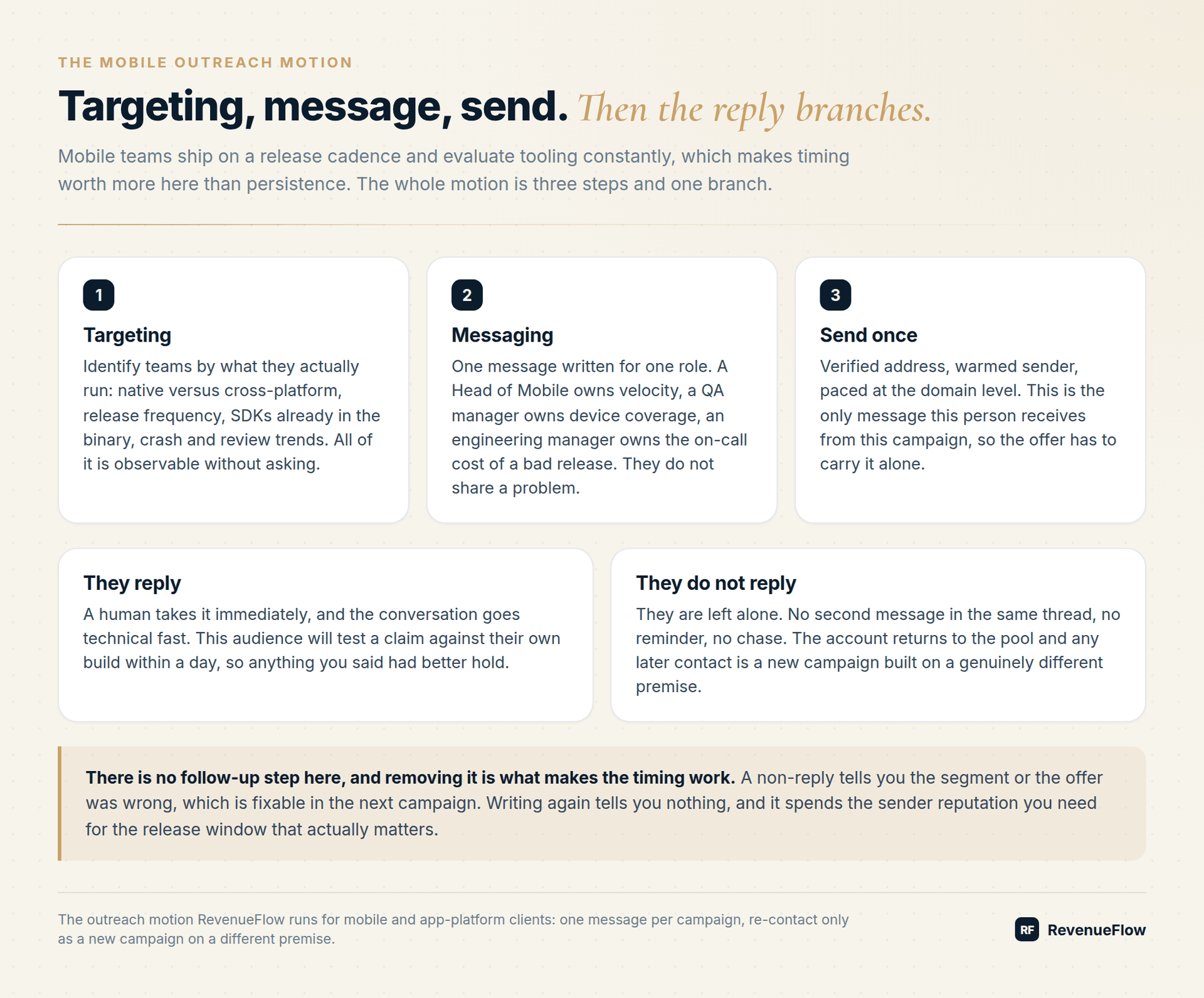
Much of the advice on this page reflects how outbound is commonly run. We run it differently, and since this page sits on our site it is worth saying where the difference is and what it costs us.
- A sequence of messages to each prospect over several weeks
- Later messages often land in the same email thread
- Every contact is reached more than once, so a distracted reader gets another chance
- The later messages go only to people who did not answer the first
- Reputation cost accrues on the sending domain across everything else it sends
- One message, then that campaign is finished for that contact
- No thread replies and no bumps
- A non-responding audience becomes a new campaign with a genuinely different premise, not a reminder
- More of the work moves into targeting and into the one message
- We reach each contact less often, and that is the cost we accept
The reasoning is mechanical rather than moral. A follow-up arrives underneath a message the recipient has already seen and chosen not to answer, so it is delivered to the population most likely to mark it as spam, and the reputation cost of that lands on the sending domain across every campaign running on it. We set that cost against the replies a sequence recovers and decided the trade was not worth it. The full argument, with the numbers from our own campaigns, is in why we stopped using follow-ups.
Follow-Up Strategy
Mobile professionals are busy shipping apps. Most programmes plan four to six touches spaced five to seven business days apart. We send one message per campaign and put that effort into targeting and into the first message instead.
Where that effort goes:
- Share relevant technical content or best practices
- Reference platform announcements or OS updates
- Provide useful information about their specific challenges
- Keep the message concise and focused
When a non-responding list is worth another approach, it becomes a new campaign with its own premise rather than a second message under the first.
Measurement and Optimization
Track metrics to improve your program over time.
Key metrics:
- Open rates by segment and platform
- Reply rates by organization type and role
- Meeting conversion rates
- Pipeline progression from cold outreach
- Deal size and close rates by source
Use data to refine targeting, messaging, and timing continuously.
Building Long-Term Relationships in Mobile
The mobile app community values technical contribution and knowledge sharing.
Contribute Technical Content
Publishing useful technical content, tutorials, or benchmarks builds credibility. Share content that helps mobile teams solve real problems.
Engage with Platform Communities
iOS and Android communities are active on forums, social media, and developer networks. Participating thoughtfully builds visibility and credibility.
Contribute to Open Source
Many mobile tools and libraries are open source. Contributing to relevant projects builds visibility within the community.
Participate in Mobile Events
Mobile conferences and meetups create networking opportunities. Building relationships at events makes subsequent outreach more effective.
Support Developer Programs
Engaging with Apple and Google developer programs demonstrates platform commitment.
Summary
Cold emailing the mobile app industry requires genuine understanding of mobile development, platforms, and current challenges.
Success depends on:
- Understanding the market including mobile-first companies, enterprise development, agencies, and cross-platform teams
- Targeting the right decision-makers with role-appropriate messaging
- Demonstrating technical credibility through platform-specific knowledge and relevant metrics
- Tailoring to industry applications with use-case-specific messaging
- Timing outreach around platform release cycles, events, and app launches
- Avoiding common mistakes like platform-agnostic messaging and ignoring device fragmentation
- Building for the long term through community engagement and technical contribution
The mobile app market continues to grow as organizations invest in mobile experiences. Vendors who demonstrate genuine expertise and provide real value will succeed in reaching decision-makers at mobile app organizations.
Related Reading
If you would rather have this run for you, RevenueFlow books qualified meetings on a pay-per-meeting basis and publishes client results.
Frequently asked questions.
Frequently asked questions- Who are the main decision-makers for mobile app tools and services?
- Mobile app purchasing decisions involve multiple stakeholders. VPs of Engineering and CTOs focus on technical architecture and team productivity. Heads of Mobile and Mobile Engineering Managers prioritize app quality, release cadence, and platform coverage. Mobile Product Managers care about user experience and feature delivery. Individual iOS or Android developers evaluate development tools and debugging capabilities. QA Directors manage testing coverage and device compatibility.
- What are the biggest mistakes in cold emailing mobile app companies?
- Platform-agnostic messaging that ignores differences between iOS and Android fails to resonate. Ignoring framework context like React Native or Flutter shows lack of understanding. Overlooking device fragmentation challenges dismisses a critical pain point for mobile teams. Underestimating quality requirements misses the high bar mobile apps must meet. Ignoring app store dynamics and making generic analytics claims without mobile-specific metrics also undermine credibility.
- When is the best time to reach out to mobile app teams?
- Time outreach around platform release cycles when teams evaluate new tools and frameworks. App store seasonality affects purchasing, with different patterns for consumer versus enterprise apps. App launch and update cycles create windows when teams address technical debt or adopt new solutions. Major conferences and events like WWDC or Google I/O trigger tool evaluations. Team growth and reorganization also create opportunities as mobile teams scale.
- How do I build credibility when emailing mobile app developers?
- Use accurate platform-specific terminology that demonstrates understanding of iOS versus Android development. Reference concrete platform challenges like SwiftUI adoption, Jetpack Compose migration, or React Native performance. Include relevant metrics around build times, crash rates, or device coverage rather than generic performance claims. Demonstrate awareness of scale differences between consumer apps serving millions and enterprise apps with controlled deployments.
- What types of companies should I target for mobile app outreach?
- Mobile-first companies build products where mobile is the primary platform and focus on user experience and growth. Enterprise mobile teams at banks, retailers, and healthcare organizations prioritize security and system integration. Mobile app development agencies need tools that accelerate client delivery. Cross-platform developers using React Native or Flutter evaluate framework compatibility. Mobile gaming companies have specialized needs around performance optimization and monetization.
About the author.

Fernando Cao is CEO at RevenueFlow, which builds and operates outbound revenue engines for B2B companies. Previously at Accenture Strategy. Studied at University of Bath.
Fernando Cao · CEO
Connect on LinkedIn →Explore more.
Ready to scale your outreach?
We build GTM engines that book real meetings. See the receipts.
Related articles.
Cold Email for Maintenance Services: The Complete Guide
A comprehensive guide to cold email outreach for commercial maintenance companies, covering how to reach facility managers, property managers, and operations directors with messaging that wins preventive maintenance and repair contracts.
Cold Email for Staffing Agencies: The Complete Guide
A comprehensive guide to cold email outreach for staffing and temp agencies, covering how to reach HR directors, hiring managers, and operations leaders with messaging that wins temporary staffing, contract placement, and direct hire business.
Cold Email for Telecom: Reaching Carriers and MSPs
Telecom companies face rapid technology changes and competitive pressures. Here's how to approach cold email outreach to carriers, MSPs, and UCaaS providers.
Cold Email for Electronics Companies: The Complete Guide
A comprehensive guide to cold email outreach for electronics manufacturers, component suppliers, and EMS providers, covering buyer personas, OEM relationships, contract manufacturing, and proven strategies for reaching engineers, procurement managers, and supply chain leaders.
Cold Email for Security Services: The Complete Guide
A comprehensive guide to cold email outreach for security service providers, covering how to reach facility managers, corporate security directors, and property managers with messaging that builds trust and wins contracts.
Cold Email for Cloud Services: The Complete Guide
Learn how to effectively reach decision-makers at cloud service providers and enterprises adopting cloud infrastructure. This guide covers targeting strategies, technical credibility, and email templates for the cloud services industry.