Cold Email Templates for Accounting Firms: 12+ Examples
Thirteen copy-pasteable cold email templates for selling into accounting firms, with subject lines, personalization variables, and the send windows that work.
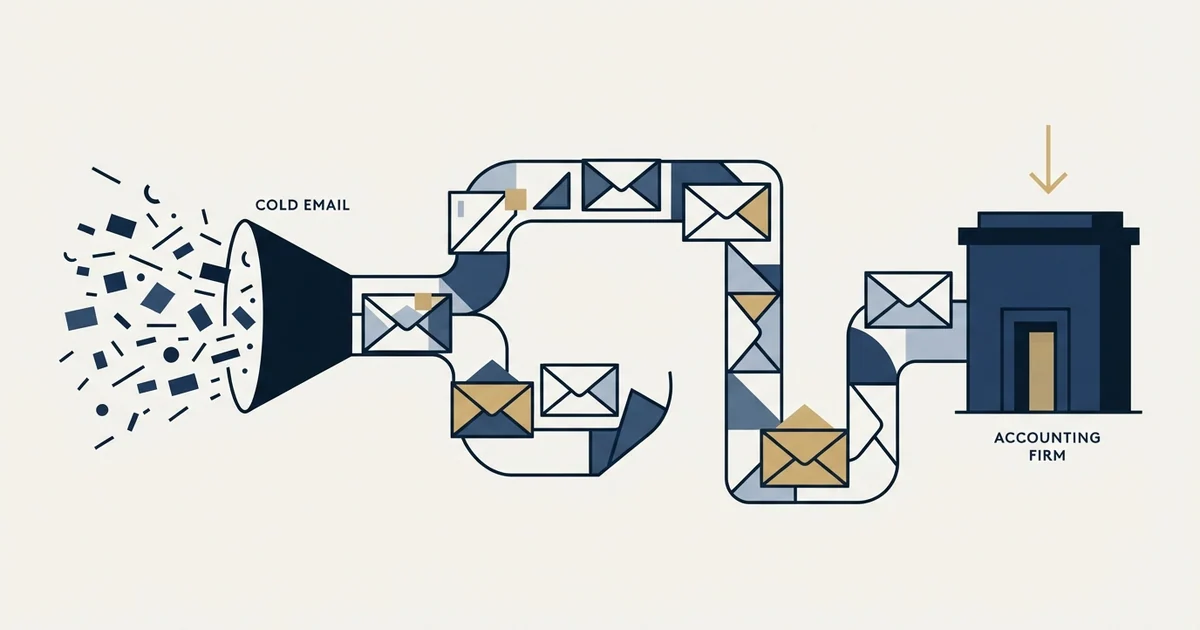
Cold emails to accounting firms work when they are sent outside filing deadlines and framed in the metrics partners track. Use the late-April-to-August and mid-October-to-December windows, personalize on firm size, tax software, and recent firm news, and open with capacity, staffing, or cost per return rather than generic efficiency language.
Key takeaways
- Accounting firms are unreachable by cold email around the March 15, April 15, September 15, and October 15 filing deadlines; the productive windows are late April through August and mid-October through mid-December.
- Personalize on three findable variables: firm headcount and service mix, tax software stack (CCH Axcess, UltraTax, Lacerte, Drake, Karbon), and recent firm news such as partner promotions or mergers.
- Frame value in the metrics partners already track: billable hours, realization rate, utilization, staff turnover, and cost per return.
- Trigger events outperform cold first touches: new partner promotions, mergers and private equity investments, and open job postings all create dated, budgeted buying moments.
- Do not ask for a demo in email one. Offer a one-pager, a peer partner reference, or a one-line question instead.
- Send one message per campaign. Re-approach non-repliers in the next open window with a new subject line and a different angle, then again the following season.
Reviewed and updated September 1, 2026
Cold Email Templates for Accounting Firms: 12+ Examples That Work
Send a cold email to a CPA firm on March 20 and it will be read by nobody. Send the same email on May 20 and a managing partner might reply within the hour. Accounting is one of the few B2B verticals where the calendar controls the entire buying cycle, and most sellers ignore it completely.
The pattern is easy to trace. Partnership and S-corp returns are due March 15, individual returns April 15, and the extended deadlines land on September 15 and October 15 (Source: IRS). Around those dates, firms operate at maximum billable capacity and every non-urgent email gets archived. The windows that matter are roughly late April through August, and mid-October through mid-December. Everything below assumes you are sending inside those windows.
The other thing to understand: accounting firms buy on peer proof and capacity math. Partners talk to partners at firms of similar size, in state society meetings and peer review groups. They evaluate purchases in terms of realization rate, utilization, staff turnover, and returns per preparer. An email that speaks that language gets read. An email that says "streamline your workflows" reads like every vendor booth at every conference they have already walked past.
Below are 13 templates grouped by scenario, with subject line options and personalization variables in {{curly_braces}}. Swap the bracket contents for real research before you send anything.
What Personalization Actually Means Here
Three variables do most of the work for this vertical, and all three are findable without a data vendor:
- Firm size and service mix. Headcount, number of partners, and whether they lean tax, audit, or advisory. This is on the firm's own site and in state CPA society directories.
- Software stack. CCH Axcess, UltraTax, Lacerte, Drake, Karbon, Canopy. Job postings name the stack explicitly, which is the cheapest research signal in the industry.
- Recent firm news. New partner announcements, office openings, mergers, private equity investment, or an INSIDE Public Accounting ranking. Firms publicize all of it.
If you cannot fill in at least two of those three for a prospect, that prospect is not ready to be emailed yet.
First-Touch Templates
Template 1: The Capacity Angle (Managing Partner)
Subject lines: capacity before {{next_busy_season}} / {{firm_name}} + 400 hours
Hi {{first_name}},

Most {{firm_size}}-person firms I talk to turned away work
last Q1 because they could not staff it. The demand was
there. The preparers were not.

We handle {{specific_task}} for firms running {{tax_software}},
which typically gives a preparer back somewhere between
{{hours_low}} and {{hours_high}} hours across a season. At
{{firm_name}}'s billable rates that is real money, and it
comes out of the exact weeks you can't buy more of.

Worth 15 minutes in {{month}} while things are quiet?

{{sender_name}}
Why this works for accounting firms: Capacity constraint is the top-of-mind problem for nearly every partner right now, and framing the benefit in billable hours converts directly into a number they already track. Naming their tax software proves you did not spray this.
Template 2: The Staffing Reality (Partner, Tax)
Subject lines: your {{job_title}} posting / staffing {{next_season}}
{{first_name}},

Saw you have been trying to fill the {{job_title}} role
since {{month_posted}}. That is a long time to carry an
open seat heading into {{season}}.

We work with firms that gave up on hiring their way out
of the crunch and instead moved {{low_value_task}} off
their seniors' plates. {{peer_firm_type}} firms in
{{region}} have used it to get through a season down
a body without pushing everyone to 70 hours.

Happy to walk through how it actually works, or send
the one-pager if that's easier.

{{sender_name}}
Why this works: An unfilled role is a public, dated, verifiable pain. Referencing how long the posting has been live signals real research, and the offer of a one-pager gives a low-commitment yes for partners who will not book a call from a cold email.
Template 3: The Firm Administrator Angle (Operations)
Subject lines: cost per return at {{firm_name}} / question on your {{software}} setup
Hi {{first_name}},

Quick question, and I'll keep it short since you're the
one who actually has to make the numbers work.

Do you have a clean figure for what a {{return_type}}
return costs {{firm_name}} to produce end to end? Most
firm administrators I ask have a rough sense but not a
number, because the time gets buried across
{{software}} and email.

We give firms that number and then cut it. If that's
worth a look, I can show you what it looks like for a
firm your size in about 12 minutes.

{{sender_name}}
Why this works: Firm administrators and directors of operations run the vendor evaluation at most mid-sized firms even though partners sign. They respond to precision and cost control, and a question they cannot immediately answer is a strong hook.
Template 4: The Peer Benchmark
Subject lines: how {{peer_count}} firms in {{state}} handle this / benchmark question
{{first_name}},

We work with {{peer_count}} firms in {{state}} in the
{{revenue_band}} range, and the same pattern shows up in
almost all of them: {{specific_pattern}}.

If {{firm_name}} looks like that too, there is a
straightforward fix that does not require changing
{{tax_software}} or retraining anyone mid-season.

If it doesn't, tell me and I'll leave you alone. Either
answer is useful to me.

{{sender_name}}
Why this works: Accounting is a referral and peer-comparison industry. Partners want to know what firms of their size and revenue band are doing. The explicit permission to say no lowers the cost of replying, and a "no" reply still opens a thread.
Re-Approach Templates
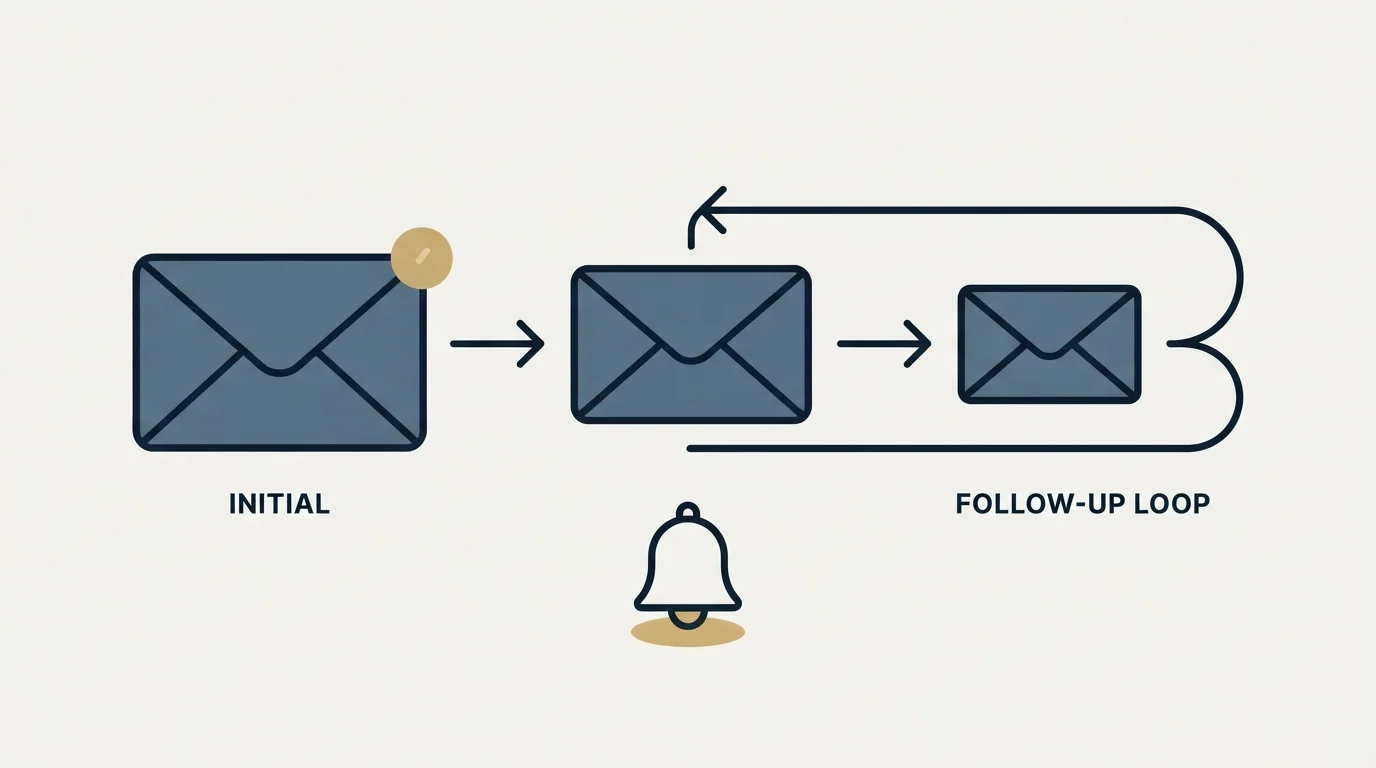
We run one message per campaign. A firm that does not reply is not written to again underneath the note it already passed over. It goes into a new campaign weeks later, carrying its own subject line and its own premise. A second note under an ignored one reads as pressure and is delivered to exactly the readers most likely to report it, so the reputation cost is charged to the sending domain across every other campaign it carries. A new email earns a fresh open. The full argument, with the numbers from our own campaigns, is in why we stopped using follow-ups.
Template 5: The Peer Proof Point
Subject line: what {{peer_firm_type}} firms did about {{problem}}
{{first_name}},

One concrete thing, in case {{problem}} is live at
{{firm_name}}.

{{peer_firm_description}} came to us with the same
{{problem}} you'd expect at their size. After
{{timeframe}}, {{specific_measurable_outcome}}. Their
managing partner is happy to talk to peers if you ever
want to skip me and hear it from them.

Still worth 15 minutes?

{{sender_name}}
Why this works: Offering a peer partner as a reference before any call is a strong credibility move in a vertical where partners trust other partners far more than vendors. Sent weeks later as its own campaign, it reaches the partner with a fresh reason to read rather than an older ask restated.
Template 6: The Different Angle
Subject line: {{alternate_angle}} at {{firm_name}}
{{first_name}},

A different angle on the same problem.

I framed this around {{original_angle}}. For a lot of
firms the sharper problem is {{alternate_angle}}, which
shows up as {{observable_symptom}} rather than anything
on a P&L.

If neither is a live issue at {{firm_name}}, no reply
needed and I'll close the loop.

{{sender_name}}
Why this works: Partners often ignore a first email because the framing was wrong, not because the product is irrelevant. Resetting the angle gives them a second entry point, and running it as its own campaign months on means they meet the new framing without being reminded of the old one.
Template 7: Post-Busy-Season Reactivation
Subject lines: now that {{deadline_date}} is behind you / picking this back up
{{first_name}},

You told me in {{prior_month}} to circle back after
{{deadline_date}}. Doing exactly that.

Nothing has changed on my end except that we now have
{{new_relevant_detail}}, which matters if
{{their_stated_concern}} was the sticking point.

Two times that work this week: {{time_1}} or
{{time_2}}. Or send me a better one.

{{sender_name}}
Why this works: "Circle back after busy season" is the single most common brush-off in this vertical, and most sellers never actually do it. Following through on the exact date the prospect named turns a stall into a credibility signal.
Trigger Event Templates
Template 8: New Partner or Promotion
Subject lines: congrats on partner / {{first_name}}, congrats
{{first_name}},

Congratulations on making partner at {{firm_name}}.

Genuine question, not a pitch: new partners usually
inherit one process that everyone privately admits is
broken but nobody owned enough to fix. If
{{likely_process}} is that thing for you, this is the
quietest window you will ever have to change it.

Happy to show you what other firms did about it. If
your first 90 days are already full, I get it.

{{sender_name}}
Why this works: New partners are given a mandate and a short honeymoon period to change things. The email arrives at the exact moment their authority to buy is new and their tolerance for the status quo is lowest.
Template 9: Merger or Private Equity Investment
Subject lines: {{firm_name}} + {{acquired_firm}} / post-close integration question
{{first_name}},

Saw the {{acquired_firm}} news. Congratulations.

The part that usually gets ugly around month three is
{{integration_pain}}, especially when the two firms
were on {{software_a}} and {{software_b}}. Client data,
workpapers, and billing rarely line up as cleanly as
the LOI assumed.

We have done this integration for {{count}} firms.
Worth a conversation now, before the first combined
{{season}}?

{{sender_name}}
Why this works: Accounting firm consolidation is constant and every deal creates a dated, budgeted integration project. Naming the specific month-three failure mode shows you have watched this happen rather than read about it.
Template 10: Hiring Signal
Subject lines: three open roles at {{firm_name}} / before you fill {{role}}
{{first_name}},

{{firm_name}} has {{count}} open roles posted right
now, including {{role}}. Fully loaded, that seat runs
somewhere north of {{cost_estimate}} once you count
recruiting and ramp.

Before you fill all of them, it may be worth seeing how
much of {{role}}'s actual workload is
{{automatable_task}}. For some firms it's most of it.

15 minutes?

{{sender_name}}
Why this works: Open headcount means budget already exists and is already approved. Reframing an approved hiring spend as a candidate for reallocation is far easier than asking a partner group to approve new spend.
Referral and Redirect Templates

Template 11: Mutual Connection
Subject lines: {{connection_name}} suggested I reach out / via {{connection_name}}
Hi {{first_name}},

{{connection_name}} at {{connection_firm}} mentioned you
when we were talking about {{topic}}. He said you had
strong opinions about {{specific_topic}}, which is
exactly why I'm writing.

We do {{one_line_description}} for firms in the
{{revenue_band}} range. {{connection_firm}} has been
using it since {{month}}.

Ask {{connection_name}} whether it's worth your time. If
he says yes, I'm around {{availability}}.

{{sender_name}}
Why this works: Referrals carry more weight in accounting than in almost any other vertical because partners share vendors inside state societies and peer networks. Inviting the prospect to verify with the referrer removes the risk of the claim being oversold.
Template 12: Wrong Person, Ask for the Redirect
Subject lines: wrong person? / who owns {{function}} at {{firm_name}}?
{{first_name}},

I may have the wrong person, which is on me.

I'm trying to find whoever owns {{function}} at
{{firm_name}}. At firms your size it's usually the
{{likely_title}}, but sometimes it sits with a partner
who just never handed it off.

If that's not you, a name is all I need and I'll stop
filling your inbox.

{{sender_name}}
Why this works: Partners are far more willing to forward an email than to book a meeting, and an internal forward from a partner functions as a warm introduction. Naming the likely title makes the ask nearly effortless to answer.
The Routing Template
Template 13: One Question, Three Answers
Subject lines: {{topic}} at {{firm_name}}: 1, 2 or 3 / one question, one number
{{first_name}},

One question about {{topic}} at {{firm_name}}, and a
number is a complete answer:

1. Handled already, and I should stop writing
2. Real, but not before {{upcoming_season}}
3. Real now, send me the detail

If {{specific_trigger}} ever changes at {{firm_name}},
reply to this one and I'll pick it up. Otherwise, good
luck with {{upcoming_season}}.

{{sender_name}}
Why this works: A numbered answer costs one keystroke, which is why this format gets replies from partners who would never write a paragraph. Naming a specific future trigger gives them a reason to keep the email rather than delete it, and a saved email in this vertical gets resurrected months later.
Send-Window Calendar

| Period | Status | What to send |
|---|---|---|
| January to April 15 | Dead | Nothing. Archive the list. |
| Late April to June | Best window | First touches, trigger events, reactivations |
| July to August | Strong | Full campaigns, peer benchmark angles |
| September 1 to October 15 | Dead | Extension deadlines. Pause everything. |
| Mid-October to mid-December | Strong | Next-season planning, budget conversations |
| Late December | Dead | Year-end close and holidays |
Mistakes That Kill These Emails
Pitching software during busy season. A partner working 65-hour weeks will not evaluate anything. Sending anyway trains them to ignore your address permanently.
Using generic efficiency language. "Streamline," "optimize," and "transform" are invisible to this audience. Say hours, seats, returns, realization, or turnover.
Asking for a demo in email one. Partners resist calendar commitments to strangers. Offer a one-pager, a peer reference, or a specific question they can answer in one line.
Ignoring the partner group. Most firms decide by consensus among partners. Give your champion something forwardable, since your email will be forwarded whether you designed it for that or not.
Personalizing the first line only. A researched opener followed by a generic body is worse than no personalization, because the drop-off is obvious. Carry the specificity through the whole email. Running this consistently across a few hundred firms is the part most teams underestimate, and it is the reason agencies like RevenueFlow exist.
- No: Pitching software during busy season. A partner working 65-hour weeks will not evaluate anything.
- No: Using generic efficiency language. "Streamline," "optimize," and "transform" are invisible to this audience.
- No: Asking for a demo in email one. Partners resist calendar commitments to strangers.
- No: Ignoring the partner group. Most firms decide by consensus among partners.
- No: Personalizing the first line only. A researched opener followed by a generic body is worse than no personalization
Putting It Together

Build a list of firms you can actually describe, not a scraped list of every CPA firm in a metro area. Fill in the software stack and headcount for each one. Pick the template that matches the strongest signal you found. Send inside the windows. Send one message, then re-approach whoever did not answer in the next window with a different angle and a new subject line.
If you would rather have this built and run for you, book a strategy call with RevenueFlow and we will map the targeting, the campaign angles, and the send calendar around how accounting firms actually buy.
Related Reading
- Cold Email Templates for Customer Success Managers: 10+ Examples by Scenario
- 15 Objection Handling Email Templates That Actually Work
- 8 Sales Pitch Email Templates That Convert
If you would rather have this run for you, RevenueFlow books qualified meetings on a pay-per-meeting basis and publishes client results.
Frequently asked questions.
Frequently asked questions- When is the best time to cold email an accounting firm?
- Late April through August and mid-October through mid-December. Firms are at maximum billable capacity around the March 15 and April 15 deadlines and again ahead of the September 15 and October 15 extended deadlines. Emails sent in those stretches are archived unread and train partners to ignore your address permanently.
- Who is the right person to email at a CPA firm?
- It depends on firm size. At small firms the managing partner decides and evaluates. At mid-sized and larger firms, the firm administrator or director of operations usually runs the evaluation while partners approve the spend. When you are unsure, send a short redirect email asking who owns the function; partners forward far more readily than they book meetings.
- What subject lines work on accounting partners?
- Short, specific, and lowercase subject lines referencing something verifiable about the firm. Examples: 'your tax senior posting', 'cost per return at {{firm_name}}', 'now that April 15 is behind you'. Avoid anything containing streamline, transform, optimize, or partnership opportunity, since those read as vendor boilerplate to this audience.
- Should I follow up when an accounting firm does not reply?
- None. Send one message per campaign and leave the first email alone. A firm that does not answer goes into the next window's campaign with a fresh subject line and a different angle: a peer proof point, a new framing of the problem, or a reactivation after a deadline the prospect named. A note under an ignored email reads as pressure to a partner already buried in an inbox.
- Why do generic efficiency pitches fail with accounting firms?
- Partners evaluate purchases against numbers they already report on: realization rate, utilization, returns per preparer, staff turnover, and cost per return. Words like streamline and optimize do not map to any of those, so the email carries no information. Translating your benefit into hours or seats makes the value legible immediately.
About the author.

Ben Carden is CRO at RevenueFlow, which builds and operates outbound revenue engines for B2B companies. Previously at Gartner Enterprise. Studied at London School of Economics.
Ben Carden · CRO
Connect on LinkedIn →Explore more.
Ready to scale your outreach?
We build GTM engines that book real meetings. See the receipts.
Related articles.
10 B2B Cold Email Templates for One-Message Sends
Ten B2B cold email templates written for a single send, with the four slot structure underneath them and the test that separates a good example from a bad one.
Cold Email Templates for Customer Success Managers
Eleven cold email templates for customer success managers, covering champion change, expansion, renewal rescue, and win-back, with subject lines and timing.
14 Renewal Email Templates That Retain Customers
Master subscription and contract renewals with 14 proven email templates. Reduce churn, lock in renewals early, and maintain customer relationships.
13 Case Study Request Email Templates That Get Results
Get proven email templates for requesting case studies, video testimonials, and written reviews from your happiest customers. Includes templates for every stage from initial ask to final approval.
13 Demo Follow-Up Email Templates to Close More Deals
Proven demo follow-up email templates for every scenario, from same-day recaps to re-engaging stalled prospects and handling competitive evaluations.
Email Subject Line Capitalization: What the Guides Say
What the style authorities actually rule on subject line case, what the published tests measured, and the default for a one to one sales email.