Cold Email Templates for Cloud Services: 12+ Examples
Fourteen copy-pasteable cold email templates for selling cloud services, grouped by first touch, trigger event, follow-up, referral and breakup.
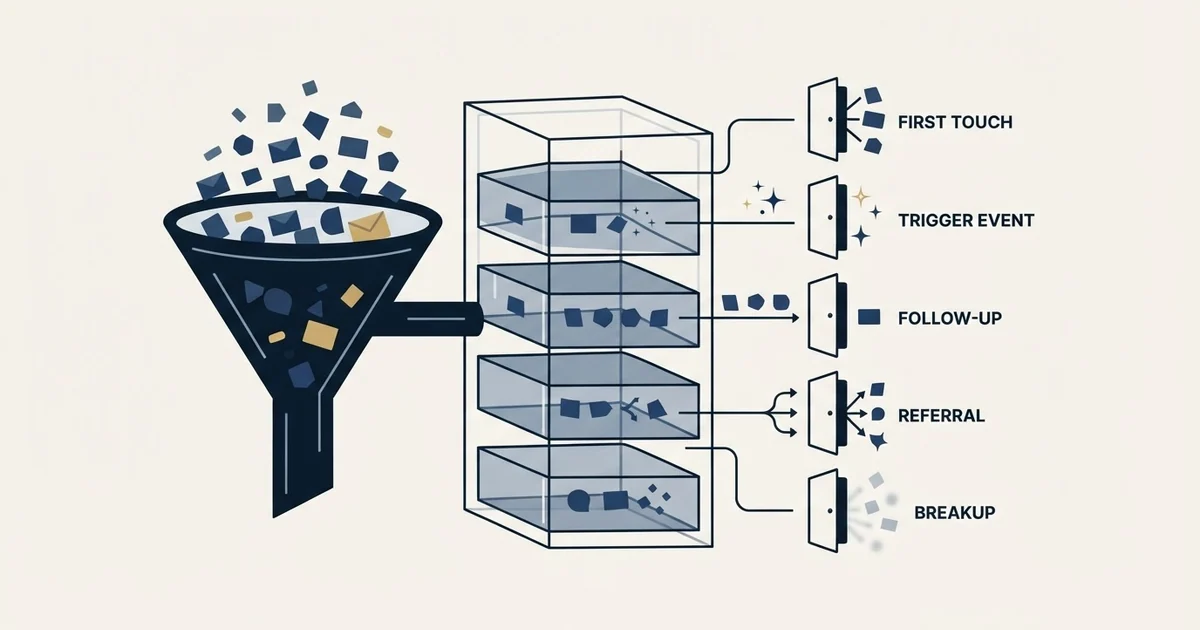
Effective cold emails for cloud services anchor on an existing budget rather than a new one. The strongest templates open with a specific stack detail, waste category, migration deadline or renewal window, address the practitioner and the signer differently, stay under 120 words, and ask for a reply instead of a demo.
Key takeaways
- Cloud services buyers rarely need a new budget line, so the strongest emails redirect spend already committed rather than requesting fresh approval.
- Fourteen templates cover five scenarios: first touch, trigger event, re-approach, referral and close, each with subject lines and {{personalization_variables}}.
- The person who feels the pain (SRE, platform engineer) is usually one level below the person who signs, so the same copy cannot serve both.
- Timing is dictated by contracts: committed spend agreements, reserved instance terms, data center lease expirations and vendor licensing changes create narrow evaluation windows.
- Marketplace private offers let buyers draw down existing committed cloud spend instead of finding new budget, which is worth naming in outreach to procurement.
- Keep every email under 120 words and make each number one you can defend on a call, because technical buyers will ask how you calculated it.
Reviewed and updated September 1, 2026
Cold Email Templates for Cloud Services: 12+ Examples That Work
Every enterprise cloud commitment has an expiry date attached to it. Somewhere in the 90 days before that date, the person who signs off on the bill starts answering emails they deleted without reading for the previous ten months. That one dynamic explains why cold outreach into cloud services performs so unevenly. The same email that gets ignored in March gets a same-day reply in September, and the copy had nothing to do with it.
Cloud services is one of the few verticals where the money already exists. You are rarely asking a prospect to create a new budget line, only to redirect spend they are already committing to or to stop wasting part of it. Credibility and specificity carry the whole email, and vague value propositions get punished harder here than in almost any other market.
The templates below are grouped by scenario: first touch, trigger event, re-approach, referral, and close. Replace the {{variables}}, and replace any placeholder number with a figure you can actually defend.
How Cloud Buyers Actually Buy
Four things shape every email you send into this vertical.
The pain is felt one level below the signature. A platform engineer or SRE lives with the Kubernetes sprawl, the noisy alerting, the six-hour migration windows. Their VP or CTO signs. Emails written for the signer that ignore the practitioner get forwarded down and die there.
Technical readers audit you in the first two lines. If you write "leverage cloud-native solutions to optimize your infrastructure," you have told an engineer you have never touched a terminal. Naming a specific service, a specific failure mode, or a specific cost center buys you the rest of the email.
Contracts and marketplaces dictate timing. Committed spend agreements, reserved instance terms, data center lease expirations, and vendor licensing changes (the shift in VMware licensing after the Broadcom acquisition being the most visible recent example) create hard windows where evaluation is possible and long stretches where it is not. Marketplace routes matter too, since private offers let a buyer draw down existing committed spend instead of finding new budget. Source: AWS Marketplace Private Offers
Security review is a second sale. SOC 2 reports, data residency, and access model questions arrive before pricing does. Emails that preempt one of these beat emails that dodge them.
| Persona | What they own | Lead with | What kills the email |
|---|---|---|---|
| CTO / VP Engineering | Roadmap velocity, headcount | Engineering time recovered | Feature lists |
| Director of Cloud / Platform | Reliability, migration delivery | A specific architectural failure mode | Generic "optimization" language |
| FinOps / Cloud Economist | Unit cost, commitment coverage | Waste category and commitment strategy | Savings claims with no method |
| CIO / IT Director | Risk, vendor consolidation | Compliance posture and exit plan | Anything that sounds like a science project |
| Procurement | Terms, marketplace, renewal dates | Contract mechanics | Technical depth |
First Touch Templates
Template 1: The Non-Production Waste Angle
Best for: FinOps leads, Directors of Cloud Infrastructure
Subject: {{company}}'s non-prod spend
Alt: idle infra at {{company}}

Hi {{first_name}},

Most teams running {{cloud_provider}} at your scale are paying for
environments nobody touches at 2am: dev clusters left warm, orphaned
volumes, snapshots with no lifecycle policy.

We run a two-week read-only review and hand back a ranked list of what
to kill, resize, or commit. You keep the list either way.

Worth 15 minutes to see if the number is big enough to bother with?

{{sender_name}}
Why this works for cloud services: It names waste categories an engineer recognizes immediately, and the read-only framing removes the security objection before it forms.
Template 2: The Migration Deadline
Best for: VPs of Infrastructure with a known deadline
Subject: {{company}} + {{deadline_event}}

{{first_name}},

Saw {{trigger_detail}}. If that timeline is real, you are probably
scoping migration waves right now and deciding what gets lifted, what
gets refactored, and what gets left to rot.

We have run {{migration_type}} moves for {{peer_company_1}} and
{{peer_company_2}}, both with hybrid dependencies that could not go down.

Happy to send the wave-planning template we use. Want it?

{{sender_name}}
Why this works for cloud services: Migration is a dated project with budget already approved, so receptiveness runs on a schedule you can predict. Offering an artifact instead of a call gets replies from leaders who resist calendar invites.
Template 3: The Practitioner Email
Best for: SRE, platform, and DevOps leads
Subject: {{specific_tool}} at {{company}}

{{first_name}},

Question for you, since you own {{platform_area}}: how are you handling
{{specific_technical_problem}} today?

Reason I ask is that every team we work with running {{specific_tool}}
hits the same wall around {{scale_threshold}}, and most solve it with
{{common_workaround}} until it stops holding.

If you have already solved it, I would genuinely like to hear how. If
not, I can show you what {{peer_company}} did in about ten minutes.

{{sender_name}}
Why this works for cloud services: Engineers answer technical questions from strangers far more readily than they accept pitches, and the email proves you know where their architecture breaks.
Template 4: The Hiring Signal
Best for: Any account posting roles you displace or support
Subject: your {{job_title}} req

Hi {{first_name}},

You are hiring a {{job_title}}, which usually means {{inferred_project}}
is on the roadmap and the current team is out of hours.

We cover {{scope_of_work}} for {{peer_company_1}} and {{peer_company_2}}
so their platform engineers stay on product work instead of
{{undifferentiated_work}}.

Not suggesting you cancel the req. Worth a short call on what we could
take off their plate in the meantime?

{{sender_name}}
Why this works for cloud services: Job postings publicly expose roadmap and capacity gaps. Acknowledging the hire instead of competing with it positions you as coverage during a slow search.
Trigger Event Templates
Template 5: Funding Round
Best for: Series B and later cloud-native companies
Subject: congrats on the {{round}}

{{first_name}},

Congrats on the {{round}}. The infrastructure math changes fast after a
raise: traffic targets go up, the architecture that got you here starts
creaking, and cloud spend becomes a board slide.

We help teams at this stage get ahead of that before the bill turns into
a fire drill. {{peer_company}} did it right after their {{round}}.

Open to a short call in the next couple of weeks?

{{sender_name}}
Why this works for cloud services: Funding creates both budget and a forecasting problem. Framing spend as a future board conversation is more persuasive to a CTO than framing it as a current cost complaint.
Template 6: Licensing or Vendor Change
Best for: Accounts affected by a pricing or licensing shift
Subject: {{vendor}} renewal at {{company}}

Hi {{first_name}},

If {{company}} is up for a {{vendor}} renewal this year, you are probably
modeling the new terms against alternatives rather than just signing.

We have helped {{peer_company_1}} and {{peer_company_2}} through exactly
that evaluation, including the parts nobody enjoys: dependency mapping,
licensing true-ups, and the rollback plan.

I can send the comparison framework we use, no call required.

{{sender_name}}
Why this works for cloud services: Vendor pricing changes force a formal re-evaluation on a fixed calendar, and naming the unglamorous work signals you have done this before.
Template 7: Compliance or Expansion Milestone
Best for: Companies entering regulated markets or new regions
Subject: {{compliance_or_region}} + your infra

{{first_name}},

Saw {{trigger_detail}}. That usually means {{compliance_requirement}}
lands on infrastructure, and the answer is either a rearchitecture or a
year of manual evidence collection.

We built the {{control_area}} setup for {{peer_company}} so their audit
evidence generates itself.

Worth a conversation before the scoping decision gets made?

{{sender_name}}
Why this works for cloud services: Compliance work has a deadline, an owner, and an approved budget. Arriving before the architecture decision is made is far more valuable than arriving after.
Re-Approach Templates
We run one message per campaign. An account that does not reply is never written to again underneath the email it already passed over. It goes into a fresh campaign weeks later, with its own subject line and its own premise. A second note under an ignored one reads as pressure and is delivered to exactly the readers most likely to report it, so the reputation cost is charged to the sending domain across every other campaign it carries. A new email earns a fresh open. The full argument, with the numbers from our own campaigns, is in why we stopped using follow-ups.
Template 8: The New Angle Re-Approach
Best for: A later campaign, four to eight weeks on, to accounts that never answered.
Subject: {{symptom}} before anyone looks at the bill

{{first_name}}, one thing worth checking.

The pattern I see most often at companies running {{cloud_provider}} is
{{specific_pattern}}. It usually shows up as {{symptom}} before anyone
looks at the bill.

Two-line question: is that happening at {{company}}, yes or no?

{{sender_name}}
Why this works for cloud services: It leads with information instead of asking for attention, and the binary question is answerable from a phone in twelve seconds. Its own subject line means it earns the open on the observation rather than on an email they already skipped.
Template 9: The Redirect
Subject: wrong person?

Hi {{first_name}},

I may have aimed this at the wrong desk. If {{topic_area}} sits with
someone else on the {{team_name}} team, could you point me at them?

If it is yours and the answer is no, tell me and I will stop.

{{sender_name}}
Why this works for cloud services: Cloud ownership is genuinely split across platform, security, finance, and procurement, so the question is honest rather than a trick. Giving an explicit exit raises reply rates from senior people.
Template 10: The Artifact Drop
Subject: the {{artifact_name}}

{{first_name}}, I put together the {{artifact_name}}.

It covers {{item_1}}, {{item_2}}, and the {{item_3}} numbers for a
{{company_profile}} setup.

Sending it over regardless. If it is useful and you want us to run the
same exercise on {{company}}'s environment, reply and I will set it up.

{{sender_name}}
Why this works for cloud services: Technical buyers evaluate vendors by reading their work. Delivering something without conditions creates reciprocity and gives an internal champion a document to circulate.
Referral Templates

Template 11: Champion Referral
Subject: {{referrer_name}} suggested I reach out

Hi {{first_name}},

{{referrer_name}} mentioned you own {{area_of_ownership}} at {{company}}
and thought this was worth five minutes of your time.

Short version: we handle {{service_description}}. {{referrer_name}} and I
talked through {{specific_problem}} last week and they thought you would
have a view on it.

Are you the right person, or should this go elsewhere?

{{sender_name}}
Why this works for cloud services: Cloud infrastructure teams are small and internally networked. A named colleague in the subject line survives filters and gets read, so lead with the name and keep the pitch to one sentence.
Template 12: Peer Network Referral
Subject: quick ask, {{first_name}}

{{first_name}},

We finished {{project_type}} with {{current_client}} and {{contact_name}}
mentioned you run something similar at {{company}}.

Not asking you to buy anything on this email. If it is relevant, I will
send what we did and you can decide whether a call makes sense.

Fair?

{{sender_name}}
Why this works for cloud services: Architecture decisions get benchmarked against similar companies rather than against vendor claims, so peer proof from a comparable environment is the strongest signal available.
Closing and Reactivation Templates
Template 13: The Calendar Close
Subject: closing this out

Hi {{first_name}},

I have not heard back, so I will assume {{topic_area}} is not a priority
this quarter and stop emailing.

One thing before I go: if your {{commitment_or_contract}} renews around
{{renewal_month}}, that is the window where this is easiest to act on.
Reply "ping me in {{month}}" and I will do exactly that, nothing else.

{{sender_name}}
Why this works for cloud services: It converts a dead account into a dated future conversation. Renewal windows are real, so the offer is genuinely useful, and the scripted reply lowers the effort of saying yes.
Template 14: The Reactivation
Subject: {{month}}, as promised

{{first_name}},

You asked me to circle back this month. Here I am.

Since we last spoke, {{relevant_change}}. That mostly matters for
{{specific_implication}} at {{company}}.

Still worth 20 minutes, or has the priority moved?

{{sender_name}}
Why this works for cloud services: Honoring a stated timeline demonstrates process discipline, which is what a buyer assesses before handing anyone access to production infrastructure.
Subject Lines Worth Testing

Short and lowercase outperforms polished in technical inboxes:
{{company}}'s {{cloud_provider}} bill{{specific_service}} at {{company}}your {{job_title}} req{{referrer_name}} suggested I reach out{{vendor}} renewalwrong person?question about {{platform_area}}{{peer_company}} → {{company}}
Avoid anything with "solutions," "partnership opportunity," "transform," or a percentage in the subject line. Those read as vendor blast copy at a glance.
Personalization Variables That Actually Move Replies
Not all variables are equal. Ranked by impact in this vertical:
- Stack detail. The specific provider, orchestrator, or database in use. Observable through job postings, engineering blogs, conference talks, and public repositories.
- A dated event. Funding, an acquisition, a new region, a compliance announcement, a renewal window.
- Named peer companies at comparable scale and architecture.
- A technical failure mode you can describe in their words.
Company name alone is nearly worthless. If you cannot fill at least one variable from the first three categories, the account is not ready to be emailed yet.
Common Mistakes

Leading with your certifications and partner tier is the most frequent error. Buyers assume competence and are screening for fit. Quoting savings percentages you cannot reproduce is the second, because any specific number invites the question "how did you get that," and having no answer ends the conversation. Third is sending identical copy to the FinOps lead and the SRE, who measure success on entirely different axes. Fourth is running a five-day cadence into accounts with quarterly planning cycles, which burns the account before the window opens.
- No: Leading with your certifications and partner tier
- No: Quoting savings percentages you cannot reproduce
- No: sending identical copy to the FinOps lead and the SRE
- No: running a five-day cadence into accounts with quarterly planning cycles
Your Pre-Send Checklist
- Confirmed the persona and their actual scope of ownership
- At least one stack, event, or peer variable filled with researched detail
- Every number in the email is one you can defend on a call
- Email is under 120 words
- Ask is a reply or a decision, not a 30-minute demo
- Security or access objection preempted where relevant
- Renewal or contract date logged for a timed reactivation
Templates get you to a competent first draft. Results come from the research layer underneath them, the list quality, and whether your sending infrastructure survives the volume.
If you would rather have this done for you, book a strategy call with RevenueFlow and we will map your target accounts, the triggers worth watching, and the campaigns to run against them.
Related Reading
- Cold Email Templates for Customer Success Managers: 10+ Examples by Scenario
- 15 Objection Handling Email Templates That Actually Work
- Cold Email for Cloud Services: The Complete Guide
If you would rather have this run for you, RevenueFlow books qualified meetings on a pay-per-meeting basis and publishes client results.
Frequently asked questions.
Frequently asked questions- What should a cold email to a CTO about cloud services actually say?
- Lead with engineering time recovered rather than a feature list. Name a specific service, failure mode or cost center in the first two lines so the reader knows you understand the environment, reference a comparable company at similar scale, and close with a request for a reply or a short artifact instead of a 30-minute demo. Keep it under 120 words.
- When is the best time to cold email a cloud services prospect?
- Timing follows contracts, not calendars. The strongest windows are roughly 60 to 120 days before a committed spend agreement, reserved instance term or vendor licensing renewal expires, plus the weeks after a funding round, acquisition, region launch or compliance announcement. Outside those windows, evaluation capacity is usually zero regardless of how good the copy is.
- Should I email the engineer or the executive?
- Both, with different copy. Platform engineers and SREs live with the technical pain and respond to specific questions about architecture and tooling. VPs and CTOs respond to engineering time recovered, risk and cost trajectory. Sending identical copy to both is a common mistake, because the two personas measure success on entirely different axes.
- How long should a cold email selling cloud services be?
- Under 120 words. Technical readers scan for a reason to delete, and length supplies one. Use the space for a specific observation about their stack or timeline, one line of peer proof, and a single clear ask. Save architecture detail, certifications and pricing for the reply, where they are actually wanted.
- Can I put savings percentages in a cold email?
- Only numbers you can reproduce on a call. Any specific figure invites the question of how you calculated it, and having no method ends the conversation and the credibility. If you have not run a defensible audit that produced the number, describe the waste categories qualitatively and offer to measure their environment instead.
About the author.

Ben Carden is CRO at RevenueFlow, which builds and operates outbound revenue engines for B2B companies. Previously at Gartner Enterprise. Studied at London School of Economics.
Ben Carden · CRO
Connect on LinkedIn →Explore more.
Ready to scale your outreach?
We build GTM engines that book real meetings. See the receipts.
Related articles.
10 B2B Cold Email Templates for One-Message Sends
Ten B2B cold email templates written for a single send, with the four slot structure underneath them and the test that separates a good example from a bad one.
Cold Email Templates for Customer Success Managers
Eleven cold email templates for customer success managers, covering champion change, expansion, renewal rescue, and win-back, with subject lines and timing.
14 Renewal Email Templates That Retain Customers
Master subscription and contract renewals with 14 proven email templates. Reduce churn, lock in renewals early, and maintain customer relationships.
13 Case Study Request Email Templates That Get Results
Get proven email templates for requesting case studies, video testimonials, and written reviews from your happiest customers. Includes templates for every stage from initial ask to final approval.
13 Demo Follow-Up Email Templates to Close More Deals
Proven demo follow-up email templates for every scenario, from same-day recaps to re-engaging stalled prospects and handling competitive evaluations.
Email Subject Line Capitalization: What the Guides Say
What the style authorities actually rule on subject line case, what the published tests measured, and the default for a one to one sales email.