How to Book Sales Meetings with AI Companies
A tactical playbook for booking meetings with AI companies: title targeting, trigger-event lists, a five-touch sequence, templates, and realistic math.
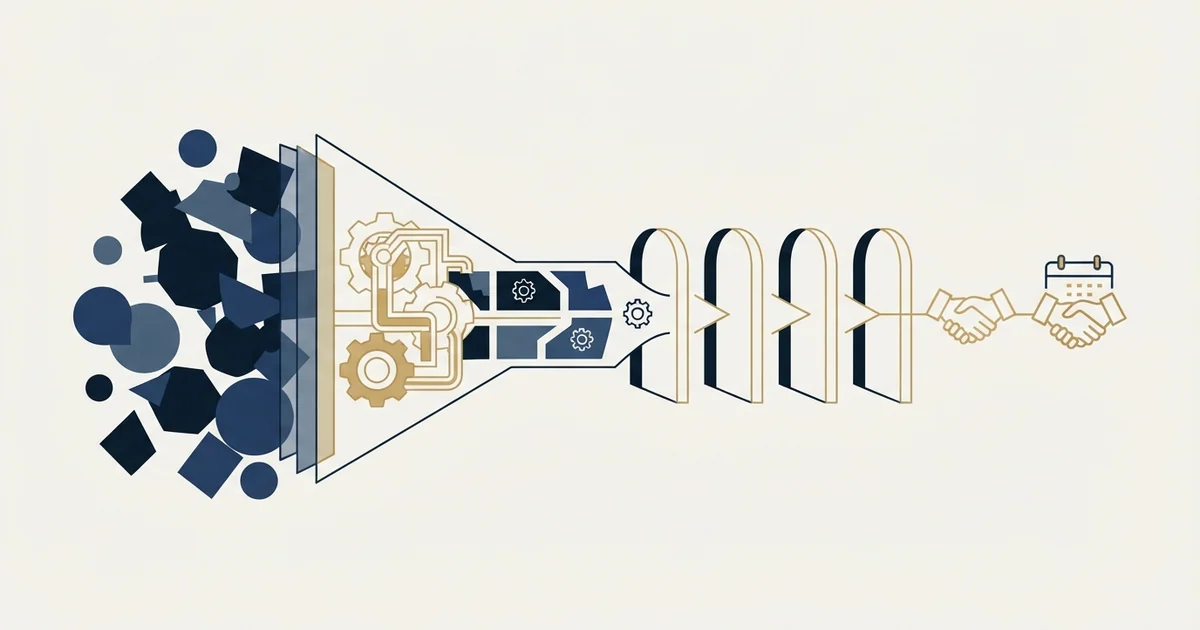
To book meetings with AI companies, target founders at sub-50-person teams and functional leads above that, build lists from trigger events like funding rounds and job postings rather than static firmographics, and ask for an artifact instead of a calendar slot. Expect one to two held meetings per 100 well-targeted prospects.
Key takeaways
- Belkins found founders and owners reply to cold email at 0.57% versus 0.32% for VPs, and companies with 0-10 employees reply at 0.72% versus 0.22% at 10,000+ employee enterprises, favoring the small-team profile typical of AI companies.
- Woodpecker's 20M+ email dataset puts the first follow-up at an 8.4% reply rate versus 3.43% for the first email, with 42% of all replies arriving on follow-up touches. Those are market figures rather than our practice: we send one message per campaign.
- Build AI-company lists from trigger events (funding rounds 2-10 weeks old, ML job postings, engineering blog posts, SOC 2 announcements) rather than static firmographic filters.
- Ask for an artifact such as a benchmark doc instead of a 15-minute call; technical buyers accept a document ask far more readily than a calendar ask.
- Send in the prospect's local morning, Tuesday through Thursday, which is the highest-reply window Belkins reported (0.54% for 8 AM-12 PM sends).
- Plan for one to two held meetings per 100 well-targeted AI-company prospects, which means 400-800 prospects in flight to support eight meetings per month.
Reviewed and updated September 1, 2026
How to Book Sales Meetings with AI Companies: A Step-by-Step Playbook
An AI infrastructure startup closes a Series B on a Tuesday. By Friday, the founder's inbox holds a fresh pile of vendor outreach: recruiters, SOC 2 platforms, dev tool vendors, cloud resellers, agencies, everyone who set a funding alert. Almost all of them open by congratulating the founder on the raise and asking for fifteen minutes.
That pileup is the defining condition of selling into AI companies. The buyers are reachable and the budgets are real. Competition for inbox attention is also brutal, and the people you are emailing are unusually good at spotting generated text, since many of them build the models that generate it.
This playbook covers the mechanics of turning cold outreach into booked calls with AI companies: who to target, how to source the list, how to shape the campaigns, what CTA converts with technical buyers, how to answer the objections you will get, and what a defensible meetings-per-100-prospects number looks like.
Why AI Companies Are a Different Sale
Three structural facts change the outreach.
Headcount is small relative to funding. A company with 25 people and $50M in the bank has real purchasing power and almost no procurement layer. The founder or a single functional lead can approve a purchase in a week. This works in your favor: Belkins, analyzing 7,530,489 cold emails, found founders and owners replied at 0.57% versus 0.32% for VPs, and companies with 0 to 10 employees replied at 0.72% versus 0.22% at 10,000+ employee enterprises. Source: Belkins B2B Cold Email Response Rates. The AI vertical skews toward exactly the company profile that answers cold email best.
The buyer is technical, even in non-technical seats. Heads of Growth at AI companies are frequently former engineers. Assume your reader can evaluate a technical claim and will discount anything unfalsifiable. "Improve model performance" gets deleted. "Cut eval latency on 70B inference from 40 minutes to 6" gets a reply or a rebuttal, and both are conversations.
Priorities reshuffle monthly. A team mid-way through a model launch or a fundraise has no bandwidth for a vendor evaluation, regardless of fit. A large share of your no-replies are timing rather than rejection, which makes recycling non-responders unusually valuable here.
Step 1: Segment Before You Target
"AI companies" is four different buying environments wearing one label. Pick the ones where your offer lands and ignore the rest.
| Segment | Examples of what they are | Who holds budget | What they buy fast |
|---|---|---|---|
| Frontier and foundation labs | Model training organizations | Research ops, infra leads, recruiting | Compute, data, evals, talent |
| AI infrastructure and tooling | Vector DBs, orchestration, observability, inference | VP Eng, Head of Platform, founder | Dev tools, security, GTM services |
| Applied and vertical AI SaaS | AI products for legal, health, support, sales | Founder, Head of Growth, VP Sales | Pipeline, data, compliance, integrations |
| AI-enabled services | Agencies and firms delivering with AI | Founder, Head of Delivery | Automation, ops tooling, hiring |
Applied and vertical AI SaaS is usually the highest-yield segment for cold outreach: commercial urgency, a named revenue owner, and a shorter evaluation cycle than a research lab. Frontier labs are the hardest to reach cold and rarely worth the list-building cost unless your product is compute, data, or safety adjacent.
Step 2: Pick the Right Titles
Target whoever owns the pain. At companies under 50 people, that is usually the founder. Between 50 and 300, it moves to a functional lead. Seniority alone is a poor proxy in orgs this flat.
| What you sell | Primary titles | Backup titles |
|---|---|---|
| ML infra, GPUs, inference tooling | Head of ML Platform, Head of Infrastructure, VP Engineering | Staff ML Engineer, CTO |
| Data, labeling, evaluation | Head of Data, Head of Applied AI, Head of Evals | Research Ops Lead, CTO |
| Security, compliance, AI governance | Head of Security, Head of Trust and Safety, General Counsel | CTO, Head of Engineering |
| GTM services, pipeline, demand gen | Founder/CEO, Head of Growth, VP Marketing | Head of Revenue, Chief of Staff |
| Recruiting and talent | Head of Talent, Founder | Chief of Staff, VP Engineering |
Two rules matter more here than elsewhere. Avoid multi-threading two people at a 20-person company in the same week, since they sit next to each other and will compare emails. Space contacts within an account by at least ten days. And keep "Head of AI" at non-AI companies on a separate list, because that is a different buyer on a different budget cycle.
Step 3: Build the List Around Trigger Events
Static firmographic lists underperform here because these companies change shape every quarter. Build from signals instead.
- Funding rounds, 2 to 10 weeks after announcement. Week one is the noisiest window, which is exactly why you should skip it. Waiting for the congratulations wave to clear puts you in an emptier inbox with the same budget on the other side.
- Job postings. A company posting three ML engineering roles and an infra role is committing to a platform buildout. Job descriptions also name the stack, which gives you a concrete hook.
- Public technical output. Engineering blog posts, model cards, GitHub repos, and conference talks tell you what the team is wrestling with in their own words. Quoting a specific line back is the highest-converting personalization in this vertical.
- Enterprise motion signals. A SOC 2 announcement, a cloud marketplace listing, or a first enterprise logo means the company just inherited problems it did not have last quarter.
- Accelerator and community rosters. Recent YC batches, AI-focused accelerators, and conference speaker lists give you clean, current cohorts.
Verify every address before sending. AI companies churn domains and email patterns during rebrands more than average, and a bounce rate above 3% will damage sending reputation fast.
Step 4: One Message Per Campaign, Then a Fresh Angle
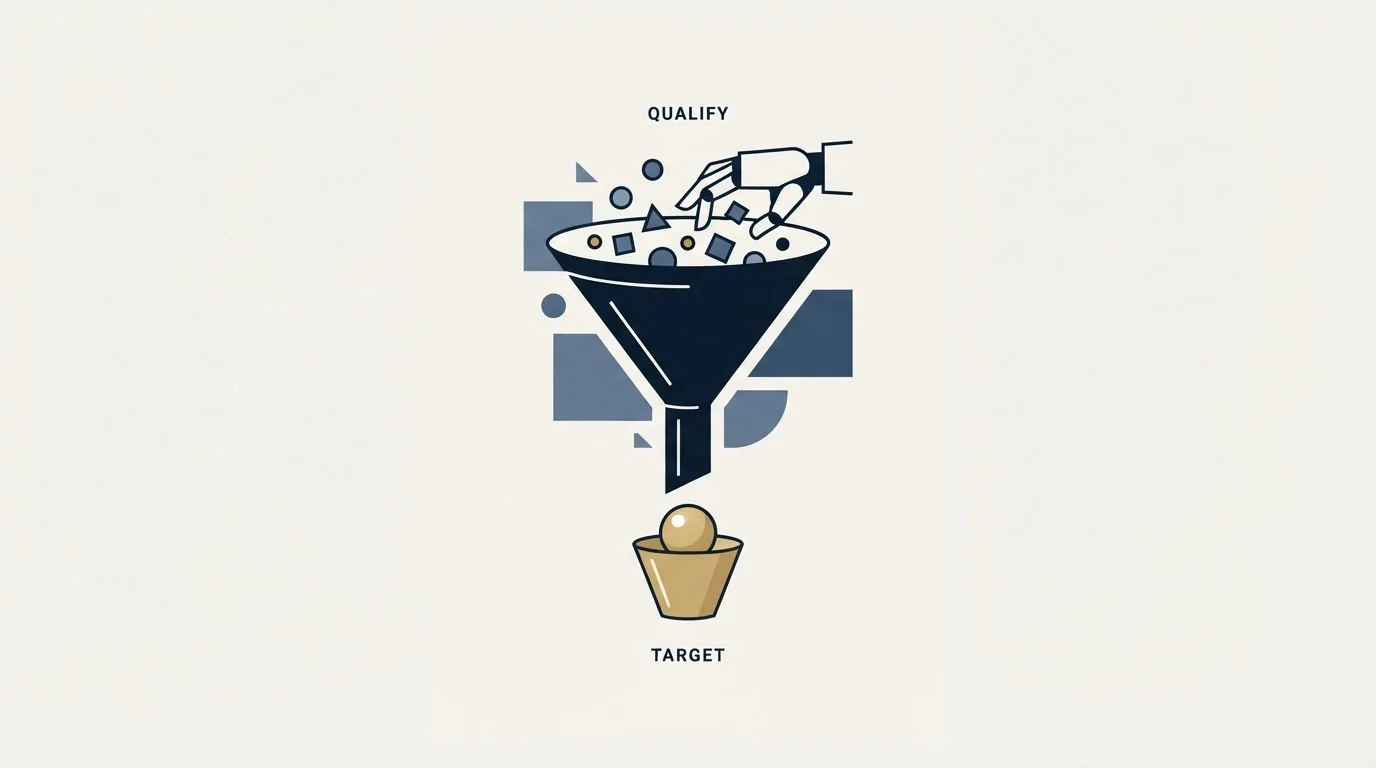
One message per campaign, email-led, with LinkedIn as a support channel. The same five ideas still get used. They run as separate campaigns spread across a quarter, each with its own subject line and its own reason to exist, rather than as five touches piled under one opener.
| Window | Message | Premise |
|---|---|---|
| Campaign 1, now | Email, one message | Specific observation plus one falsifiable claim |
| Alongside campaign 1 | LinkedIn request, no pitch | Face recognition, not a second copy of the email |
| Campaign 2, four to six weeks on | Email, one message | Proof artifact from a comparable company |
| Campaign 3, on the next trigger | Email, one message | A different pain the same title owns |
| Campaign 4, at 90 days | Email, one message | The quarter reset and a new roadmap window |
| Any campaign, optional | One call with its own reason | Never a reminder that an email was sent |
Follow-ups are where the rest of the market puts most of the load. Woodpecker's analysis of more than 20 million cold emails puts the first email at a 3.43% reply rate and the first follow-up at 8.4%, the highest-performing single step, with 42% of all replies arriving on follow-up touches and a single added follow-up lifting total replies by 65.8%. Source: Woodpecker Cold Email Statistics.
We do not run them. Every campaign carries exactly one message, and a prospect who did not answer is written to again weeks later in a new single-message campaign with its own subject line and its own premise, never as a reply under the email they already chose to leave. We stopped sending the second touch because a bump lands beneath a message the reader has already skipped, in front of exactly the people most likely to flag it, and the reputation cost of that lands on the sending domain across everything else it sends, which a reply-rate table never prices in. A fresh email also gets a fresh open. The full argument, with the numbers from our own campaigns, is in why we stopped using follow-ups.
On timing, Belkins found morning sends between 8 AM and 12 PM produced the highest reply rate at 0.54%, with Wednesday and Thursday leading the week at 0.48%. Source: Belkins. Send in the prospect's local morning, and skip Mondays.
Recycle non-responders at 90 days with a new angle. Priorities rotate so fast at AI companies that the recycled pass often outperforms the original.
Step 5: Write Copy a Technical Buyer Will Answer
Three templates below, each under 120 words. Length correlates with deletion when the reader is skimming on a phone between standups.
Template 1: Post-funding, to a founder at an applied AI company
Subject: {{company}} + {{specific_workflow}}
Hi {{first_name}},

Saw {{company}} raised {{round}} in {{month}} and is hiring {{number}} people
into {{team}}. Usually that means {{specific_operational_problem}} shows up
about a quarter later.

We handle {{your_offer}} for {{comparable_company_1}} and
{{comparable_company_2}}, both roughly your stage. For
{{comparable_company_1}} that meant {{concrete_outcome_with_number}}.

Worth 15 minutes in the next two weeks, or should I check back after
{{their_next_milestone}}?

{{sender_name}}
Why this works: It skips the congratulations opener every competing email leads with, names a problem tied to a stage the founder recognizes, and offers an explicit "not now" exit. Giving the reader a way to say later without saying no keeps the account alive for recycling.
Template 2: To a technical platform owner
Subject: {{their_blog_post_topic}}, question on {{specific_detail}}
{{first_name}},

Read your post on {{blog_post_title}}, specifically the part about
{{specific_technical_detail}}. Curious whether {{follow_on_question}} is
still the bottleneck now that you're at {{scale_indicator}}.

Reason I ask: we work on {{narrow_problem}} with teams running
{{similar_stack}}. At {{reference_company}}, {{specific_metric}} moved from
{{before}} to {{after}} in {{timeframe}}.

Happy to send the benchmark methodology so you can pick it apart. Want it?

{{sender_name}}
Why this works: The ask is for a document rather than a calendar slot, which costs the reader nothing and starts a thread. Technical buyers respond to an invitation to critique something, and sending the methodology on request continues a conversation they started.
Template 3: The routing ask, a later campaign to non-repliers
Subject: {{problem_area}} at {{company}}: 1 or 2
{{first_name}},

When a team at {{company}}'s stage hasn't tackled {{their_problem}} yet, it
usually isn't on the roadmap this quarter, which is a fine answer.

Two options:
1. I check back in {{month}}.
2. You point me to whoever owns {{problem_area}} and I'll take it there.

Either is genuinely fine. Just tell me which.

{{sender_name}}
Why this works: Binary choices are easier to answer than open questions, and both branches are useful to you. It goes out as its own campaign weeks after an earlier one, with its own subject line, rather than as a reply under a message nobody answered. Option two is the referral path, which at small AI companies frequently routes you to the actual budget holder in one hop.
Step 6: Make the CTA Small and Concrete
The "quick 15 minutes to learn about your priorities" ask is the largest source of lost meetings in this vertical, because it asks a technical buyer to spend time so you can qualify them. Better CTAs, roughly in order of conversion:
- Artifact ask. "Want the benchmark doc?" Costs the reader one word to accept, and a sent artifact converts to a call far better than a cold calendar ask.
- Interest check. "Worth a look, or off base?" Invites a one-word answer and produces useful negative signal.
- Named-time ask with an out. "15 minutes Thursday, or after your launch?"
- Referral ask. "Wrong person? Who owns this?"
Keep the calendar link out of the first email. Link-free first touches read as human and avoid the deliverability penalty of tracked links to cold recipients.
Step 7: Handle the Five Objections You Will Actually Get
- No: "We built this internally."
- No: "We're heads down until launch."
- No: "How is this different from {{open source project}}?"
- No: "We can't send data to a third party."
- No: "Not my area."
"We built this internally." Very common at AI companies, and often true. Do not argue. Ask what the maintenance burden looks like and where the internal build stops. The gap between a working internal tool and a supported one is where the deal lives.
"We're heads down until launch." Take it at face value and pin a date. "Understood, I'll come back the week of {{date}}." Then actually do it. That scheduled return converts better than most first touches.
"How is this different from {{open source project}}?" Answer in two sentences with a specific limitation of the OSS option that you have actually hit. Vague differentiation ends the thread instantly with this audience.
"We can't send data to a third party." Lead with your deployment model: VPC, on-prem, zero retention, whatever is true. If none apply, say so and offer the architecture doc anyway.
"Not my area." Ask for the name directly. Internal forwards die, and a name lets you start a fresh thread with a referral in the first line.
What a Realistic Outcome Looks Like
Public benchmarks vary widely by measurement method. Belkins reports a 0.45% average reply rate across 7.5M+ emails in 2025 campaigns, while Woodpecker's 20M+ email dataset puts first-email replies at 3.43%. Source: Belkins, Woodpecker. The spread reflects list quality and campaign size more than anything else. An aggregated breakdown published by Woodpecker puts campaigns under 50 contacts at 5.8% replies versus 2.1% for campaigns of 500 or more.
Treat those as planning inputs rather than promises. A defensible model for a tightly targeted AI-vertical campaign, using conservative assumptions:
97%
5% to 8%
30% to 40%
60% to 70%
Bar widths are equal here because these stage values are not a single comparable measure.
| Stage | Assumption | Per 100 prospects |
|---|---|---|
| Deliverable, verified contacts | 97% | 97 |
| Total replies across the campaigns | 5% to 8% | 5 to 8 |
| Share of replies that are positive | 30% to 40% | 2 to 3 |
| Positive replies that convert to a held meeting | 60% to 70% | 1 to 2 |
One to two held meetings per 100 well-targeted prospects is a reasonable planning number for a first campaign here, improving as signals and copy sharpen. Anyone promising five per hundred on a cold list is describing a warm one.
Volume still matters: a program targeting eight meetings per month needs 400 to 800 well-researched prospects in flight. And list quality compounds harder than copy quality, so spend your marginal hour on signals and verification before rewriting subject lines. At RevenueFlow, the list and the offer explain more variance in booked meetings than anything happening at the sentence level.
Pre-Send Checklist
- Segment chosen and irrelevant AI subsegments excluded
- Titles mapped to the pain you solve
- Every contact sourced from a trigger event inside 90 days
- Emails verified, bounce risk under 3%
- One contact per account per 10 days
- One message per campaign, campaigns spaced weeks apart, morning sends, Tuesday through Thursday
- Every email under 120 words with one falsifiable claim
- No tracked or calendar link in the first message
- Objection responses written before the first send
- 90-day recycle list configured
Getting This Running
Operations decide whether this playbook produces meetings. Maintaining a list built on signals that decay in weeks, keeping deliverability clean across a run of single-message campaigns, and answering technical objections fast enough that live conversations stay alive are all recurring weekly work. Most teams can write two good emails. Fewer can keep 500 AI-company prospects moving through the loop every month.
If you would rather have this built and run for you, book a strategy call with RevenueFlow. We build the list, write the campaigns, manage the sending infrastructure, and put booked meetings on your calendar.
Related Reading
- Cold Email for Partnerships: Building Strategic Business Relationships
- Cold Email for Product Feedback: Complete Strategy Guide
- Cold Email for User Research: Complete Strategy Guide
If you would rather have this run for you, RevenueFlow books qualified meetings on a pay-per-meeting basis and publishes client results.
Frequently asked questions.
Frequently asked questions- Who should I email at an AI startup?
- Under 50 employees, email the founder or CEO directly, since there is rarely a procurement layer and the founder can approve a purchase in a week. Between 50 and 300 employees, target the functional lead who owns the pain: Head of ML Platform for infrastructure, Head of Data for evaluation tooling, Head of Growth for GTM services, Head of Security for compliance products.
- When is the best time to email a startup after it announces funding?
- Wait two to ten weeks. The week of the announcement is the noisiest window in the founder's inbox, because every vendor with a funding alert sends the same congratulations email at once. Sending after that wave clears puts you in a much emptier inbox while the budget is still unspent and hiring plans are still forming.
- How many cold emails does it take to book one meeting with an AI company?
- With a tightly targeted list, published planning models put it at roughly 50 to 100 verified prospects per held meeting. That assumes a 5% to 8% total reply rate across a multi-message programme, 30% to 40% of replies being positive, and 60% to 70% of positive replies converting to a meeting that actually happens. We send one message per campaign, so the same meeting count comes from a bigger verified list, and looser lists degrade quickly.
- Why do technical buyers ignore cold emails?
- Most cold emails make claims that cannot be checked. Engineers and technical leads discount anything unfalsifiable, so phrases like improve model performance get deleted on sight. Emails that name a specific metric, a before and after number, and a stack the reader recognizes get answered, and even a rebuttal opens a conversation you can work with.
- Should a cold email campaign keep messaging the same person at an AI company?
- No. Woodpecker's analysis of more than 20 million cold emails found the first follow-up is the highest-performing single step at an 8.4% reply rate, and that 42% of all replies come from follow-up touches, and most of the market plans around exactly those figures. We send one message per campaign instead, because a technical buyer who ignored a checkable claim is telling you the claim or the timing was wrong, and the useful answer to that is a new premise sent to a fresh trigger list, not another message on the same thread.
About the author.

Ben Carden is CRO at RevenueFlow, which builds and operates outbound revenue engines for B2B companies. Previously at Gartner Enterprise. Studied at London School of Economics.
Ben Carden · CRO
Connect on LinkedIn →Explore more.
Ready to scale your outreach?
We build GTM engines that book real meetings. See the receipts.
Related articles.
Cold Email for Influencer Outreach: Partner with Creators
Learn how to use cold email to build authentic influencer partnerships that drive real results for your brand, with proven templates and strategies.
Cold Email for Product Feedback: Complete Strategy Guide
Learn how to use cold email to gather valuable product feedback from users and prospects. Includes proven templates, feedback frameworks, and response optimization techniques.
Cold Email for PR: How to Pitch Journalists and Get Coverage
Learn how to craft cold emails that get journalists to open, read, and respond to your pitches. Includes real templates, timing strategies, and a complete PR outreach checklist.
Cold Email for Reviews: Complete Strategy Guide
Learn how to use cold email to generate authentic product reviews on G2, Capterra, and other platforms. Includes proven templates, compliance guidelines, and review generation frameworks.
Cold Email for Link Building: How to Get Quality Backlinks
Learn how to use cold email outreach to build high-quality backlinks that improve your SEO rankings, with proven templates and strategies that get responses.
Cold Email for Focus Groups: Complete Strategy Guide
Learn how to use cold email to recruit qualified participants for focus groups. Includes proven templates, screening strategies, and group composition frameworks.