How to Book Sales Meetings with Automotive
A tactical playbook for booking meetings with automotive buyers: segment targeting, title maps, sequence timing, copy-ready templates, and objection handling.

To book meetings with automotive buyers, pick one segment (franchised dealer groups, OEMs, Tier 1 suppliers, aftermarket, or fleet), target the operator who owns that budget such as a General Manager or Fixed Operations Director, and run five to seven single-message email, LinkedIn, and phone campaigns, landing each in the first ten days of a month with a single-rooftop pilot offer.
Key takeaways
- There are 16,990 franchised light-vehicle dealerships in the US, but they belong to five or six distinct buying segments that need separate campaigns.
- Target the operator, not the owner: General Manager and General Sales Manager for sales, Fixed Operations Director and Service Director for service and parts, Plant Manager and Quality Manager at suppliers.
- Cap outreach at two to four titles per account, since more contacts per domain hurts deliverability before it lifts reply rate.
- Land the first touch in the first ten days of a month, Tuesday to Thursday between 7:00 and 9:00 a.m. local, and stay clear of month-end and quarter-end pushes.
- Use five to seven single-message campaigns across email, LinkedIn, and phone spread over a quarter, with every email under 90 words.
- A single-digit number of held meetings per hundred well-targeted prospects is a healthy result in this vertical, so plan on thousands of contacts per quarter, not hundreds.
Reviewed and updated September 1, 2026
How to Book Sales Meetings with Automotive: A Step-by-Step Playbook
There are 16,990 franchised light-vehicle dealerships in the United States, and they sold 16.2 million light-duty vehicles in 2025. Source: NADA Data. That number gets quoted in every automotive go-to-market deck, and it is also why most cold outreach into this vertical fails. Sixteen thousand rooftops looks like a list. It is actually five or six different buying organizations wearing one industry label, and the person who books a meeting at a 40-store dealer group has almost nothing in common with the person who books one at a Tier 1 supplier.
This playbook is narrowly about one outcome: turning cold outreach into booked calls with automotive decision makers. Every step below gets judged against whether it puts a meeting on the calendar.
Step 1: Decide Which "Automotive" You Are Selling Into
Before you write a line of copy, split the vertical. Each segment has a different buyer, budget cycle, and reason to take a call.
| Segment | Who they are | What moves them |
|---|---|---|
| Franchised dealer groups | Multi-rooftop retailers, 3 to 300 stores | Gross per unit, fixed ops absorption, CSI, headcount cost |
| Independent / used dealers | Single or small-group used car operations | Cost per acquisition, floor plan efficiency, speed |
| OEMs | Automaker regional and corporate teams | Program economics, compliance, network rollout |
| Tier 1 and Tier 2 suppliers | Component and systems manufacturers | Plant uptime, PPAP and quality escapes, launch timing |
| Aftermarket and parts | Distributors, service chains, parts e-commerce | Fill rate, catalog data, technician throughput |
| Fleet, mobility, EV infrastructure | Fleet operators, charging networks, mobility platforms | Uptime, cost per mile, charger utilization |
Pick one. A campaign written for a Fixed Operations Director reads as noise to a Plant Quality Manager, and blending them guarantees both perform badly. If you genuinely sell to two segments, run two campaigns with separate lists, copy, and reporting.
Step 2: Target the Titles That Actually Own the Calendar
Automotive is unusually literal about titles, which works in your favor once you know the map. The common mistake is emailing the most senior name available. Dealer Principals rarely take vendor meetings for operational software, and at suppliers the VP of Operations just routes you down.
Franchised dealer groups. For anything touching sales, target the General Manager and General Sales Manager. For service, parts, and reconditioning, target the Fixed Operations Director and Service Director. For lead handling, the Marketing Director and BDC Manager. Above roughly 15 rooftops, add a corporate layer: VP of Variable Operations, VP of Fixed Operations, Director of Digital Retail, CIO. That layer buys once for the whole group, which is why a 30-rooftop group is worth more list-building effort than 30 single stores.
OEMs. Work the program level rather than the C-suite: Director of Dealer Network Development, Manager of Aftersales Programs, Director of Connected Services, and category Purchasing Managers. OEM cycles are long, so treat these as next-model-year pipeline.
Suppliers. Plant Manager, Director of Manufacturing Engineering, Quality Manager, Supply Chain Director, Continuous Improvement Manager. Plant-level leaders answer their own email far more often than corporate ones and can pull budget for anything protecting a launch date.
Aftermarket and fleet. Director of Category Management, Director of Parts Operations, Fleet Manager, Director of Maintenance.
Two to four titles per account is the practical ceiling. Beyond that you hit the same domain repeatedly and deliverability suffers before reply rate improves.
Step 3: Build the List So It Survives Verification

One structural quirk trips up most teams: rooftop and group email domains are often different. A store may run on its own local domain while corporate staff sit on the parent group domain. Build both, then decide which layer you are selling to. A build order that holds up:
- Start from a group spine. Automotive News publishes rankings of the largest US dealership groups, and state and metro dealer associations publish member directories. Assemble the parent entities first, then expand to rooftops.
- Expand rooftops with brand and geography filters. OEM dealer locators give you brand, city, and store name for every franchised point. This is how you build "all Stellantis rooftops in the Southeast owned by groups with 5+ stores."
- Layer hiring signals. Job postings are the highest-signal free data in this vertical. A group posting three BDC Manager roles in a quarter is scaling lead volume. A supplier hiring Launch Quality Engineers is about to have a launch problem. Reference the signal and your reply rate moves.
- Enrich, then verify hard. Dealer staff turn over faster than most B2B roles, so a list built six months ago is not a list. Re-verify before every send, split catch-all domains into a separate low-volume segment, and cap unknown-status addresses per batch.
- Deduplicate at the group level. Ten rooftops under one owner is one account, and ten near-identical emails into one organization is the fastest way to get flagged internally.
Target 800 to 1,500 verified contacts in a single segment for a first campaign. Smaller and you cannot read your own data. Larger and you burn the market before the messaging is dialed in.
Step 4: One Message Per Campaign, Then a Fresh Angle
Automotive buyers check email between other things, so long emails lose and multichannel wins. What that does not mean is a five-email thread. Every campaign carries exactly one message, so the same ideas run as separate campaigns spread across a quarter, and the shape below holds across dealer and supplier segments:
| Window | Message | Purpose |
|---|---|---|
| Campaign 1, now | Email, one message | Signal-based opener, one specific observation, soft interest CTA |
| Alongside campaign 1 | LinkedIn, no pitch | Profile view and connection request, familiarity only |
| Alongside campaign 1 | Phone, one call | Its own reason to ring, mid-morning, never a reminder about an email |
| Campaign 2, four weeks on | Email, one message | The same problem reframed with a peer-group reference |
| Campaign 3, on the next signal | Email, one message | New angle, new subject line, a different pain |
| Campaign 4, next quarter | Email, one message | Short proof point, one metric, one sentence |
| Campaign 5, next planning window | Email, one message | The routing ask: right person, or not this year |
A prospect who does not answer is written to again weeks later in a fresh campaign with a fresh subject line, never with a reply under the email they already skipped. We stopped sending that second touch because a bump lands in front of exactly the readers most likely to mark it as spam, and the reputation damage lands on the sending domain across every other campaign it carries. A new email also gets a new open, which a reply under an ignored one never does. The reasoning, with the numbers from our own campaigns, is in why we stopped using follow-ups.
Timing matters here. Dealership managers get consumed by month-end and quarter-end volume pushes, so land your first touch in the first ten days of a month. Weekends are working days in retail automotive, and Monday mornings are a wall of weekend cleanup. Tuesday through Thursday, 7:00 to 9:00 a.m. local, catches GMs before the drive fills up. Plant-side contacts skew earlier and go dark during launch weeks and shutdowns.
Keep every email under 90 words. These leaders read on phones between customer escalations, and a five-paragraph email reads as a vendor who does not understand the job.
Step 5: The Offer and CTA That Convert Here
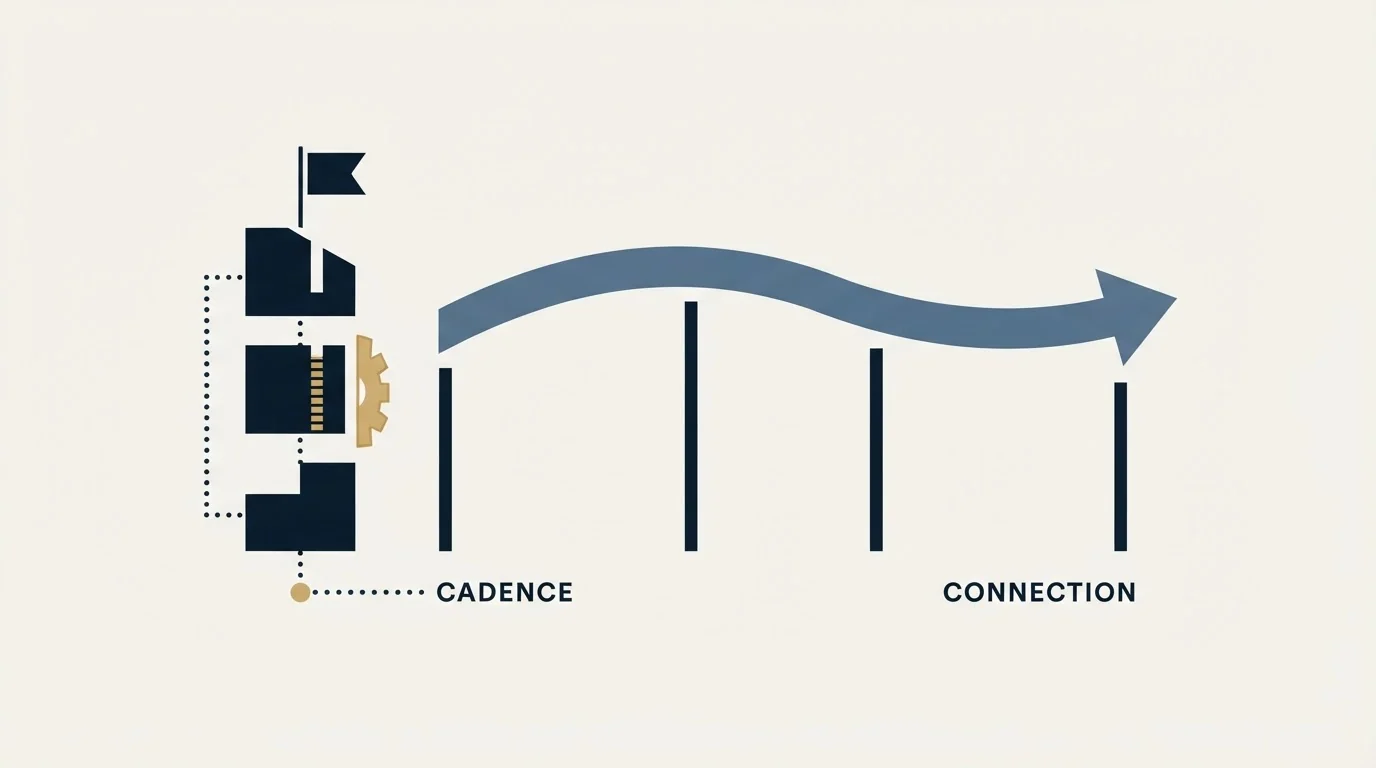
Generic demo requests underperform badly here. The offers that book meetings share three traits: scoped to one store or plant, expressed in the buyer's native metric, low time cost.
- The single-rooftop pilot. "Run it at one store for 60 days" removes the group-wide procurement conversation and lets a GM say yes on their own authority.
- The teardown. Offer a personalized artifact: a review of their lead response times, a mystery-shop of their service scheduler, a comparison of their fixed ops absorption against similar-size groups.
- The peer reference. Automotive is a small world with dense operator networks. Naming a comparable group or plant (with permission) does more than any feature list.
- The recovery angle. Money already being lost is more urgent than money that could be gained. Unsold recon days, unbilled warranty labor, and abandoned service appointments all beat "grow revenue."
Use an interest-based ask on the first touch rather than a calendar link. "Worth a look?" gets replies from people who would never click a booking link from a stranger. Move to a specific time offer in a later campaign, or in the reply to anyone who engages, and always name a duration under 15 minutes.
Templates You Can Send Today
Template 1: Dealer group, fixed operations
Subject: {{dealer_group}} service capacity

Hi {{first_name}},

Saw {{dealer_group}} is hiring three techs across the {{city}} stores. Usually that means the service drive is booked out further than you'd like and advisors are turning down same-day work.

We help fixed ops teams at groups your size recapture appointments that fall off between the online scheduler and the drive. Most of the lift shows up in same-day carryover.

Worth a look at what that would mean for {{rooftop_name}}?

{{sender_name}}
Why this works: The hiring signal proves the email was written for them, the problem is stated in fixed ops language (service drive, advisors, carryover), the claim is bounded, and the CTA scopes to one rooftop so the GM can decide alone.
Template 2: Tier 1 supplier, plant leadership
Subject: {{plant_city}} launch timing

{{first_name}},

Quick one. With the {{program_name}} ramp coming up, the usual pressure point for plants like {{plant_city}} is containment: a quality escape in week two eats the buffer you built for week six.

We work with manufacturing engineering teams to catch those escapes at the station instead of at final audit. One of the {{oem_name}} suppliers we support is happy to talk to peers about how their last launch went.

Want me to send the two-minute version?

{{sender_name}}
Why this works: It leads with the specific launch, uses vocabulary a plant leader uses daily (containment, escape, final audit, station), and offers information rather than a meeting on the first touch.
Template 3: The re-approach, a later campaign to non-repliers
Subject: where {{dealer_group}} loses same-day appointments

{{first_name}},

One number from the groups we work with: the biggest gap sits between when a customer requests an appointment online and when someone confirms it. Past a few hours, a real share of them book at the independent down the street.

If that's not a live issue at {{dealer_group}}, say "not now" and I'll leave it there.

{{sender_name}}
Why this works: It goes to the people an earlier campaign did not reach, as its own message with its own subject line, so it opens with a new idea rather than asking whether they saw the last one. It makes the loss concrete and local, and offers an easy negative reply, which keeps your list clean and surfaces the "not now" prospects worth writing to again later.
Template 4: The routing ask
Subject: Wrong person at {{dealer_group}}?

{{first_name}},

Service appointment capture at a group your size is usually either not your area or already handled, and both are useful answers.

If it's not your area, who runs fixed ops across the {{city}} stores? Happy to take it there.

If it's handled, say so and I'll leave it.

{{sender_name}}
Why this works: It converts a cold read into routing information, offers two low-effort responses, and assumes nothing about an earlier email having been seen, which is what lets it run as its own campaign weeks after one.
Objection Handling
- No: "We already use [DMS or CRM vendor]."
- No: "Send me some information."
- No: "Talk to our vendor management team."
- No: "No budget until next model year."
- No: "We're not interested."
"We already use [DMS or CRM vendor]." Never argue with the incumbent. Position around the gap it does not cover and ask a diagnostic: "Makes sense, most groups your size do. Does it show you the appointments that never get confirmed?"
"Send me some information." Usually a soft brush-off, so make it cost something. Send one short artifact plus a question that requires an answer: "Sending it now. So I send the right version, are you focused on the fifteen stores in {{state}} or the whole group?"
"Talk to our vendor management team." At large groups and OEMs this is real. Ask for the introduction and keep the operator engaged: "Happy to go through them. Open to fifteen minutes first so you can tell me if it is worth their time?"
"No budget until next model year." Agree, then take a date. Book the meeting for the planning window while you have their attention.
"We're not interested." Ask one question, once. "Understood. Is that a timing thing or a fit thing?" The answer tells you whether to write again in two quarters or suppress permanently.
What a Realistic Outcome Looks Like Per 100 Prospects
Treat the following as a planning model, not a benchmark. The only numbers that matter are the ones your own first 500 sends produce. Build the model as a chain rather than a single conversion rate:
- Deliverable contacts. Expect a portion of any raw automotive list to bounce or sit in catch-all limbo and never reach an inbox.
- Total replies. A signal-based run of campaigns into a tight segment produces replies in the low single digits per hundred delivered.
- Positive replies. Roughly a third to a half of replies land positive or neutral-curious. The rest are referrals, "not now," and unsubscribes, and the referrals are worth more than they look.
- Booked meetings. Most positive replies that get a same-day response convert to a call. Response speed is the biggest lever you control.
- Held meetings. No-shows run high here because retail and plant schedules blow up without warning. Confirm the morning of, and rebook no-shows twice before dropping them.
The practical implication: a single-digit number of held meetings per hundred well-targeted prospects is a healthy campaign here, so volume and list quality both have to be right. One hundred prospects is not a campaign. Three thousand well-segmented prospects across a quarter is.
Track four numbers weekly: delivered, replied, positive, booked. Low replies point at targeting or deliverability. Healthy replies with low bookings point at the offer or your response time.
The Weekly Operating Cadence
Each week: re-verify the next batch, refresh hiring and news signals for accounts entering a campaign, reply within two hours during business hours, confirm tomorrow's meetings today, and move "not now" replies into a dated re-engagement list. Each month: review which titles booked and which segments produced held meetings, then cut the worst performer rather than trying to rescue it.
Teams that run this for a full quarter end up with a mapped view of who owns which budget across their slice of the industry, which is the asset that makes the second quarter outperform the first. Building that map is a large part of what a done-for-you outreach program handles on a client's behalf, alongside the deliverability work that keeps sends landing.
If you would rather have this built and run for you, book a strategy call with RevenueFlow and we will map the automotive segment you sell into, the titles that own the budget, and the campaigns to reach them.
Related Reading
- Automotive Cold Email Benchmarks: 2026 Performance Data
- Cold Email for Partnerships: Building Strategic Business Relationships
- Cold Email for Product Feedback: Complete Strategy Guide
If you would rather have this run for you, RevenueFlow books qualified meetings on a pay-per-meeting basis and publishes client results.
Frequently asked questions.
Frequently asked questions- Who should I email at a car dealership group to book a meeting?
- Email the operator who owns the budget line you affect. For sales, front-end, and lead handling, that is the General Manager, General Sales Manager, or BDC Manager. For service, parts, and reconditioning, it is the Fixed Operations Director or Service Director. At groups above roughly 15 rooftops, add corporate titles like VP of Fixed Operations and Director of Digital Retail, since they buy once for every store.
- When is the best time to send cold emails to automotive prospects?
- Send in the first ten days of a month, Tuesday through Thursday, between 7:00 and 9:00 a.m. in the prospect's local time. Dealership managers get consumed by month-end and quarter-end volume pushes, and Monday mornings are spent clearing weekend business. Plant-side contacts at suppliers start earlier and are effectively unreachable during launch weeks and scheduled shutdowns.
- How many campaigns does automotive cold outreach need?
- Five to seven separate campaigns, each carrying exactly one email, spread across a quarter rather than across 24 days. A workable shape is a signal-based opener now, a LinkedIn connection in the same week, one call carrying its own reason, then a peer-reframe campaign four weeks on, a proof-point campaign on the next signal, and a routing ask in the planning window.
- What offer converts best when cold emailing dealerships?
- A single-rooftop or single-plant pilot. Scoping the offer to one store lets a General Manager approve it without triggering a group-wide procurement process. Personalized teardowns also work well, such as a review of lead response times or a mystery-shop of the service scheduler. Frame the value as money already leaking, like unbilled warranty labor or abandoned service appointments.
- How many meetings should I expect per 100 automotive prospects?
- Plan for a single-digit number of held meetings per hundred well-targeted, verified prospects, and treat that as a planning assumption until your own first 500 sends produce real data. Replies typically land in the low single digits per hundred delivered, a third to a half of those are positive, and no-show rates run high because retail and plant schedules change without warning.
About the author.

Ben Carden is CRO at RevenueFlow, which builds and operates outbound revenue engines for B2B companies. Previously at Gartner Enterprise. Studied at London School of Economics.
Ben Carden · CRO
Connect on LinkedIn →Explore more.
Ready to scale your outreach?
We build GTM engines that book real meetings. See the receipts.
Related articles.
Cold Email for Influencer Outreach: Partner with Creators
Learn how to use cold email to build authentic influencer partnerships that drive real results for your brand, with proven templates and strategies.
Cold Email for Product Feedback: Complete Strategy Guide
Learn how to use cold email to gather valuable product feedback from users and prospects. Includes proven templates, feedback frameworks, and response optimization techniques.
Cold Email for PR: How to Pitch Journalists and Get Coverage
Learn how to craft cold emails that get journalists to open, read, and respond to your pitches. Includes real templates, timing strategies, and a complete PR outreach checklist.
Cold Email for Reviews: Complete Strategy Guide
Learn how to use cold email to generate authentic product reviews on G2, Capterra, and other platforms. Includes proven templates, compliance guidelines, and review generation frameworks.
Cold Email for Link Building: How to Get Quality Backlinks
Learn how to use cold email outreach to build high-quality backlinks that improve your SEO rankings, with proven templates and strategies that get responses.
Cold Email for Focus Groups: Complete Strategy Guide
Learn how to use cold email to recruit qualified participants for focus groups. Includes proven templates, screening strategies, and group composition frameworks.