How to Book Sales Meetings with Nonprofits
Every nonprofit's Form 990 lists its fiscal year end, budget, and decision makers. Here is how to turn that public data into booked sales meetings.
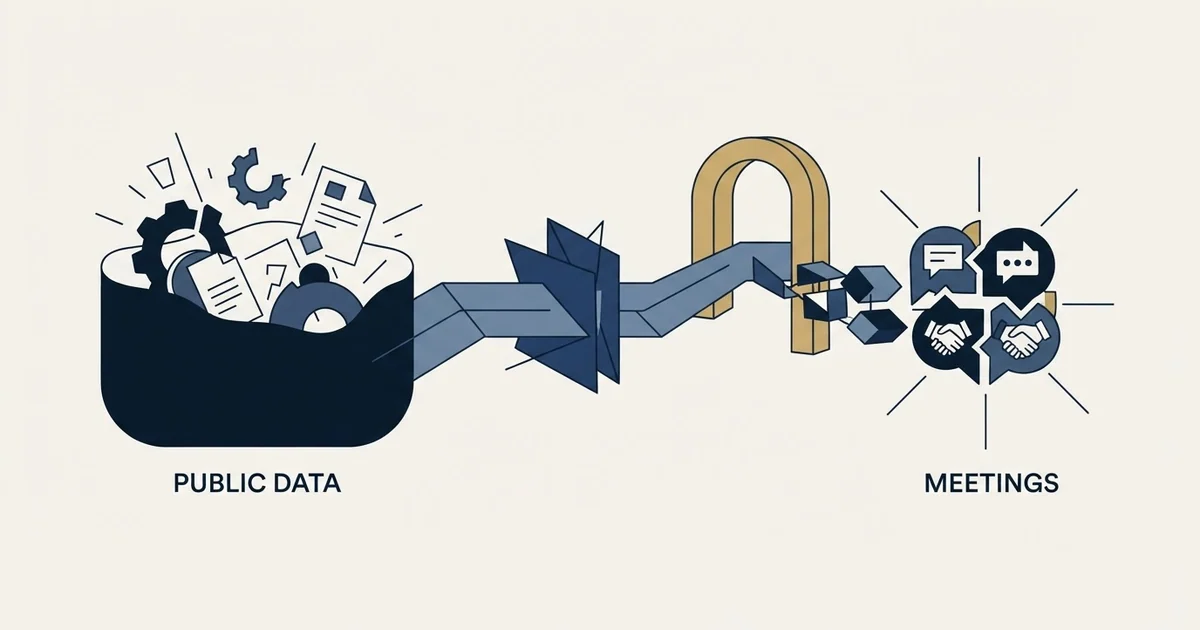
To book meetings with nonprofits, target the executive director, development officer, or COO at organizations in one defined revenue band, build the list from public Form 990 filings, time outreach four to six months before their fiscal year end, and ask for a short call framed around mission capacity rather than ROI. Expect a longer cycle than commercial B2B.
Key takeaways
- Segment nonprofits by annual revenue band before targeting titles, since a $400K arts group and a $180M hospital foundation share only a tax status.
- Build lists from IRS Form 990 filings, which publicly disclose fiscal year end, total revenue, functional expense split, and named officers in the Part VII compensation table.
- BBB Wise Giving Alliance Standard 8 asks charities to spend at least 65% of total expenses on program activities, so organizations near that line are under real overhead pressure and are strong targets for efficiency offers.
- Land the first touch four to six months before fiscal year end, while budgets are still being drafted, and avoid the last six weeks of the calendar year at any organization running a year-end giving campaign.
- Run five single-message campaigns spread across the fiscal year, then recycle the contact after 90 days or on a trigger such as a new fiscal year, new grant, or new hire.
- CAN-SPAM applies to your commercial email regardless of the recipient's nonprofit status, so every send needs a physical address and a clear opt-out.
Reviewed and updated September 1, 2026
How to Book Sales Meetings with Nonprofits: A Step-by-Step Playbook
A regional food bank with $9 million in revenue publishes, for free, the name of its CFO, the pay of its top eight staff, the date its fiscal year ends, its board roster, and a breakdown of every dollar it spent last year. That document is the IRS Form 990, and every 501(c)(3) above the smallest filing threshold files one. The filings are searchable through ProPublica's Nonprofit Explorer and the IRS Tax Exempt Organization Search.
Most teams selling into the sector ignore all of it. They pull "nonprofit" companies from a database, filter by headcount, write a generic pitch about efficiency, and wonder why reply rates collapse against their commercial segment. There are roughly 1.8 million registered nonprofits in the US (Source: Candid), and almost all of the useful targeting signal is public. Here is how to turn that into booked calls.
Step 1: Segment by Revenue Band Before You Do Anything Else
Nonprofit is a tax status rather than a market segment. A $400K community arts organization and a $180M hospital foundation share a filing category and nothing else. Pick one revenue band and build around it.
| Annual revenue | Who signs | Typical deal and cycle |
|---|---|---|
| Under $1M | Executive Director, often alone | Sub-$5K, card or single invoice, weeks |
| $1M to $10M | ED plus a functional director | $5K to $40K, needs a budget line, one to two quarters |
| $10M to $50M | Functional VP, ED approves, finance reviews | $25K to $150K, budgeted a year ahead, two to four quarters |
| $50M+ | Department head with procurement | Six figures, formal review, three or more quarters |
Target the under-$1M band with a product that needs a budget line and you book meetings that cannot buy. Sell a $3K tool into $80M organizations and you get routed to a procurement portal.
Step 2: Target the Title That Owns the Outcome
Nonprofit org charts are compressed. One person frequently covers three commercial-equivalent roles, so title targeting from a standard B2B database misfires constantly. Work backward from the outcome you affect.
- Executive Director / CEO / President. Strategy, board reporting, capacity. Under roughly $5M in revenue, usually the only real buyer.
- Chief Development Officer / VP of Advancement / Director of Development. Owns revenue. The most productive title in the sector for donors, campaigns, events, grants, or CRM.
- COO / Director of Operations. Owns process, systems, and staff time. Best target for workflow, HR, and back-office tools.
- Director of Programs / Chief Program Officer. Owns service delivery and outcome measurement. Target for case management and evaluation software.
- CFO / Director of Finance. Owns compliance, audit, and the 990. Target for accounting, grant tracking, and restricted funds.
Handle two titles with care. Grants Manager is a doer rather than a buyer, though a strong internal champion. Board members have real influence and zero operational authority.
Step 3: Build the List from Public Filings
Work from the Form 990 population rather than a general company database, filtering on the fields that predict fit:
- NTEE code for cause area (human services, education, health, arts, environment). Your message changes completely between them.
- Total revenue to hit your band from Step 1.
- Fiscal year end, on page one of the 990. This drives your send timing in Step 4.
- Functional expense split. The 990 splits spending into program, management, and fundraising. BBB Wise Giving Alliance Standard 8 asks charities to spend at least 65% of total expenses on program activities (Source: BBB Wise Giving Alliance), so organizations near that line are under real overhead pressure. Sell efficiency there. Anything that reads as administrative spend is a hard sell.
- Part VII compensation table, naming officers, directors, and key employees. Verified names and titles straight from a legal filing.
Layer on budget triggers: a new ED or CDO in the last six months, an announced capital campaign, a large grant, a merger, a new strategic plan on the website, or an open job req adjacent to what you sell. A posted req for a "Salesforce Administrator" tells you more about CRM budget than any intent vendor.
Verify every address. Nonprofit domains have high turnover and heavy use of aliases like info@ and development@, and sending to a role alias is the fastest way to get filed as noise.
Step 4: Time the Campaigns Around the Fiscal Calendar
Nonprofits run tighter, more predictable budget cycles than most commercial buyers, because grant reporting and audits force the discipline. A large share of the sector uses a June 30 fiscal year end, aligning with school and government funding cycles, while others use December 31 or September 30. The 990 tells you which.
Budgets get drafted roughly three to four months before fiscal year end, approved by the board one to two months before, and locked on day one of the new year. For a June 30 organization, March and April decide whether your category gets a line item.
Scheduling rules:
- Land your first touch four to six months before fiscal year end, while the budget is still being shaped.
- Avoid the last six weeks of the calendar year at any organization running a year-end giving campaign, and the two weeks around a known gala or campaign kickoff.
- Late January through March is the strongest general window. Year-end giving has closed, results are known, planning is underway.
- For grant-funded programs, ask about the grant period rather than the fiscal year. Restricted funds have their own clock.
Step 5: One Message Per Campaign

Nonprofit decision makers are overloaded and read email on their phones between meetings. What works here runs longer in duration and lighter in weekly volume than a commercial SaaS sequence, and the patience sits between campaigns rather than inside one.
We send one message per campaign. A development director who does not answer is never written to again beneath the note they already passed over: no reply on that thread, no shorter version of the same ask, no permission close. They enter a later campaign with its own subject line and its own premise. A second message under an unanswered one reads as pressure, it reaches the readers most likely to report it, and the reputation cost is charged to the sending domain across every other campaign it carries. A new email earns a new open. The full argument, with the numbers from our own campaigns, is in why we stopped using follow-ups.
| Campaign | Window | Channel | Job of this message |
|---|---|---|---|
| 1 | Day 0 | Email, one message | Specific observation plus soft ask |
| 1 | Day 4 | LinkedIn connect, no pitch | Face recognition, not a copy of the email |
| 2 | About six weeks on | Email, new subject line | A different angle, shorter |
| 2 | Same week | LinkedIn message or phone | Its own reason to make contact |
| 3 | About twelve weeks on | Email, new subject line | Peer proof from same cause area and revenue band |
| 4 | The next fiscal window | Email, new subject line | Resource with no ask attached |
| 5 | On the next trigger | Email, new subject line | The routing question |
Between campaigns, leave the contact alone, and re-enter them 90 days later or on a trigger (new fiscal year, new grant, new hire). Spread campaigns with a long recycle beat a compressed 14-day blitz here, because non-replies are usually about calendar load rather than disinterest, and calendar load clears on its own schedule.
Keep send volume per inbox conservative and warm your domains properly, since nonprofit IT is often outsourced and filters aggressively. Send from a real person with a real signature and a physical address, which the CAN-SPAM Act requires of commercial email regardless of who receives it. The recipient's tax status changes none of your obligations as a sender.
Step 6: The Offer That Converts in This Vertical
Three framings reliably outperform here.
- Yes: Mission capacity over ROI
- Yes: Peer proof at matched size and cause area
- Yes: A small, reversible ask
Mission capacity over ROI. "Save 12 hours a month" lands better as "12 hours a month back to program staff." The buyer's internal justification runs through mission even when the underlying math is efficiency.
Peer proof at matched size and cause area. A development director at a $6M human services org does not care what a $200M university did. They care what the food bank two states over did.
A small, reversible ask. Demo requests underperform. What works: a 15-minute call, a two-page summary of what a comparable organization did, or a question about whether the problem even exists for them.
Template 1: Cold open to a Development Director
Subject: {{org_name}}'s donor reporting

Hi {{first_name}},

Saw {{org_name}}'s FY{{fiscal_year}} filing shows {{metric_observation}}, which
usually means the development team is doing a lot of the reporting by hand.

We work with {{cause_area}} organizations in the {{revenue_band}} range on
exactly that. At {{peer_org_name}}, it cut the monthly donor reporting cycle
from {{before}} to {{after}}, and that time went back to major gift work.

Worth 15 minutes in the next couple of weeks to see whether the same thing
applies to you? Happy to be told it does not.

{{sender_name}}
{{title}} | {{company}}
{{physical_address}}
Why this works: The opening line proves you read a public filing rather than scraping a title, which separates you from everything else in that inbox. The benefit is framed as time returned to fundraising, and the ask is 15 minutes with an explicit out, which lowers the cost of replying.
Template 2: Cold open to an Executive Director
Subject: quick question about {{program_name}}

{{first_name}},

Your strategic plan mentions expanding {{program_name}} to {{expansion_goal}}
by {{target_year}}. Most of the {{cause_area}} orgs we talk to hit the same
wall at that stage: {{specific_operational_wall}}.

Two questions and I will get out of your inbox.

1. Is that on your list for the FY{{next_fy}} budget?
2. If it is, who owns it, you or {{likely_owner_title}}?

If it is not a priority this cycle, say so and I will check back after
your fiscal year turns over.

{{sender_name}}
{{title}} | {{company}}
{{physical_address}}
Why this works: EDs reply to questions more readily than to pitches. Asking who owns the problem gives them a low-commitment reply that either routes you onward or disqualifies the account, and naming the next fiscal year signals you understand their planning cycle.
Template 3: The peer-proof re-approach (a later campaign)
Best for: a later campaign to organizations that did not answer an earlier one. Its own subject line, sent as a new email rather than a reply into the old thread.
Subject: what {{peer_org_name}} did about {{specific_problem}}

{{first_name}},

One concrete example from an organization shaped a lot like yours.

{{peer_org_name}} ({{peer_revenue}} in revenue, also {{cause_area}}) had
{{specific_problem}}. Their {{peer_title}} ran a {{timeframe}} pilot before
committing budget, and the board approved it at the {{month}} meeting.

I can send the two-page write-up, or we can do 15 minutes. Either is fine.

{{sender_name}}
Why this works: It arrives as its own message with its own premise, gives a named comparable at matched size and cause area, and shows a low-risk buying path (pilot first, board approval after). Offering the document as an alternative captures prospects who are interested but not ready to schedule.
Template 4: The routing ask (the last campaign of the cycle)
Best for: the last campaign of a cycle, to organizations that did not answer the earlier ones. Its own subject line and its own question.
Subject: FY{{next_fy}} budget at {{org_name}}

{{first_name}},

When an organization your size has not taken {{specific_problem}} on by
budget season, it is usually not a priority right now, or the timing is
wrong with
{{fiscal_or_campaign_reference}}.

Either is a fine answer. If it is worth revisiting when you start building the
FY{{next_fy}} budget, reply with "check back" and I will reach out in
{{month}}.

Either way, good luck with {{upcoming_event_or_campaign}}.

{{sender_name}}
Why this works: It offers a graceful exit and a one-word re-entry path tied to a real date. Where non-replies are usually about bandwidth, "check back" is a common outcome and builds warm pipeline for the next cycle.
Step 7: Objection Handling
- No: "We don't have budget."
- No: "Do you have nonprofit pricing?"
- No: "This has to go to the board."
- No: "We already use {{incumbent}}."
- No: "Send me information."
"We don't have budget." Frequently true and frequently temporary. Ask which source would cover it if approved (operating budget, restricted grant, capacity-building grant, board-designated reserve). Capacity-building grants exist to fund infrastructure that operating budgets cannot, and many organizations forget the option.
"Do you have nonprofit pricing?" Answer with a real number. Vagueness here kills more deals than the price itself. If you have a discount, say the percentage. If you do not, say so and explain what you include instead.
"This has to go to the board." Usually accurate above a dollar threshold. Ask when the board meets, what a proposal needs to contain, and offer to build that document. Boards typically meet quarterly, and that calendar is your real close date.
"We already use {{incumbent}}." Common incumbents are donated or heavily discounted (the Google Ad Grant, nonprofit Salesforce and Microsoft licensing). Do not attack them. Ask what they do not cover and sell the gap.
"Send me information." Send exactly one document, then ask a specific question about it with a proposed time. An unanswered attachment is a dead thread.
What a Realistic Outcome Looks Like
Model this with your own numbers rather than a published sector benchmark, since public cold email averages blend wildly different list quality. Per 100 verified contacts in one cause area and revenue band, track four stages: deliverable after verification, total replies across the campaigns, positive replies, and meetings held. Multiply your own rates through that chain for a forecast you can defend, then rerun it after 500 sends with real data.
Two things are specific to this vertical. No-show rates run higher than commercial B2B, because a program emergency always outranks your call, so confirm the day before and reschedule without friction. And the gap between booked meeting and signed agreement is longer, since board approval and fiscal timing add months. A meeting booked in April at a June 30 organization is realistically a July start.
Judge the campaign on meetings held per 100 contacts and on "check back" replies banked, then measure revenue two or three quarters out.
Your Nonprofit Meeting-Booking Checklist
- Revenue band selected and matched to your price point
- Cause area narrowed to one or two NTEE categories per campaign
- Contact names verified against Form 990 Part VII
- Fiscal year end recorded, send window set four to six months ahead of it
- Year-end giving season and known events excluded
- Peer proof identified at matched size and cause area
- Nonprofit pricing decided and stated plainly in the first reply
- Five single-message campaigns spread across the fiscal year, with a 90-day recycle
- Physical address and clear opt-out in every send, confirmations the day before
Run the list narrow and the research deep. Two hundred well-researched contacts in one cause area will outbook two thousand generic ones, and the research compounds, since everything you learn about one food bank applies to the next forty.
If you would rather have this built and run for you, RevenueFlow does done-for-you cold email, from 990-based list research through inbox infrastructure and booked meetings. Book a strategy call and we will map the segment, the fiscal timing, and the campaigns before you spend a dollar on tooling.
Related Reading
- Cold Email for Nonprofits: Reaching Development Directors and Foundation Leaders
- Cold Email for Partnerships: Building Strategic Business Relationships
- Cold Email for Product Feedback: Complete Strategy Guide
If you would rather have this run for you, RevenueFlow books qualified meetings on a pay-per-meeting basis and publishes client results.
Frequently asked questions.
Frequently asked questions- Who is the right person to email at a nonprofit?
- It depends on the outcome you affect. The Executive Director is usually the only real buyer below roughly $5M in revenue. Above that, target the Chief Development Officer for anything touching donors or fundraising, the COO for operations and back-office tools, the Program Director for service delivery, and the CFO for finance and grant compliance.
- When is the best time of year to cold email nonprofits?
- Late January through March is the strongest general window, because year-end giving has closed and budget planning is underway. More precisely, send four to six months before the organization's fiscal year end, which is printed on page one of its Form 990. Avoid the last six weeks of the calendar year entirely for organizations running year-end appeals.
- How do I find nonprofit contact data and decision maker names?
- Start with Form 990 filings, searchable free through ProPublica's Nonprofit Explorer and the IRS Tax Exempt Organization Search. The Part VII compensation table names officers, directors, and key employees straight from a legal filing. Then verify every email address, since nonprofit domains have high staff turnover and heavy use of role aliases like info@.
- Should I offer nonprofit pricing in a cold email?
- Answer the pricing question directly the first time it comes up, with a real number. Vagueness kills more nonprofit deals than the price does. If you offer a discount, state the percentage. If you do not, say so plainly and explain what you include instead, such as onboarding, training, or extra seats.
- How many meetings should I expect per 100 nonprofit prospects?
- Model it from your own data rather than a published benchmark, since public cold email averages blend very different list quality. Track deliverability after verification, total replies across the campaigns, positive replies, and meetings actually held. Plan for higher no-show rates than commercial B2B and a longer gap between the booked meeting and a signed agreement.
About the author.

Ben Carden is CRO at RevenueFlow, which builds and operates outbound revenue engines for B2B companies. Previously at Gartner Enterprise. Studied at London School of Economics.
Ben Carden · CRO
Connect on LinkedIn →Explore more.
Ready to scale your outreach?
We build GTM engines that book real meetings. See the receipts.
Related articles.
Cold Email for Influencer Outreach: Partner with Creators
Learn how to use cold email to build authentic influencer partnerships that drive real results for your brand, with proven templates and strategies.
Cold Email for Product Feedback: Complete Strategy Guide
Learn how to use cold email to gather valuable product feedback from users and prospects. Includes proven templates, feedback frameworks, and response optimization techniques.
Cold Email for PR: How to Pitch Journalists and Get Coverage
Learn how to craft cold emails that get journalists to open, read, and respond to your pitches. Includes real templates, timing strategies, and a complete PR outreach checklist.
Cold Email for Reviews: Complete Strategy Guide
Learn how to use cold email to generate authentic product reviews on G2, Capterra, and other platforms. Includes proven templates, compliance guidelines, and review generation frameworks.
Cold Email for Link Building: How to Get Quality Backlinks
Learn how to use cold email outreach to build high-quality backlinks that improve your SEO rankings, with proven templates and strategies that get responses.
Cold Email for Focus Groups: Complete Strategy Guide
Learn how to use cold email to recruit qualified participants for focus groups. Includes proven templates, screening strategies, and group composition frameworks.