How to Book Sales Meetings with Staffing and Recruiting
A tactical playbook for booking meetings with staffing and recruiting firms: titles, list signals, sequence timing, CTAs, templates, and objections.
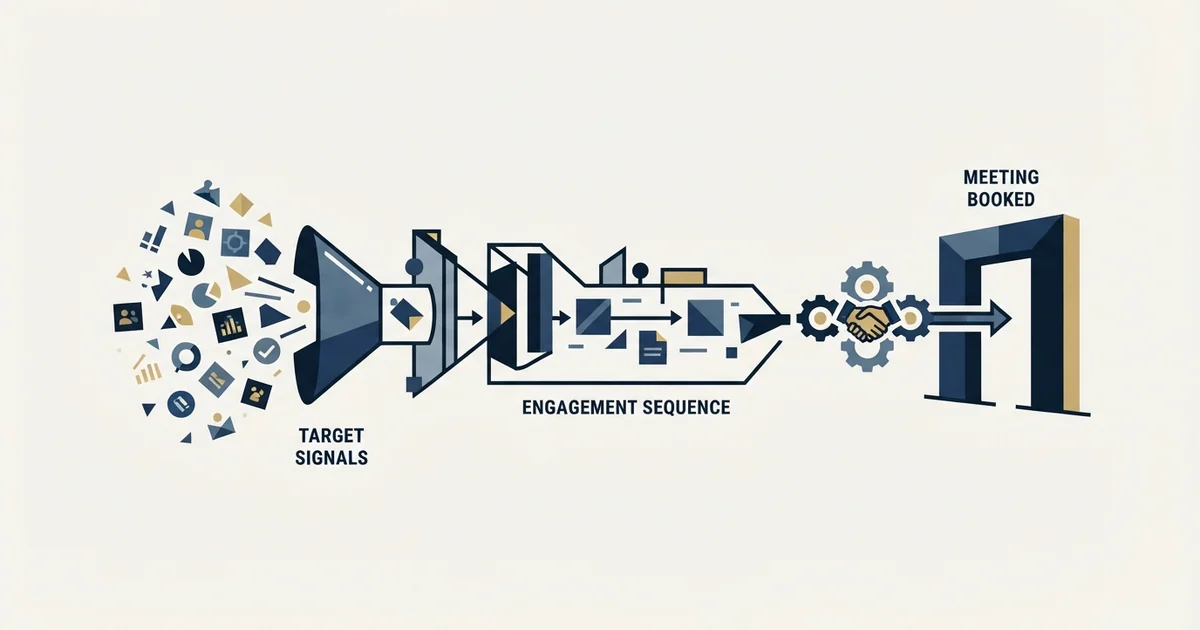
To book meetings with staffing and recruiting firms, segment by business model and vertical, target owners at small firms and COO or VP of Recruiting at larger ones, build lists from job posting volume, ATS footprints, and leadership changes, then run single-message campaigns spread across months with CTAs framed in their operating metrics.
Key takeaways
- The American Staffing Association counts roughly 27,000 US staffing and recruiting companies operating close to 54,000 offices, placing more than three million workers weekly.
- Segment by business model first: temp/contract, perm placement, retained search, and RPO/MSP firms buy on completely different metrics.
- Below 50 employees the founder signs everything; above 200, COO, VP of Operations, and RecOps leaders hold the budget.
- ATS detection (Bullhorn, JobDiva, Loxo, Crelate, Avionte, Ceipal) and job posting volume are the two highest-signal list-building inputs in this vertical.
- Four single-message campaigns plus two LinkedIn touches and one call, spread across months and sent Tuesday and Wednesday between 6:30 and 8:00 AM, fit how delivery teams work.
- Frame every CTA in staffing operating metrics (submittal-to-interview ratio, time-to-fill, spread per contractor hour) instead of asking for a 15-minute demo.
Reviewed and updated September 1, 2026
How to Book Sales Meetings with Staffing and Recruiting: A Step-by-Step Playbook
The owner of a 40-person IT staffing firm gets pitched by sourcing tools, job boards, ATS vendors, payroll funding companies, and offshore recruiting services in the same week. Sometimes the same day. Staffing leaders run outbound teams themselves, so they recognize a sequence the moment it lands and delete accordingly.
That familiarity works in your favor once you clear the first three seconds. Staffing decision makers answer their own email, decide without a twelve-person buying committee, and will take a call the same week if the numbers make sense. The market is also fragmented enough to support serious outbound: the American Staffing Association counts roughly 27,000 staffing and recruiting companies in the US operating close to 54,000 offices, placing more than three million workers every week. Source: American Staffing Association
Here are the mechanics of turning that market into booked calls.
Step 1: Segment Before You Target
"Staffing and recruiting" is four different businesses wearing the same label, and a message that lands with one will die with another.
Temp and contract staffing firms make money on spread (bill rate minus pay rate) across a large contractor base. They care about recruiter throughput, redeployment rate, and cash flow, since they pay contractors weekly and get paid on 45 to 60 day terms.
Permanent placement and contingency recruiting firms make money per placement. They care about submittal-to-interview ratio, time-to-fill, and how many searches a recruiter can carry at once.
Retained and executive search firms sell on process and access. Volume tooling pitches land badly here. Research depth and market mapping land well.
RPO and MSP providers sell into enterprise procurement. Long cycles, real buying committees, and concerns skewed toward compliance, reporting, and SLA performance.
Vertical matters as much as model. Healthcare firms live with credentialing overhead, light industrial firms with no-show rates and same-day fill, IT and engineering firms with candidate scarcity and rate pressure. Write to the vertical, not to "staffing."
Pick one model plus one vertical for your first campaign. A message written for owners of 20 to 100 person healthcare staffing firms will beat one written for "staffing leaders" by a wide margin.
Step 2: The Titles That Actually Take the Meeting
Firm size determines who owns the decision. Below 50 employees the founder still signs everything. Above 200, functional leaders own budget.
| Firm size | Primary target | Secondary target | What they are measured on |
|---|---|---|---|
| Under 25 | Founder, Owner, President | Director of Recruiting | Revenue, gross margin, cash in the bank |
| 25 to 100 | CEO, COO, VP of Sales | VP of Recruiting, Director of Delivery | Placements per recruiter, fill rate, headcount growth |
| 100 to 500 | COO, VP of Operations, VP of Recruiting | Head of RecOps | Time-to-fill, recruiter ramp, cost per placement |
| 500+ | VP or SVP of Operations, Chief Growth Officer | Director of Recruiting Technology | Program margin, SLA performance, systems consolidation |
Two title notes specific to this vertical. "RecOps" and Recruiting Operations roles now hold real budget at mid-size firms and are usually the fastest path to a technical evaluation. And be careful with "Recruiter" and "Talent Acquisition Manager" titles at staffing firms, since half are internal recruiters hiring for the agency itself and half are client-facing producers. Filter on that difference or your list will be half wasted.
If you sell to the sales side (job board credits, data, lead gen), target VP of Sales or Business Development Director. If you sell to delivery (sourcing, screening, ATS, credentialing), target VP of Recruiting. Sending a delivery pitch to a sales leader is the most common targeting error here.
Step 3: Build the List With Signals, Not Just Firmographics

Staffing firms leave more public signal than almost any other buyer, because their business runs on public job postings.
Job posting volume and mix. A firm that jumped from 40 to 120 open reqs in a quarter is scaling delivery and feeling the pain. A firm posting for internal recruiters, account executives, or a Director of Delivery has budget in motion. Scrape their careers page and Indeed employer page monthly.
Tech stack. Bullhorn, JobDiva, Loxo, Crelate, Avionté, and Ceipal leave detectable footprints on career sites and application URLs. BuiltWith or a scrape of application redirect domains tells you what a firm runs, which lets you write "since you are on Bullhorn" instead of "depending on your ATS."
Association and event lists. ASA membership directories, Staffing Industry Analysts conference speaker lists, and regional staffing association member pages give you clean, verified, in-market names.
Leadership changes. A new COO or VP of Recruiting in seat for 60 to 120 days is the single best trigger here. They have a mandate, a budget conversation coming, and no loyalty to the incumbent vendor.
Growth events. Trade coverage of acquisitions, new offices, and PE investment points you at firms with a consolidation problem.
Build at 300 to 800 contacts per segment. Smaller and you cannot read the data. Larger and you cannot personalize at the level this vertical demands.
Step 4: One Message Per Campaign, Timed to How Recruiters Work
Staffing people are in their inbox early and they triage fast. Build for that.
Cadence: four single-message campaigns plus two LinkedIn touches and one call attempt, spread across months rather than packed into 21 days. Each campaign carries one email and is then finished for that contact: no reply in the same thread, no bump. An owner who did not answer goes into the next campaign with a new subject line and a different premise. A second note under an ignored one is delivered to the readers most likely to report it, and the reputation cost is charged to the sending domain across every other campaign it carries. The full argument, with the numbers from our own campaigns, is in why we stopped using follow-ups.
| Campaign | Channel | Purpose |
|---|---|---|
| 1, day 1 | Email, one message | Signal-based opener, one problem, soft CTA |
| 1, day 3 | Connection request, no pitch in the note | |
| 1, day 10 | Phone | Morning call with its own reason, never "did you see my email" |
| 2, about five weeks on | Email, new subject line | New angle plus one concrete proof point |
| 3, about ten weeks on | Email, new subject line | Short, one question, easiest possible reply |
| 3, same week | Comment or DM on something they posted | |
| 4, on the next trigger | Email, new subject line | Direct ask or clean exit |
Timing: Tuesday and Wednesday between 6:30 and 8:00 AM local time, because delivery teams start early. Avoid Monday before 10 AM, when submittal and start-date fires dominate, and skip Friday afternoons. In light industrial and healthcare, drop Monday morning entirely, since that is when no-shows and call-offs get handled.
Length: 60 to 90 words for email one. Staffing leaders read on their phone between calls, and anything requiring a scroll gets archived.
Volume discipline: dedicated sending domains, warmed inboxes, and no more than 30 to 40 sends per mailbox per day. Staffing firms run their own outbound, and their spam filters are configured by people who know what a sequence looks like.
Step 5: The Offer and CTA That Convert in This Vertical

Staffing leaders think in ratios and dollars per head. Frame everything in their operating metrics: placements or submittals per recruiter per month, submittal-to-interview and interview-to-hire ratios, time-to-fill and time-to-submit, gross margin per placement or spread per contractor hour, redeployment rate on ending assignments, recruiter ramp time to first placement, and days sales outstanding.
A CTA that references one of those beats a generic meeting request. Ranked by what converts in staffing outreach:
- A specific, small, time-boxed ask. "Worth 12 minutes to compare your submittal-to-interview ratio against other IT firms your size?" Concrete, short, and it implies benchmarking value.
- An asset in exchange for a reply. "Want the one-page breakdown of how {{similar_firm_type}} cut time-to-submit?" Interest-based CTAs pull replies from people who will not book on the first message, and a reply is a conversation.
- A single yes or no question. "Is recruiter throughput on your list this quarter, or is the focus on new logos?" Easy to answer from a phone, and the answer segments them for you.
Avoid "15 minute demo," "quick sync," and calendar links in email one. Staffing owners get twenty of those a week. Avoid any placement volume claim you cannot substantiate, because this audience sells promises for a living and prices yours instantly.
Templates
Template 1: Recruiter Throughput (Delivery Leader)
Subject: {{company}} submittal ratio

Hi {{first_name}},

Saw {{company}} posted {{number}} new reqs in {{vertical}} this month. At that volume most delivery teams I talk to start losing time on screening rather than sourcing.

{{proof_point_sentence}}

Is submittal throughput something your team is actively working on this quarter, or is the bottleneck further upstream?

{{sender_name}}
Why this works: the opener proves you looked at their actual reqs, the problem is stated in delivery language (screening versus sourcing), and the close is a diagnostic question. Answering costs one sentence.
Template 2: Tech Stack Trigger (RecOps or COO)
Subject: since you're on {{ats_name}}

{{first_name}},

Noticed {{company}} runs {{ats_name}}. The firms we work with on that stack usually hit the same wall: {{specific_limitation}}, which shows up as {{downstream_symptom}}.

We plug into {{ats_name}} directly, so nothing changes in your recruiters' workflow.

Worth 12 minutes to see whether that wall is costing you anything meaningful? If your team already solved it, tell me and I'll stop.

{{sender_name}}
Why this works: naming the ATS is a credibility shortcut generic personalization cannot match. "Nothing changes in your recruiters' workflow" pre-answers the biggest objection in staffing tech buying (adoption), and the exit line lowers the cost of replying.
Template 3: Margin Angle (Owner or President)
Subject: spread on {{vertical}} contractors

Hi {{first_name}},

Bill rates in {{vertical}} have been tight, and most owners I speak with are protecting margin on the cost side rather than fighting for rate increases.

{{one_sentence_mechanism}}, which shows up as {{dollar_or_percent_framing}} per contractor on assignment.

Want the one-page version? I'll send it over and you can decide if a call is worth it.

{{sender_name}}
Why this works: it speaks to gross margin, the number an owner tracks daily, and opens with a market condition instead of a compliment. The CTA asks for a reply rather than a calendar slot, which starts a thread with someone who would not book yet.
Template 4: The Re-Approach With New Information
Best for: a later campaign to firms that did not answer an earlier one. Its own subject line, sent as a new email rather than a reply into the old thread.
Subject: one {{vertical}} number for {{company}}

{{first_name}},

One data point worth your quarter: {{specific_stat_or_example}}.

Two questions and I'll leave you alone:

1. Is {{problem}} actually on your list this quarter?
2. If not you, who owns it at {{company}}?

{{sender_name}}
Why this works: it carries information and its own premise instead of "bumping this to the top of your inbox," which is a phrase this audience has read a thousand times. The referral question converts when the answer to question one is no, and staffing leaders route internally fast because they run flat orgs.
Template 5: The Standing Offer
Best for: the last campaign of a cycle, to firms that did not answer the earlier ones. Its own subject line and no ask beyond one word.
Subject: {{vertical}} desk at {{company}}

{{first_name}},

I'll assume {{problem}} isn't a priority right now, which is a fine answer.

If it moves up the list before {{quarter}}, reply "later" and I'll come back then. Otherwise, good luck with the {{vertical}} desk this year.

{{sender_name}}
Why this works: the one-word reply option costs nothing and creates a legitimate re-engagement window. A message that removes pressure often produces the highest reply rate of any campaign, which is exactly why it deserves its own send rather than a sign-off underneath a note nobody answered.
Objection Handling

| What they say | What it means | How to respond |
|---|---|---|
| "We already use {{competitor}}" | Not a no. They are testing whether you know the landscape. | Name one thing the incumbent does not do, then ask if that gap costs them anything. Never attack the incumbent. |
| "Send me some info" | Polite deflection, or a real request from someone who reads. | Send one page, not a deck, with a specific question attached: "Does the number on page one match what you see?" |
| "Bill rates are compressed, no budget" | Real market pressure. | Reframe around cost per placement or recruiter capacity rather than new spend. Anything that holds headcount flat while growing output survives this objection. |
| "We built our own" | Common at firms with 100+ heads and an internal dev resource. | Ask what it costs to maintain and what the backlog looks like. Home-grown staffing tools decay fast. |
| "Our recruiters won't adopt it" | The real objection behind most staffing tech losses. | Lead with workflow: what changes, what does not, how long onboarding takes. Offer a single-desk pilot instead of a firm-wide rollout. |
| "Call me after Q1" | Often real, given seasonal hiring cycles. | Confirm the specific week and what changes by then. Book it live, not as a CRM task. |
What Realistic Output Looks Like
Model your own pipeline with explicit assumptions, then correct them with real numbers after 30 days. A useful frame per 100 verified staffing contacts:
- Deliverability first. A bounce rate above 3 percent means your list is the problem before your copy is. Verify every address and remove catch-all domains.
- Replies before meetings. Track total reply rate including negatives as your leading indicator. Negative replies are signal. Zero replies mean deliverability or targeting failure.
- Count meetings held. Staffing calendars break when a candidate falls through or a client escalates. Expect a real no-show rate and confirm 24 hours and 1 hour before the call.
- Read by segment. Compare results by firm size and vertical, never in aggregate. Owners at 20-person firms behave nothing like COOs at 300-person firms, and averaging them hides which one is working.
Hold copy constant for two weeks at a time and change one variable per test. Teams that rewrite their campaigns every four days never learn anything.
Your First 30 Days
- Week 1Choose one firm model and one vertical
Pull 400 to 600 contacts, verify emails, remove internal-recruiter false positives.
- Week 2Set up dedicated sending domains and warm mailboxes
Write four single-message campaigns plus two LinkedIn touches.
- Week 3Launch at 30 to 40 sends per mailbox per day
Book calls same-week when replies come in, since staffing decision makers lose interest fast.
- Week 4Read replies by segment
Cut the worst segment, double the best, and rewrite only the subject line and first sentence.

Week 1. Choose one firm model and one vertical. Build the title map. Pull 400 to 600 contacts, verify emails, remove internal-recruiter false positives.
Week 2. Set up dedicated sending domains and warm mailboxes. Write four single-message campaigns plus two LinkedIn touches. Build signal enrichment (ATS detection, req volume, leadership changes).
Week 3. Launch at 30 to 40 sends per mailbox per day. Book calls same-week when replies come in, since staffing decision makers lose interest fast.
Week 4. Read replies by segment. Cut the worst segment, double the best, and rewrite only the subject line and first sentence.
Teams that run this well treat month one as list and targeting work, with copy as the smaller variable. Copy matters, and it matters less than talking to the right 400 people.
If you would rather have this built and run for you, book a strategy call with RevenueFlow. We handle the list, the domains, the campaigns, and the reply handling so booked meetings land on your calendar instead of your task list.
Related Reading
- Best Sales Engagement Tools for Staffing & Recruiting (2026)
- Best Data Enrichment Tools for Staffing & Recruiting (2026)
- Best CRM Tools for Staffing & Recruiting (2026)
If you would rather have this run for you, RevenueFlow books qualified meetings on a pay-per-meeting basis and publishes client results.
Frequently asked questions.
Frequently asked questions- Who should I target at a staffing agency?
- It depends on firm size. Under 50 employees, the founder, owner, or president signs everything and should be your primary target. Between 100 and 500 employees, target the COO, VP of Operations, or VP of Recruiting. Above 500, go to SVP of Operations or Director of Recruiting Technology. Recruiting Operations leaders are often the fastest path to a technical evaluation.
- What is the best time to cold email a recruiting firm?
- Tuesday and Wednesday between 6:30 and 8:00 AM local time works well, because staffing delivery teams start early and triage their inbox before candidate calls begin. Avoid Monday before 10 AM, when submittal and start-date fires dominate, and skip Friday afternoons. In light industrial and healthcare staffing, avoid Monday morning entirely.
- Should I follow up when a staffing firm does not reply?
- Four single-message campaigns plus two LinkedIn touches and one call, spread across months rather than packed into 21 days. Keep every email between 60 and 90 words, since staffing leaders read on their phones between calls. Each campaign carries new information and its own subject line rather than a reply under the previous message.
- What CTA works best when selling to staffing agencies?
- A small, time-boxed ask tied to one of their operating metrics converts best, for example asking whether it is worth 12 minutes to compare their submittal-to-interview ratio against similar firms. An offer of a one-page asset in exchange for a reply also works. Avoid generic demo requests and calendar links in the first email.
- How do I handle the objection that a staffing firm already uses a competitor?
- Treat it as interest rather than rejection. They are testing whether you understand the landscape. Name one specific capability the incumbent does not cover, then ask whether that gap costs them anything measurable. Never attack the incumbent directly, since staffing buyers talk to each other and vendor bashing reads as desperation.
About the author.

Ben Carden is CRO at RevenueFlow, which builds and operates outbound revenue engines for B2B companies. Previously at Gartner Enterprise. Studied at London School of Economics.
Ben Carden · CRO
Connect on LinkedIn →Explore more.
Ready to scale your outreach?
We build GTM engines that book real meetings. See the receipts.
Related articles.
Cold Email for Influencer Outreach: Partner with Creators
Learn how to use cold email to build authentic influencer partnerships that drive real results for your brand, with proven templates and strategies.
Cold Email for Product Feedback: Complete Strategy Guide
Learn how to use cold email to gather valuable product feedback from users and prospects. Includes proven templates, feedback frameworks, and response optimization techniques.
Cold Email for PR: How to Pitch Journalists and Get Coverage
Learn how to craft cold emails that get journalists to open, read, and respond to your pitches. Includes real templates, timing strategies, and a complete PR outreach checklist.
Cold Email for Reviews: Complete Strategy Guide
Learn how to use cold email to generate authentic product reviews on G2, Capterra, and other platforms. Includes proven templates, compliance guidelines, and review generation frameworks.
Cold Email for Link Building: How to Get Quality Backlinks
Learn how to use cold email outreach to build high-quality backlinks that improve your SEO rankings, with proven templates and strategies that get responses.
Cold Email for Focus Groups: Complete Strategy Guide
Learn how to use cold email to recruit qualified participants for focus groups. Includes proven templates, screening strategies, and group composition frameworks.