Best Data Enrichment Tools for Staffing & Recruiting (2026)
Staffing runs two data motions and these tools serve only one. Compare Apollo.io, Lusha, Clay, UpLead and LeadIQ on client-side prospecting, ATS write-back and signals.
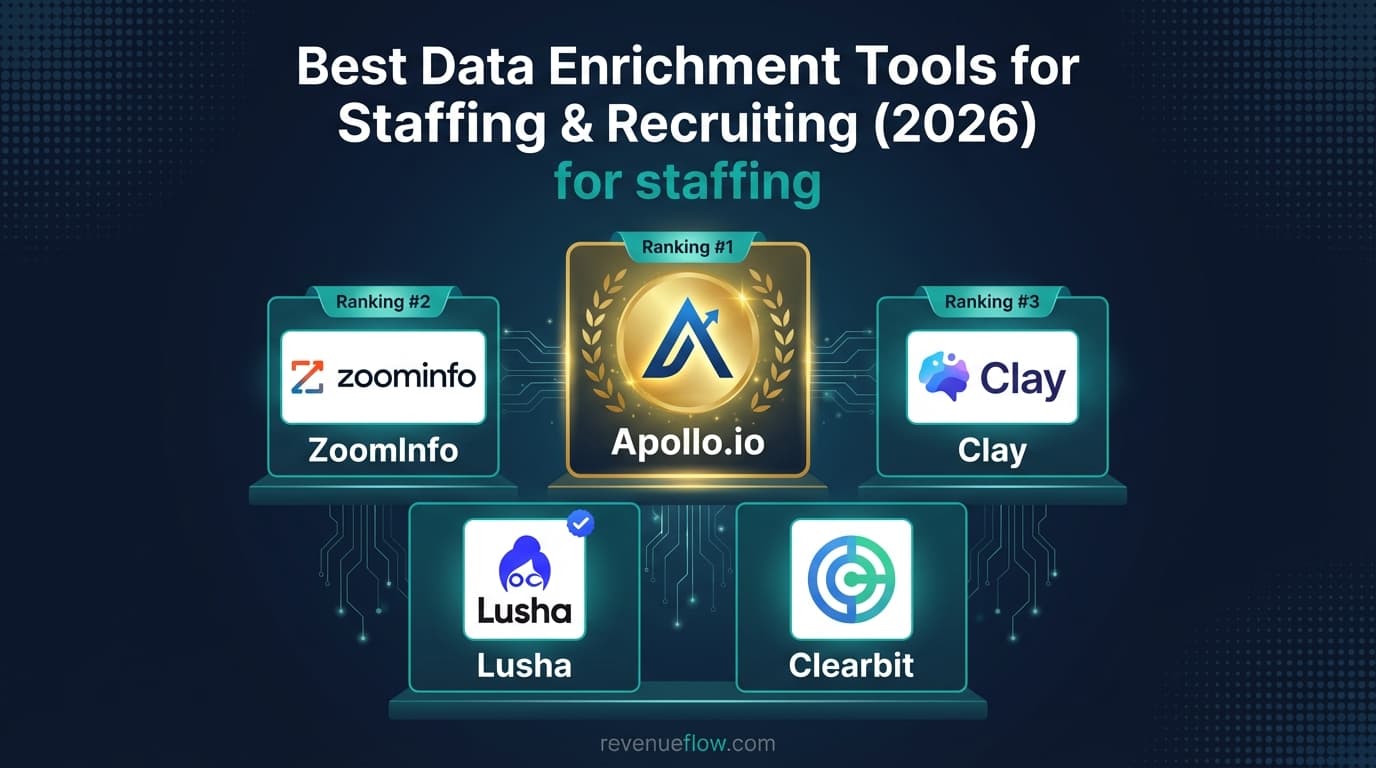
To enrich contact data in an ATS or CRM, look the contact up, verify it, and write it back to the record recruiters already use, spending credits only on chosen records. LeadIQ lists CRM enrichment on every plan, Lusha lists CSV enrichment on Pro, Apollo lists it on Basic, and Clay runs multi-provider waterfalls.
Key takeaways
- Staffing runs two data motions: B2B contact databases serve the client side, while candidate sourcing runs on job boards, professional networks and your own database.
- Write-back to the ATS or CRM decides whether enrichment sticks, so push one real record end to end during the trial before buying credits.
- Lusha lists Free at $0 with 40 credits a month, then Starter at $37.45 a month billed yearly or $49.90 monthly, and puts CSV enrichment on Pro.
- Credits are not comparable across vendors: an UpLead credit unlocks one contact, a phone number costs 5 Lusha credits or 10 LeadIQ credits, and Clay meters actions and data credits separately.
Reviewed and updated September 21, 2026
A staffing firm buys an enrichment tool to source candidates and finds it has bought a tool for selling to companies. That is the defining confusion in this market: staffing runs two entirely different data motions, and the five tools here serve one of them well and the other barely at all. The practical question is narrower than the marketing: how contact data gets enriched into the ATS or CRM record a recruiter already works in.
How to enrich contact data in your ATS and CRM
Enrich inside the system recruiters already use. The tool looks up the contact, verifies it, and writes the email or phone back to the ATS or CRM record, spending credits only on records someone has chosen to contact. Of the five here, LeadIQ lists CRM enrichment on every plan, Lusha lists CSV enrichment on Pro, Apollo lists CSV enrichment and job change enrichment on Basic, and Clay runs multi-provider waterfalls.
Test the write-back with a real record during the trial, whatever the system is. A firm running its client side on Salesforce or Pipedrive should push one enriched contact through end to end before buying credits, and a firm weighing the larger databases can compare them in ZoomInfo alternatives, or the sequencing layer in Salesloft alternatives.
What Staffing Firms Actually Need From Enrichment
Staffing is two businesses sharing a CRM, and enrichment serves them differently.
The client side, which these tools fit. Finding hiring managers, HR leaders and department heads at companies that might buy placements is ordinary B2B prospecting, and every tool in this roundup does it. This is the half where the category earns its price.
The candidate side, which they mostly do not. Sourcing candidates means finding people by skill, experience and availability rather than by company and title, and B2B contact databases are built the other way round. They index the buyer, not the workforce. Candidate sourcing runs on job boards, professional networks and your own database, and treating an enrichment tool as a sourcing tool is the most expensive mistake available here.
ATS write-back, which decides whether any of it sticks. A contact enriched into a spreadsheet is work that has to be redone. Whether the tool writes cleanly into the applicant tracking system your recruiters actually use is a bigger practical question than match rate.
Volume with the personalisation intact. Staffing outreach is high-volume by nature, and the temptation is to let merge fields do the work. They do not; a message assembled from fields reads assembled, and the reply rate shows it.
How to find verified candidate contact data
Finding the candidate and finding the candidate's contact details are two different jobs. Finding people by skill, experience and availability runs on job boards, professional networks and your own database, because B2B contact databases index the buyer, not the workforce. Once a candidate is identified, the same lookups work on anyone with a professional profile: Lusha's product menu lists an extension that reveals contacts on professional networks and sites, and LeadIQ's plans list prospecting via a Chrome extension. Verified matters more than found, so check every address at the point of use; UpLead's homepage, for one, states 95% data accuracy and backs it with a 95%+ accuracy guarantee.
Top 5 Data Enrichment Tools for Staffing

1. Clay
Data enrichment and workflow platform. Its pricing page lists a Free plan with 500 actions a month, 100 data credits a month, unlimited seats and tables, multi-provider waterfalls and Claygent, Clay's AI agent with access to web research; then Launch at $167/mo billed annually, starting at 180,000 actions a year, or $185/mo on the Monthly tab with 15,000 actions a month; Growth at $446/mo annually or $495/mo monthly; and Enterprise at a custom price. The page opens on its Annual tab, which saves 10%. Its data marketplace buys data from 200+ providers in one place. It is the most capable option here and the one with the steepest setup.
2. Lusha
B2B contact database whose product menu lists an extension that reveals contacts on professional networks and sites. Its pricing page, driven on both billing tabs, lists Free at $0 with 40 credits a month and no credit card, Starter at $37.45 a month billed yearly ($49.90 monthly), Pro at $52.45 ($69.90), which adds CSV enrichment, API access and signals with 2 free seats, and Premium at $299.95 ($399.90) with 5 free seats. It suits recruiters who already work profile by profile. A verified email costs 1 credit and a phone number 5.
3. UpLead
B2B prospecting platform whose homepage states 200M+ leads and 95% data accuracy. Its pricing page lists a 7-day Test Drive at $0 with 5 credits, Essentials at $99 a month for 170 credits and Plus at $199 for 400, with annual plans at $74 a month for 2,040 credits and $149 for 4,800; Professional is quoted on request. A credit unlocks a contact for download or CRM export, so a small, well-chosen list is where it pays.
4. LeadIQ
Prospecting platform built around capture from the browser into the CRM. Its pricing page lists Free at $0 for 1 user and 50 credits, and its plans list tracking job changes for champions, CRM enrichment and signals that include hiring. Pro is priced by a credit slider: the rendered page showed $15.00 a month with 5 users included at its default, while the page's server HTML carried a different figure, so set the slider to your own volume before budgeting. An email costs 1 credit and a phone number 10.
5. Apollo.io
All-in-one platform whose product menu cites 240M contacts and 30M companies. Its pricing page lists Free at $0 with 900 credits per seat a year, Basic at $49 per seat a month billed annually, Professional at $79 and Organization at $119 with a minimum of 3 seats. Basic lists CSV enrichment and job change enrichment, and the FAQ says a lapsed trial can downgrade to a Starter plan which is free forever.
Comparison Table
| Tool | Free option | Entry paid price | What a credit buys |
|---|---|---|---|
| Clay | Free, 100 data credits a month | Launch $167/mo annual, $185 monthly | Actions and data credits, metered separately |
| Lusha | Free, 40 credits a month | Starter $37.45 yearly, $49.90 monthly | Email 1 credit, phone number 5 |
| UpLead | 7-day Test Drive, 5 credits | Essentials $99 for 170 credits | One contact for download or CRM export |
| LeadIQ | Free, 50 credits, 1 user | Pro, priced by a credit slider | Email 1 credit, phone number 10 |
| Apollo.io | Free, 900 credits per seat a year | Basic $49 a seat, annual | Credits retrieve contact data |
Credits are the unit to model, and they are not the same unit across vendors. Price the plan at your real monthly volume of contacts you intend to reach, not at the headline.
Which of These Fits Staffing

Apollo.io is the strongest all-round fit for the client side, because staffing sells at volume and one subscription covering a database its menu sizes at 240M contacts, plus sequencing, keeps the cost per touch low.
Lusha fits the recruiter workflow directly: work a LinkedIn profile, reveal the contact, move on. That is what recruiters already do all day, which makes adoption near-automatic.
Clay is the right answer for a firm building a real client-side pipeline, particularly for hiring-signal work where the trigger is a company posting roles. Turning a signal into the right contact at the right company is a workflow, and Clay is the tool for it.
UpLead suits a defined client target list where accuracy matters more than reach. LeadIQ contributes job-change tracking, which in staffing is unusually valuable: a hiring manager who moves is both a warm client lead and a live requisition.
None of the five is a candidate sourcing tool, and the fit section that told you otherwise would be selling you the wrong product.
Where Enrichment Stops
Enrichment tools fill in fields. That is genuinely useful and it is a narrower job than the category's marketing implies, so it is worth naming the boundary before the selection criteria.
They do not decide who is worth contacting. A tool that returns a verified address for every row on a badly chosen list has done its job perfectly and produced nothing, because the list was the problem. Enrichment quality and targeting quality are separate decisions, and the second one is where results actually move.
They do not make a message land. Merge fields are not personalisation, and a paragraph assembled from enriched attributes reads exactly like a paragraph assembled from enriched attributes. What earns a reply is a relevant offer, and no data provider supplies one.
They do not fix deliverability. A verified address means the mailbox exists, not that mail reaches it. Sender reputation, authentication and sending volume decide that, and they sit in a different part of the stack entirely.
And they are not a substitute for a defensible campaign structure. RevenueFlow sends one message per campaign, with no bump sequences and no thread replies, so re-contacting a non-replier is a fresh campaign rather than step two of a cadence. Under that structure the enrichment budget goes into getting the list right the first time rather than into finding more ways to touch the same people.
Choosing for Staffing
Which side of the business is this for? Answer it first and out loud. Client-side prospecting is what this category serves; candidate sourcing needs different tools entirely, and conflating them wastes the budget on both.
Does it write into your ATS? Test the integration during the trial with a real record. A tool that produces exports somebody re-keys is a tool that will quietly stop being used.
Can it act on hiring signals? A company posting roles is the clearest buying trigger in this industry. If the motion depends on that, the question is whether the tool can turn a signal into the right contact, which favours workflow platforms.
What is the cost per contacted person? Staffing is a volume business, so the credit price compounds fast. Model it at your real monthly volume rather than at the plan's headline.
How does personalisation survive volume? Decide what makes each message specific before choosing a tool, because no amount of enriched fields produces that on its own.
Getting It Running Without Burning Credits
Every tool here meters something, so the first month is where the money goes wrong.
On the free tier or trial, checked against reality, not the tool's confidence score.
Enrich late, not early.
Stale addresses turn into bounces, which cost deliverability.
Not cost per credit.
Start with a sample. Take 100 rows you know well, run them through the free tier or the trial, and check the results against reality rather than against the tool's own confidence score. Coverage varies enormously by segment, and a provider that is excellent on one population can be thin on the next. That check costs an afternoon and it is the only thing that tells you whether the tool works on your list.
Enrich late, not early. Pulling a full record for every company in a target market before anybody has decided who is worth contacting is the most common way a credit balance disappears. Qualify first, enrich the survivors.
Verify at the point of use. A record enriched six months ago is not a current record, and stale addresses turn into bounces, which cost deliverability rather than credits. Re-verify before a send rather than trusting the export date.
Then track cost per usable record instead of cost per credit. The credit price is the number on the pricing page; the number that matters is what you paid for each contact that turned out to be real, current and worth contacting.
How This Comparison Was Put Together
Prices, plan names and capability claims come from each vendor's own pricing or product page, read on the day of writing and kept as a dated snapshot. Where a vendor's page no longer renders its prices, that is said rather than filled in from a third-party roundup, because a figure copied from another article is not a source.
No tool here was ranked by measured match rate or data accuracy, and nothing in this guide is presented as a test result. Enrichment coverage depends on the segment, the geography and the seniority of the people being looked up, so a league table built on somebody else's list would not predict yours. That is why the setup section above leads with a 100-row sample: the only accuracy figure worth acting on is the one you measure on your own data.
The Short Version

For client-side prospecting at volume, Apollo.io is the best value because one subscription covers the database and the sending. Lusha fits the recruiter workflow with no adoption cost. Clay is the right build for hiring-signal work, where a company posting roles becomes the trigger for a targeted approach. UpLead suits a fixed client list, and LeadIQ's job-change tracking is doubly useful here, since a hiring manager who moves is both a lead and a live requisition.
For candidate sourcing, none of these is the answer. That runs on job boards, professional networks and your own database, and buying a B2B contact tool for it is the most common way this budget gets wasted.
Related Reading
If you would rather have this run for you, RevenueFlow books qualified meetings on a pay-per-meeting basis and publishes client results.
Pricing and features are taken from the vendors' own pages. Verify current terms with the vendor before relying on them.
Frequently asked questions.
Frequently asked questions- How do you enrich contact data in an ATS or CRM?
- Qualify the record first, then look up the contact, verify it at the point of use, and write it back to the ATS or CRM record your recruiters already work in. LeadIQ lists CRM enrichment on every plan, Lusha lists CSV enrichment on Pro, Apollo lists CSV and job change enrichment on Basic, and Clay runs multi-provider waterfalls.
- What is the best data enrichment software for recruiters?
- For the client side of a staffing firm, Apollo.io covers database and sequencing in one subscription, Lusha fits recruiters who work profile by profile, and Clay suits hiring-signal workflows. UpLead suits a fixed target list where accuracy matters, and LeadIQ lists job-change tracking, useful because a hiring manager who moves is both a lead and a requisition.
- How do I find verified candidate contact data?
- Find the candidate on job boards, professional networks or your own database, then look up and verify the contact details. Lusha's product menu lists an extension that reveals contacts on professional networks and sites, and LeadIQ's plans list prospecting via a Chrome extension. Verify every address at the point of use, because a verified record from months ago is not a current one.
- Is there a CSV enrichment service among these tools?
- Yes. Lusha's pricing page lists CSV enrichment on its Pro plan, at $52.45 a month billed yearly or $69.90 monthly, and Apollo's lists CSV enrichment on Basic at $49 per seat a month billed annually. Clay enriches tables row by row through multi-provider waterfalls. Run a 100-row sample you know well before enriching a full file.
About the author.

B2B cold email experts helping companies generate qualified leads through done-for-you outreach campaigns.
RevenueFlow Team
Explore more.
Ready to scale your outreach?
We build GTM engines that book real meetings. See the receipts.
Related articles.
Seamless.AI Email Finder: How It Works, What a Credit Buys
How Seamless.AI's email finder resolves a contact in real time, what one Universal Credit buys, the Total AI score on every address, and what the Chrome extension reads.
Is Clay Free? The Free Plan, the Trial and Where Each Stops
Clay's free plan, its 14-day trial and the no-charge-on-a-miss rule are three different things. What each holds and where it stops, from clay.com on 19 September 2026.
TexAu Pricing: Four Tiers, Billed Only on a Match
TexAu charges credits only when a lookup succeeds. The four tiers at both billing states, the rollover cap, and three places the page disagrees with itself.
Autobound Pricing: One-Time Credit Packs, Not Seats
Autobound's pricing page sells one-time credit packs for a signal data API, not seats. The six packs, the per-endpoint meter, and what a company costs.
Firmographic Data Providers: What Six of Them Publish
Six firmographic data providers read from their own pages: the fields each sells, the coverage each states, how the data is delivered, and who prints a price.
Airscale Pricing: Three Plans, One Credit, Four Rates
Airscale prints a different credit cost on every plan, and its advertised per-email price belongs to the custom one. The dated ladder and the rollover rules.