How to Cold Email Office Managers: What Gets a Reply
Office managers hold real budget and delete vendor email in one swipe. What the role is judged on, which angles land, and four templates that earn replies.
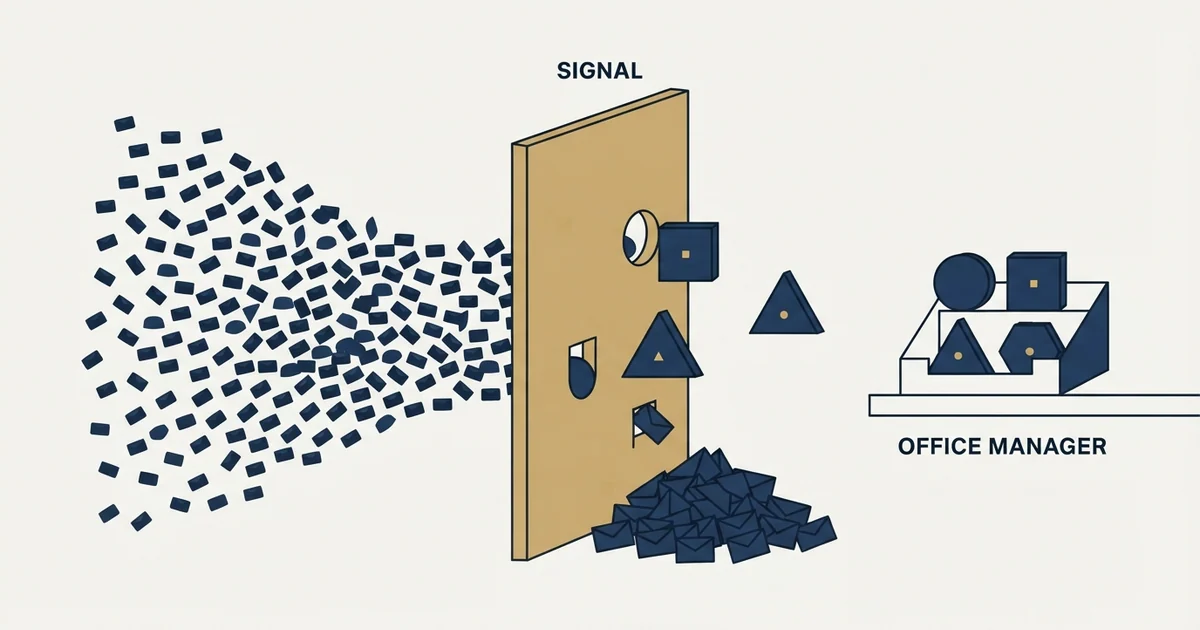
To cold email office managers, tie your offer to a metric they are judged on: cost per employee, ticket volume, day-one new hire readiness, vendor consolidation, or compliance deadlines. Keep the message under 120 words, use a real trigger such as a move or hiring surge, and ask for a reply rather than a meeting.
Key takeaways
- The median annual wage for administrative services managers was $108,390 as of May 2024, with about 36,400 openings projected each year through 2034 (U.S. Bureau of Labor Statistics).
- At companies under roughly 300 people, the office manager is often the entire evaluation committee for purchases under a few thousand dollars a year.
- Seven metrics drive this role: cost per employee, ticket volume, day-one readiness, vendor count, space utilization, compliance items, and event execution.
- Best send window is Tuesday or Wednesday between 7:15 and 8:30 a.m. local time, when office managers are in the building before interruptions start.
- Keep cold emails to this persona under 120 words with a reply-sized ask, no attachment and no calendar link in the first touch.
- Peer proof matched on headcount and city outperforms enterprise logos, because this role's constraints come from headcount and building rather than industry.
Reviewed and updated September 1, 2026
How to Cold Email Office Managers: What Actually Gets a Reply
Picture the Monday inbox of an office manager at a 140-person company. Sixty-something unread messages. Nine from vendors she has never heard of. Two from the building about a fire panel inspection. One from finance asking why the snacks line went up last quarter. One from an employee whose desk chair collapsed on Friday. The chair gets answered in four minutes. The nine vendor emails get archived in one swipe, most of them unopened.
That swipe is your real competition. Office managers sit on a pile of purchasing authority (supplies, cleaning, catering, coffee, furniture, badges, security, printers, travel, events, moves, and often first-line IT hardware) while most sales teams treat them as either a gatekeeper to route around or a spam target to blast. Both approaches lose. The role is a genuine buyer with real budget, an unusually short evaluation cycle, and almost no patience for pitches that do not connect to something on this week's to-do list.
The Bureau of Labor Statistics puts the median annual wage for administrative services managers at $108,390 as of May 2024, with roughly 36,400 openings projected each year across administrative services and facilities management through 2034. Source: U.S. Bureau of Labor Statistics. That is a large, professionalized, well-paid buying population that most outbound teams write to as if it were a receptionist.
What Office Managers Actually Control
The title is a wrapper around wildly different scopes. Before you write anything, figure out which version you are emailing.
| Variant | Typical company | What they own | Spending authority |
|---|---|---|---|
| Office Coordinator / Office Admin | 20 to 60 people | Supplies, snacks, mail, visitors, small vendor orders | Usually under $500 without approval |
| Office Manager | 50 to 300 people | Vendors, facilities, events, onboarding logistics, budget line | Often $1,000 to $5,000 at their discretion |
| Workplace Experience Manager | 150 to 1,500 people, often tech | Employee experience, RTO programs, multi-floor operations, perks | Manages a defined annual budget |
| Director of Workplace / Facilities | 500+ or multi-site | Leases, build-outs, security systems, vendor consolidation | Signs or heavily influences five and six figure contracts |
| Office Manager plus People Ops | 30 to 120 people | Everything above plus HR admin, payroll support, benefits logistics | Recommender to the founder or CFO |
At companies under about 300 people, the office manager is frequently the entire evaluation committee for anything under a few thousand dollars a year, which means a good email can move to a signed order in under two weeks. Above that size they become a recommender, and their power shifts to veto and speed. They can kill you quietly or walk your quote into the CFO's office. Write to that power rather than around it.
What Their Inbox Actually Looks Like
Office managers are the default catch-all address for the entire company. They usually monitor shared aliases like office@, facilities@, or hello@, the easiest addresses in any company to guess and the ones most heavily scraped into purchased lists. They get pitched by every janitorial service, coffee subscription, plant vendor, snack box, first aid supplier, printer reseller, and furniture broker within fifty miles.
They also read on the move. Much of the job happens standing up: receiving deliveries, walking a contractor through the space, resetting a conference room. Emails get triaged on a phone in small windows, so the first line of preview text carries more weight than in almost any other persona.
And they respond fast to deadlines. Anything attached to a real date (a lease event, an inspection, a first day, an insurance certificate expiring) jumps the queue. Open-ended exploration goes to the bottom and stays there.
The Metrics This Role Is Judged On
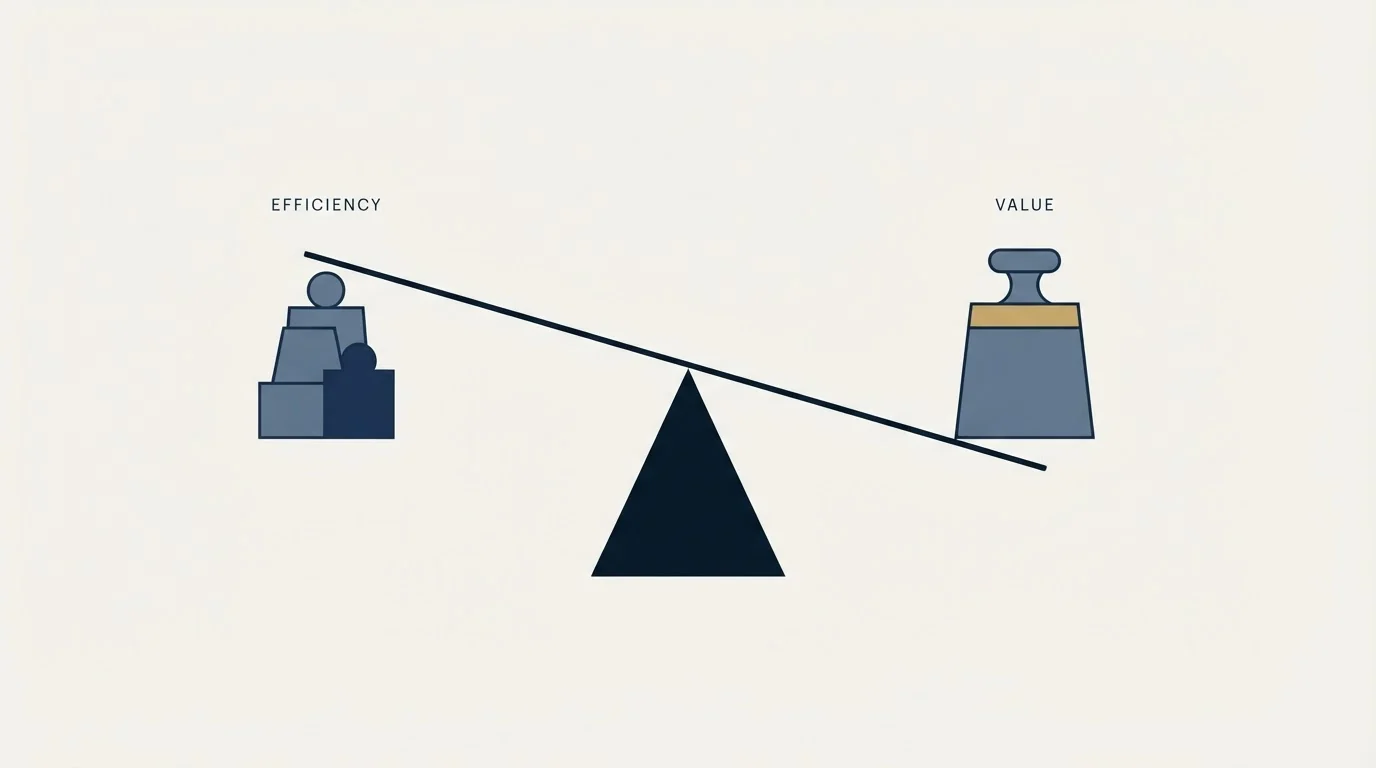
Office managers rarely have a quota, so most sellers assume they have no numbers. They have plenty, and referencing the right one is the single fastest way to sound like an insider.
- Cost per employee per month. Finance tracks office spend per head. When headcount grows and per-head spend stays flat, the office manager looks excellent. Any pitch that raises total spend while lowering per-head cost should say so explicitly.
- Ticket volume and time to resolve. Broken chairs, jammed printers, no oat milk, badge not working. Complaint volume is the informal scoreboard, and reducing recurring complaints is career-relevant to them.
- Day-one readiness. Desk, monitor, badge, laptop, chair, and welcome kit ready for every new hire. Missing any of it is visible to the whole company.
- Vendor count and contract hygiene. Consolidating twelve invoices into four is a legitimate accomplishment they will bring up in a review. So is renegotiating a renewal before it auto-renews.
- Space utilization and attendance. Under hybrid and return-to-office policies, badge-in data and desk utilization now sit on the office manager's dashboard, and leadership asks about them.
- Compliance and audit items. Certificates of insurance, fire inspections, OSHA postings, evacuation plans. Boring, mandatory, and a source of real anxiety.
- Event execution. All-hands, offsite, holiday party, client visits. Judged on whether it went smoothly and came in on budget.
Write your value proposition against one of those seven and you are already in the top decile of what lands in that inbox.
Angles That Resonate
Give back a specific recurring hour. "Four hours a month reconciling three supply invoices" beats "streamline operations" every time. Name the chore.
Hand them a number their CFO will ask about. Office managers are frequently asked to justify spend they did not choose. An email that arms them with a defensible per-head figure makes you useful before you have sold anything.
Remove a public failure mode. The conference room that never has working HDMI. The new hire with no desk. Catering that arrived an hour late during a board meeting. These are the moments that make the role feel exposed, and preventing them lands harder than saving money.
Attach yourself to a real date. Lease expirations, an office move, a new floor, a hiring surge, a scheduled inspection, an annual renewal.
Use peer proof at matched headcount and geography. "Three other 100 to 200 person offices in River North" outperforms a Fortune 500 logo, because their constraints are set by headcount and building rather than by industry.
Angles That Get Deleted Instantly

"Partnership opportunity" in the subject line. Opening with "quick question" and then asking no question. Pitching a product this role has no scope over (revenue software, developer tooling, marketing platforms) because a list said they were a decision maker. Leading with a paragraph of features. Asking in email one to be forwarded to the CEO, which reads as a statement that they do not matter. Vague percentage claims with no mechanism attached. A calendar link before you have earned thirty seconds of attention. A cold attachment, which most workplace security tools will flag anyway.
One more that specifically burns this persona: over-familiar fake rapport. "Hope you're crushing it this week!" from a stranger reads as automation to someone who processes hundreds of automated messages a month.
Four Emails That Get Replies
1. The recurring chore email
Subject: {{company}} supply reorders

Hi {{first_name}},

Most office managers at {{headcount}}-person companies tell us reordering
supplies eats three to five hours a month once you count the reconciling,
the "we're out of X" Slacks, and the invoice coding at month end.

We consolidate that into one standing delivery and one invoice per month.
{{peer_company_1}} and {{peer_company_2}} in {{city}} both run it that way now.

Worth a 10-minute look, or should I send the one-pager and let you decide
on your own time?

{{sender_name}}
{{sender_title}} | {{phone}}
Why this works: it names the chore in the recipient's own vocabulary (the "we're out of X" Slack is a real, recognizable experience), quantifies in hours rather than percentages, uses local peers at matched headcount, and offers an exit that does not require a meeting. The two-option close converts well with busy operators because declining the call still produces a reply.
2. The cost-per-head email
Subject: per-head office spend at {{headcount}} people

Hi {{first_name}},

When {{company}} went from {{prior_headcount}} to {{headcount}}, your
office cost per employee probably moved in one direction or the other,
and finance almost certainly asked about it.

We put together a per-head benchmark for {{city}} offices in the
{{headcount_band}} range across cleaning, coffee, and supplies. Happy to
send it over whether or not we ever work together, it's useful for budget
season either way.

Want me to send it?

{{sender_name}}
{{sender_title}} | {{phone}}
Why this works: the ask is to receive something, not to attend something, which drops the cost of replying to a single word. It speaks directly to a metric leadership actually asks about, and it positions the sender as a source of ammunition for a conversation the office manager is already having. Only send this if the benchmark genuinely exists.
3. The hiring-surge email
Subject: {{open_roles}} open roles at {{company}}

Hi {{first_name}},

Saw {{company}} has {{open_roles}} roles posted right now. If even half of
those close in the next quarter, that's a lot of day-one setups: desk,
chair, monitor, welcome kit, badge.

We ship pre-configured new hire kits that arrive before the start date, so
nobody is hunting for a spare monitor on a Monday morning. Setup runs about
{{lead_time}} and scales up or down with your actual offer volume.

If onboarding logistics are already handled, tell me and I'll stop. If
they're currently a scramble, I can walk you through how {{peer_company}}
set theirs up in about twenty minutes.

{{sender_name}}
{{sender_title}} | {{phone}}
Why this works: the trigger (open job postings) is public, scrapeable, and unambiguous evidence of relevance. It maps to day-one readiness, a metric this role is visibly judged on, and it uses a scenario the recipient has personally lived through. The explicit permission to say no ("tell me and I'll stop") reliably increases reply rate because it makes a two-word response feel legitimate.
4. The office move or lease event email
Subject: {{building_or_address}} move

Hi {{first_name}},

Congrats on the {{new_location}} space. Moves at {{headcount}} people
usually surface the same three problems in week one: furniture that doesn't
fit the new floor plan, a cabling plan nobody owns, and a stack of vendor
contracts still pointing at the old address.

We handle the third one. We audit existing service contracts, reassign or
cancel what doesn't transfer, and get the new building's certificates of
insurance sorted before your landlord asks.

Is the move date locked yet? If it's more than six weeks out there's time
to do this properly.

{{sender_name}}
{{sender_title}} | {{phone}}
Why this works: it opens on a specific, verifiable event rather than a compliment about the company. The three-problem list demonstrates operational knowledge in one sentence and lets the recipient self-identify. Ending on a question about their timeline (rather than yours) invites a factual reply, which is much easier to give than a yes or no on a meeting.
Best Send Windows

Time of day. 7:15 to 8:30 a.m. local time. Office managers are often in the building before anyone else, unlocking doors, checking deliveries, and clearing the queue before interruptions start. A second decent window is 1:00 to 2:00 p.m.
Day of week. Tuesday and Wednesday. Monday mornings are firefighting: whatever broke over the weekend, whoever is starting today. Friday afternoons are for closing out the week. Thursday works as a follow-up day.
Time of month. Avoid the first three and last three business days if the person handles invoice coding or month-end reconciliation, which many do at companies under 300 people.
Season. Budget planning for most calendar-year companies runs September through November, the best window for anything requiring a new line item. January brings restocking and a wave of new hires. Summer suits projects that require downtime, such as furniture swaps or space reconfiguration. December is a wash after the first week.
Where we differ from standard practice
Much of the advice on this page reflects how outbound is commonly run. We run it differently, and since this page sits on our site it is worth saying where the difference is and what it costs us.
- A sequence of messages to each prospect over several weeks
- Later messages often land in the same email thread
- Every contact is reached more than once, so a distracted reader gets another chance
- The later messages go only to people who did not answer the first
- Reputation cost accrues on the sending domain across everything else it sends
- One message, then that campaign is finished for that contact
- No thread replies and no bumps
- A non-responding audience becomes a new campaign with a genuinely different premise, not a reminder
- More of the work moves into targeting and into the one message
- We reach each contact less often, and that is the cost we accept
The reasoning is mechanical rather than moral. A follow-up arrives underneath a message the recipient has already seen and chosen not to answer, so it is delivered to the population most likely to mark it as spam, and the reputation cost of that lands on the sending domain across every campaign running on it. We set that cost against the replies a sequence recovers and decided the trade was not worth it. The full argument, with the numbers from our own campaigns, is in why we stopped using follow-ups.
Sequence Structure That Fits This Role
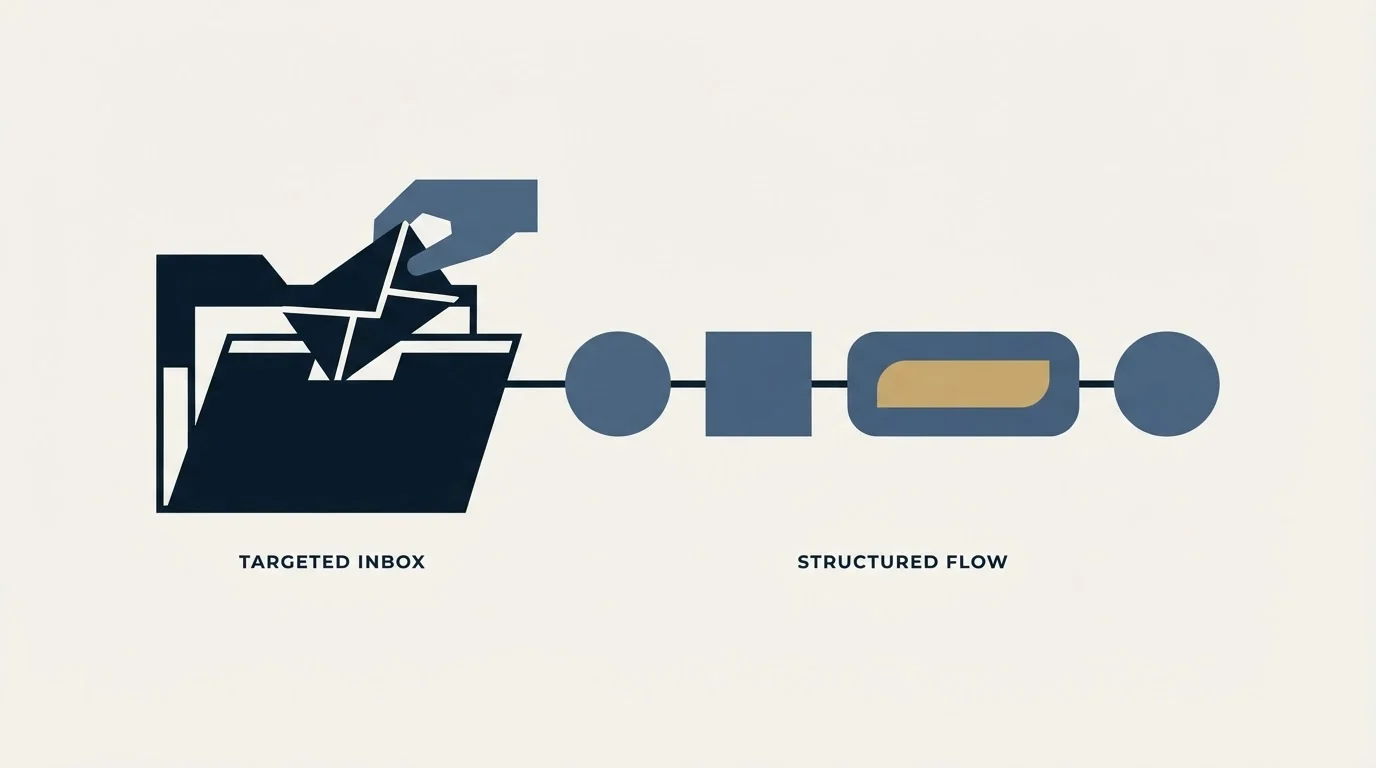
Four touches over roughly eighteen days, each carrying one new concrete thing rather than a nudge.
- Day 0: the core email, one angle, one ask, under 110 words.
- Day 4: the artifact. Send the benchmark, checklist, or one-pager you offered, whether or not they asked. Delivering on a promise buys credibility.
- Day 10: a different angle. If touch one was about cost, make this one about a failure mode or a deadline.
- Day 18: the close-out. "Sounds like this isn't a priority right now, I'll stop here. If the timing changes, reply and I'll pick it back up." This touch pulls replies from people who meant to answer and forgot.
Keep every message under 120 words and never send an attachment before you have a reply. Teams that run persona-specific outbound at volume (in house or through an agency like RevenueFlow) win on research discipline more than on copy polish.
Pre-Send Checklist
- Confirmed which variant of the role you are emailing, and whether your price sits inside their discretionary authority
- Identified a real trigger: headcount growth, job postings, a move, a funding round, a renewal window
- Value proposition maps to one of the seven metrics above
- Peer references matched on headcount and city rather than industry logos
- Subject line lowercase, specific, under six words
- Body under 120 words with one ask
- Ask is reply-sized rather than calendar-sized
- No attachment, no calendar link, no "partnership"
- Scheduled Tuesday or Wednesday, 7:15 to 8:30 a.m. recipient local time
- Sending domain warmed and separate from your primary corporate domain
Office managers are one of the few B2B personas where a genuinely useful, well-timed cold email still reads as a favor rather than an intrusion. They are drowning in vendor noise because so few senders bother to learn what the job involves. Learning it is a small amount of work and a large edge.
If you would rather have this built and run for you, from target list and trigger research through the copy and inbox infrastructure, book a strategy call with RevenueFlow.
Related Reading
- How to Cold Email CTOs: What Actually Gets a Reply
- How to Cold Email Procurement Managers: What Actually Gets a Reply
If you would rather have this run for you, RevenueFlow books qualified meetings on a pay-per-meeting basis and publishes client results.
Frequently asked questions.
Frequently asked questions- Do office managers actually have buying authority?
- Yes, within a range. Office managers typically hold discretionary authority somewhere between $1,000 and $5,000 per purchase, covering supplies, cleaning, catering, furniture, coffee, printers, and often first-line IT hardware. Above that threshold they usually become the recommender who walks a quote to the CFO or founder, which still makes them the person worth convincing first.
- What is the best time to send a cold email to an office manager?
- Tuesday or Wednesday between 7:15 and 8:30 a.m. in the recipient's local time zone. Office managers are frequently in the building before the rest of the company, handling deliveries and unlocking doors, so early morning catches them before interruptions. Avoid Monday mornings, Friday afternoons, and month-end if they handle invoice coding.
- What subject lines work best for office managers?
- Short, lowercase, and specific to something real: an address, a headcount, a move, a number of open roles, or a named recurring chore. Six words or fewer. Avoid anything containing partnership, opportunity, revolutionary, or a percentage claim, because those patterns match the vendor spam this persona archives in bulk every day.
- Should I ask an office manager to forward me to the decision maker?
- Not in the first email. Asking to be routed upward tells an office manager their own scope does not matter, and it is one of the fastest ways to get archived. If your price point genuinely exceeds their authority, pitch them on the problem first and let them decide whether to bring in finance or leadership.
- What makes an office manager reply to a cold email?
- One concrete thing they can act on, tied to something real about their building or headcount: a move, a hiring surge, an address, or a named recurring chore. Keep it under 120 words and make the ask reply-sized. If you promise an artifact, include it in that same message rather than holding it back for a later touch.
About the author.

Ben Carden is CRO at RevenueFlow, which builds and operates outbound revenue engines for B2B companies. Previously at Gartner Enterprise. Studied at London School of Economics.
Ben Carden · CRO
Connect on LinkedIn →Explore more.
Ready to scale your outreach?
We build GTM engines that book real meetings. See the receipts.
Related articles.
Cold Email Frameworks: Which One Fits Your Offer
AIDA, PAS and Before-After-Bridge arrange the same four elements in different orders. What each one assumes about the reader, and what none of them fix.
CAN-SPAM Act Compliance for B2B Cold Email: The Rules
The CAN-SPAM Act makes no exception for business-to-business email. Here are the seven requirements, the opt-out clocks, and where liability lands when an agency sends.
How to Write a New Year Outreach Email, Line by Line
A new year outreach email works only where January is a fact about the account. Who that is, the structure line by line, and two worked examples.
How to Write a Third Follow Up Email, Line by Line
A third follow up email belongs only in a thread where the person replied or agreed to something. When to send one, and how to write it line by line.
BASHO Email: Four Sentences Built on One Insight
A BASHO email is four or five sentences built on one researched insight about a specific person. The format is documented, and it cannot be produced at volume.
No-Reply Email Address: What It Costs a Sender
A no-reply address is defensible on a receipt and indefensible on a cold message, because the reply is the entire product of a first contact.