Lead Generation for Supply Chain Companies: Four Filters
How a supply chain software vendor generates leads: the titles the industry's own survey counts, the barriers buyers name, the integration gate and the show calendar.
A supply chain software company's lead is a leader at director level or above, in the department that owns the use case, at a company whose systems the product integrates with. The 2026 MHI report, from more than 500 supply chain leaders, says 56% plan to raise innovation spending and names integration complexity and business cases as barriers.
Key takeaways
- MHI's 2026 Annual Industry Report drew on more than 500 supply chain leaders surveyed in December 2025; titles from CEO to department head provided 61% of the data, and 56% of organizations plan to increase supply chain innovation spending.
- MHI Solutions reports AI in use for demand forecasting and inventory at 33% of organizations, predictive maintenance at 30%, operational decision-making at 27%, transportation routes at 26% and purchasing at 24%, with nearly 28% not yet using it.
- The barriers the survey names are workforce constraints, high capital costs, integration complexity, long deployment timelines, and difficulty knowing where to begin or building a compelling business case.
- The vertical's calendar is public: a report keynote at MODEX on 15 April 2026, CSCMP EDGE from 4 to 7 October 2026 in Nashville, and ProMat from 19 to 21 April 2027 at McCormick Place in Chicago.
Reviewed and updated September 18, 2026
The buyers a supply chain software company wants to reach have said, in their own industry's survey, what they plan to spend and what is stopping them. The 2026 MHI Annual Industry Report, researched and written by the trade association MHI with Deloitte for the past 13 years by its magazine's account, was informed by survey responses received in December 2025 from "more than 500 supply chain leaders," and MHI's magazine reports three of its findings together: "56% of organizations plan to increase supply chain innovation spending," 52% expect to spend over $1 million, and 17% plan to invest more than $10 million (MHI Solutions, Rewiring the Supply Chain for What's Next, 26 June 2026). The same article names what slows them down, and integration is on the list.
This page is for the supply chain software and technology company: the vendor of warehouse management, transportation management, visibility, planning or procurement software that sells to shippers, manufacturers and logistics providers. It is not about lead generation for a logistics service provider, which logistics lead generation covers, and it is not about selling warehouse space or freight. Here the product is software, the buyer runs a supply chain, and the sources are the industry's own reports and event calendars.
Who buys, as the industry's own survey counts them
The survey's respondent list is a usable picture of who holds the decision. MHI's magazine quotes the report's description of them: "Participants with the titles of CEO, president, vice president, SVP, director, general manager or department head provided 61% of the data," from companies of which 51% reported annual sales above $50 million and 18% reported $1 billion or more. Those are the titles the report treats as supply chain leadership, and a list built below director level is aimed under the people the industry itself surveys about technology spending.
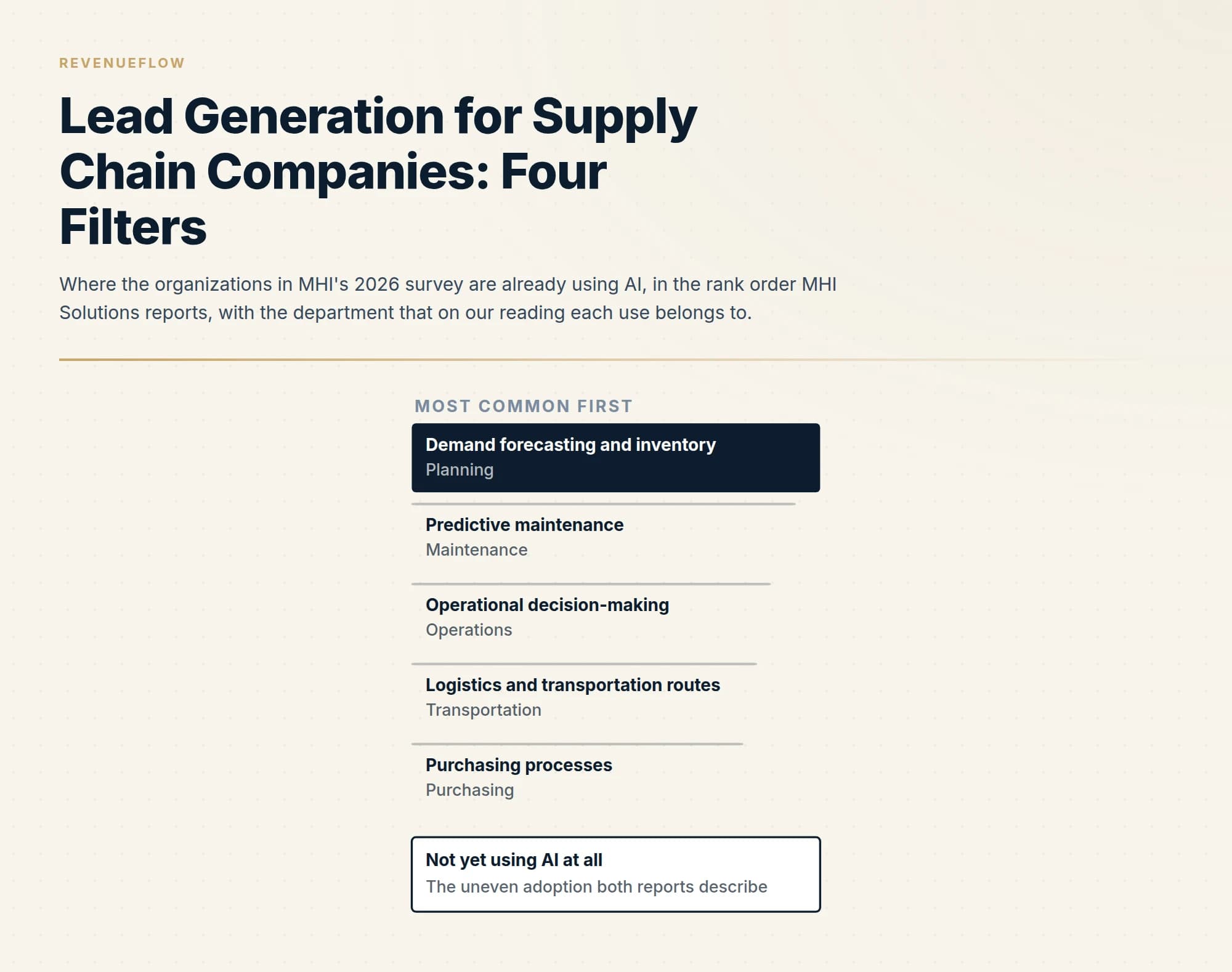
The same article says where software is already in use, which tells a vendor which function owns the problem. MHI Solutions reports that among the organizations surveyed, 33% are using AI to enhance demand forecasting and inventory optimization, 30% apply it to predictive maintenance, 27% are automating operational decision-making, 26% are optimizing logistics and transportation routes, and 24% are streamlining purchasing processes, while nearly 28% are not yet using AI at all. On our reading those uses belong to planning, maintenance, operations, transportation and purchasing, which are different departments with different heads. A vendor of transportation software and a vendor of procurement software are not selling to the same person inside the same company, and the survey's ranking says which conversations are already common and which are early.
The Council of Supply Chain Management Professionals reaches the same conclusion from the other side. Its annual State of Logistics report, produced for CSCMP by the consulting firm Kearney and presented by Penske Logistics, puts United States business logistics costs at $2.4 trillion, 7.8% of national GDP, and says that "Adoption of AI remains uneven by shippers and logistics providers across the supply chain," with a large gap between companies that have placed it into core workflows and those restricted to isolated point solutions (CSCMP, State of Logistics Report, read 18 September 2026). Uneven adoption is what a lead generation programme in this market is sorting for.
The barriers the buyers name, and what they do to a first message
The objections in this market are published. MHI's magazine lists them: "Workforce constraints, high capital costs, integration complexity and long deployment timelines continue to slow progress," and adds that "Many organizations also struggle with where to begin or how to build a compelling business case." Modern Materials Handling, a trade publication, reported the same survey's account of where leaders get stuck on AI: "unclear use cases and automation cost, paired with limited understanding; difficulty building business cases; talent shortages; and budget constraints" (Modern Materials Handling, New MHI and Deloitte report finds AI biggest disruptor of supply chains over the next decade, read 18 September 2026). It also printed the respondents' top five trends, and the fifth is one a software vendor will be asked about: cybersecurity and data security.
Read as objections, those lists say what a first message has to carry. A buyer struggling with where to begin does not want a platform tour; it wants one named use case. A buyer who cannot build a business case wants the inputs to one. A buyer worried about integration complexity and long deployment timelines wants to know what the software connects to and how long that has taken elsewhere, stated only if the vendor can document it.
| Barrier the survey names | Reported by | What the first message carries |
|---|---|---|
| Where to begin; unclear use cases | MHI Solutions, Modern Materials Handling | One named use case, not a platform tour |
| Building a compelling business case | MHI Solutions, Modern Materials Handling | The inputs to a business case |
| Integration complexity, long deployment timelines | MHI Solutions | What the software connects to, documented |
| Cybersecurity and data security | Modern Materials Handling | Nothing in the opener; an answer ready for the meeting |
The integration gate
Integration complexity is the barrier a software vendor can do most about before the first conversation, because the large enterprise systems publish a route. SAP operates an integration and certification centre for partner products and describes its purpose in one line: "Validate the integration of your solutions with SAP technologies." It tells partners that the certification exists to "Boost customer confidence in your SAP partner products by participating in our open certification program," and claims for it that certified partners can "Grow your customer base faster and reduce the duration of your sales cycle" (SAP, Certification and Technical Services, read 18 September 2026; the last claim is SAP's own and the page gives no figures for it).
For lead generation the consequence is a list rule. A vendor whose product is certified against the enterprise system a prospect runs has an answer to the integration objection before it is raised, and a vendor without it is asking the prospect's IT team to take the risk. Segmenting a list by the system the buyer runs, and writing only where the integration exists, removes the objection the survey says slows these purchases down. How the vendor assessment that follows a first meeting works for technology sellers is covered in information technology lead generation.
The calendar: the report, the shows and the conference
This vertical publishes its calendar. The MHI report's survey was taken in December 2025 and its findings were set for a keynote panel at the MODEX show on 15 April 2026 (MHI Blog, 2026 MHI Annual Industry Report Debuts During MODEX Keynote, read 18 September 2026). CSCMP's annual conference, EDGE 2026, runs from 4 to 7 October 2026 at the Gaylord Opryland Resort and Convention Center in Nashville (CSCMP EDGE 2026, read 18 September 2026). MHI's other show, ProMat 2027, will be held from 19 to 21 April 2027 at McCormick Place in Chicago, and MHI describes it this way: "ProMat is the largest international manufacturing and supply chain show and conference held in the United States" (MHI Solutions, Dates Set for ProMat 2027, 18 September 2025).
Those dates are outreach windows for a reason that has nothing to do with booths. A message that names the show and asks for twenty minutes there is a smaller ask than a demo, and a message that cites a finding from the industry's own annual report is about the reader's world. No source fetched for this page states a fiscal year common to these buyers, so ask each account when its planning cycle closes; none is asserted here.
- December 2025MHI survey responses received
More than 500 supply chain leaders
- 15 April 2026Report keynote panel
At the MODEX show
- 4 to 7 October 2026CSCMP EDGE 2026
Gaylord Opryland Resort and Convention Center, Nashville
- 19 to 21 April 2027ProMat 2027
McCormick Place, Chicago
What the rules require of the vendor's outreach
The rule on the message itself is the ordinary one for commercial email. The Federal Trade Commission's guide states that the CAN-SPAM Act "makes no exception for business-to-business email," names a penalty of up to $53,088 for each separate email in violation, and requires a valid physical postal address and a clear way to opt out in every commercial message (FTC, CAN-SPAM Act: A Compliance Guide for Business, read 18 September 2026). A software vendor writing to a vice president of supply chain is sending commercial email. Prospects outside the United States fall under their own countries' rules, which this page does not cover. Whether a specific practice is compliant is a question for counsel.
Channel reality, and when outbound is the wrong play
Written outreach by email and LinkedIn suits this market because the buyer is a named senior title at a company whose systems, sites and announcements are public. It is RevenueFlow's motion, one message per campaign; RevenueFlow does not cold-call. The shows are the vertical's other channel, and the two work together: the message books the conversation and the show hosts it.
Outbound is the wrong play in three cases. It is wrong when the product does not integrate with the system the prospect runs, because the survey's integration objection will end the conversation in the first reply. It is wrong when the vendor cannot name one use case for the function it is writing to, because a buyer that is stuck on where to begin is not helped by a catalogue. And it is wrong when aimed below the titles the industry's own survey treats as leadership, in a market where 52% of respondents expect to spend over $1 million on supply chain innovation: the person who replies is unlikely to hold that budget. Where a warehouse operator is the target, the way those companies are approached is covered in cold email for warehousing.
Three openers, each grounded in a page the buyer can check
Three sample first lines a supply chain software company could send, each tied to one fetched source. Results are not claimed, the recipients are not real people and contact details are absent.
To a vice president of supply chain, after the annual report. MHI's 2026 report says many organizations struggle with where to begin or how to build a compelling business case for supply chain technology. We work on one use case, transportation route optimization, and we can send you the inputs a business case for it needs. If that is on your list for next year, twenty minutes is the ask. The finding is MHI's own and the offer is the thing the finding says is missing.
To a director of transportation, before a show. CSCMP EDGE runs from 4 to 7 October in Nashville. If you are going, we would like twenty minutes there to show you how our software connects to the enterprise system you already run. If you are not, the same conversation by video works. The dates are CSCMP's and the ask is sized to the event.
To a head of IT at a manufacturer running SAP. SAP runs an open certification programme that validates a partner's integration with SAP technologies, and our product holds it. If integration complexity is what has kept supply chain software off your roadmap, a short technical conversation is the ask. The programme is SAP's own, and a vendor should send this only if it holds the certification.
To: Vice president of supply chain, after the annual report
MHI's 2026 report says many organizations struggle with where to begin or how to build a compelling business case for supply chain technology. 1
We work on one use case, transportation route optimization, and we can send you the inputs a business case for it needs. If that is on your list for next year, twenty minutes is the ask. 2
Postal address and opt-out line in the footer. 3
- 1A finding from MHI's own report, which the reader can check.
- 2One named use case and the inputs to a business case, the two things the survey says are missing.
- 3The postal address and opt-out line the FTC's CAN-SPAM guide requires of every commercial email.
What a lead is for a supply chain software company
A lead is a named leader at director level or above, in the function that owns the use case the product serves, at a company that runs a system the product integrates with, reached in a window the industry's own calendar creates. That is four filters, and each comes from a published source: the survey's titles, its use case ranking, its integration objection and the show dates. The difference between buying names and buying meetings with people like that is in appointment setting versus lead generation.
RevenueFlow works by email and LinkedIn, sends one message per campaign, agrees the qualification criteria in writing before launch and is paid on attended meetings that meet them. If that is the part you would rather have run, you can see what a campaign would look like for your market.
The MHI, CSCMP, Modern Materials Handling, SAP and FTC pages were fetched on 18 September 2026 from the pages linked. The survey figures are MHI's and Deloitte's as MHI Solutions reports them, from more than 500 respondents in December 2025; SAP's statements about certification are SAP's own. Dates and rules change; confirm them at the source. Nothing here is legal advice.
Sources: MHI Solutions, Rewiring the Supply Chain for What's Next, Modern Materials Handling, MHI and Deloitte report, MHI Blog, 2026 Annual Industry Report keynote, MHI Solutions, Dates Set for ProMat 2027, CSCMP, State of Logistics Report, CSCMP EDGE 2026, SAP, Certification and Technical Services, FTC, CAN-SPAM compliance guide
Frequently asked questions.
Frequently asked questions- Who should a supply chain software company target with lead generation?
- The titles the industry's own survey counts as leadership. MHI Solutions reports that participants with the titles of CEO, president, vice president, SVP, director, general manager or department head provided 61% of the data in the 2026 MHI Annual Industry Report. Within that level, write to the department that owns the use case your product serves, since the survey separates forecasting and inventory, maintenance, operational decisions, transportation routes and purchasing.
- What stops supply chain leaders from buying new technology?
- MHI Solutions lists workforce constraints, high capital costs, integration complexity and long deployment timelines, and says many organizations struggle with where to begin or how to build a compelling business case. Modern Materials Handling reports the same survey naming unclear use cases and automation cost, difficulty building business cases, talent shortages and budget constraints. A first message that carries one named use case and the inputs to a business case answers two of them.
- Does certification with an enterprise system help a supply chain software vendor sell?
- SAP says so of its own programme. Its partner page describes the SAP Integration and Certification Center as an open certification program to boost customer confidence in partner products, says the framework validates the integration of a partner's solutions with SAP technologies, and claims partners can reduce the duration of their sales cycle. The page gives no figures for that claim. The practical use is as a list filter: write where the integration exists.
- When is outbound the wrong lead generation play for a supply chain software company?
- When the product does not integrate with the system the prospect runs, because the integration objection ends the conversation in the first reply. When the vendor cannot name one use case for the department it is writing to, because a buyer stuck on where to begin is not helped by a catalogue. And when it is aimed below director level in a market where 52% of surveyed organizations expect to spend over $1 million.
About the author.

B2B cold email experts helping companies generate qualified leads through done-for-you outreach campaigns.
RevenueFlow Team
Explore more.
Ready to scale your outreach?
We build GTM engines that book real meetings. See the receipts.
Related articles.
Lead Generation for Trucking Companies: Three Routes
How a motor carrier finds freight customers: the load board, the broker relationship and the shipper's annual bid, with the calendar and the rules on outreach.
Sales Strategy for Logistics Companies: Segment, Seat, Cycle
How a broker, forwarder, carrier or 3PL sets its sales strategy: Armstrong's segments and contract terms, the four provider seats shippers keep, and the rate cycle.
Sales Strategy for Manufacturing Companies: Direct or Reps
How a manufacturer decides whose salespeople carry its line: the published definition of a representative, MANA's agreement clauses and the split commission problem.
Lead Generation for Telecommunications Companies: Four Lead Sources
For carriers, ISPs, UCaaS providers and MSPs: the installed base, the advisor channel, dated outbound and the funded network map as lead sources, with FCC rules.
LinkedIn Outreach for Software Development Companies
LinkedIn outreach for development firms: buyers are saturated with capacity pitches, LinkedIn prohibits the usual playbook, and public signals earn a reading.
Lead Generation for HR Consulting Firms: The Threshold Map
Lead generation for HR consultancies and PEOs built on federal headcount thresholds: 15, 20, 50 and 100 employees, each a dated reason to write to an owner.