Lead411 vs Pipedrive: Cross-Category Comparison
Compare Lead411 (data enrichment tool) and Pipedrive (crm platform) side by side. Understand how these tools fit different stages of your sales workflow.
Lead411 vs Pipedrive compares a data tool with a CRM, so the question is which to buy first. Lead411 finds and verifies contacts from $49 a month for 1,000 exports; Pipedrive tracks deals from 14 a seat a month billed annually in the visitor's currency. Buy Lead411 first when reach is short, Pipedrive first when follow-up is.
Key takeaways
- Lead411 and Pipedrive are not alternatives: Lead411 produces verified contacts, Pipedrive tracks what happens after they reply.
- Lead411 publishes Spark at $49 a month for 1,000 exports, or $490 a year for 12,000 with buyer intent data, after a free 7-day, 50-export trial.
- Pipedrive publishes Lite, Growth, Premium and Ultimate at 14, 39, 59 and 79 a seat a month billed annually, in the visitor's currency.
- Agree a matching key and field ownership before either tool writes to the other, or enrichment quietly creates duplicates.
Reviewed and updated September 19, 2026
Lead411 vs Pipedrive is a comparison across categories: Lead411 finds and verifies the people, at $49 a month on its Spark tier after a free seven-day trial, and Pipedrive tracks what happens after they answer, from 14 a seat a month billed annually in the visitor's own currency. Neither number says which to buy first, because the two sit at different points in one outbound run. The decision worth making carefully is the order.
Lead411 vs Pipedrive: The Short Answer
Buy the side that closes the gap costing you now, and expect both eventually. For most teams starting outbound from scratch, Lead411 goes first: an empty CRM is cheap to live with, and an unworked list is not. Pipedrive earns its place once the pipeline is large enough that forgetting what was agreed costs more than the seat does.
Before that first purchase, the metering unit matters, since Lead411 sells exports rather than credits and a record with a direct dial costs the same as one without.
Why Compare These Two Tools?
Data enrichment tools find and verify contact information; CRMs organise and track those contacts through the sales process. The comparison comes up because a CRM's own data features look, on a feature list, as though they might remove the need for the other tool. They rarely do. A CRM field that completes a record the system already holds is a different job from producing a record nobody holds yet, and the second job decides how many people a campaign can reach at all.
Lead411 is a data enrichment tool focused on B2B lead data and contact enrichment. B2B lead intelligence platform with verified emails, direct dials, growth intent data, and unlimited search capabilities.
Pipedrive is a CRM platform focused on customer relationship management. A sales-focused CRM designed by salespeople for salespeople, built around a visual deal pipeline. Pipedrive emphasizes simplicity and ease of use with powerful automation features, AI-powered sales assistance, and activity-based selling methodology.
Where Each Tool Fits in Your Workflow
| Aspect | Lead411 | Pipedrive |
|---|---|---|
| Category | Data Enrichment Tool | CRM Platform |
| Workflow Stage | Lead sourcing and data | Pipeline and deal tracking |
| Primary Focus | B2B lead data and contact enrichment | Customer relationship management |
| Starting Price | $49/mo | $14/mo |
| Features Listed | 10 | 8 |
| Integrations | 8 | 8 |
What Each Side Does in a Cold Outbound Run
Neither of these tools sends cold volume. That is worth saying before any comparison of them, because it decides what each one is actually for.
RevenueFlow runs cold outbound on one message per campaign, with no bump sequences and no thread replies, so a prospect gets a single well aimed email and either answers it or does not. That moves the leverage upstream, onto the list: with no second touch to rescue a bad first one, a wrong name or a dead mailbox is the entire contact.
Lead411 sits at that upstream point, where a row becomes a person with a verified address. The match rate it achieves on a segment decides how much of a build is sendable at all. Addresses that fail there and get sent anyway become hard bounces, and on shared sending inventory a bounce rate moves the sender reputation of every domain in the pool. That is why list hygiene is a deliverability control here rather than tidiness.
Pipedrive sits downstream of the send, holding who answered, what was agreed and who owns the next step. A meeting counts once it is held and meets criteria agreed in writing before launch, and a qualified appointment nobody logged is indistinguishable from one that never happened when the invoice is written.
So the two are not alternatives in any run that sends at volume.
Pricing Comparison

Pipedrive Pricing
| Plan | Price |
|---|---|
| Lite | £14 per seat a month, billed annually |
| Growth | £39 |
| Premium | £59 |
| Ultimate | £79 |
Every price above is the per seat per month rate billed annually, which Pipedrive also publishes as one payment of £168, £468, £708 and £948 per seat a year, with "Save up to 42%" against monthly billing and a free 14-day trial with no card. The page renders in the visitor's currency and showed pounds here; the dollar figures this page carried before use the same numerals, so read your own region's page for the exact price.
Source: Pipedrive Pricing
Lead411 Pricing
| Plan | Price | Contacts | Emails |
|---|---|---|---|
| Pilot Light (free trial) | Free | 50 exports over 7 days | N/A |
| Spark | $49/mo | 1,000 exports/month | N/A |
| Ignite | From $150/mo | 1,000+ exports/month | N/A |
| Blaze | Contact Sales | Unlimited exports/year | N/A |
Annual billing is priced separately: Spark $490/yr for 12,000 exports and Ignite from $1,500/yr. Buyer intent data and unlimited exports are available on annual subscriptions only.
Source: Lead411 Pricing
Pricing Context
A straight price comparison here does not mean much, because these are not substitutes: one is a per seat licence and the other a metered allowance. A CRM line grows with headcount; an enrichment line grows with how many people the team wants to reach and barely notices a sixth rep joining.
Pipedrive enters at 14 a seat a month billed annually, in the visitor's currency. Lead411 enters at $49 a month on the Spark tier, after a seven-day trial.
The number that decides the bill sits further down each ladder than the entry point: on the CRM side the tier carrying reporting and permissions, on the enrichment side the credit volume.
What the Pair Costs at a Realistic Team Size
The figures below are an illustrative worked example rather than a quote. The team is invented for the arithmetic: five people wanting 500 verified contacts a month, running one message per campaign. Every rate comes from the vendors' own pricing pages cited above.
The Pipedrive side
Pipedrive's Lite at 14 a seat a month billed annually is 70 a month across five seats, or 840 for the illustrative year, in the visitor's currency (£840 as the page rendered here).
The Lead411 side
Lead411's pricing page lists Spark at $49 a month and, on the annual column, $490 a year for 12,000 exports. Twelve monthly payments come to $588 for that same allowance, so Lead411's annual column buys it for $98 less. The illustrative 500 contacts a month is 6,000 exports a year, which either column covers with room to spare.
That page also puts buyer intent data and unlimited exports on annual subscriptions only, so the cheaper column is the one carrying the intent signal too.
| Line, illustrative five person team | Annual |
|---|---|
| Pipedrive, Lite, five seats | £840 as rendered here |
| Lead411, cheapest published route to the volume | $490 |
The split matters more than any total, and the two lines are priced in different currencies here, so this page does not add them. Pipedrive is the heavier line at these volumes, and a team of two would pay less for Pipedrive and the same for Lead411, because seats scale and an export pool does not.
Feature Highlights
Lead411 Key Capabilities (Data Enrichment Tool)
- Verified emails and direct dials
- Bombora intent data
- Growth intent signals
- Unlimited email views
- Chrome extension for LinkedIn
- CRM enrichment
- Advanced search filters
- Sales intelligence alerts
- CSV export
- 7-day free trial with 50 leads
Pipedrive Key Capabilities (CRM Platform)
- Visual deal pipeline management
- Activity-based selling methodology
- Email sync with templates and tracking
- Workflow automation builder
- AI-powered sales assistant
- Revenue forecasting and reporting
- Customizable web forms and chatbot
- Mobile app with caller ID and call logging
Feature Overlap
On this pair the lists genuinely sit in different categories. Pipedrive's is about what happens to a record already in the pipeline, Lead411's about producing a record nobody holds yet, so they describe consecutive steps rather than competing ones.
The one place they meet is the handover: Lead411 writes into a CRM and Pipedrive is a CRM. That is an integration rather than an overlap, worth naming because an integration entry on an enrichment tool's list is routinely read as duplicated capability.
One caveat on reading those lists. A difference between them supports the claim that one vendor lists something and the other does not. It never supports a claim that only one of them can do it, because a feature list is a marketing surface and absence from it is not evidence of absence from the product.
Integration Ecosystem
Lead411 Integrations
Lead411 connects with: Salesforce, HubSpot, Zoho CRM, Pipedrive, Outreach, SalesLoft, Zapier, Make.
Pipedrive Integrations
Pipedrive connects with: Google Workspace, Microsoft Outlook, Slack, Zoom, Zapier, Mailchimp, Trello, Asana.
Shared Integrations
Both tools integrate with: Zapier. This shared ecosystem means they can work together in your tech stack.
Do You Need Both, and in Which Order?
The order matters more than the shortlist, and it is not the same for every team.
Take Lead411 first when the constraint is reach: a rep assembling a list by hand, a build that comes back thin after verification, a bounce rate drifting up because addresses are guessed rather than found. None of that improves by organising it better.
Take Pipedrive first when the constraint is memory: a meeting nobody acted on, two reps mailing one account, a handover where the person who booked cannot say what was promised. More contact data makes that worse.
Take both once the run is continuous. At that point the two are joined by a field rather than used side by side, and record matching between them decides whether that works or quietly creates duplicates.
A checklist reading mostly on the first two lines says buy Lead411; one on the middle pair says buy Pipedrive. The last two are not a choice but the conditions under which either purchase pays for itself.
When to Choose Lead411

Pick Lead411 when reach is the constraint. The panel here sets those signals beside the case for Pipedrive, so the two read against each other.
When to Choose Pipedrive
| Pipedrive, per seat a month, billed annually | Lead411 |
|---|---|
| Lite: £14 (£168 a year) | Pilot Light: free, 50 exports over 7 days |
| Growth: £39 (£468 a year) | Spark: $49 a month, 1,000 exports |
| Premium: £59 (£708 a year) | Spark annual: $490, 12,000 exports, intent data |
| Ultimate: £79 (£948 a year) | Ignite: from $150 a month; Blaze: quoted |
Pick Pipedrive when the pipeline is leaking rather than the list. The panel under the next heading sets those signals beside the case for Lead411.
Rolling the Second Tool In Without Breaking the First
Adding a second tool to a working stack breaks things in a predictable order, so the rollout below is written to fail cheaply.
Decide field ownership before the first sync. Write down which system owns the email address, the job title and the company name. Without that, Lead411 overwrites a correction a rep made in Pipedrive last week, the rep stops trusting the field, and the enrichment budget buys data nobody reads. Data decay is why a field that was right in March is wrong by September, which argues for a refresh cadence over a one time import.
Agree the matching key. Domain plus person is more robust than company name, which varies by punctuation and legal suffix across every source. Getting this wrong shows up as duplicates rather than as an error, so nothing tells you it happened.
Run one segment first. Fifty records is enough to read CRM enrichment coverage by hand: how many came back with a usable direct email, how many are at the employer the row claims, and how many were already in Pipedrive under a different spelling. That last count predicts the duplicate problem at full volume.
Send before you scale. One campaign built from the enriched segment says more than any coverage report, because a bounce is an answer and a coverage percentage is a claim.
Switching away later costs differently on each side. Leaving Pipedrive means exporting deal history and rebuilding automations; leaving Lead411 is usually faster, because what it produced already sits in the CRM as data the team owns. Be more careful about the CRM decision.
Using Both Together
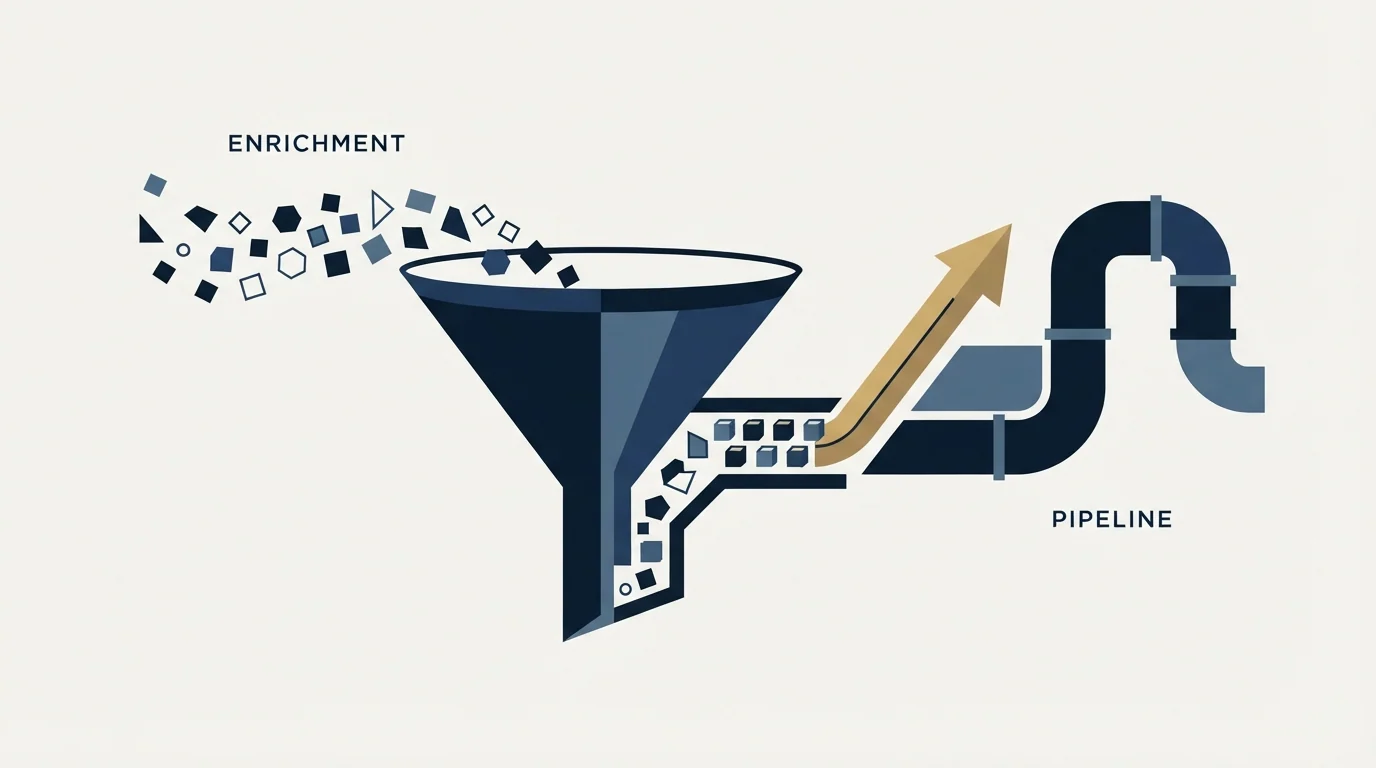
Many sales teams use both a data enrichment tool and a CRM platform as part of their complete workflow. Lead411 handles lead sourcing and data while Pipedrive covers pipeline and deal tracking.
Since both tools integrate with Zapier, connecting them in your workflow is straightforward.
The Decision Shortcut
Answer one question honestly: in the last month, did the team run out of people to contact, or run out of track of the people it had already contacted?
Running out of people points at Lead411; losing track points at Pipedrive. If the answer is both, the tie breaker is which side has a usable free or trial entry point. Pipedrive enters at $14/mo billed annually, and Lead411 at $49/mo on the Spark tier, after a seven day trial. If the answer is neither, the stack is not the constraint.
How These Figures Were Checked
Every figure here was checked against the vendors' own pricing pages, and the two sides of this pair did not come back the same way.
Lead411's pricing page was readable, and every Lead411 figure above was matched whole token against it.
Pipedrive's pricing page renders in the visitor's currency. The figures above are what it showed here, in pounds, so a reader in another region should read the same page for the local price before sizing a budget.
Where a vendor publishes one rate on one tab and another elsewhere, both are stated with the tab they came from.
Related Reading
- Best Lead411 Alternatives in 2026
- Best Pipedrive Alternatives in 2026
- Apollo.io vs Lead411: Data Enrichment Tool Comparison
- Lead411 vs ZoomInfo: Data Enrichment Tool Comparison
- Pipedrive vs Salesforce: CRM Platform Comparison
If you would rather have this run for you, RevenueFlow books qualified meetings on a pay-per-meeting basis and publishes client results.
Pricing and features are taken from the vendors' own pages. Verify current terms with the vendor before relying on them.
Frequently asked questions.
Frequently asked questions- Lead411 vs Pipedrive: which should I buy first?
- Buy the side that closes the gap costing you now. Lead411 first when reach is the constraint: thin lists, rising bounces, rows built by hand. Pipedrive first when memory is: missed next steps, two reps on one account, lost promises. Most teams starting outbound from scratch buy Lead411 first.
- How much does Lead411 cost?
- Lead411 publishes a free Pilot Light trial with 50 exports over 7 days, Spark at $49 a month for 1,000 exports, or $490 a year for 12,000 exports with buyer intent data, and Ignite from $150 a month or $1,500 a year. Blaze, with unlimited exports, is quoted.
- How much does Pipedrive cost?
- Pipedrive's pricing page lists Lite, Growth, Premium and Ultimate at 14, 39, 59 and 79 per seat a month billed annually, in the visitor's currency; it rendered pounds here. Annual billing saves up to 42 percent against monthly, and every plan has a free 14-day trial with no credit card.
- Do Lead411 and Pipedrive integrate?
- Lead411 lists Pipedrive among the CRMs it writes into, and both connect through Zapier. The integration is the handover point: Lead411 produces the record and Pipedrive holds it. Agree which system owns each field and a matching key, such as domain plus person, before the first sync.
About the author.

Tim Carden is CMO / CTO at RevenueFlow, which builds and operates outbound revenue engines for B2B companies. Studied at McGill University.
Tim Carden · CMO / CTO
Connect on LinkedIn →Explore more.
Ready to scale your outreach?
We build GTM engines that book real meetings. See the receipts.
Related articles.
AroundDeal vs Salesflare: Data Enrichment Tool vs CRM Platform Comparison
Compare AroundDeal (data enrichment tool) and Salesflare (CRM platform) side by side. See pricing, features, and integrations to decide which one, or both, your stack needs.
Evaboot vs Microsoft Dynamics 365 Sales: Data Enrichment Tool vs CRM Platform Comparison
Compare Evaboot (data enrichment tool) and Microsoft Dynamics 365 Sales (CRM platform) side by side. See pricing, features, and integrations to decide which one, or both, your stack needs.
Agile CRM vs LeadIQ: CRM Platform vs Data Enrichment Tool Comparison
Compare Agile CRM (CRM platform) and LeadIQ (data enrichment tool) side by side. See pricing, features, and integrations to decide which one, or both, your stack needs.
Anymail Finder vs Pipeline CRM: Data Enrichment Tool vs CRM Platform Comparison
Compare Anymail Finder (data enrichment tool) and Pipeline CRM (CRM platform) side by side. See pricing, features, and integrations to decide which one, or both, your stack needs.
AroundDeal vs Maximizer: Data Enrichment Tool vs CRM Platform Comparison
Compare AroundDeal (data enrichment tool) and Maximizer (CRM platform) side by side. See pricing, features, and integrations to decide which one, or both, your stack needs.
Breakcold vs Bulk Email Checker: CRM Platform vs Data Enrichment Tool Comparison
Compare Breakcold (CRM platform) and Bulk Email Checker (data enrichment tool) side by side. See pricing, features, and integrations to decide which one, or both, your stack needs.