Sales Strategy for Cyber Security Companies: On the Clock
How a security vendor or MSSP sets its sales strategy: the buying group the SEC rule names, the compliance clocks that open buying windows, and direct against channel.
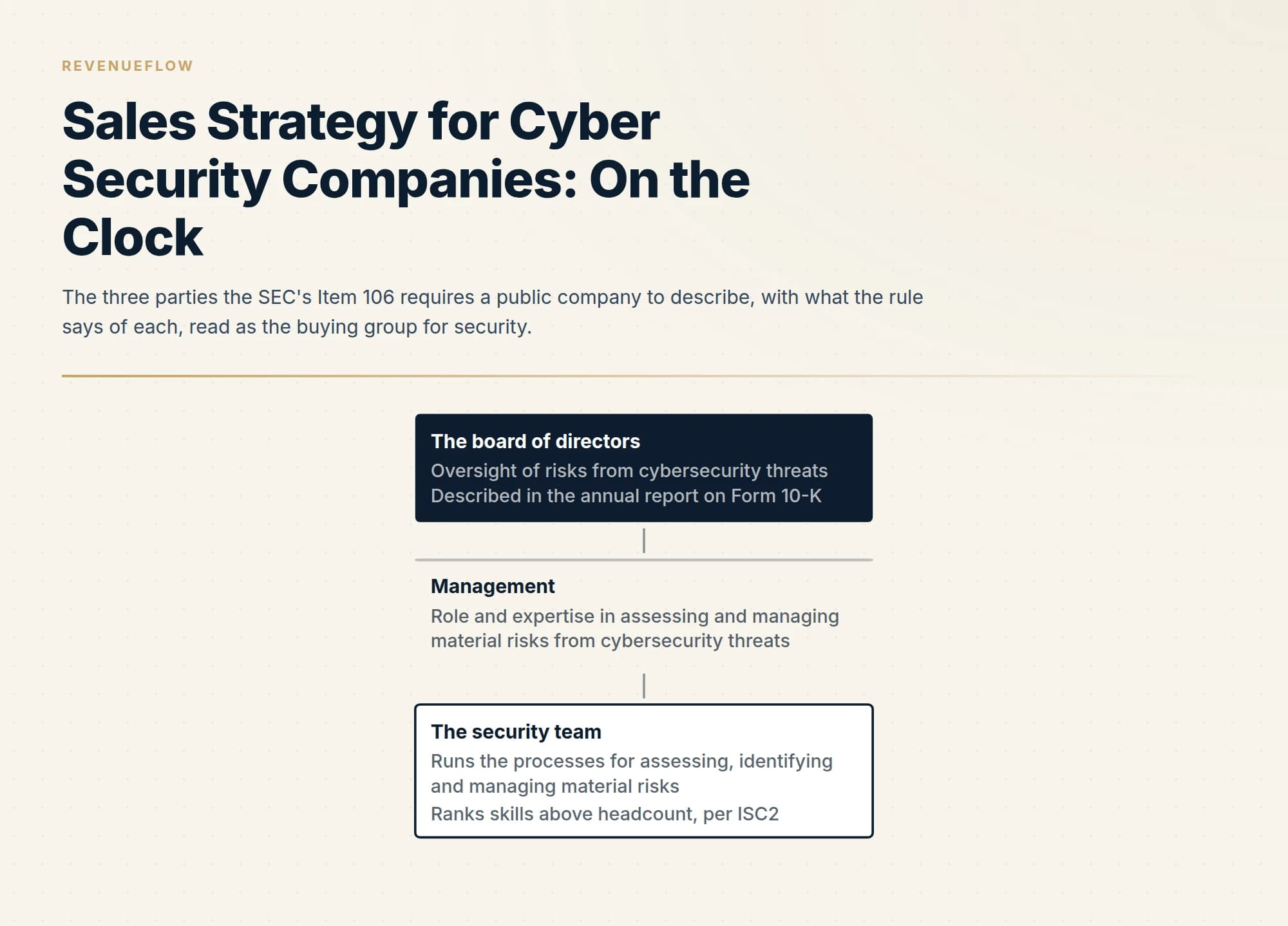
A cybersecurity company's sales strategy rests on three published facts. The SEC's Item 106 names the buying group: the board, management and the security team. Compliance clocks such as the four business day Form 8-K open the buying windows. And ISC2's 2025 study of 16,029 participants says buyers rank skills above headcount, which favours services and the channel.
Key takeaways
- ISC2's 2025 Cybersecurity Workforce Study, with 16,029 participants, reports that 36% of respondent organizations experienced budget cuts in 2025 and that respondents rank critical skills above more people.
- The SEC's rules of 26 July 2023 require registrants to describe their cybersecurity risk processes, the board's oversight and management's role and expertise in the annual Form 10-K, and to file a Form 8-K generally within four business days of a material incident.
- The European Commission describes NIS2 as a unified legal framework for cybersecurity in 18 critical sectors across the EU, and the PCI Security Standards Council retired PCI DSS v4.0 on 31 December 2024.
- CrowdStrike's partner page names channel and distributors, service providers and strategic technology partners, and Check Point runs a separate MSP programme with subscription, consumption or leasing pricing.
Reviewed and updated September 18, 2026
The people a cybersecurity company sells to have told their own professional body what state they are in. ISC2's 2025 Cybersecurity Workforce Study drew on what it calls "A record 16,029 cybersecurity practitioners and decision-makers," and it reports that the share of respondent organizations experiencing budget cuts rose from 30% in 2023 to 37% in 2024 and fell by a single point, to 36%, in 2025 (ISC2, 2025 Cybersecurity Workforce Study, December 2025). On ISC2's count more than a third of respondent organizations are buying with less money than they had, and the study's other headline says what that market thinks it is short of: "Respondents to the 2024 and 2025 studies have prioritized the need for critical skills as more important than the need for more people."
This page is for the security vendor, the managed security service provider and the security consultancy working out their own sales strategy. It is not about selling to cybersecurity companies, which cold email for cybersecurity covers, and it does not repeat the lead generation play for this market, including the argument that nearly every buyer already has a product in place, which is in cybersecurity lead generation. Physical security and guarding are a different vertical. Here the question is strategic: what creates a buying window, who inside the customer has to be part of it, and whether the company sells alone or through someone else.
Who is in the room, as the rules define it
For a public company in the United States, the buying group for security is written into a disclosure rule. The Securities and Exchange Commission's rules adopted on 26 July 2023 added Regulation S-K Item 106, which, in the Commission's words, "will require registrants to describe their processes, if any, for assessing, identifying, and managing material risks from cybersecurity threats." The same item requires registrants to describe the board of directors' oversight of those risks and management's role and expertise in assessing and managing them, in the annual report on Form 10-K. The Commission also adopted rules requiring foreign private issuers to make comparable disclosures (SEC, press release 2023-139, 26 July 2023).
That is three parties, named by a regulator: the board that oversees, the management that holds the role and the expertise, and the security team that runs the processes. A vendor whose strategy reaches only the third is selling to one party of three. A vendor that can explain, without fear and without exaggeration, how its product changes what the company can truthfully write under Item 106 has something to say to the first two.
The workforce study fills in the third party's state of mind. ISC2 reports that the pressures of hiring freezes, layoffs and budget cuts "have leveled off and are not reported at higher rates this year," and that it has stopped publishing a workforce gap estimate because respondents now rank skills above headcount. A team short of skills, not of seats, reads a tool that needs an expert to run it as more work.
The calendar: compliance dates are the buying windows
Security is one of the few markets where the regulator publishes the customer's deadlines. Three regimes set most of them.
The SEC rule has two clocks. The annual one is the Form 10-K, where Item 106 disclosures appear. The incident one is short: "An Item 1.05 Form 8-K will generally be due four business days after a registrant determines that a cybersecurity incident is material." A company that has to decide materiality and file in four business days is a company whose detection, logging and response processes are a board matter.
In the European Union the frame is NIS2. The European Commission describes it this way: "The NIS2 Directive establishes a unified legal framework to uphold cybersecurity in 18 critical sectors across the EU," introducing risk management measures and reporting requirements for entities from more sectors. Its predecessor, the page says, already covered energy, transport, healthcare, finance, water management and digital infrastructure, and the new rules reach further (European Commission, NIS2 Directive, read 18 September 2026). Each Member State adopts its own national strategy under the directive, so the dates a customer faces depend on the country it operates in.
For any company that handles payment cards the frame is PCI DSS. The PCI Security Standards Council's post announcing version 4.0.1 says the revision made "no additional or deleted requirements" and gives the transition date plainly: "PCI DSS v4.0 will be retired on 31 December 2024" (PCI Security Standards Council, Just Published: PCI DSS v4.0.1, read 18 September 2026). A version retirement is a date by which every assessed company has to be working to the newer text.
| Regime | Who it applies to | The clock its page states |
|---|---|---|
| SEC cybersecurity disclosure rules | Registrants, meaning public companies, and foreign private issuers | Form 8-K four business days after an incident is determined material; Item 106 in the annual Form 10-K |
| NIS2 Directive | Entities in 18 critical sectors across the EU | Set by each Member State under its national strategy |
| PCI DSS | Companies assessed against the standard | Version 4.0 retired on 31 December 2024, after version 4.0.1 was published |
Alone or through the channel
The second strategic decision is the route, and the large vendors publish how they have made it. CrowdStrike's partner programme page names three kinds of partner: channel and distributors, to whom it offers "a recurring revenue model that scales, requiring minimal upfront investment"; service providers, invited to "Offer end-to-end security solutions as a service provider or global system integrator (GSI)"; and strategic technology partners (CrowdStrike, partner programme, read 18 September 2026). Check Point runs a separate programme for managed service providers and says why: "Check Point recognizes MSP as a strategic market and is dedicated to delivering an enhanced business offering," with pricing the page describes as subscription, consumption or leasing and no upfront commitments (Check Point, MSP Program, read 18 September 2026).
Put that beside the ISC2 finding and the logic of the channel is clear. A customer short of skills is a customer for a service, and the managed service provider is the company that turns a vendor's product into one. A security vendor's strategy therefore has to say whether it wants the end customer's contract or the provider's. A managed security service provider's strategy has to say which vendors' programmes it builds on, because those programmes set its margins and its pricing model. Selling direct into an account that already buys security as a service from a provider means selling against the provider the customer chose because it lacked the skills to run tools itself.
| Row | Channel and distributors | Service providers | Strategic technology partners |
|---|---|---|---|
| CrowdStrike partner programme | Yes | Yes | Yes |
| Check Point MSP Program | No | Yes | No |
What the rules require of the seller's outreach
The rule on the message is the ordinary one for commercial email. The Federal Trade Commission's guide leaves no room on the point: the CAN-SPAM Act "makes no exception for business-to-business email," each separate email in violation is subject to penalties of up to $53,088, and a valid physical postal address and a clear way to opt out are required in every commercial message (FTC, CAN-SPAM Act: A Compliance Guide for Business, read 18 September 2026).
This vertical needs one more discipline, and it is about truth. A message that tells a named company it has been breached, is about to be, or is out of compliance is making a factual claim the sender almost never has the evidence for. The regimes above are public, so a seller can state what a rule requires and ask how the reader handles it. It cannot state the reader's condition. Whether a specific practice is compliant is a question for counsel.
The objections, from the buyers' own study
The first objection is money, and ISC2 has measured it: 36% of respondent organizations experienced budget cuts in 2025. A proposal that adds a line to a security budget is competing with a cut. One that replaces a line, or moves spending the customer already makes, is a different conversation.
The second is capacity. Respondents rank critical skills above more people, which means the honest question about any new product is who will run it. A vendor that cannot answer with a named partner or a managed option is asking a stretched team to take it on.
The third is fatigue with fear. The SEC's own release quotes its chair putting the matter in plain terms: whether a company loses a factory in a fire or millions of files in a cybersecurity incident, it may be material to investors. Boards now hear about this risk from their regulator. A vendor adds nothing by repeating it and earns attention by being specific about one process.
Channel reality, and when outbound is the wrong play
Written outreach by email and LinkedIn suits this market because the buyer's obligations are public and the message can be about them. RevenueFlow runs that motion, one message per campaign, and does not cold-call.
Direct outbound is the wrong play in three cases. It is wrong into an account that buys security as a service from a provider, where the provider is the buyer and the vendor's partner programme is the route. It is wrong when the message asserts something about the reader's security that the sender cannot know. And it is wrong as a compliance scare tied to a date that has passed or does not apply: a private company is not a registrant, a company outside the 18 sectors is not in NIS2's scope, and a seller who gets that wrong has shown the buyer it did not check. What suppliers writing to security companies see in reply, the opposite direction from this page, is in cybersecurity cold email benchmarks.
Three openers, each grounded in a page the buyer can check
Three sample first lines a security company could send, each tied to one fetched source. They make no claim about results or about the reader's security, name no real person and carry no contact details.
To a chief financial officer at a public company. The SEC's rules require a Form 8-K generally within four business days of determining that a cybersecurity incident is material. The hard part is usually the determination, because it needs the facts quickly. We build the process that gets them to management. If you own part of that decision, a short conversation is the ask. The rule is stated as the Commission states it and nothing is claimed about the reader.
To a head of security operations. ISC2's 2025 study of more than 16,000 practitioners found that respondents rank critical skills above more people. We run our detection product for customers as a service, so it does not need a new specialist on your team. If that is the constraint, a short conversation is the ask. The finding is the profession's own.
To the owner of a managed service provider. Check Point and CrowdStrike both publish partner routes for service providers. We are a smaller vendor with the same model: you hold the customer, and pricing is by consumption. If you are adding a service this year, we would like to show you the margins. The programmes named are public and the offer is a partnership.
To: Chief financial officer, a public company
The SEC's rules require a Form 8-K generally within four business days of determining that a cybersecurity incident is material. 1
The hard part is usually the determination, because it needs the facts quickly. We build the process that gets them to management. If you own part of that decision, a short conversation is the ask. 2
Postal address and opt-out line in the footer. 3
- 1The rule as the Commission's release states it, with nothing claimed about the reader.
- 2One process, written for management's role under Item 106.
- 3The postal address and opt-out line the FTC's CAN-SPAM guide requires of every commercial email.
What the strategy has to decide
A cybersecurity company's sales strategy is four decisions: which regime's clock its customers are on, and therefore when they buy; which of the three parties in the room each message is for; whether it holds the customer's contract or a provider does; and what it will never say, because it cannot know it. The second and fourth are the ones this page would put first.
RevenueFlow sends one message per campaign by email and LinkedIn, agrees what counts as a meeting in writing before launch, and is paid only for attended meetings that meet it. If reaching boards, management and security leaders in writing is the part you would rather have run, you can see what a campaign would look like for your market.
The ISC2, SEC, European Commission, PCI Security Standards Council, CrowdStrike, Check Point and FTC pages were fetched on 18 September 2026 from the pages linked. ISC2's figures come from 16,029 participants; the vendors' statements about their partner programmes are their own. Rules and dates change, and their scope differs by company; confirm them at the source. Nothing here is legal advice.
Sources: ISC2, 2025 Cybersecurity Workforce Study, SEC, press release 2023-139, European Commission, NIS2 Directive, PCI Security Standards Council, PCI DSS v4.0.1, CrowdStrike, partner programme, Check Point, MSP Program, FTC, CAN-SPAM compliance guide
Frequently asked questions.
Frequently asked questions- Who is involved in buying cybersecurity in a public company?
- The SEC's Regulation S-K Item 106 names three parties. It requires registrants to describe their processes for assessing, identifying and managing material risks from cybersecurity threats, the board of directors' oversight of those risks, and management's role and expertise in assessing and managing them, in the annual report on Form 10-K. A vendor whose strategy reaches only the security team that runs the processes is selling to one party of three.
- What compliance deadlines create buying windows for security vendors?
- Three regimes set most of them. The SEC's rules make a Form 8-K generally due four business days after a registrant determines a cybersecurity incident is material, with Item 106 disclosures in the annual Form 10-K. NIS2 covers 18 critical sectors across the EU, with dates set by each Member State. PCI DSS v4.0 was retired on 31 December 2024, after version 4.0.1 was published. Each applies only to the companies in its scope.
- Should a cybersecurity vendor sell direct or through managed service providers?
- ISC2's 2025 study says respondents rank critical skills above more people, and a customer short of skills is a customer for a service. CrowdStrike publishes partner routes for channel and distributors, service providers and strategic technology partners, and Check Point runs a programme for managed service providers with subscription, consumption or leasing pricing. The decision is whether the vendor wants the end customer's contract or the provider's.
- When is direct outbound the wrong play for a cybersecurity company?
- Into an account that buys security as a service from a provider, where the provider is the buyer and the partner programme is the route. When the message asserts something about the reader's security that the sender cannot know. And as a compliance scare tied to a rule that does not apply, since a private company is not a registrant and a company outside the 18 sectors is outside NIS2's scope.
About the author.

B2B cold email experts helping companies generate qualified leads through done-for-you outreach campaigns.
RevenueFlow Team
Explore more.
Ready to scale your outreach?
We build GTM engines that book real meetings. See the receipts.
Related articles.
Sales Strategy for Logistics Companies: Segment, Seat, Cycle
How a broker, forwarder, carrier or 3PL sets its sales strategy: Armstrong's segments and contract terms, the four provider seats shippers keep, and the rate cycle.
Sales Strategy for Manufacturing Companies: Direct or Reps
How a manufacturer decides whose salespeople carry its line: the published definition of a representative, MANA's agreement clauses and the split commission problem.
Lead Generation for Trucking Companies: Three Routes
How a motor carrier finds freight customers: the load board, the broker relationship and the shipper's annual bid, with the calendar and the rules on outreach.
MEDDIC vs BANT: What Each Qualifies and When to Use Which
MEDDIC and BANT from the originators' own text: IBM's BANT form as a gate after the first call, PTC's six themes as an audit of a live deal, and when to run each.
Gap Selling vs SPIN Selling: What Each Method Diagnoses
Gap Selling and SPIN Selling from their authors' own pages: four question types that develop a stated need, against a measured gap between two states.
Merchant Services Cold Calling Scripts: The Honest Version
Six call scripts for merchant services agents and ISO reps, built around what the FTC alleged about this exact call: no affiliation claim, no rate before a statement.