Sales Strategy for Medical Device Companies: Coverage Before Pitch
For device makers planning field sales: direct reps, independent reps or distributors, credentialing as a gate, group contracts, hospital fiscal years and conduct rules.
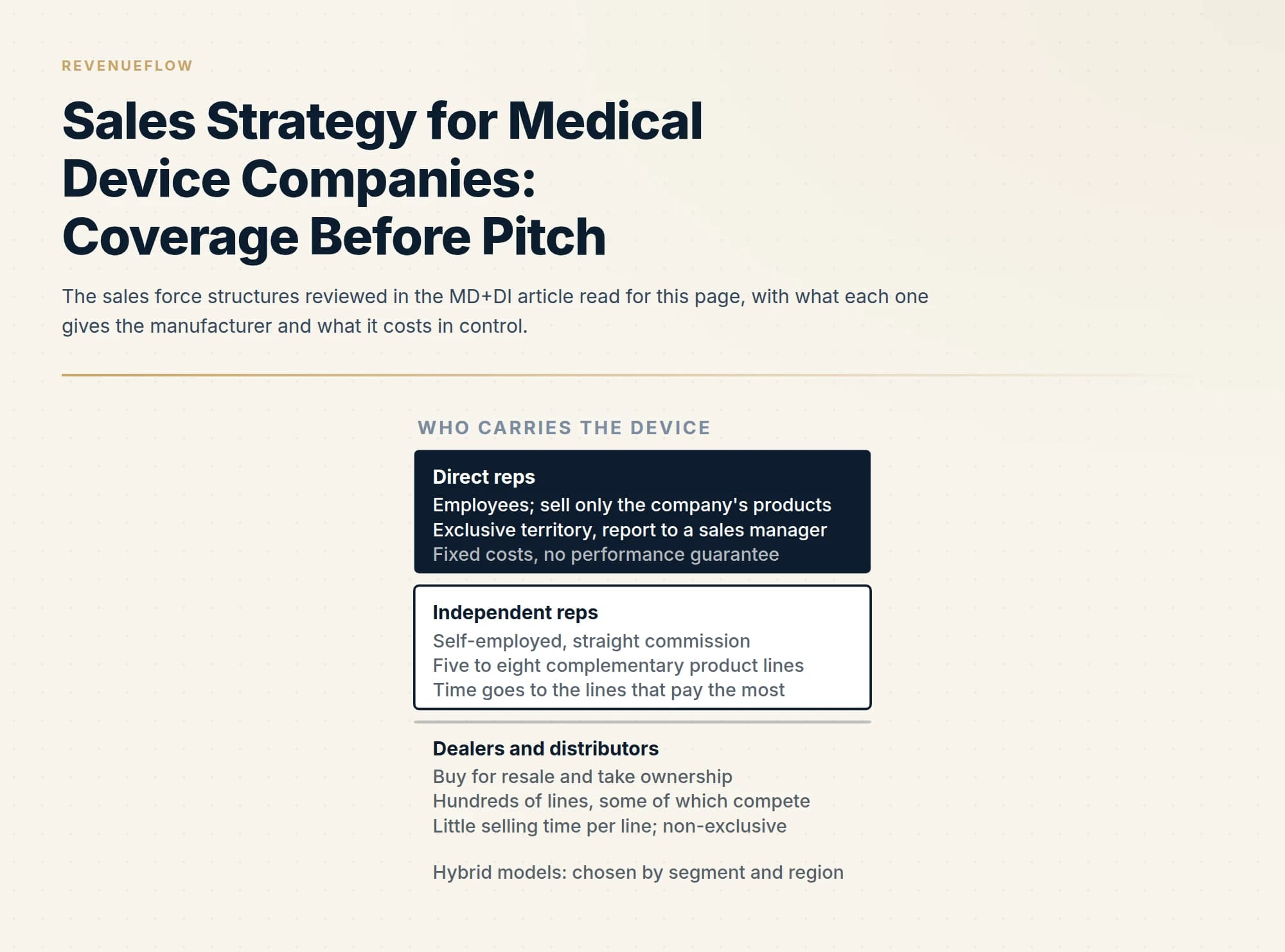
A medical device sales strategy is decided by coverage, access and contract before the pitch. Choose direct reps, independent reps or distributors by what each segment's volume can pay for, give rep credentials an owner because requirements vary by facility, and record each hospital's group purchasing contract and fiscal year-end on the account.
Key takeaways
- MD+DI's review of medtech sales forces, dated 1 September 2008, sets out four structures: direct reps, independent reps carrying five to eight complementary lines, dealers and distributors handling hundreds of lines, and hybrid models.
- GHX wrote on 29 August 2023 that hospital credentialing requirements vary from facility to facility even within one health system, with no standard set; Ballad Health calls product demonstration a privilege, not a right.
- The Healthcare Supply Chain Association says group purchasing organisations negotiate contracts but do not purchase, and that most providers make group purchasing selections in a committee of clinicians.
- Hospital finance leaders in an HFMA forum said most not-for-profit and for-profit hospitals use calendar years while state and local hospitals traditionally close in June or September; CMS publishes Open Payments data by 30 June.
Reviewed and updated September 18, 2026
Sales Strategy for Medical Device Companies: Coverage Before Pitch
Picture a device company with a newly cleared product and fresh funding that hires six direct reps, gives each a region and a quota, and sends them out. Three months later two of them have still not been inside the hospitals that matter most, because their credentials at those facilities lapsed and nobody at the company was tracking it. A third has a surgeon who loves the product and a hospital that buys through a group contract the company is not on. The pitch was never the problem. The coverage, the access and the contract were.
This page is for the medical device company planning its own field sales: the chief commercial officer, the sales vice president or the founder deciding how the product gets carried into facilities. The regulatory gate, the buying committee and the evidence question are already set out in medical device go-to-market strategy, and the committee is not described again here. Companies selling services to device makers want cold email for medical devices. What follows is the field layer: who carries the product, how a rep gets through the door, which contract the hospital buys on, and the calendar and conduct rules around all three. Sources were fetched on 18 September 2026.
Four ways to carry a device into the field
The clearest map of the options is an old one, and it is cited here as such. Writing in MD+DI on 1 September 2008, John C. Zimmer reviewed four common sales force structures for a medtech company: direct reps, independent reps, dealers and distributors, and hybrid models, with the right choice depending on the company's size, available cash, sales objectives and need to establish market share.
Direct reps are employees who sell only the company's products, hold an exclusive territory and report to a sales manager. Zimmer calls a dedicated force a luxury that comes at a cost, and wrote that adequately staffing one with specialists was prohibitive for all but large companies because the fixed costs are too high and carry no performance guarantee. Independent reps are self-employed, work on straight commission, carry their own expenses and typically represent five to eight complementary product lines, giving their time to the lines that pay the most for the least effort. Their territories are often larger than a direct rep's. Dealers and distributors buy products for resale and take ownership of them, including shipping, billing and collections, and commonly handle hundreds of lines, some of which compete. His two concerns about selling only through them are the lack of selling time any one person gives any one line, and non-exclusivity.
His figures are from 2008 and are not repeated as current. The structure is what lasts. One of his observations explains why the choice matters to most of the industry: citing the Dun and Bradstreet database at the time, Zimmer wrote that only 4 percent of medtech companies had annual sales of 50 million dollars or more.
Access is a gate the sales plan has to staff
RepMove, a vendor of rep software, described the work on 5 September 2025 as a business-to-business, field sales-based industry in which reps meet face to face at hospitals, clinics and surgical centers, and split it into capital equipment, disposables, and the more specialised categories of implants and diagnostics. Face to face means getting into the building, and the buildings have rules.
GHX, which runs a credentialing service, wrote on 29 August 2023 that hospital vendor credentialing requirements have grown in scope and complexity, that they can vary from facility to facility even within the same health system, and that there is no standard set. Essentially anyone not employed by the hospital who represents an outside organisation needs credentialing, it says, and denial of access can mean lost business opportunities and revenue. The hospitals say the same thing more bluntly. Ballad Health's vendor page states that demonstration of products by vendor representatives at any of its facilities is a privilege, not a right, that non-compliance will result in financial penalty or suspension of privileges at all locations, that it works through the vendor management agency symplr, and that it will not remind a rep of upcoming expirations. UC Davis Health runs a Vendor Access Program to monitor on-site visits, and expects suppliers to know and adhere to the rules of each unit they wish to visit.
For a sales strategy this is a staffing line. Somebody owns credentials for every rep at every facility, and a rep's real territory is the set of facilities where they are current.
The contract the hospital buys on
The Healthcare Supply Chain Association, the trade body for group purchasing organisations, explains the mechanism in its own FAQ. A group purchasing organisation aggregates the purchasing volume of hospitals, nursing homes, surgery centers and clinics and negotiates contracts with manufacturers and distributors. It does not purchase anything: after a contract is created it is still up to the hospital to decide which product is appropriate and to make the purchase. Most providers make group purchasing selections in a committee of doctors, nurses and other clinicians. The organisations are financed in part by administrative fees paid by vendors, and the FAQ cites a 2010 Government Accountability Office report that put the average weighted fee between 1.22 and 2.25 percent.
SPOTIO, another field sales software vendor, wrote on 13 July 2026 that generic customer profiles do not work in medtech, that the addressable market should be segmented into hospitals and integrated delivery networks, ambulatory surgery centers, physician offices and outpatient clinics, and that a value analysis committee, not a single physician, decides which products get approved. The strategic consequence is that the account list carries the contract: which group purchasing organisation each facility uses and whether the company is on it. How the committee itself works is in the go-to-market page linked above, and how to build the target list around it is in medical device lead generation.
The calendar: fiscal years and the disclosure cycle
Hospital finance leaders answered the fiscal year question in a forum published by the Healthcare Financial Management Association. David A. Williams, a partner at Horne LLP, wrote that most not-for-profit and for-profit hospitals have calendar years while most state, local government or hospital-district hospitals traditionally have a June or September year-end. Robert J. Ellertsen, an interim chief financial officer in Massachusetts, wrote that nearly all of that state's not-for-profit acute care hospitals have a 30 September year-end. Marty Knutson, a health lawyer, described the end-of-year nuttiness that a calendar fiscal year adds to December. A capital equipment plan that treats every hospital as closing its budget in December is wrong for public hospitals and for a whole state.
The second calendar is the government's. The Centers for Medicare and Medicaid Services describes Open Payments as a national disclosure programme with a publicly accessible database of payments that reporting entities, including medical device companies, make to covered recipients like physicians. Companies collect data from 1 January to 31 December, submit it between 1 February and 31 March, covered recipients review and dispute from 1 April to 15 May, corrections run to 30 May, and publication is on or by 30 June. The programme year 2025 data holds 17.07 million published records.
The rules that shape what a rep may do
Three sets of rules reach rep conduct. Open Payments makes what a company gives a physician public, and CMS notes that it does not comment on which relationships may be beneficial or a conflict of interest; it publishes the data and leaves interpretation open. The AdvaMed Code of Ethics gives medical technology companies guidance on interactions and relationships with health care professionals, strongly encourages a company that adopts it to submit a biennial certification that it has an effective compliance programme, and carries revisions effective 1 November 2025 on handling data responsibly. And each facility has its own policy: UC Davis Health says its vendor relations policy exists to reduce the potential for industry influence on providers' decisions and points vendors to its gifts policy.
For written outreach to administrators and supply chain staff, the Federal Trade Commission's CAN-SPAM guide says the Act makes no exception for business-to-business email and requires accurate header information, subject lines that are not deceptive, a valid physical postal address and an opt-out honoured within 10 business days. None of this is legal advice.
Channel reality, and when each model is the wrong play
This vertical sells in person, and its own sources say so. Our own motion is email and LinkedIn, one message per campaign and no bump sequences, and in medical devices its honest use is narrow: opening conversations with supply chain, value analysis and administrative contacts who work at a desk, and with distributors and independent rep groups a manufacturer wants to recruit. It does not replace the rep in the procedure room, and we do not claim it does.
- No: A direct force: the company cannot carry fixed costs that come with no performance guarantee
- No: Distributors only: the product needs selling time that a catalogue of hundreds of lines will not give it
- No: Independent reps: the line pays less for more effort than the others they carry
- No: Any visit: the rep's credentials at that facility are not current
- No: Any account: the hospital buys on a group contract the company is not on, and nobody has checked
- Yes: A hybrid: each segment or region gets the model its volume can pay for
Three openers, for the desks a message can reach
Each rests on one fetched source. The companies and facts in them are invented for illustration, and none claims a result.
To a supply chain director at a regional health system
We make single-use retractors and are not yet on your group purchasing contract for that category. Before we ask any of your surgeons for time, could you tell me how a new vendor is reviewed at your system, and who coordinates it? 1
To the administrator of an ambulatory surgery center
Our rep for your area is credentialed at the two hospitals nearest you and would like to be at your center too. Which vendor management service do you use, and is there a unit policy she should read first? 2
To the principal of an independent rep group
You carry orthopaedic lines in three states where we have no coverage. Our line is complementary to the ones on your site and competes with none of them. Would you look at the commission terms and tell me if it earns a place in the bag? 3
- 1Built on the HSCA explanation that hospitals buy on negotiated group contracts and decide product selection in committee; the ask is the process, not a meeting with a clinician.
- 2Built on GHX and the hospital pages: requirements vary by facility and each unit has rules; asking first is the compliant opening.
- 3Built on the MD+DI description of independent reps carrying five to eight complementary lines and giving time to the ones that pay.
Writing the plan
Choose the coverage model by segment and region, from what the volume can pay for. Give credentials an owner and count a rep's territory as the facilities where they are current. Put the group purchasing contract and the fiscal year-end on every account record. Train reps on the company's adopted code and on what becomes public in June each year. The general planning worksheet is the sales strategy template.
If the constraint is opening conversations with supply chain and administrative buyers, or recruiting distribution, RevenueFlow books qualified meetings on a pay-per-meeting basis, by email and LinkedIn, with the qualification criteria agreed in writing before launch.
Sales force structures per John C. Zimmer in MD+DI, 1 September 2008; field description per RepMove, 5 September 2025; segmentation per SPOTIO, 13 July 2026; credentialing per GHX, 29 August 2023, Ballad Health and UC Davis Health; group purchasing per the Healthcare Supply Chain Association FAQ; fiscal years per the HFMA forum; disclosure per CMS Open Payments; conduct guidance per AdvaMed; email rules per the FTC's CAN-SPAM guide. All fetched 18 September 2026.
Sources: Sales Force Strategies for a Competitive Advantage, MD+DI, Medical Device Sales Playbook, RepMove, Medical Device Sales Strategies, SPOTIO, Vendor Credentialing in Hospitals, GHX, Vendors, Ballad Health, Vendor Credentialing, UC Davis Health, FAQ, Healthcare Supply Chain Association, Hospital Fiscal Year Forum, HFMA, Open Payments, CMS, AdvaMed Code of Ethics, CAN-SPAM Act Compliance Guide, FTC
Frequently asked questions.
Frequently asked questions- Should a medical device company use direct reps or distributors?
- It depends on what each segment can pay for. MD+DI's 2008 review describes direct reps as a dedicated force with fixed costs and no performance guarantee, independent reps as commission-only sellers who give time to the lines that pay most, and distributors as resellers of hundreds of lines with little selling time for any one. Many companies run a hybrid, assigning a model by segment or region.
- What is vendor credentialing in medical device sales?
- It is the screening a hospital requires before an outside representative may enter. GHX wrote on 29 August 2023 that requirements vary from facility to facility, even within the same health system, and that there is no standard set. Ballad Health, for example, works through the agency symplr, does not remind reps of expirations, and can suspend privileges at all its locations for non-compliance.
- How do group purchasing organisations affect device sales?
- They set the contract many hospitals buy on. The Healthcare Supply Chain Association explains that a group purchasing organisation aggregates volume and negotiates contracts with manufacturers, but does not purchase; the hospital still chooses the product. Selections are usually made in a committee of clinicians, and vendors pay administrative fees. A sales plan should record which organisation each account uses and whether the company is on contract.
- When do hospitals close their fiscal year?
- It varies by ownership. In a Healthcare Financial Management Association forum, a partner at Horne LLP wrote that most not-for-profit and for-profit hospitals use calendar years while state, local government and hospital-district hospitals traditionally close in June or September, and a Massachusetts finance executive wrote that nearly all of that state's not-for-profit acute care hospitals close on 30 September.
About the author.

B2B cold email experts helping companies generate qualified leads through done-for-you outreach campaigns.
RevenueFlow Team
Explore more.
Ready to scale your outreach?
We build GTM engines that book real meetings. See the receipts.
Related articles.
Merchant Services Cold Calling Scripts: The Honest Version
Six call scripts for merchant services agents and ISO reps, built around what the FTC alleged about this exact call: no affiliation claim, no rate before a statement.
Appointment Setting for 3PL Companies: Fit Before the Calendar
For 3PLs, warehousing operators and brokers wanting shipper meetings: the five fit gates, the bid calendar, contract terms, the trade's rules and three openers.
LinkedIn Outreach for Machine Shops
How a job shop or CNC machine shop uses LinkedIn to win OEM work: the four buyer titles, the RFQ gate, the ISO, AS9100 and ITAR facts, and LinkedIn's own rules.
Lead Generation for Telecommunications Companies: Four Lead Sources
For carriers, ISPs, UCaaS providers and MSPs: the installed base, the advisor channel, dated outbound and the funded network map as lead sources, with FCC rules.
Sales Outsourcing for SaaS Companies: What to Hand Over
For SaaS companies weighing an outside sales team: what the industry's own survey found, what a third party cannot hold in a software sale, and what can go out.
Cold Calling Scripts for SEO Agencies: After Google's Warning
Six call scripts for SEO agencies calling local businesses, written around what Google and the FTC tell owners about this call: no Google tie, no ranking guarantee.