Sales Training Statistics, Traced to Their Sources
Every circulating sales training figure followed to whatever produced it, from a named survey of seventy one professionals to an 1885 memory experiment.
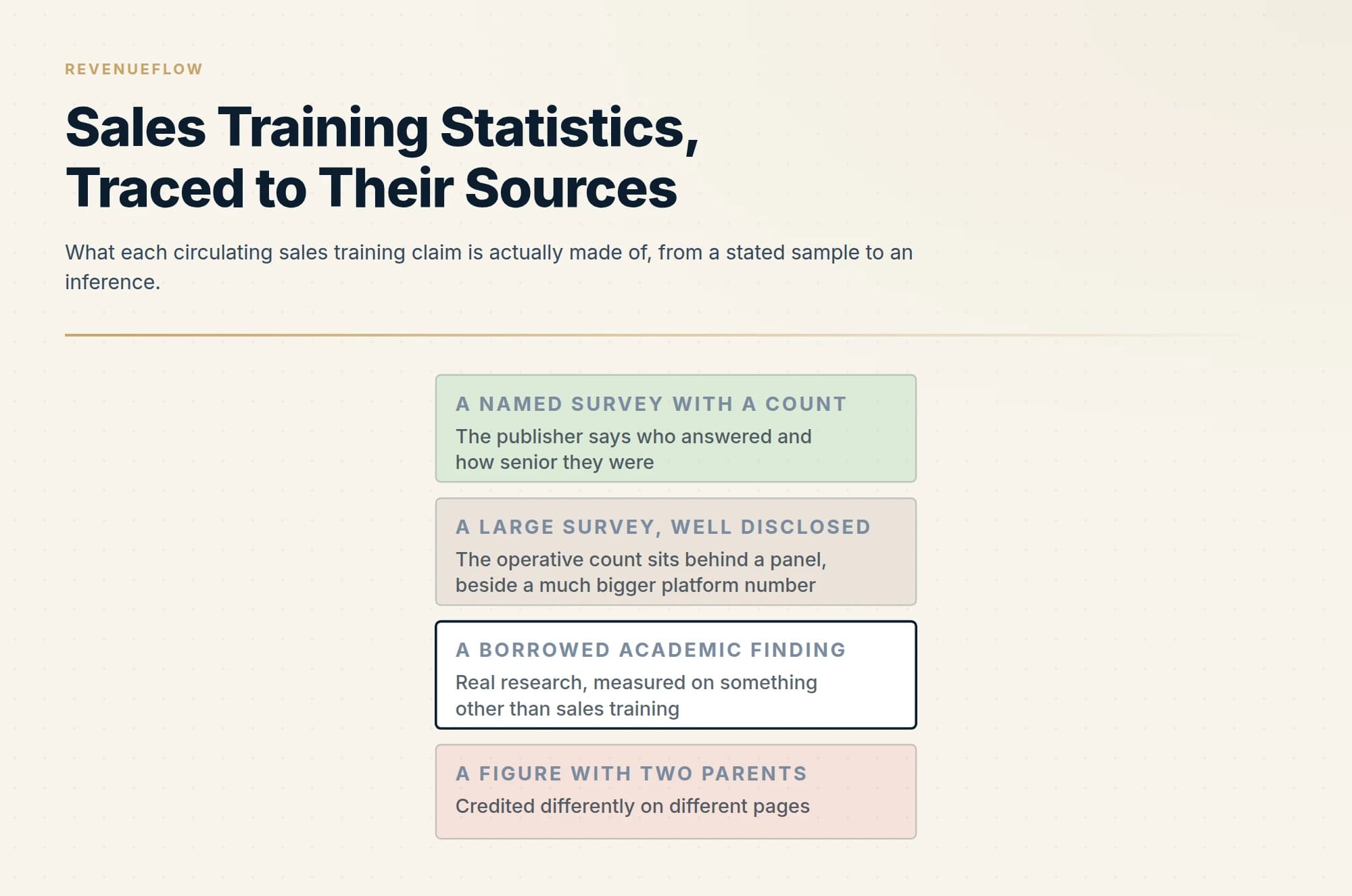
The sales training literature has one well disclosed survey of seventy one talent development professionals, one large report whose operative sample sits one disclosure from its headline number, one borrowed academic paper from 1984, and a family of retention percentages that different pages attribute to two incompatible sources.
Key takeaways
- The most repeated claim in this field, that reps forget most of a workshop within a month, is credited to a research firm on one page and to an 1885 self experiment with nonsense syllables on another.
- The best disclosed sales training research states its respondent count openly, and that count is seventy one talent development and sales enablement professionals with the seniority split published beside it.
- The largest recurring workplace learning report opens on a billion platform members and puts the survey behind its quotable findings, nine hundred and thirty seven professionals, one disclosure away.
- The widely quoted return per dollar of training spend could not be traced to any named publisher, population or year.
Reviewed and updated September 21, 2026
The most repeated statistic in this field is that sales reps forget eighty seven percent of what they were taught within a month. Two pages carrying that figure on 21 September 2026 give it two different parents. One credits it to Gartner, writing that "sellers forget 70% of what they were taught within a week, and 87% within a month". The other traces it to a German psychologist, saying that Hermann Ebbinghaus published research in 1885 on the forgetting curve, which it describes as "the predictable rate at which humans lose newly acquired information without reinforcement".
Those are not the same claim. One is contemporary research into sellers. The other is a nineteenth century experiment about memory in general, and its own encyclopedia entry describes the method plainly: "From 1880 to 1885, Hermann Ebbinghaus ran a limited, incomplete study on himself and published his hypothesis in 1885", memorising nonsense syllables and testing himself at intervals. A finding about one man recalling invented syllables is being quoted as a measurement of what a sales team retains from a workshop.
This page does the same job for sales training figures that sales statistics does for the wider literature: follow each circulating number to whatever produced it, say what it counted, and keep only the ones that survive.
The figure that does carry a population
One body of research into sales training states its respondent count on the page, and the number is smaller than most people assume.
The Association for Talent Development published its 2023 State of Sales Training research, and the announcement states the scope exactly: "This research surveyed 71 talent development and sales enablement professionals about sales training in their organizations. Of these, 25 percent were directors or above, 46 percent were managers or supervisors, and 25 percent were individual contributors." That is a named organisation, a named report, a stated population, a stated seniority mix and a date of 5 July 2023.
Seventy one people is a small sample and saying so is not a criticism. It is the disclosure that lets a reader decide what the findings can carry. The same release reports that organisations "dedicate 63 percent of their sales budget to internal costs, such as talent development, sales enablement staff salaries, and the costs to deliver sales training", that sales training content "was created by a dedicated internal sales enablement function at 40 percent of responding organizations, but this figure rose to 56 percent for high-performing organizations", and that on the job coaching by managers "was the top method of on-the-job learning for salespeople, used to a high or very high extent by 56 percent of respondents."
A second ATD release on the same research family reports that "60 percent of organizations provided quarterly skills training to their sales personnel" and that "Nearly nine in 10 organizations used a sales process or sales methodology to support their sales training, compared to 69 percent that used a sales competency model." Read as evidence about what seventy one talent development professionals report about their own organisations, those are usable. Read as facts about the industry, they are a sample of that size being asked to describe an economy.
The report whose impressive number is not its operative one
LinkedIn's 2025 Workplace Learning Report is the largest recurring piece of research that touches sales training, and it is genuinely well disclosed. The catch is where each number sits.
Its summary names three inputs: "The data in this report comes from three primary sources: interviews with global talent leaders; the annual Workplace Learning survey; and studies of LinkedIn platform data derived from 1 billion members, 14 million jobs, and 5 million profile updates per minute."
Open the methodology panel on the same page and the survey behind the quotable findings is described exactly: it "surveyed 937 L&D and HR professionals with L&D responsibilities who have some influence on budget decisions and 679 learners", across named geographies in North America, South America, Asia Pacific and Europe.
Nine hundred and thirty seven professionals is a solid sample and it is not a billion of anything. The billion members belong to the platform analysis; almost every figure a roundup lifts from the report belongs to the survey. Both numbers are on the page, one in the opening summary and one behind a disclosure, and a reader who takes the first as the basis for the second has overstated the research by six orders of magnitude without being misled by anybody.
That pattern is the standard shape of this literature rather than a flaw peculiar to one publisher: the impressive number and the operative number are different numbers, presented together.
The claims with no original at all
Three figures circulate constantly and none of them could be traced to a publisher on 21 September 2026.
The first is the return figure, usually given as several dollars back for every dollar spent on sales training. Every page carrying it attributes it to research, and none of them names the research, the population, the industries or the year.
The second is the share of companies that believe their training works, commonly quoted as roughly a quarter. It appears without a survey behind it.
The third is the family of retention figures above, which circulate in four incompatible forms. Seventy percent in a week, eighty seven percent in a month, eighty four percent in three months, ninety percent in a week. Those are four different curves quoted as one finding, and the two attributions in circulation, a research firm and an 1885 self experiment, cannot both be right.
None of that means the underlying idea is wrong. Knowledge decays without reinforcement, and the argument for coaching over a single workshop stands on its own without a percentage attached. That is exactly how our guide to sales training for cold calling puts it: the decay problem is an argument for a practice loop, not a number to quote.
- 1885Ebbinghaus publishes the forgetting curve
A self experiment on memorising nonsense syllables, not a study of sales training
- 1984Bloom compares three ways of teaching
Classroom teaching, mastery learning and one to one tutoring, in an education journal
- 2023ATD publishes its sales training research
A named survey with its respondent count and seniority mix stated on the page
- 2025LinkedIn Learning publishes its annual report
A survey of professionals and learners, disclosed in a methodology panel
The one academic finding worth carrying
Underneath the borrowed retention statistics sits a real paper that is rarely named, and it says something more useful than any of them.
One of the pages tracing the decay claim gives the citation. It reports that in 1984 Benjamin Bloom published a paper in the journal Educational Researcher "comparing three instructional conditions: conventional classroom teaching, mastery learning with structured feedback and correction, and one-on-one tutoring combined with mastery learning". The reported result is that individual tutoring with mastery learning outperformed conventional classroom instruction by about two standard deviations.
The reason Bloom called it a problem is the part that transfers. As that page puts it, "One-on-one tutoring for every student was too expensive to run broadly." The finding was never that classroom teaching does not work. It was that the thing which works much better does not scale, which is precisely the constraint a sales organisation meets when it compares a workshop with weekly coaching.
Two cautions before carrying it anywhere. It is a study of instruction in education rather than of selling, so it is evidence about teaching methods and not about quota attainment. And a sales page quoting it is quoting a paper from 1984 that it has usually not read, which is the same behaviour this page has been documenting throughout.
What to measure instead
The reason all of this matters operationally is that a borrowed figure is almost always standing in for a measurement you could take.
Before buying training, split your own numbers into the rates that a programme can actually move, which is the argument sales training for cold calling makes at length: a weak connect rate is a data problem, a weak conversation to meeting rate points at the offer or the targeting, and only the middle rate is a skills problem. Record those three for the month before the programme runs. Compare the month after. That comparison is worth more than any published return figure because it is measured on your team, your list and your market.
Then measure retention the same way rather than quoting a curve. Take the specific behaviour the training was meant to change, sample a handful of real calls or messages per rep per month, and check whether the behaviour is still present at thirty and ninety days. If it is not, you have your own decay figure, measured on the only population that matters, and you never needed the nineteenth century one. Who sells which kind of programme, grouped by what each one teaches, is set out in sales training programs, and the seat level version of the same question is in SDR training.
- 1Who collected it. The page reprinting a figure and the organisation that produced it are usually different, and only the second can be checked.
- 2How many people answered, stated somewhere a reader can actually reach rather than implied by a platform's size.
- 3Who they were: talent development professionals, sellers, or the organisations those people describe.
- 4What year the research itself was done, which is a different fact from the year on the article quoting it.
The short version
The sales training literature has one well disclosed survey, one large report whose survey count sits one disclosure away from its findings, one borrowed academic paper that is better than the figures taken from it, and a family of retention percentages with two incompatible attributions.
Quote the first as what it is, evidence about what seventy one talent development professionals reported in 2023. Quote the second against its survey of nine hundred and thirty seven professionals rather than against its billion members. Cite Bloom for what he actually studied. And stop quoting the forgetting curve as a sales statistic, because the study behind it was one person memorising invented syllables in the 1880s.
Then measure your own. Three rates before the programme, the same three after, and a monthly sample of real work to see whether the behaviour survived. If the underlying problem turns out to be the number of conversations rather than what happens inside them, see what a first campaign produces against your own market.
Figures and wording above were read on the publishers' own pages on 21 September 2026, with dated snapshots kept as evidence, and each is attributed to the page it appears on. RevenueFlow sells no training and holds no training data of its own. Verify current figures at source before relying on them.
Frequently asked questions.
Frequently asked questions- Do sales reps really forget 87 percent of training in a month?
- Nobody quoting that figure can show you what produced it. One page credits it to a research firm without linking the research; another traces it to Hermann Ebbinghaus, whose 1885 work was a self experiment on memorising nonsense syllables. Four different retention curves circulate as one finding, so treat the idea as sound and the percentage as unusable.
- What is the most reliable sales training statistic?
- The Association for Talent Development's sales training research, because it publishes its respondent count and seniority mix on the page. Its 2023 edition surveyed seventy one talent development and sales enablement professionals. LinkedIn's Workplace Learning Report discloses a larger one, nine hundred and thirty seven professionals plus six hundred and seventy nine learners, in a methodology panel.
- Is there evidence that coaching beats classroom sales training?
- The evidence usually cited is Benjamin Bloom's 1984 paper in Educational Researcher, which compared conventional classroom teaching with mastery learning and with one to one tutoring, and found tutoring far ahead. It is a study of instruction in education rather than of selling, and Bloom's own point was that the better method does not scale.
- How do I measure whether sales training worked?
- Record the three calling rates the programme is meant to move for the month before it runs: dials to connects, connects to conversations, conversations to meetings. Compare the month after. Then sample a handful of real calls per rep at thirty and ninety days to see whether the specific behaviour survived. That is your own decay figure.
About the author.

Hosun Chung is COO at RevenueFlow, which builds and operates outbound revenue engines for B2B companies. Previously at Gleacher Shacklock LLP. Studied at London School of Economics.
Hosun Chung · COO
Connect on LinkedIn →Explore more.
Ready to scale your outreach?
We build GTM engines that book real meetings. See the receipts.
Related articles.
Sales Enablement Statistics, Traced to Their Sources
The sales enablement figures in circulation, followed to their publishers: which state a population, which are gated, and which are quietly seven years old.
B2B Marketing Conversion Rates: Who Published What
Every published B2B conversion benchmark, by channel and by stage, with the publisher, the population, the method and the date beside each figure.
Real Estate Cold Email Reply Rate Benchmarks (2026)
No vendor publishes a real estate cold email benchmark. Here are the published reply-rate tiers that do apply, and how to read your own results.
Legal Services Cold Email Reply Rate Benchmarks (2026)
Cross-industry cold email reply rates average 3.43%. Here is what good looks like when your list is law firms, plus the levers with real data behind them.
Cold Email Conversion Benchmarks: 2026 Performance Data
Complete benchmark data for cold email conversion rates from reply to meeting to opportunity. Learn what drives conversions and how to optimize your full funnel.
Education Cold Email Benchmarks: 2026 Performance Data
Industry benchmark data for education cold email campaigns, including open rates, reply rates, and conversion metrics for companies targeting K-12 schools, higher education, and corporate training organizations.