B2C CRM: The Object Model It Leaves Out
A B2C CRM is customer relationship management software for selling to individual consumers. In the B2C CRM model the person is the record, with events and purchases attached, and automation messages large segments on behaviour. It leaves out the account and opportunity objects a B2B sale depends on, which is why B2B teams should not buy one.
Key takeaways
- A B2C CRM is built around a person record and their behaviour, while a B2B CRM is built around an account, the people at it and the deals in progress.
- The B2C CRM model often has no account object and no opportunity object with stages, so there is nothing to route, suppress at company level or forecast over.
- A B2B outbound team that buys a consumer system loses account-level suppression, ownership and routing, a record of the buying committee and a forecastable pipeline.
- If the thing you sell to is an organisation you need an account object, even in high-volume small business selling, because volume changes the cadence and not the model.
A B2C CRM is customer relationship management software built for selling to individual consumers, where the record at the centre of the system is a person rather than a company. Volumes are high, purchases are frequent and quick, and the work the software is optimised for is segmenting a large audience and messaging it on behaviour.
A B2B CRM inverts every one of those assumptions. The unit of purchase is an organisation, several people at it decide together, the cycle runs for months, and the record that matters is the account. The two products share a category name and a set of screens, and they are built around different objects.
What is a B2C CRM, and what is the B2C CRM model?
A B2C CRM is a CRM for selling to consumers. The B2C CRM model puts one person at the centre of the record and hangs their behaviour off it: what they browsed, bought, opened and returned. The system segments a large audience on that behaviour and messages each segment automatically. It has no company record and no deal record, because a consumer purchase needs neither.
What each model is optimised for
The clearest way to hold the difference is to ask what the system is a record of, which is the same question any CRM has to answer first and is set out in CRM basics.
A consumer system is a record of a person and their behaviour: what they browsed, bought, opened, returned and how long ago. Its natural operations are segment, trigger and send, at a volume where no human reads an individual record before a message goes out. Its reporting is cohort reporting.
A business system is a record of an account, the people at it, the potential purchases in progress and what has happened with each. Its natural operations are qualify, route, advance a stage and forecast. Its reporting is pipeline reporting, and a human reads the record before most outbound actions.
| B2C CRM: the person is the record | B2B CRM: the account is the record | |
|---|---|---|
| Who decides | One buyer, alone and quickly | A committee, over weeks or months |
| The audience | Large, segmented by behaviour and lifecycle | Small target lists selected on company attributes |
| Richest fields | Purchase history and events | Company attributes and deal state |
| Before a message | Automation sends to segments with no human read | A person reads the record first |
| Success is | Retention, repeat rate and lifetime value | Pipeline, win rate and forecast accuracy |
Neither column is a better product. They are answers to different questions, and a team that buys from the wrong column spends a year fighting the software's assumptions rather than its limitations.
Where the object model actually diverges
Three differences carry the weight here, and they are structural rather than cosmetic.
There is often no account object. A consumer system stores people and, where a household or a subscription exists, a light grouping. A B2B motion needs the company as a first-class record with its own identity rule, because everything downstream depends on it: a contact with no company attached cannot be routed, cannot be suppressed and cannot be reported on. The order those objects have to be built in is in CRM setup for an outbound team.
There is often no opportunity object with stages and exit criteria. Consumer purchases are transactions, recorded after the fact. Business purchases are forecast before they happen, which requires a record carrying a value, a close date, a stage and an owner. Without that object there is nothing to run a forecast over and nothing for pipeline management in a CRM to be about.
The rich fields point the other way. A consumer platform is deep on events and shallow on firmographics. A business platform is the reverse. That matters because a B2B target list is selected on company attributes, and a system with nowhere to store industry, headcount or technology stack cannot hold the segment definition that the next campaign will be built from.
There is a fourth difference that is easy to miss because it looks like a feature. Consumer systems assume permission-based, high-frequency messaging to people who signed up, and their automation is built for that. A cold business programme is a different legal and practical animal, and the sequencing machinery that suits a consumer lifecycle is not the machinery a cold campaign needs.
What a B2B outbound team loses by buying one
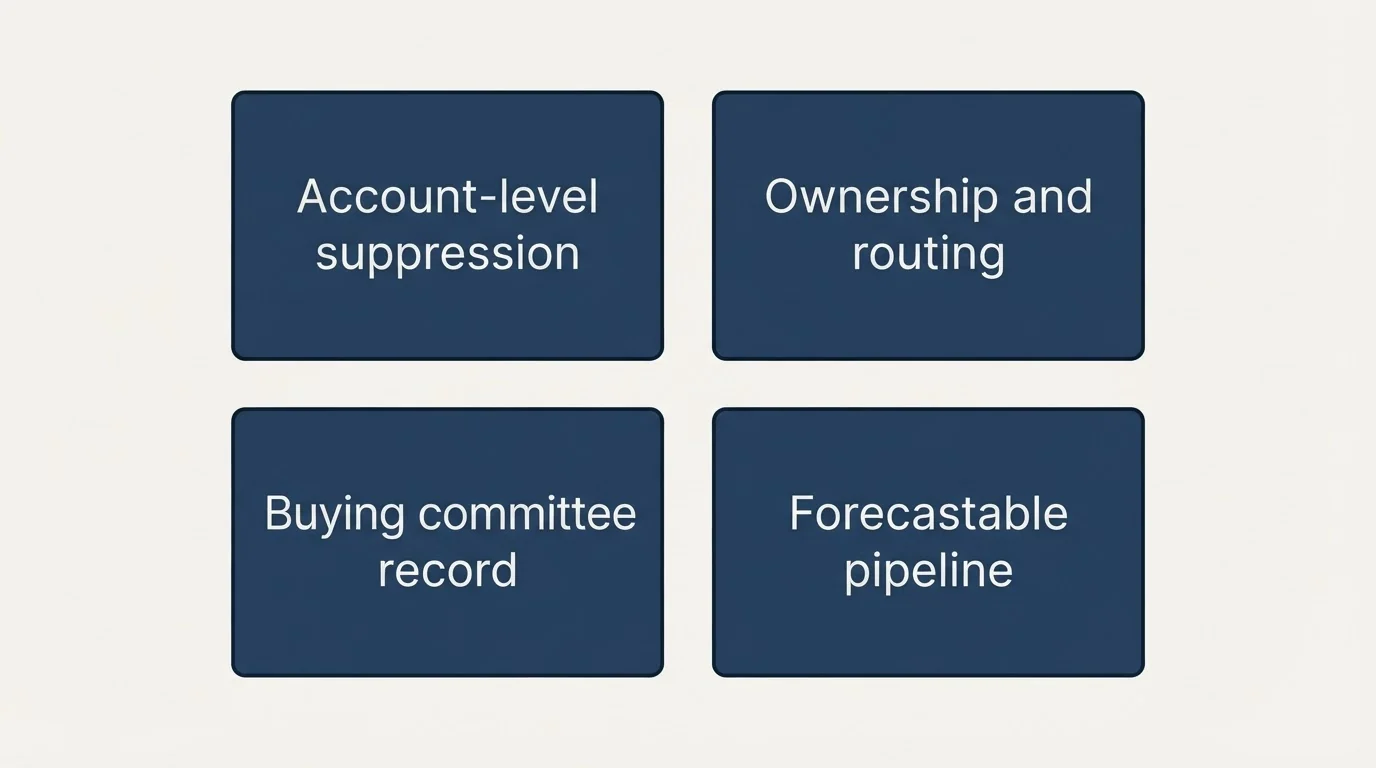
Four capabilities go missing, and each one is discovered late because nothing in the interface announces the gap.
Account-level suppression. A person who asked not to be contacted has to be suppressed at the company record so a different campaign next quarter does not reach a colleague on the same thread. Person-level opt-out alone does not deliver that.
Ownership and routing. A reply that arrives with no owner is a reply nobody answers, and nothing in the system complains. The rules that prevent it are lead routing, and they are written against accounts and territories rather than against individuals.
A record of the committee. Business purchases involve several people with different objections, which is what the buying committee entry describes. A system that cannot express two contacts at one account as participants in one decision cannot show a seller who is missing from the conversation.
A forecastable pipeline. The boundary at which a conversation becomes a deal somebody answers for is the subject of sales qualified opportunity, and it needs a stage model to sit in.
A yes points to the B2B model
- Does more than one person at the buyer have to agree?
- Is the list selected on company attributes rather than individual behaviour?
- Does a person read the record before an outbound message goes out?
- Do you need a value and a close date on something before it happens?
- Does a suppression request have to bind at the company, not the person?
A yes points to the B2C model
- Is repeat purchase frequency the number the business runs on?
- Are audiences sized in the tens of thousands and messaged on behaviour?
What it changes about running outbound
For a team running cold outreach the distinction stops being taxonomy and becomes four concrete jobs the CRM either supports or does not.
Building the segment. A cold campaign starts from a definition made of company attributes: this industry, this size band, this geography, this stack. That definition has to live somewhere queryable, and it has to survive the campaign so the next one can be cut against the same shape or deliberately against a different one. A person-centred system with no place to store the company attributes forces the definition into a spreadsheet, where it stops being reproducible.
Deciding who is contacted next. Coverage in a business motion is measured in accounts rather than in people, because contacting three colleagues at one company is not the same reach as contacting three companies. A system whose only unit is the person cannot report coverage honestly, and the number that looks like progress is the one that inflates most easily.
Getting the reply to the right person fast. A reply to a cold message is perishable, and the rules that get it owned within the hour are written against accounts, territories and ownership rather than against an individual's behaviour score.
Learning what worked. The outcome cut a business programme needs is reply and meeting rate by segment and by premise, which requires both to be stamped on the record at the time of the approach. A consumer platform records events richly and the fields it records are the wrong ones for this cut.
None of those four is impossible in a consumer system. Each becomes a workaround, and the workarounds compound, because the second campaign inherits the first one's improvisation.
Where the label misleads
The clean split above is the model, and three cases blur it in practice.
One vendor often sells both. Several mainstream platforms ship a marketing product built on the consumer model and a sales product built on the business one, under one brand. Reading the brand rather than the product is how a B2B team ends up on the consumer side of a suite. Check which objects the edition you are buying actually has.
Which vendors sell which shape, read from their own pages, is worked through in B2C CRM examples.
Some businesses genuinely run both motions. A company selling a subscription to individuals and an enterprise plan to organisations has two motions with two record shapes, and the honest answer is usually two systems with a defined boundary rather than one system bent to cover both.
High-volume B2B is not B2C. Selling to very small businesses looks consumer-shaped: one decision maker, a short cycle, a large addressable market. The account object is still needed, because the buyer is still an organisation with a domain, a size and a suppression obligation attached to it. Volume changes the cadence, not the model.
The test that survives all three: if the thing you are selling to is an organisation, you need an account object, whatever the cycle length looks like.
| The case | Why it confuses | What to do |
|---|---|---|
| One vendor sells both | A consumer-model marketing product and a business-model sales product share a brand | Check which objects the edition you are buying actually has |
| The business runs both motions | Subscriptions to individuals and an enterprise plan to organisations | Usually two systems with a defined boundary |
| High-volume B2B | One decision maker, a short cycle and a large market look consumer-shaped | Keep the account object. Volume changes the cadence, not the model |
Choosing between them
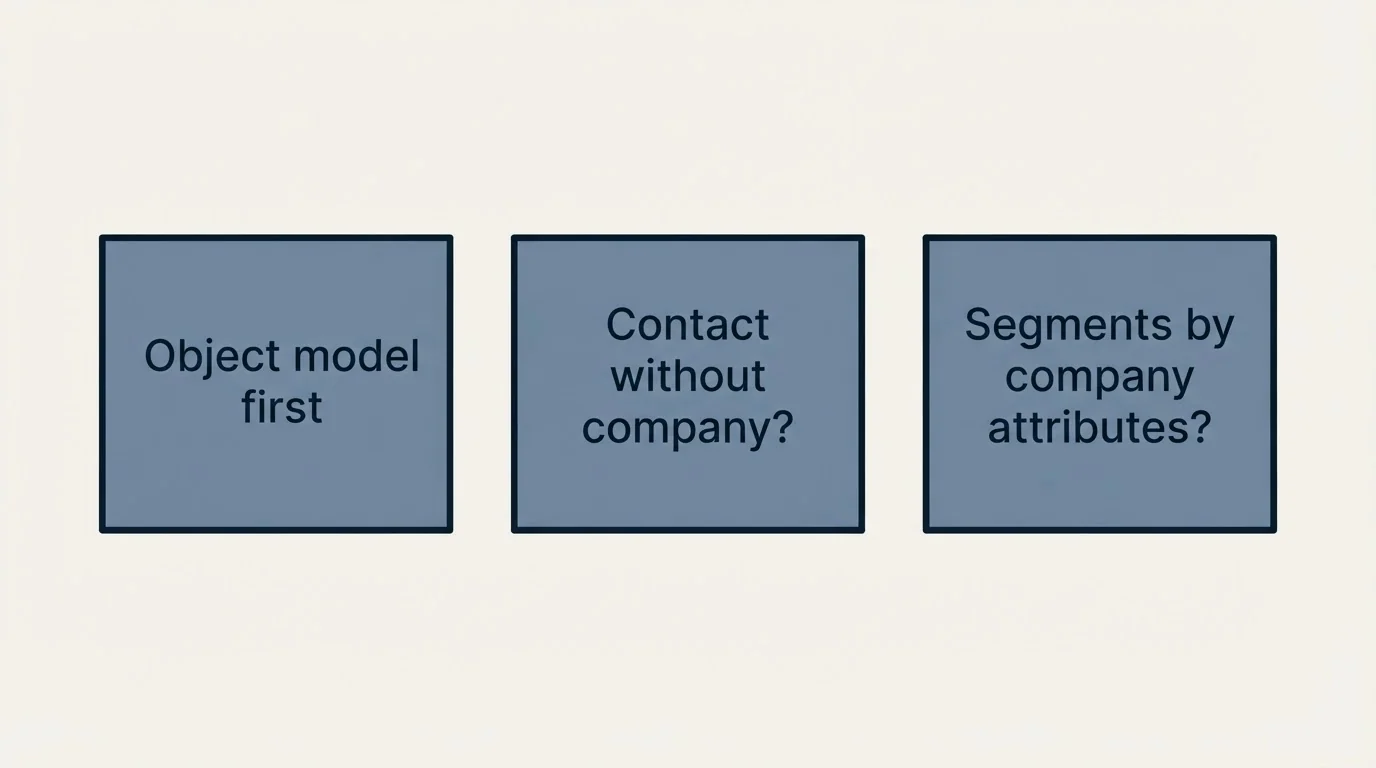
Decide the object model before the shortlist. A team that has written down what its CRM is a record of can read a product page in minutes, and a team that has not will be persuaded by whichever demo it saw last. The questions worth settling before any signature are in the CRM evaluation checklist, and if the platform question is open, best CRM tools for SDR teams compares the field for this motion specifically.
Then check the two fields that break first: whether a contact can exist without a company, and whether the system can hold a segment definition made of company attributes. A product that fails either one will make every campaign after the first one harder.
And if the CRM is the right shape and there is nothing arriving at the top of it, that is a supply problem rather than a software one. See what a first campaign produces against your market.
Related terms and guides
CRM basics covers the four objects and the question a system has to be a record of, lead routing and lead scoring cover the two rules most often built on top of them, and lead list covers what a usable row has to contain before any of it matters. Buying committee and sales qualified opportunity cover the two things a consumer model has no place to put.
On the build side, CRM setup for an outbound team is the configuration order, pipeline management in a CRM is what the opportunity object is for, sales activity tracking is what a logged activity has to contain, and the CRM evaluation checklist is what to settle before signing.
Frequently asked questions.
Frequently asked questions- What is a B2C CRM?
- A B2C CRM is customer relationship management software built for selling to individual consumers. The record at the centre of the system is a person rather than a company, volumes are high, purchases are frequent and quick, and the software is optimised for segmenting a large audience and messaging it automatically on behaviour.
- What is the B2C CRM model?
- It is the data model a consumer CRM is built on. One person sits at the centre of the record, with events, purchases and segment membership attached. Its natural operations are segment, trigger and send, and its reporting is cohort reporting. There is usually no company object and no opportunity object with stages, because consumer purchases are recorded after the fact.
- What is the difference between a B2C CRM and a B2B CRM?
- What sits at the centre of the record. A B2C CRM records a person and their behaviour, serves one buyer deciding quickly, and measures retention and lifetime value. A B2B CRM records an account, the people at it and the deals in progress, serves a committee deciding over months, and measures pipeline, win rate and forecast accuracy.
- Can a B2B company use a B2C CRM?
- It can, and every core job becomes a workaround. Without an account object a contact cannot be routed, suppressed at company level or reported on. Without an opportunity object there is nothing to forecast. Segment definitions made of company attributes end up in a spreadsheet, and the second campaign inherits the first one's improvisation.