B2C CRM Examples: Four Shapes, One Person at the Centre
Nine vendors' own pages, read on 18 September 2026, describe four consumer CRM shapes: marketing-led, pipeline-led, journey-led and platform. Plus one worked record.
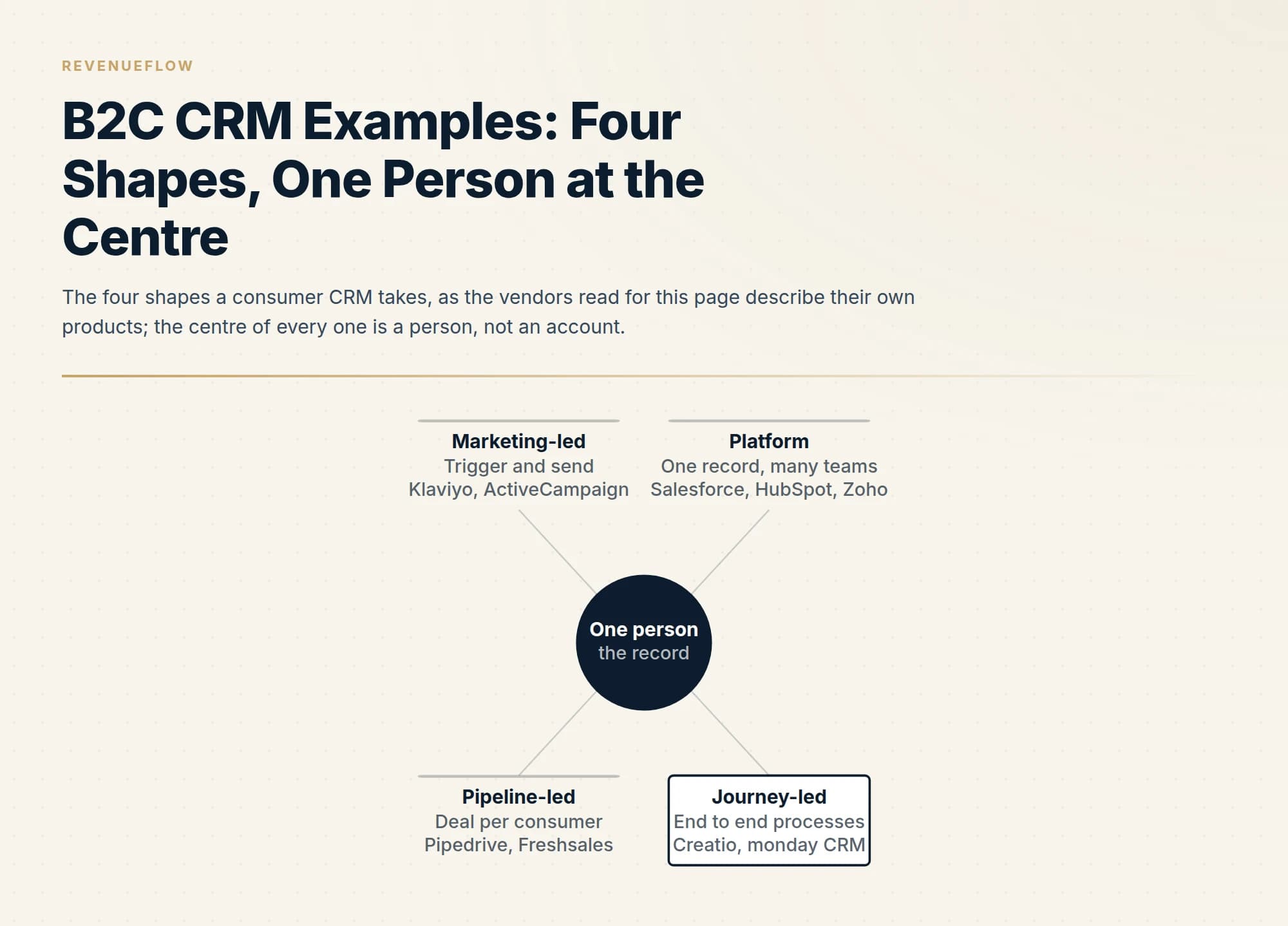
B2C CRM examples fall into four shapes, each with a person rather than an account at the centre: marketing-led trigger systems like Klaviyo and ActiveCampaign, pipeline-led systems like Pipedrive and Freshsales, journey systems like Creatio and monday CRM, and platforms like Salesforce, HubSpot and Zoho, per their own pages on 18 September 2026. Pick by how a sale is worked.
Key takeaways
- Klaviyo's page defines a B2C CRM as software that centralises customer data to personalise experiences across the lifecycle, and its own example is a cross-sell email triggered by products viewed in a store.
- Salesforce's B2C CRM page lists mass marketing, segmentation, personalised communication, rapid service and loyalty programme management as the key features, and routes to a 30-day trial of the wider CRM.
- Pipedrive's B2C industry page and Freshworks' Freshsales page describe a deal per consumer worked by a rep, which fits sales large enough for a person's time.
- Creatio, updated 27 January 2025, defines the category around end-to-end consumer journeys and names retailers, hotels, delivery services, telecoms and banks; ActiveCampaign prices on contact count and draws CXA as the decision layer between CRM and automation.
Reviewed and updated September 18, 2026
Klaviyo's page on what a B2C CRM is, read on 18 September 2026, puts the difference in a table: thousands of business accounts against millions of customers, long complex cycles against quick transactional relationships, account-level personalisation against individual-level, and sales-driven high-touch interactions against automated, scalable, self-service ones. Salesforce's B2C CRM page, read the same day, says the same thing in an FAQ: a larger number of customers, shorter sales cycles, and features built around mass marketing, segmentation, personalised communication, rapid service and loyalty programmes.
Those are the two vendors most often named when someone asks for B2C CRM examples, and the definitions match. What the question usually wants is not the definition but the shapes: what the products actually look like when a business runs one, what a record holds, what a segment does, and which vendors sell which shape. The B2C CRM glossary entry sets out the object model a consumer system leaves out; this page walks the examples, every one from the vendor's own page on 18 September 2026, and ends with one worked record and one worked segment, both invented for illustration and labelled as such.
Example one: the marketing-led CRM, Klaviyo
Klaviyo's page describes a B2C CRM as software designed to help businesses manage their interactions with individual customers, centralising customer data so that it is easy to communicate with people and create personalised experiences throughout the entire customer lifecycle. Its own example of what that means is a system that centralises purchase history and online behavioural data and can trigger automated cross-selling emails based on products viewed in an online store.
The page's feature list is the shape: channels named as email, SMS, mobile, web, social and in-store; data integration described as marketing, commerce and service unified; analytics described as cohort and lifetime value rather than pipeline. Klaviyo's platform navigation lists the components it sells around the record, a marketing product, a service product with a help desk and a customer agent, an analytics product and a data platform, with a marketplace of 350 plus apps.
The tell for this shape is the trigger. A Klaviyo-style CRM exists to send the next message automatically when a person does something. Nobody reads the record before the message goes out.
Example two: the platform CRM, Salesforce
Salesforce's B2C CRM page defines the category as managing relationships with individual consumers, handling a high volume of interactions, personalising communication and tracking individual preferences and purchasing behaviour across touchpoints. Its FAQ lists the key features as mass marketing capabilities, customer segmentation, personalised communication tools, rapid customer service response and loyalty programme management, and states that the CRM is instrumental in loyalty programmes, tracking points, rewards and redemption while segmenting loyal customers for exclusive offers.
The page routes to a 30-day free trial of the wider Salesforce CRM with no credit card and to a sales conversation, and its framing is the platform's: the same record serving marketing, commerce, service and loyalty. The shape here is breadth. A consumer brand on Salesforce is buying one customer record that several departments write to, and the B2C label describes the record's centre, the person, rather than a separate product.
Example three: the pipeline CRM sold to consumer businesses, Pipedrive
Pipedrive's B2C CRM industry page, read the same day, is a sales pipeline product describing itself for consumer businesses. Its feature list is centralised customer tracking of each rep's interactions with individual customers, revenue management through accounting integrations, email marketing, forecasting dashboards, workflow automation that assigns tasks and schedules meetings, and segmentation on past communications and touchpoints. Its description of the job is to create a hub of prospect and customer information, log touchpoints, record past conversations across departments and automatically send follow-up emails when someone is ready to convert.
The shape is a deal per consumer. A Pipedrive-style CRM in a consumer business is used where each sale is large enough for a person to work it, a property, a course, a vehicle, a financial product, and the record looks like a B2B pipeline with a person in the account's place. Freshworks' Freshsales page describes the same shape with AI attached: kanban views, drag-and-drop cards, intent scores from its Freddy AI, deal recommendations and email drafting. Pipedrive's plans and the gate its sequences sit behind are read in the Pipedrive pricing guide.
Example four: the journey and automation CRMs
Creatio's glossary page on B2C CRM, rendered in a headless browser on 18 September 2026 and marked updated 27 January 2025, defines the product as software that enables companies to automate end-to-end journeys for individual consumers, streamline consumer lead management and deliver personalised experiences at every touchpoint, designed to handle large volumes of data for thousands and millions of clients. It names the industries it has in mind, retailers, hotels and restaurants, delivery services, telecoms and banks, and it carries a differentiator table of its own. Its opening statistic, that a CRM is estimated to be used by over 90 percent of businesses with more than 11 employees, is unsourced on the page and is recorded as the vendor's claim.
ActiveCampaign's page on customer experience automation defines a category adjacent to CRM rather than inside it: CXA uses AI, automation and data to deliver personalised interactions across every stage of the customer journey, and the page draws the line itself, with CRM as the memory, marketing automation as the megaphone, and CXA as the decision-maker between them. Its example is a cart abandoner who is a repeat buyer, browses on mobile, prefers email over SMS and responds to free shipping, receiving a message that reflects all of that. The vendor's home page requests a contact count before quoting a price, which is the pricing unit of this shape: people in the database, not seats.
monday CRM's page, read the same day, describes a CRM that puts marketing, sales and delivery on one platform with AI agents doing the work between: a lead sourcing agent that finds, enriches and scores new leads daily, a calling agent that handles outreach and initial qualification, and agents for call prep, meeting notes and follow-up. It states a customer count of over 35,000 on the page. That is a journey shape aimed at teams, and the B2C fit depends on whether the agents are pointed at consumers or at businesses.
Example five: the platform CRMs with a consumer edition
HubSpot's CRM product page describes a Starter Customer Platform for startups and small businesses and an Enterprise Customer Platform, with marketing, sales, service and content hubs on one record, an agent hub, and a marketplace of integrations. Zoho CRM's page describes a product used by over 300,000 businesses, a multi-agent AI layer it calls Zia, and a CRM for Everyone model in which each team gets its own workspace on the same data, with teams able to create their own modules through prompts. Neither page is written for consumer businesses specifically, and both are bought by them, because the record at the centre can be a person as easily as an account. How HubSpot's record compares with a Google-native alternative is in Copper against HubSpot CRM.
The record, marketing-led shape
- Person: Dana Okafor, joined 3 March 2026 via a footer form
- Consent: email yes, SMS no, last updated 3 March 2026
- Orders: three, most recent 2 August 2026, running shoes
- Behaviour: viewed trail shoes twice this week, no purchase
- Lifecycle: repeat buyer, 47 days since last order
- Next automated step: trail shoe message, fires on the third view
The same person, pipeline-led shape
- Person: Dana Okafor, enquiry 3 March 2026 via web form
- Deal: mid-range bike fitting package, stage Proposal
- Owner: one named rep, last activity 12 September 2026
- Next action: call to confirm fitting date, due 20 September 2026
- Value and expected close date on the deal, not the person
- Stage moves by hand, follow-up email drafted by the rep
What a segment looks like, and why it is the whole product
In the marketing-led shape, the segment is the unit of work, and it replaces the pipeline. Here is one, invented for illustration and matching no vendor's screen: everyone who has bought at least twice, has not ordered in more than 45 days, has opened an email in the last 30, and has viewed a product page this week. Klaviyo's page describes exactly this kind of construction, segmentation on preferences, behaviours and purchase history, and ActiveCampaign's page describes the segmentation and personalisation pillars that act on it. The segment is rebuilt continuously, a message is attached to it, and a person enters and leaves it as their behaviour changes without anyone opening their record.
The pipeline-led shape has no equivalent, because its unit of work is a deal a person owns. The journey-led shape sits between: Creatio's language is end-to-end journeys, which is a segment with stages.
| Row | Person record | Deal per person | Behaviour triggers | Service desk | Consumer industries named |
|---|---|---|---|---|---|
| Klaviyo | Yes | No | Yes | Yes | Yes |
| Salesforce B2C page | Yes | Partial | Yes | Yes | No |
| Pipedrive B2C page | Yes | Yes | Partial | No | Partial |
| Freshsales | Yes | Yes | Partial | No | No |
| Creatio | Yes | Partial | Yes | Partial | Yes |
| ActiveCampaign | Yes | No | Yes | Partial | No |
| monday CRM | Yes | Yes | Partial | No | No |
| HubSpot | Yes | Yes | Yes | Yes | No |
| Zoho CRM | Yes | Yes | Partial | Partial | No |
Choosing an example to copy
Copy the marketing-led shape when the purchase is small, frequent and unattended: a trigger fires, nobody reads the record first, and the measure is cohort behaviour over time. Klaviyo and ActiveCampaign are the pages that describe this most completely, and both price on the size of the database.
Copy the pipeline-led shape when each consumer sale is worth a person's time and takes more than one conversation. Pipedrive's and Freshsales' pages describe this, and the record looks like a small B2B deal; at low volume the Excel CRM template is the same shape in a sheet.
Copy the platform or journey shape when several departments write to the same person and the business wants one record: Salesforce, HubSpot and Zoho describe the platform version, Creatio and monday CRM the journey and agent version. The cost of that breadth is that no single team owns the record's accuracy.
Where this leaves a B2B outbound team
None of these shapes is built for the work we do, which is contacting a defined list of companies, one message per campaign, and recording who replied. We run Email Bison and in-house tooling for email and HeyReach for LinkedIn, and the record we keep is an account with people at it and a suppression list in front of it. A consumer CRM adopted for that job puts the person at the centre and loses the account, which is the failure the glossary entry describes.
If the constraint is that the companies on a B2B list are not taking meetings, that is not a CRM question. RevenueFlow books qualified meetings on a pay-per-meeting basis, against criteria agreed in writing before launch.
The short version
B2C CRM examples fall into four shapes, all with a person at the centre: marketing-led trigger systems, Klaviyo and ActiveCampaign by their own pages; pipeline-led systems sold to consumer businesses, Pipedrive and Freshsales; journey and agent systems, Creatio and monday CRM; and platforms with a consumer edition, Salesforce, HubSpot and Zoho. Pick by whether a sale is unattended, worked by a person, or written to by several teams, and expect the pricing unit to follow: database size for the first shape, seats for the rest.
Definitions, feature lists and descriptions are per each vendor's own page as served on 18 September 2026: Klaviyo's what-is-a-B2C-CRM page, Salesforce's B2C CRM page, Pipedrive's B2C CRM industry page, Freshworks' Freshsales page, Creatio's B2C CRM glossary page rendered in a headless browser and marked updated 27 January 2025, ActiveCampaign's customer experience automation and home pages, monday CRM's product page, HubSpot's CRM product page and Zoho CRM's product page. The example record and segment are invented for illustration. No price is quoted because none appears on the pages read, except as noted.
Sources: What is a B2C CRM, Klaviyo, B2C CRM, Salesforce, B2C CRM, Pipedrive, Freshsales, Freshworks, B2C CRM, Creatio, Customer experience automation, ActiveCampaign, monday CRM, HubSpot CRM, Zoho CRM
Frequently asked questions.
Frequently asked questions- What is an example of a B2C CRM?
- Klaviyo is the clearest example by its own description on 18 September 2026: a system that centralises purchase history and behavioural data and triggers automated messages, such as a cross-sell email based on products viewed in an online store, across email, SMS, mobile, web, social and in-store channels. Salesforce's B2C CRM page describes the platform version of the same idea, with mass marketing, segmentation, service and loyalty programmes on one person record.
- What is the difference between a B2B and a B2C CRM?
- Klaviyo's page puts it in a table: thousands of business accounts against millions of customers, long complex cycles against quick transactional relationships, account-level against individual-level personalisation, and sales-driven high-touch interactions against automated self-service ones. Salesforce's FAQ says a B2C CRM handles a larger number of customers with shorter cycles while a B2B CRM manages fewer, more complex relationships with multiple stakeholders. The object model a consumer system leaves out is set out in the B2C CRM glossary entry.
- Can a sales pipeline CRM like Pipedrive be used for B2C?
- Pipedrive publishes a B2C CRM industry page describing exactly that: tracking each rep's interactions with individual customers, segmentation on past communications, automated follow-up emails when someone is ready to convert, and forecasting dashboards. The shape is a deal per consumer, and it fits where each sale is worth a person's time and takes more than one conversation, such as a property or a course. Freshworks' Freshsales page describes the same shape with AI intent scores and deal recommendations.
- How is a B2C CRM priced?
- By the shape. ActiveCampaign's home page asks for a contact count before quoting a price, which is the marketing-led unit: people in the database. The pipeline-led and platform shapes price per seat, as Pipedrive's support centre documents for its plans. None of the nine vendor pages read on 18 September 2026 for this article carries a B2C-specific rate, so no price is quoted here; read each vendor's pricing page in your own currency and billing cycle.
About the author.

B2B cold email experts helping companies generate qualified leads through done-for-you outreach campaigns.
RevenueFlow Team
Explore more.
Ready to scale your outreach?
We build GTM engines that book real meetings. See the receipts.
Related articles.
RingLead vs LeanData: ZoomInfo Operations Compared
RingLead is now ZoomInfo Operations. How it compares with LeanData on matching, routing, deduplication and enrichment, read from each vendor's own pages.
Outbound Lead Generation Tools, Layer by Layer
Outbound tools do six jobs and price on different units: contacts, credits, seats, sends. Thirteen vendors read from their own pages on 18 September 2026, by layer.
Twain Pricing: Credits per Lead, Three Research Modes
Twain sells credits, not seats, and a lead costs 1 to 14 of them depending on the research mode. The two ladders, the four expiry clocks and the cap.
Lavender Pricing: Two Products, No Pricing Page
Lavender has no pricing page. The Email Coach ladder per seat at both billing states, the free routes, and the separate per-agent price for Ora.
Demandbase vs RollWorks: Now AdRoll ABM, Compared
RollWorks is now AdRoll ABM. How it compares with Demandbase on positioning, data sources and the shape of the purchase, read from both vendors' own pages.
The Real Cost per 1,000 Emails, Verifications and Data Credits in 2026
Unit prices computed from verified vendor plans: $1.00 per 1,000 emails sent, $2.00 per 1,000 verifications and $19.60 per 1,000 enrichment credits.