Channel Partner: The Types, and What Each Owns
A channel partner is an independent company that sells, implements, bundles or supports another company's product and is paid in margin, commission or fees. There are four channel partner types: resellers, referral and affiliate partners, service and delivery partners, and technology alliances, separated by what each one takes on.
Key takeaways
- There are four channel partner types, resellers, referral or affiliate partners, service or delivery partners and technology alliances, sorted by what the partner takes on.
- A reseller takes the transaction and often the renewal, a referral partner takes only the introduction, and a service partner takes the delivery work around the product.
- Three things move to the partner when the arrangement starts: the first conversation, the customer relationship with its renewal, and the market signal.
- A list of companies a partner could call is not a channel asset, and gold, silver and bronze tiers describe volume commitment, not partner type.
A channel partner is an independent company that sells, implements, bundles or supports another company's product for end customers, and is paid in margin, commission or service fees rather than in salary. The defining feature is who owns the customer relationship the product travels through rather than what the partner does with it, because that relationship is the asset the vendor is renting.
The word covers arrangements that behave very differently. A firm that buys your software at a discount and invoices the customer itself, a consultancy that installs it as part of a larger project, and a company that makes an introduction and steps back are all channel partners, and a programme designed for one of them will fail the other two.
What are the types of channel partner?
There are four types of channel partner, separated by what the partner takes on. Resellers take the transaction: they buy the product and invoice the customer. Referral and affiliate partners take only the introduction and are paid on what closes. Service and delivery partners take the implementation work around the product. Technology and alliance partners take nothing transactional, and trade access to each other's customers through an integration or joint offer.
The types, and the axis that separates them
Sorting partner types by industry or by size produces categories that do not predict anything. Sorting them by what the partner takes on produces four groups that behave consistently.
Resellers buy the product and sell it on, holding the commercial relationship and usually the invoice. The word covers a range wide enough to need its own treatment, including value-added resellers who wrap implementation and support around the product, and the tier question of whether a distributor sits between you and them. That range is unpicked in reseller.
Referral and affiliate partners introduce a buyer and take a commission on what closes. They carry no delivery obligation, no invoice and no support burden, which makes them the cheapest partner to sign and the least predictable to forecast from. A referral partner has given you access to a relationship; a reseller has taken on a business.
Service and delivery partners are consultancies, agencies, systems integrators and managed service providers. They may or may not resell the licence, and the part they own is the work around it. Their commercial interest is in billable delivery, which means they are excellent at bringing you products a customer already wants installed and indifferent to whether it is your product.
Technology and alliance partners build an integration or a joint offering. The exchange is access to each other's customer bases rather than margin on a transaction, and the relationship lives or dies on whether either side's sellers ever mention the other.
| Type | What it owns and how it earns | What it needs from you |
|---|---|---|
| Reseller Takes the transaction | Buys at a discount, invoices the customer, owns the commercial relationship and often the renewal | Margin that survives their own cost of sale, and a product they can demonstrate without your team present |
| Referral or affiliate Takes the introduction | Passes a buyer and is paid on what closes. No delivery, invoice or support obligation | A simple payout rule and fast confirmation. Cheapest to sign, hardest to forecast |
| Service or delivery Takes the delivery | Consultancies, integrators and managed service providers. Revenue is billable work, not your licence | Certification, documentation and a technical contact. Neutral about whose product sits underneath |
| Technology or alliance Takes nothing transactional | An integration or joint offering. The exchange is access to each other's customer bases | A named person on each side with a reason to raise the other in a live deal this quarter |
The fourth group, technology alliances, is the odd row in that table because nothing is transacted. The test of one is whether a named person on each side has a reason to raise the other in a live deal this quarter.
What the partner actually owns
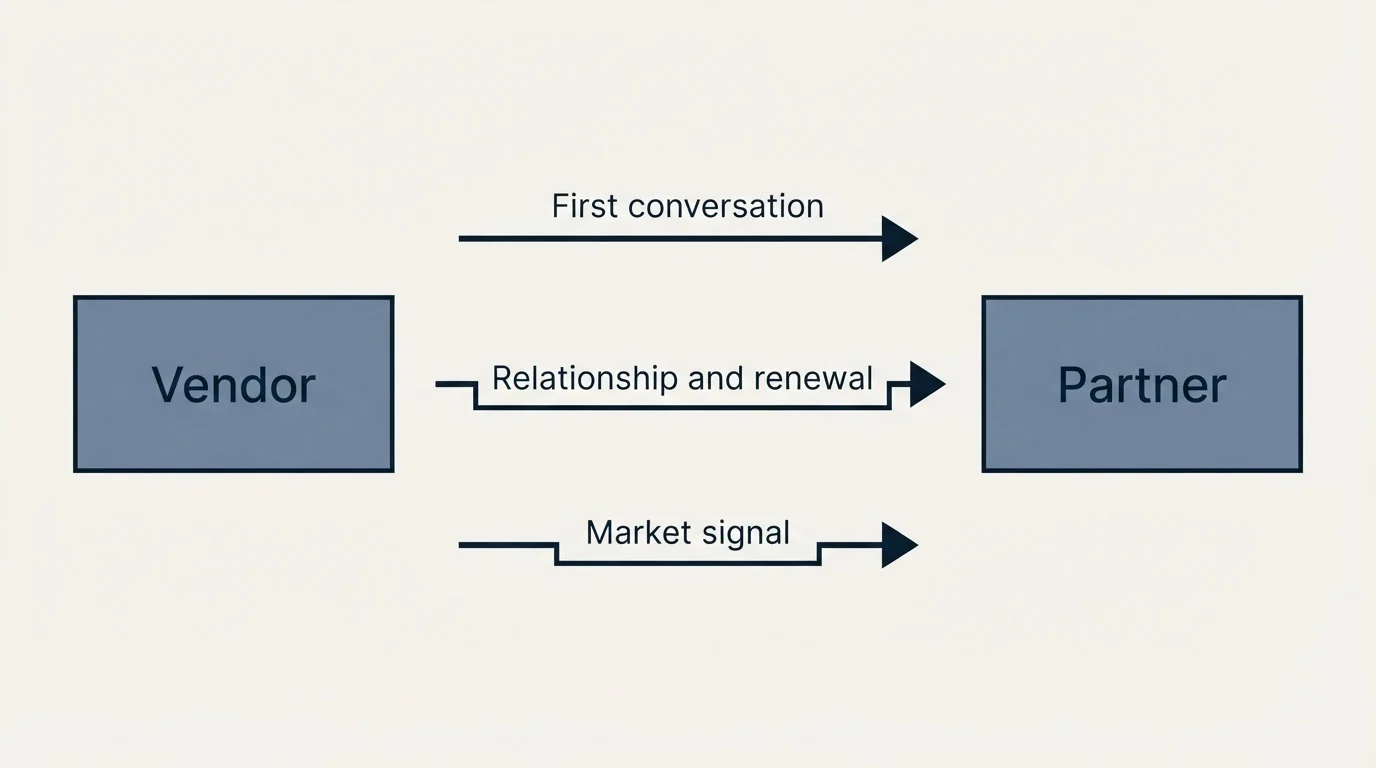
Three things move to the partner when the arrangement starts, and the vendor rarely lists all three.
The first conversation moves. The buyer hears about the category, the problem and the option set from somebody else, framed in that partner's language and ordered by that partner's priorities. If the partner carries competing products, the framing is comparative before you are in the room.
The relationship moves, and with it the renewal. Whoever the customer calls when something breaks is the party the customer believes they bought from. A vendor that discovers this at renewal time discovers it late.
And the market signal moves. A direct team hears the objection in the buyer's own words the week it is said. Through a partner, that arrives as a summary of a summary, shaped by somebody explaining their own quarter. The consequences of that filtering, and why keeping a small direct motion running is the cheapest correction, are worked through in channel sales versus direct sales.
One thing that may not move at all is the paperwork. Where a distributor sits between the vendor and the partner selling to the end customer, the distributor holds the commercial terms and the partner holds the relationship, so a programme designed as though the selling partner were the counterparty keeps discovering that the contract disagrees. Settle which tier you are actually contracting in before designing anything downstream of it.
Channel conflict is the name for what happens when two parties can legitimately work the same account, and it is a structural consequence of having both a direct team and partners rather than a failure of goodwill. It shows up first as a partner quietly declining to register deals, because registering one is how they learn they have lost it.
What does not move is the obligation to enable. A signed partner who sells nothing costs no commission and a great deal in training, materials, product updates and a named person answering their questions inside a working day. That work is front-loaded and spent before anyone knows whether the partner will sell anything, and it is the subject of partner enablement.
Where the definition misleads

Three readings of the term are common and expensive.
A list of companies a partner could call is not a channel asset. The asset is an existing relationship through which those buyers already purchase this category. A partner presenting a target list has offered you the same thing a data provider sells, at a much higher margin cost, and the introduction problem is unsolved. The question to ask is not how many accounts they can reach but what those accounts have already bought from them and whether they were happy with it.
Partner types are not tiers of the same thing. Gold, silver and bronze describe volume commitment. They do not describe whether the partner resells, refers or delivers, and a programme that sorts partners by tier while giving all of them the same enablement is giving three different businesses one set of materials, two of which are wrong.
Attribution inside a channel is genuinely hard rather than merely unmeasured. When a partner introduces a buyer who was already researching, and the vendor's own marketing touched that buyer first, no rule settles the credit question after the fact. It has to be settled before, which is what a registration policy is for. What that policy has to bind, including the vendor's own direct team, is covered in deal registration.
Establish all five
- They already sell something to these buyers, and the buyers are happy with it
- Which of the four groups they belong to, written down, with the enablement that group needs
- Margin or commission that survives their own cost of sale, not just yours
- A registration rule agreed in advance that binds your direct team too
- A named person on your side who owns the relationship as their actual job
Do not sign if
- The partner was chosen because they produced a list of companies they could call
- The channel is being used to avoid hiring, before anyone has sold this directly
- Your positioning is still changing every few weeks
That last line is the one that quietly decides the outcome. A partner cannot carry a message that keeps moving, because their sellers hold several products and yours gets whatever attention is left over. Positioning that is still being rewritten belongs with people you can retrain in an afternoon.
What this means for an outbound programme
Recruiting channel partners is an outbound problem, and it is a harder one than customer outbound because the offer is different in kind.
A customer message argues that a problem is worth solving. A partner message argues that adding your product to a portfolio is worth the effort, against the products the partner already carries. That means the message is about economics and access rather than about the product: what the partner earns, what it costs them to learn, who supports their customer when something breaks, and which of their existing accounts this opens. Getting that message right is the subject of cold email for reseller partnerships.
Campaign to customers
Argues that a problem is worth solving
About the buyer's situation and the product. Written for one defined population of end customers.
Campaign to partners
Argues that a portfolio slot is worth the effort
About economics and access: what the partner earns, what it costs them to learn, who supports their customer when something breaks, and which of their accounts this opens.
Two operational points follow from how we run outbound, and both are documented practice rather than claims about outcomes.
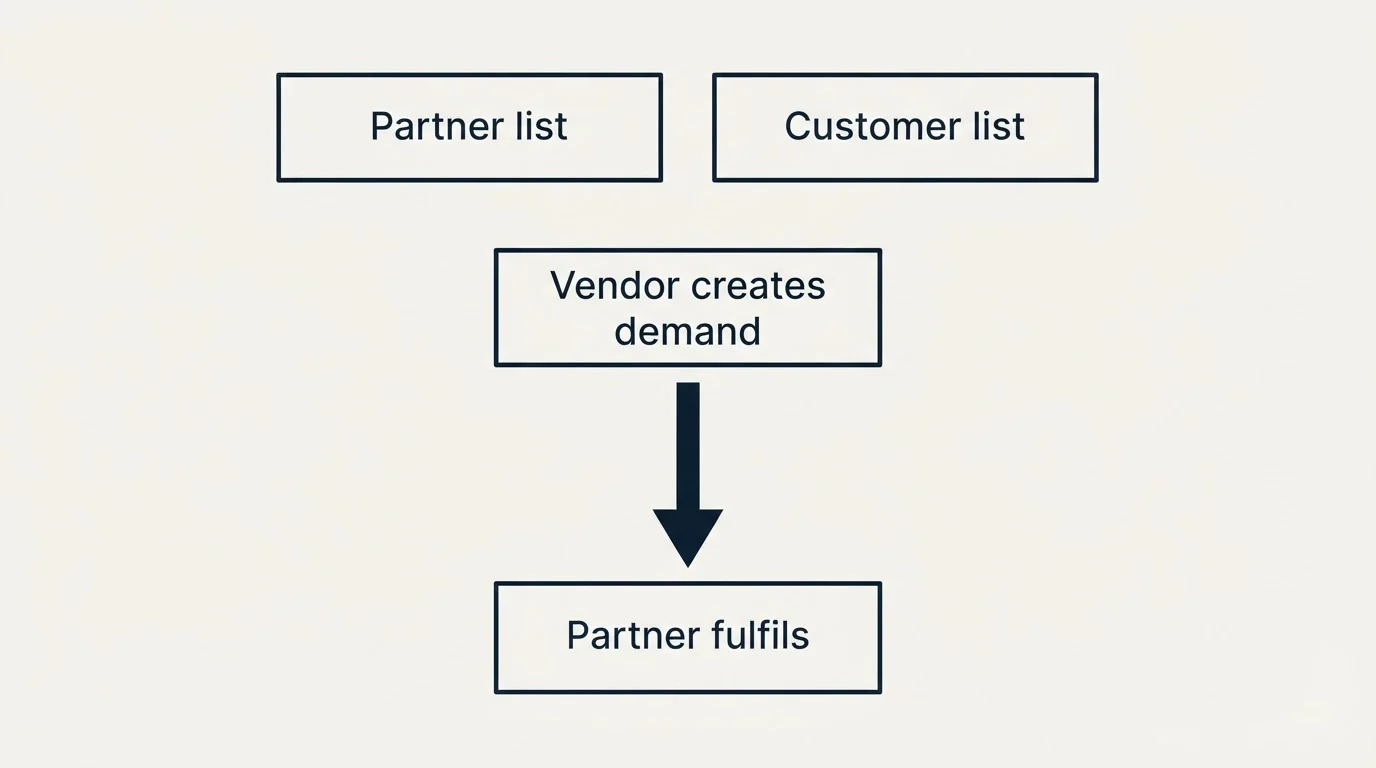
A partner list and a customer list are two campaigns, never one list contacted twice. We run one message per campaign, with no bumps and no thread replies, so a premise is written for one defined population. A list that blends prospective partners with prospective customers produces a message that fits neither, and a partner who receives a message aimed at their own market has learned something unhelpful about how you intend to treat it.
And a channel motion does not remove the need to create demand. A partner is generally much better at closing a buyer who is already interested than at finding one, so the common working arrangement is that the vendor generates the conversation and the partner fulfils it. That is a supply relationship rather than a delegation of the whole motion, and it is worth naming in the agreement, because a partner who was promised leads and a vendor who expected origination will argue about it in month four.
Where a partner programme is a year from producing anything and the quarter needs pipeline now, the two are not alternatives. Direct contact is the cheapest instrument for finding out which segments have an incumbent relationship worth renting in the first place.
Related terms and guides
Reseller covers the transaction-taking group in detail, including the distributor and dealer distinctions and the tier question. Channel sales versus direct sales covers the route decision itself and what the signal loss costs. Partner enablement covers what a signed partner actually needs and why attribution inside the motion is so hard.
On the programme mechanics, deal registration covers the rule that stops a partner losing the deals they bring you, market development funds covers the money vendors use to buy attention inside a partner carrying competing products, and white label reseller programs covers the four shapes the arrangement takes when the vendor is deliberately invisible.
If the segment you want has no incumbent relationship to rent, a partner adds margin cost without removing the introduction problem. See what a first campaign produces against that market.
Frequently asked questions.
Frequently asked questions- What are the types of channel partner?
- Four, separated by what the partner takes on. Resellers buy the product and invoice the customer. Referral and affiliate partners introduce a buyer and are paid on what closes. Service and delivery partners, such as consultancies, integrators and managed service providers, own the work around the product. Technology and alliance partners build an integration or joint offering.
- What is a channel partner?
- A channel partner is an independent company that sells, implements, bundles or supports another company's product for end customers, and is paid in margin, commission or service fees instead of salary. The defining feature is who owns the customer relationship the product travels through, because that relationship is the asset the vendor is renting.
- What is the difference between a reseller and a referral partner?
- A reseller buys the product, sells it on, holds the commercial relationship and usually the invoice, so it has taken on a business. A referral partner introduces a buyer and takes a commission on what closes, with no delivery, invoice or support obligation. Referral partners are the cheapest to sign and the least predictable to forecast from.
- What should you check before signing a channel partner?
- That they already sell something to these buyers, which of the four types they are and the enablement that type needs, that margin survives their own cost of sale, that a registration rule binds your direct team too, and that a named person owns the relationship. Do not sign on the strength of a target list.