Channel Sales vs Direct Sales: Choosing a Route
The choice is about who owns the first conversation with a buyer and who pays for it. Margin, control and reach all follow from that, and so does the failure mode.
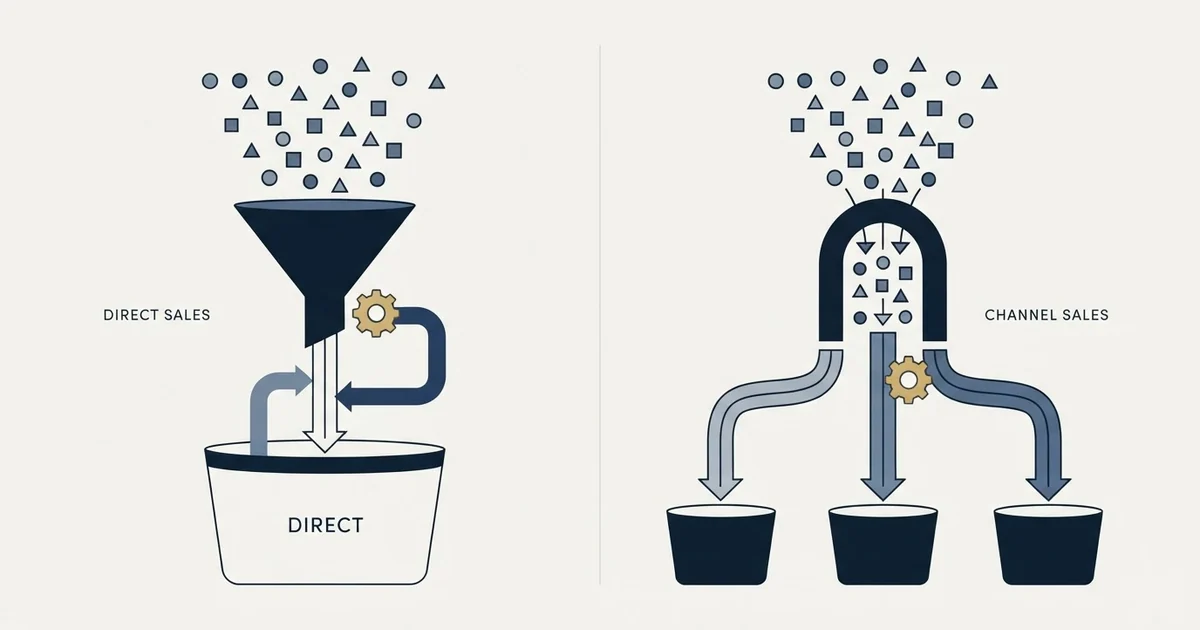
Channel sales and direct sales answer one question: who has the first real conversation with a buyer and who carries the cost of making it happen. The deciding test is whether the buyer already trusts somebody who is not you, in a relationship through which they buy this category of product.
Key takeaways
- A partner rents access to a trusted relationship, so a partner who has no existing relationship with the buyer does not remove the introduction problem.
- Channel converts a fixed cost into a variable one and adds a front-loaded enablement cost that is spent before you know whether the partner sells anything.
- A deal that is marginal at full price stops being a deal once a partner takes a share, so deal size is a hard gate rather than a preference.
- Route to market is decided segment by segment rather than once for the company, and the ownership rule for contested accounts has to exist before the first contested deal.
Reviewed and updated September 2, 2026
Take an illustrative case, invented to show the shape of the mistake rather than to report a particular company. A founder with eleven customers and a partner who says they can sell into forty accounts is looking at what appears to be the cheapest growth available. No headcount, no ramp, no salary. Eighteen months later the partner has closed two deals, both to companies the founder had already met, and nobody can work out where the other thirty-eight went.
That outcome is not evidence that channel sales does not work. It is evidence that the decision was made on cost when the question was about ownership.
Channel sales and direct sales are two answers to one question: who has the first real conversation with a buyer, and who carries the cost of making that conversation happen. Everything else that gets argued about, margin, control, reach, follows from that.
What each model actually is
Direct sales means your own people generate and close the revenue. You own the pipeline, the process, the message and the relationship, and you pay for all four.
Channel sales, also called indirect sales or partner sales, means a third party sells your product to the end customer. That third party may be a reseller who buys and resells, a value-added reseller who bundles your product into something larger, a distributor who reaches a market you cannot, an agency or consultancy that implements, or a referral partner who introduces and steps back. Those are genuinely different arrangements with different economics, and treating them as one category is where most channel planning goes wrong. The word itself and what it commits you to is unpicked in reseller.
The thing they share is that somebody outside your company owns the customer relationship, or at least owns its first act.
The umbrella term for all of those arrangements is channel partner, and which of the four groups a given partner belongs to decides what it needs from you.
- You choose which accounts get approached and when
- Message and positioning change the week you decide to change them
- Every signal from the market reaches you unfiltered
- Cost is fixed and arrives before the revenue does
- Reach is bounded by headcount and by the markets you can staff
- Reach into markets, segments and buying relationships you do not have
- Cost is variable and mostly arrives after the revenue
- Your message is delivered by somebody with their own priorities
- Market signal reaches you second-hand, filtered by the partner
- The partner decides which of their products to sell this quarter
The question that actually decides it
The cost comparison is the one everybody runs and it is the least decisive.
Published lists of B2B sales channels mix these routes to market with the demand channels that feed whichever route is chosen, and the two are picked on different tests: a route on who owns the relationship, a demand channel on how fast it answers, which is the sorting in lead generation channels.
The question that decides it is whether the buyer already has a trusted relationship with somebody who is not you, through which they buy this category of thing. If they do, that relationship is a real asset and a channel model rents access to it. If they do not, a partner adds a layer between you and a buyer who was going to have to meet somebody new either way, and the layer costs margin without removing the introduction problem.
That reframes the founder's situation at the top of this page. The forty accounts were not a channel asset unless the partner already sold something to those accounts that they were happy with. A list of companies a partner could theoretically call is a list, and lists are the cheap part.
Three further conditions matter and they are easy to check.
Whether your product needs implementation work that somebody else is better placed to do. A product that requires configuration inside a customer's environment has a natural partner shape, because the implementer is already in the building.
Whether the sale requires knowledge of a local market, a regulatory regime or a procurement process you cannot economically learn. This is the honest case for distribution in geographies you are not staffing.
Whether your average deal supports two margins. A partner takes a share, and a deal that is marginal at full price is not a deal at all once it is split.
What channel costs that nobody puts in the model

The pitch for channel is that it converts a fixed cost into a variable one. That part is true. What the model usually omits is that the fixed cost does not go to zero, it changes shape.
Cost arguments answer only half the question, and the split between conversion quality and cost explains why a route can look cheap while converting badly.
A partner who sells nothing costs you nothing in commission and a great deal in enablement: training, materials, product updates, a named person answering their questions, and the quarterly attention it takes to stay one of the products they think about. That work is real, it is front-loaded, and it is spent before you know whether the partner sells anything. What it consists of, and why attribution inside it is so hard, is worked through in partner enablement.
Then there is the money that moves the other way. Co-marketing budgets, development funds and incentive programmes are how vendors buy attention inside a partner who carries competing products, and they are a real line item rather than a nice-to-have. What that money actually buys is examined in market development funds.
And there is the conflict cost. The moment you have both a direct team and partners, two people can work the same account, and the rule that settles it has to exist before it is needed rather than after. That rule is the subject of deal registration, and a channel programme without one produces exactly one outcome: the partner stops bringing you deals, because bringing you a deal is how they lose it.
- Yes: The partner already sells something to these buyers, and the buyers are happy with it
- Yes: The deal size supports two margins without the economics turning marginal
- Yes: A written rule decides who owns a contested account, agreed before the first deal
- Yes: Somebody named on your side owns partner enablement as their actual job
- No: The partner is chosen because they gave you a list of companies they could call
- No: The channel is being used to avoid hiring, while nobody has proven the sale directly yet
- No: Your product is early enough that the message changes every six weeks
That last row is the one that costs the most. A partner cannot sell a message that changes every six weeks, because their reps carry several products and yours gets whatever attention is left. Positioning that is still moving belongs with people you can retrain on a Tuesday.
The signal you stop receiving
There is one cost that never appears in a channel model and is frequently the largest.
A direct team hears the market. Every objection, every reason a deal stalled, every phrase a buyer used to describe the problem in their own words arrives at your company the same week it was said. That flow is the raw material for positioning, for pricing, and for deciding what to build, and it arrives free as a side effect of selling.
Through a partner, that flow is filtered twice. The partner hears it, forms their own view of what it means, and reports the version that fits their account of why the quarter went the way it did. What reaches you is a summary of a summary, arriving late, shaped by somebody whose incentive is to explain their own number.
The consequence is specific rather than vague. A company that has been channel-only for two years frequently cannot say why it loses, in the buyer's language, and it discovers this the first time it tries to write a direct campaign. Positioning built on partner feedback describes what partners find easy to sell, which is a different thing from what buyers find easy to buy.
The practical mitigation is to keep some direct motion running even in segments assigned to partners, purely as an instrument. A small number of conversations you have yourself, in a market a partner owns, is the cheapest market research available and the only version that is not filtered.
Why it is rarely either one
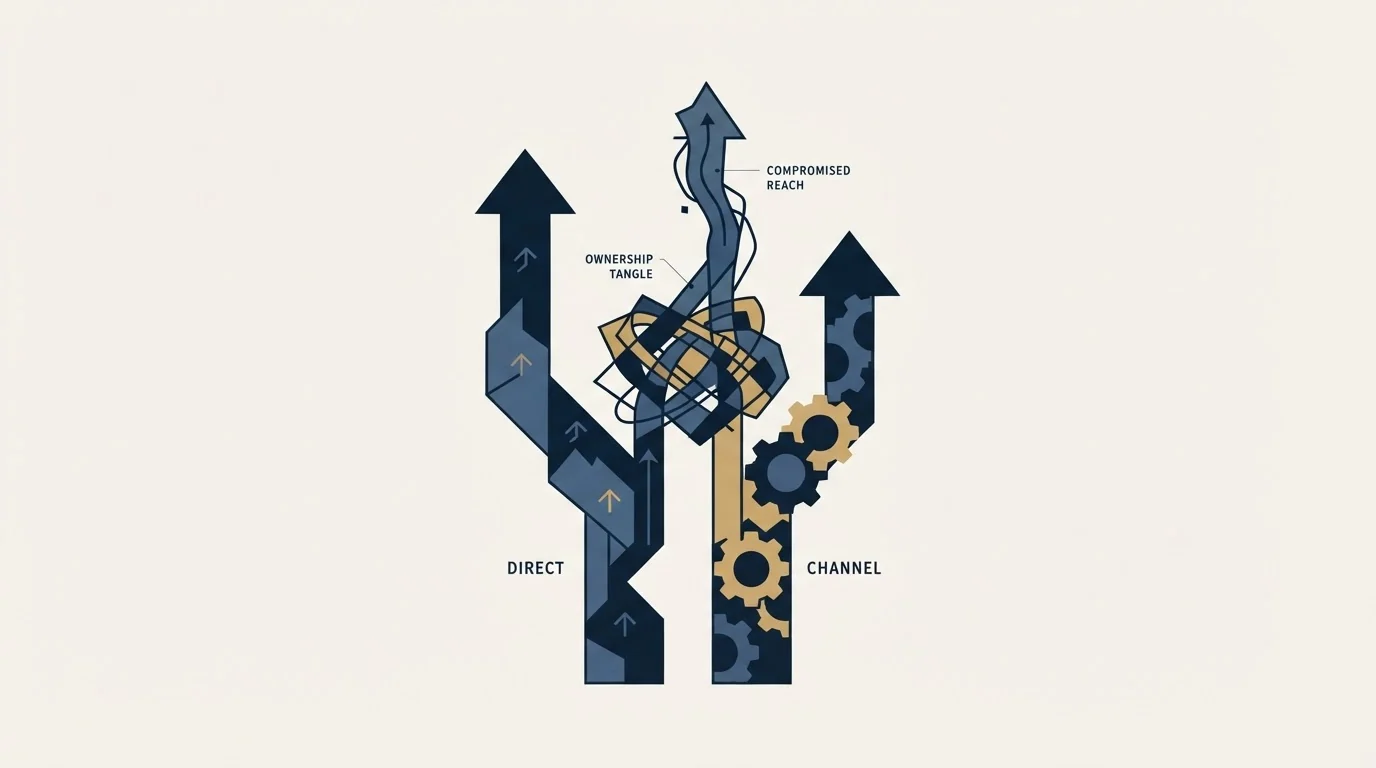
Companies that look like a channel business commonly run both, and the useful framing is not which model to pick but which model owns which segment.
The split that tends to hold is by deal size and by proximity. Larger, more complex accounts stay direct because the margin supports the cost and the relationship is worth owning. Smaller accounts, adjacent geographies and verticals with an entrenched implementer go to partners because reaching them directly costs more than they return.
The split that tends to fail is by effort. A team that gives partners the accounts it does not want to work has given partners a segment it has already decided is not worth the effort, and then reads the partner's poor results as a partner problem.
Writing the split down is the whole discipline. Which segments are direct, which are partner-led, what happens when an account moves between them, and who owns a deal that arrives from a partner in a direct segment. Every one of those is cheap to decide in advance and expensive to arbitrate in a quarter where somebody's number is short.
- Step 1List the segments you can describe precisely
A segment is a group one sentence is true of, small enough to enumerate
- Step 2Ask who the buyer already trusts in each one
If the answer is nobody, a partner does not remove the introduction problem
- Step 3Check the deal supports two margins
A deal that is marginal at full price is not a deal once it is split
- Step 4Write the ownership rule before the first deal
Contested accounts get settled by a rule agreed in advance, never in the quarter
- Step 5Fund enablement for the segments you assign
An unenabled partner is a fixed cost with no variable revenue attached
Where outbound sits in both
This is worth saying because the two models are usually presented as if only one of them involves reaching out to strangers.
In a direct motion, outbound is the demand creation mechanism. You decide which accounts to approach, on what premise, and you carry the cost of the approach.
In a channel motion, outbound does not disappear. It changes target. Recruiting partners is itself an outbound problem, and it is a harder one, because the message has to answer why a company already carrying other vendors' products should add yours. The shape of that message is covered in cold email for reseller partnerships.
There is also a third pattern that gets missed. A vendor with partners frequently still needs to create demand that the partner then fulfils, because a partner is much better at closing an interested buyer than at finding one. Under that arrangement the vendor runs outbound and hands qualified conversations to the partner, which is a supply relationship rather than a delegation of the whole motion.
Our own practice is relevant to exactly one detail of this. We run one message per campaign, with no bumps and no thread replies, which means a partner-recruitment campaign and a direct-demand campaign are two campaigns with two premises rather than one list contacted twice. That is documented policy rather than a claim about results, and it matters here because a partner who receives a message aimed at end customers has learned something unhelpful about how you treat their market.
The short version
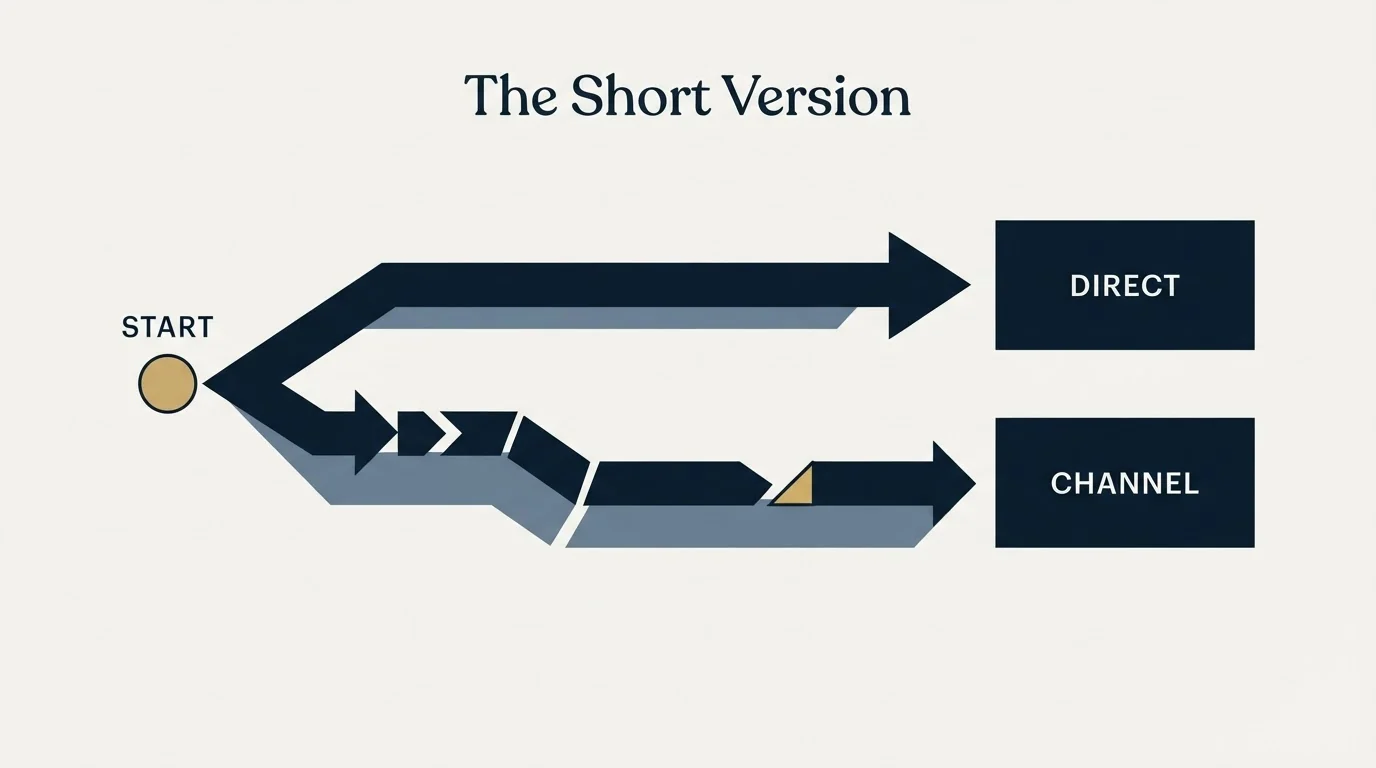
Channel and direct are two answers to the question of who owns the first conversation with a buyer and who pays for it. The deciding test is whether the buyer already trusts somebody who is not you, in a relationship through which they buy this category. Where that relationship exists, a channel model rents genuine access. Where it does not, a partner adds margin cost without solving the introduction.
Channel converts a fixed cost into a variable one and adds a front-loaded enablement cost, an incentive cost and a conflict cost that the simple comparison leaves out. Decide the route segment by segment rather than once for the company, write the ownership rule before the first contested deal, and do not hand partners the accounts you had already decided were not worth working.
If the segment you want to reach has no incumbent relationship to rent, see what a first campaign looks like.
Frequently asked questions.
Frequently asked questions- What is the difference between channel sales and direct sales?
- Direct sales means your own people generate and close the revenue, so you own the pipeline, the process, the message and the relationship, and you pay for all four. Channel sales means a third party sells to the end customer, which may be a reseller, a value-added reseller, a distributor, an implementer or a referral partner. The shared property is that somebody outside your company owns the first act.
- Which model is cheaper?
- Channel looks cheaper because it converts a fixed cost into a variable one, and the comparison usually stops there. What it omits is that the fixed cost changes shape rather than disappearing: training, materials, a named person answering partner questions, incentive money to stay one of the products a partner thinks about, and the cost of arbitrating contested accounts.
- When does a channel model actually work?
- When the buyer already has a trusted relationship with the partner through which they buy this category, when your product needs implementation work somebody else is better placed to do, when local market or regulatory knowledge is expensive for you to acquire, and when the deal size supports two margins. A list of companies a partner could theoretically call is not one of those conditions.
- Can a company run both at once?
- Most that look like channel businesses do, and the useful framing is which model owns which segment. The split that holds is by deal size and proximity: larger complex accounts stay direct, smaller accounts and adjacent geographies go to partners. The split that fails is by effort, where partners are handed the accounts the direct team had already decided were not worth working.
About the author.

B2B cold email experts helping companies generate qualified leads through done-for-you outreach campaigns.
RevenueFlow Team
Explore more.
Ready to scale your outreach?
We build GTM engines that book real meetings. See the receipts.
Related articles.
SDR Outsourcing for Business Brokers: The Fee Timing
Whether a success-fee brokerage should rent sales development at all: the fee timing, the texts that limit what an outside person may say about value, and who signs.
SDR Outsourcing for Logistics Companies: The Brokerage Line
What an outside sales development team may do in a freight company's name, the calling and email rules it inherits, and which arrangement survives a bid-shaped market.
Appointment Setting for Business Brokers: The Seller Meeting
What a bought meeting with a business owner has to be for a brokerage: the three-part qualification, the confidentiality rules, the licence line and the owner's reasons.
Win Rate Benchmarks: Which Figures State a Population
A catalogue of the published average sales win rates, sorted by whether the page names the population behind its own number. Most do not.
Sales Enablement Charters: What the Published Ones Ask For
Six publishers set out what a sales enablement charter should contain. Five describe a document nobody can check, and one writes a definition with inspection in it.
Sales Kickoff Agendas: Five Published, Session by Session
Five publishers print a sales kickoff agenda. They agree on four blocks and disagree on session length, rehearsal and where the agenda comes from.