Cloud-Based CRM: What the Deployment Decides
A cloud-based CRM is CRM software the vendor hosts and operates, reached over the internet through a browser or an app. The buyer rents access and an operator; the vendor owns the servers, upgrades, backups and uptime. The contrast is on-premise or self-hosted software, where the operating job stays with the buying company.
Key takeaways
- Cloud, hosted and software as a service describe one arrangement from three angles, and the real question is who is on the hook when the system stops running.
- Self-hosting is not the same as on-premise: you can self-host on rented cloud infrastructure and still own every operating job.
- Vendor hosting transfers the upgrade, the backup and restore, the reachable endpoint and the rate limiter, and every one of those returns if the decision reverses.
- For an outbound team the deployment decides whether connectors exist, whether change notification works, and whether the sync survives an upgrade window.
A cloud-based CRM is customer relationship management software that the vendor hosts and operates on its own infrastructure, reached by the buyer over the internet through a browser or an app. The buyer rents access and a service; the vendor owns the servers, the upgrades, the backups and the uptime.
That is the whole definition, and almost everything written under the heading is a benefits list rather than a definition. The part worth spending time on is narrower: what the deployment choice decides about the systems that sit above the CRM, because a sending platform, an enrichment provider and a reporting layer all make assumptions about the CRM underneath them, and those assumptions were written for a hosted one.
The words in circulation, and which ones name a real difference
Four terms get used interchangeably and only two distinctions underneath them are load-bearing.
Cloud, hosted and software as a service all describe the same arrangement from slightly different angles. Cloud names where it runs, hosted names who runs it, and software as a service names how it is sold, usually per seat per month. In ordinary usage a cloud CRM is a CRM somebody else operates and you subscribe to.
On-premise names software installed on servers the buying company owns and keeps in its own building or its own rack. It is now rare in this category and it is the historical contrast the term cloud was coined against.
Self-hosted is the term that gets flattened into on-premise and should not be. Self-hosting means you install and operate the software yourself, and the machine can perfectly well be a rented instance at a cloud provider. It is a deployment decision about who operates the thing, not about where the metal is. Twenty's pricing FAQ, published on twenty.com and read on 2 September 2026, puts the fork in one sentence: "You can self-host to fully own your infrastructure, or run it on our managed cloud for a zero-ops setup."
So the real question behind cloud-based CRM is not where the software runs. It is who is on the hook when it stops running.
- The vendor applies upgrades, patches and backups
- Uptime and monitoring are the vendor's obligation
- A published API and a rate limiter you did not build
- Priced per seat, so the bill scales with headcount
- Support is usually part of the subscription
- Your team applies updates and security patches
- Uptime during sending hours is your problem
- You supply the endpoint, the auth app and the limiter
- Licence may be free, infrastructure and labour are not
- Support is a decision somebody has to make deliberately
SuiteCRM writes the same fork into its own pricing page, published on suitecrm.com and read on 2 September 2026, where the self-hosted card is labelled "Best for: technical teams with in-house IT" and the managed card is "Best for: teams without in-house IT resource". Its support step states the asymmetry plainly: "If you are on fully managed hosting, Standard support is required", and on the self-hosted path the same step is optional.
What the buyer stops owning
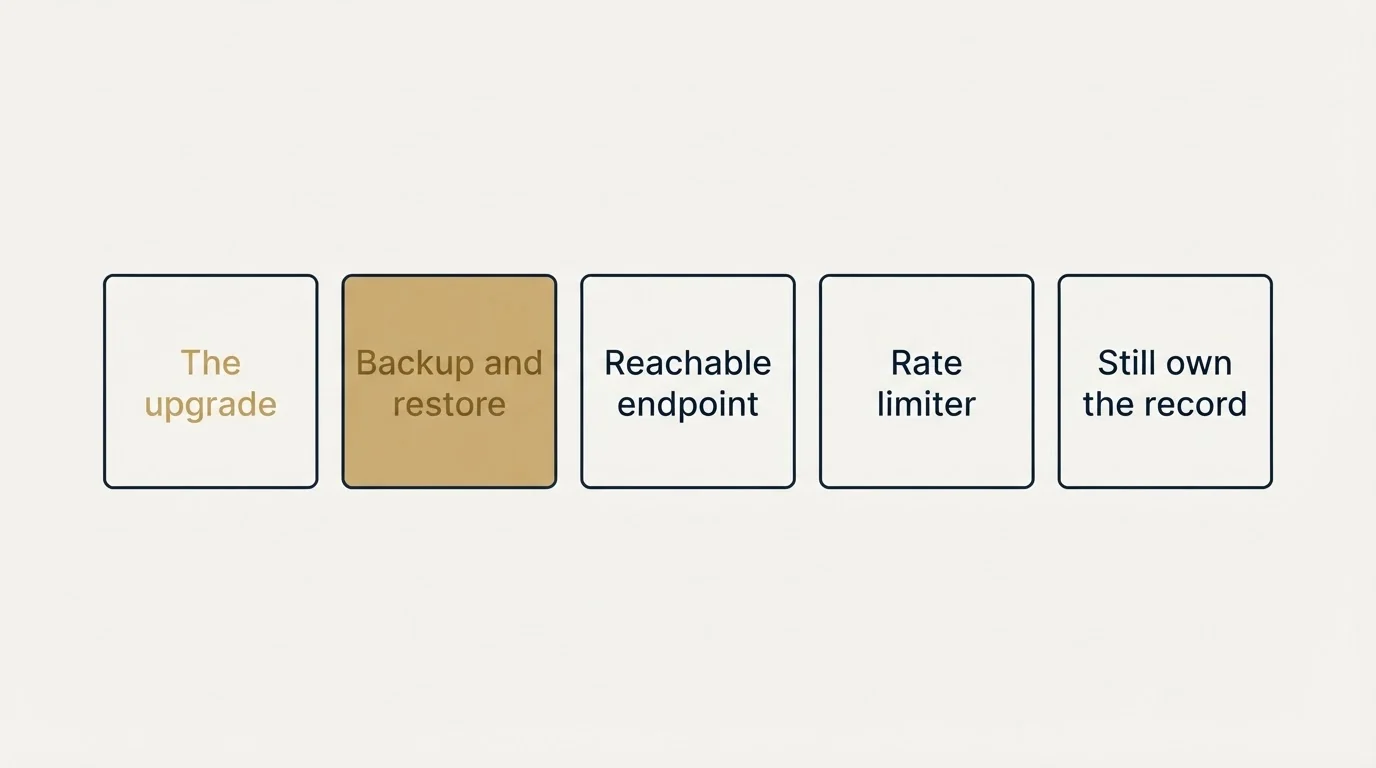
Choosing a cloud CRM transfers four specific jobs, and it is worth naming them because they are the jobs that come back if the decision is ever reversed.
The upgrade. The vendor ships a release and it arrives. Nobody schedules a window, and nobody has to notice that the window overlapped with a live campaign.
The backup and the restore. The distinction matters more than it reads. Most teams that operate their own instance take backups. Far fewer have ever tested a restore, and an untested backup is a belief rather than a control.
The reachable endpoint. Every third-party tool that syncs with a CRM needs an address it can reach and a way to be told a record changed. On a vendor-hosted platform that address exists and is somebody else's uptime obligation. The three ways an integration actually gets built, and what each one costs, are in CRM integration.
The rate limiter. A hosted platform meters your API calls, which reads as an annoyance and functions as a circuit breaker. A runaway sync job hits a wall instead of the database. On your own instance the wall is your database, and the first symptom is the CRM getting slow for the people using it.
What the buyer does not stop owning is the record itself. Every claim in this deployment discussion is about operations, and none of it improves what is written in the fields. That work is data hygiene and it belongs to whoever runs the go-to-market motion, on any deployment.
What the deployment decides for an outbound stack
This is the section the generalist definitions do not write, and it is the one that matters to a team sending cold email.
An outbound programme is not one system. It is a sending platform, a source of contacts, and a CRM that has to end up holding what happened, and the value of the whole arrangement depends on events crossing between them reliably. A cloud CRM makes four things true that a self-operated instance makes conditional.
Connectors exist. Vendors publish native integrations against platforms they can reach. Nobody publishes a connector to an instance behind your firewall, so the cheapest integration route disappears and the expensive one becomes the default.
Change notification works out of the box. Being told that a record changed requires the notifying party to reach you. On a hosted platform that is configuration. On your own instance it is a certificate, a firewall rule and an uptime commitment.
The sync survives your holiday. A cold campaign writes sends, replies, bounces and opt-outs back continuously. If the CRM is down for an upgrade during a sending window, nothing fails loudly. It simply stops writing replies, and somebody discovers on Thursday that Tuesday's reply is not on the record.
Suppression stays enforceable. A person who asked not to be contacted has to be suppressed at the company record, not in a campaign setting, and that only works if the record is reachable from wherever the next campaign is built. The object model this depends on is in CRM basics, and the configuration order is in CRM setup for an outbound team.
None of that argues that self-hosting is wrong. It argues that the deployment decision is an outbound-stack decision as much as an IT one, and the operator's version of the case is worked through in self-hosted CRM.
Where the definition misleads

Three things travel with the term and each is worth checking before it is repeated.
Cloud is not a feature set. The same vendor frequently ships different capability bundles on each deployment, so a comparison built from a benefits list can be comparing two configurations of one product. Read what is included on the path you are buying rather than what the product page says the product does.
A free cloud tier and a free open-source edition are different products. They share a name in the same shortlist and they are not the same thing, which is how a team downloads one expecting the other. Where the licence is genuinely free, the bill is hosting, implementation and support instead, which is exactly the three-step shape SuiteCRM prices on its own page.
Multi-tenancy is the question data-residency answers to. Most cloud CRMs run many customers on shared infrastructure with logical separation. That is ordinary and safe in the general case, and it is beside the point when a contract or a regulator requires records to sit in a named jurisdiction. When that requirement exists the deployment decision is already made and the rest of the discussion is a cost to plan. The questions worth settling before a signature, on either path, are in the CRM evaluation checklist.
A fourth misreading is quieter. A cloud CRM removes the operating job and leaves every decision that actually determines whether the system is useful: what it is a record of, which fields are required, what a stage means, and which system is allowed to be wrong when two of them disagree. Buying a hosted product settles none of those.
What to do with it
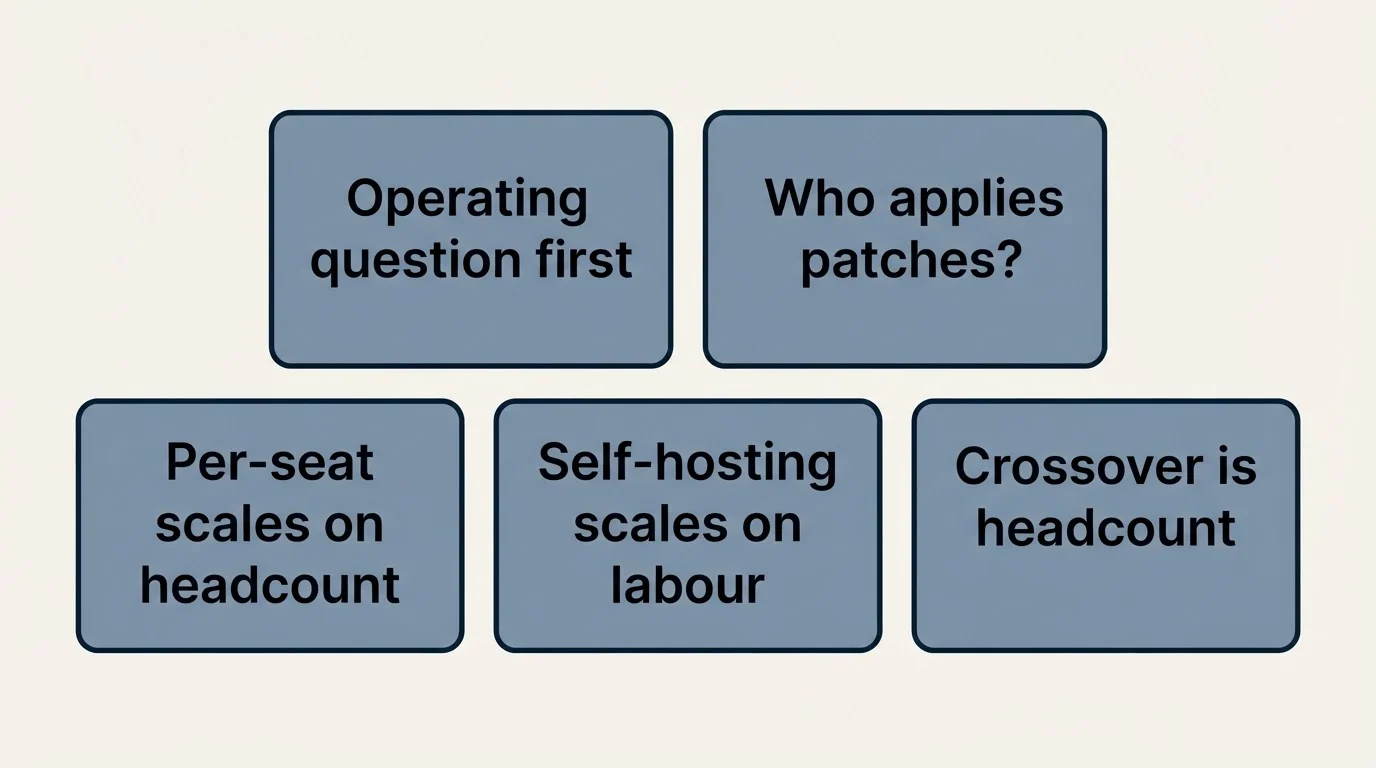
Decide the operating question first and the product second. If nobody on the team can name who applies a security patch, the deployment answer is vendor-hosted and the rest of the comparison is about fit.
- Yes: Name who applies a security patch, as a person rather than a team
- Yes: Say where an upgrade window sits relative to your sending hours
- Yes: Decide who owns the authentication app and its secrets
- Yes: Confirm a third party can reach the instance to report a record change
- Yes: Check which capability bundle is included on the path you are buying
- Depends: Work out the headcount at which per-seat billing passes the operating cost
- Depends: Ask whether a contract or regulator names a jurisdiction for the records
Then price the path rather than the product, because per-seat billing scales on headcount and self-hosting scales on labour, and the crossover point is a headcount rather than an opinion. If the platform question is genuinely open, best CRM tools for SDR teams compares the field with the seat question in front.
And if the CRM is clean on either deployment and there is nothing flowing into the top of it, the constraint is supply rather than software. See what a first campaign produces against your market.
Related terms and guides
CRM basics covers the four objects any deployment holds and the question the system has to be a record of. CRM enrichment covers filling the fields a segment query needs, data hygiene the maintenance that keeps them worth querying, and CRM reports what can be read back out once they are.
On the build side, self-hosted CRM is the operator's case for the other path and what it does to the tools above the CRM, CRM integration is the sync layer both paths need, CRM setup for an outbound team is the vendor-neutral configuration order, and the CRM evaluation checklist is what to settle before signing anything.
Vendor deployment terms quoted from pages fetched on 2 September 2026. Verify current terms with the vendor before relying on them.
Frequently asked questions.
Frequently asked questions- What is a cloud-based CRM?
- Customer relationship management software that the vendor hosts and operates on its own infrastructure, reached by the buyer over the internet through a browser or an app. The buyer subscribes to access and to an operating service. The vendor owns the servers, the upgrades, the backups and the uptime commitment, and usually bills per seat per month.
- What is the difference between a cloud CRM and an on-premise CRM?
- On-premise means the software is installed on servers the buying company owns and operates, traditionally in its own building. Cloud means the vendor runs it. The distinction people actually need is a third one: self-hosting, where you operate the software yourself on any machine including a rented cloud instance, so location and operator are separate questions.
- Is a cloud CRM safe for company data?
- For most teams the operating risk is lower on a hosted platform, because patching, backups and monitoring belong to a vendor doing them full time. The question that overrides the general case is jurisdiction: where a contract or a regulator requires records to sit in a named place, the deployment decision is already made and the rest is a cost to plan.
- Does a cloud CRM make an outbound programme easier to run?
- It removes four obstacles rather than solving the programme. Native connectors exist because a vendor can reach the platform, change notification works without a firewall project, the sync is not interrupted by an upgrade window you scheduled, and suppression stays enforceable at the company record. What gets written into the fields is still your job.