Agile CRM Pricing: The Card Shows the Two Year Rate
Agile CRM's cards headline the two year prepaid rate and keep the monthly one in a hover tooltip. The full ladder, the tier meters, the email overage and two FAQs.
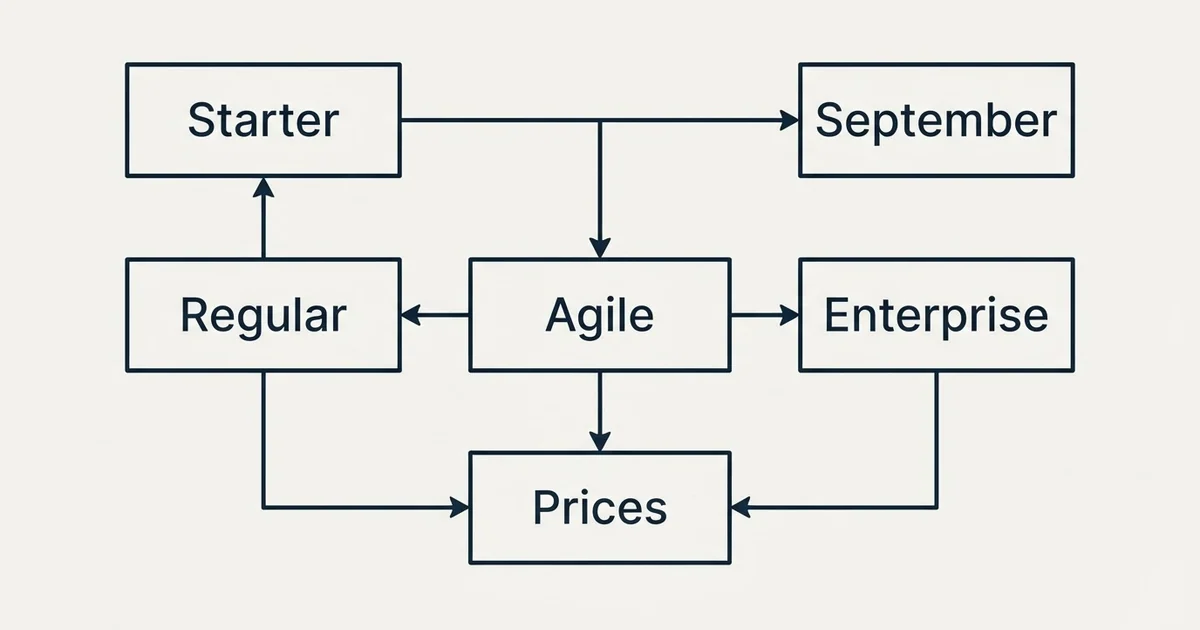
As published on Agile CRM's pricing page on 4 September 2026, Starter, Regular and Enterprise cost $14.99, $49.99 and $79.99 per user per month billed monthly, $9.99, $39.99 and $64.99 yearly, and $8.99, $29.99 and $47.99 on a two year term. The cards show only the two year figure; the rest sits in a hover tooltip.
Key takeaways
- The as low as figure on each card is the two year prepaid rate, and the monthly rate is a little under twice it, printed only in a tooltip that appears on hover.
- The free plan is a working plan for ten users and 1,000 contacts, and the paid tiers are separated by contact ceilings, workflow counts and API calls rather than by the seat rate.
- Every tier includes 5,000 branded emails, with overage priced per email in a tooltip and a lower rate for bringing your own sending service.
- The vendor's two pricing pages answer the nonprofit discount question differently, and the 500apps bundle advertised on the same page is a separate product at a coincidentally similar rate.
Reviewed and updated October 1, 2026
The three paid cards on Agile CRM's pricing page headline a rate the page labels "as low as", and that rate is the two year prepaid figure. The monthly rate for the same tier is printed only in a tooltip that appears when a cursor hovers over the price, and it is a little under twice the headline. A buyer who reads the card and not the tooltip budgets the Starter tier at nine dollars a user when a month to month subscription costs fifteen.
Everything below was read from Agile CRM's pricing page and its expanded pricing page on 4 September 2026, with each figure attributed to the surface it appears on and dated, including the tooltip figures.
Four tiers, three billing periods, one visible number
As published on Agile CRM's pricing page on 4 September 2026, the page carries a Free plan for ten users and three paid tiers named Starter, Regular and Enterprise. Each paid card on the page headlines a single figure with the words "as low as" above it: Starter at $8.99, Regular at $29.99 and Enterprise at $47.99, all per user per month.
The hover tooltip on each price carries the full ladder. The Starter tooltip states $14.99 per user per month billed monthly, $9.99 billed yearly, which it marks as 34 percent off, and $8.99 on a two year term, marked 40 percent off. The Regular tooltip states $49.99 monthly, $39.99 yearly at 20 percent off, and $29.99 on two years at 40 percent off. The Enterprise tooltip states $79.99 monthly, $64.99 yearly at 20 percent off, and $47.99 on two years at 40 percent off. All three tooltips end with the words "Prices per user per month".
So the visible ladder is the two year ladder. The monthly ladder, the one a small team actually starts on, is roughly $15, $50 and $80, and it exists on the page only in a hover state. That is the single most important thing to know about Agile CRM pricing, and it is why most third party pages quote the wrong number: they copy the card.
What the free plan and the tiers carry
The free plan is genuinely a plan rather than a trial: ten users, 1,000 contacts and companies, one campaign workflow with five nodes, one automation rule, one plugin, 500 API calls a day and 5,000 branded emails, with no card required. The comparison table beneath the cards scales those meters through the paid tiers. Contacts run 1,000, 10,000, 50,000 and unlimited. Campaign workflows run one, five, ten and unlimited, with five, ten, 25 and 50 nodes per campaign. Automation rules run one, five, ten and unlimited. Plugins and integrations run one, three and then fifty plus on the top two tiers. API calls a day run 500, 5,000, 10,000 and 25,000.
Every tier, free included, lists 5,000 branded emails. The pricing page FAQ explains how to buy more: an email add-on package, whose emails last for one month from the time of purchase. The tooltip behind that row on the page prices the overage: up to 100,000 emails at $0.004 each, the next million at $0.003 each, and $0.002 each when you bring your own sending service through Mandrill, Amazon SES or SendGrid. A second tooltip on the page prices contact level analytics beyond the free 10,000 events: the next 50,000 at $50, the next 500,000 at $150 and the next million at $249. A third tooltip on the page prices SMS through your own Twilio or Plivo account at $2 per thousand.
- 10,000 contacts and companies
- Five campaign workflows, ten nodes
- Five automation rules
- Three plugins
- 5,000 API calls a day
- Two way email integration and tracking
- 50,000 contacts and companies
- Ten campaign workflows, 25 nodes
- Ten automation rules
- Fifty plus plugins and integrations
- 10,000 API calls a day
- Telephony and call recording
- Unlimited contacts and companies
- Unlimited workflows, 50 nodes
- Unlimited automation rules
- Fifty plus plugins and integrations
- 25,000 API calls a day
- Automated voicemails and dedicated support
The two FAQs that disagree
Agile CRM publishes two pricing pages. The primary page, at the pricing path, carries the cards and a short FAQ. The expanded page, at the pricings path, carries the same cards, the same tooltips and a longer FAQ. On 4 September 2026 the two answered the same nonprofit question differently. The primary page says that nonprofit organisations with limited resources can use the free plan and that the vendor has kept its prices among the lowest in the industry so both nonprofits and for-profit companies benefit. The expanded page says that Agile CRM currently does not offer special discounts for nonprofit organisations. Both are true readings of the same policy, since a free plan is a plan rather than a discount, and a nonprofit buyer reading only one of them comes away with a different expectation.
The primary page FAQ carries the other commitments: plans can be upgraded, downgraded or cancelled at any time from the dashboard; paid plans carry a 99.5 percent uptime guarantee; a user is any staff member with their own login; and more emails come from the add-on package described above.
The bundle on the same page is a different product
Beneath the pricing cards the page advertises 500apps, described as the vendor's new initiative for small businesses, at $14.99 per user for a suite of apps with no tiered plans. The homepage carries the same offer at a different app count and a note that the suite was developed as part of the 500apps application suite and is kept free for Agile CRM customers on request. That $14.99 figure is the same numeral as Agile CRM's own Starter monthly rate, which is a coincidence worth flagging because a page that shows both can be read as one product priced two ways. It is not. The CRM's monthly Starter rate lives in a tooltip; the bundle's rate is for a separate suite.
- Step 1Ignore the headline
The as low as figure on each card is the two year prepaid rate.
- Step 2Hover the price
The tooltip prints monthly, yearly and two year rates with the discount for each.
- Step 3Check the contact ceiling
1,000, 10,000, 50,000 and unlimited are the tier boundaries that move a team up.
- Step 4Size the email meter
5,000 branded emails on every tier, then per email overage or bring your own sender.
- Step 5Read both FAQs
The primary and expanded pricing pages answer the nonprofit question differently.
Who the page says it is for
Agile CRM describes itself as a complete sales and marketing solution for small businesses, and its solutions page names SaaS companies and startups, eCommerce sites and online stores, small and medium businesses, call centres and real estate, with an SDR CRM page beside them. The product's shape matches: campaign workflows, landing page and form builders, web popups and telephony sit in the same table as the deal pipeline, which is why the tier meters are marketing meters as much as sales ones.
The site's own Ontraport cost read sets Agile CRM among the all-in-one marketing suites priced on contacts, and that is the right bracket for it. A sales team that wants only a pipeline and a mailbox sync is paying for automation it may never open, and the contact ceiling, not the seat rate, is the number that moves it between tiers.
What an outbound team should weight at nothing
Agile CRM's campaign workflow and node rows describe drip campaigns, and its Starter tier's headline feature is the workflow builder. That is accurate, and it is the feature to weight at nothing for a cold programme run the way this site runs it. RevenueFlow sends one message per campaign, with no bumps and no thread replies. The reasoning is in why we stopped using follow-ups.
The branded email allowance is the other row to read carefully. Five thousand emails a month through a CRM's shared sending infrastructure is a marketing allowance, and cold volume does not belong on it or on the mailbox a company's relationships run through. The sending architecture question for a team that does both is set out in the CRM comparison for cold email teams, and the answer there is a separate sending stack whatever CRM sits behind it.
Why the ranking pages disagree with each other
Search the query and the results quote three different Starter figures, and all three are on the vendor's page: the two year rate on the card, the yearly rate in the tooltip and the monthly rate beside it. A review that says Agile CRM starts at $8.99 is quoting a two year commitment. One that says $14.99 is quoting the page's month to month rate, or the 500apps bundle. Neither is wrong about the page and both are wrong for a buyer who did not pick the same term. The same pattern of a headline rate and a second meter deciding the bill shows up on Pipedrive's pricing page, where the visible figure is the annual one.
- Yes: Hover every price and write down the term your quote is on
- Yes: Check the contact ceiling against your list before choosing a tier
- Yes: Price the email overage or plan to bring your own sender
- Yes: Confirm which nonprofit answer applies if that is your status
- Yes: Treat the 500apps bundle as a separate purchase
- No: Budget on the as low as figure for a month to month plan
The short version
As published on Agile CRM's pricing page on 4 September 2026, the free plan covers ten users and 1,000 contacts, and the paid tiers run $14.99, $49.99 and $79.99 per user per month billed monthly, $9.99, $39.99 and $64.99 billed yearly, and $8.99, $29.99 and $47.99 on a two year term, with only the two year figure visible on the cards and the rest in a hover tooltip. Every tier includes 5,000 branded emails with per email overage above it, tiers are separated by contact ceilings and workflow counts, and the vendor's two pricing pages give different answers on nonprofit discounts.
For the field around it, the site's own Agile CRM alternatives page sets the product against the rest of the category. If the constraint is the number of qualified conversations reaching the CRM rather than how they get nurtured, see what a first campaign produces against a qualification standard agreed in writing before launch.
Card figures, tooltip ladders, tier meters, overage rates and quoted FAQ answers above were read from Agile CRM's pricing page and its expanded pricings page on 4 September 2026, with the tooltip figures taken from the served page markup. Verify current terms with the vendor before relying on them.
Frequently asked questions.
Frequently asked questions- How much does Agile CRM cost per user per month?
- As published on Agile CRM's pricing page on 4 September 2026, the hover tooltips price Starter at $14.99 per user per month billed monthly, $9.99 yearly and $8.99 on a two year term; Regular at $49.99, $39.99 and $29.99; and Enterprise at $79.99, $64.99 and $47.99. The cards themselves show only the two year figure under the words as low as.
- Is Agile CRM really free for 10 users?
- Yes, on the page read on 4 September 2026. The free plan covers ten users with no card, 1,000 contacts and companies, one campaign workflow with five nodes, one automation rule, one plugin, 500 API calls a day and 5,000 branded emails. It is a working plan rather than a trial, and the primary pricing page points nonprofits with limited resources to it.
- What does Agile CRM charge for extra emails?
- Every tier includes 5,000 branded emails. The pricing page FAQ says more come from an email add-on package whose emails last one month from purchase, and the tooltip behind the email row prices overage at $0.004 per email up to 100,000, $0.003 for the next million, and $0.002 when you bring your own sending service through Mandrill, Amazon SES or SendGrid.
- Does Agile CRM offer a nonprofit discount?
- The vendor's two pricing pages answered differently on 4 September 2026. The primary page says nonprofits with limited resources can use the free plan and that prices are kept low for everyone. The expanded pricings page says Agile CRM currently does not offer special discounts for nonprofit organisations. Both describe the same policy of no discount beyond the free plan.
About the author.

B2B cold email experts helping companies generate qualified leads through done-for-you outreach campaigns.
RevenueFlow Team
Explore more.
Ready to scale your outreach?
We build GTM engines that book real meetings. See the receipts.
Related articles.
Capsule CRM Pricing: Five Tiers, Priced by Where You Stand
Capsule's pricing URL redirects to a signup page that draws dollars or pounds by location. Both annual ladders, the contact ceilings, the add-on and the downgrade rule.
Less Annoying CRM Pricing: One Rate, Changed Once Since 2009
Less Annoying CRM publishes a single per user rate with everything included. What it covers, the settled terms, the no discount answer and the one price change.
Salesflare Pricing: Three Seat Rates, Two Currencies
Salesflare's cards switch between monthly and annual billing and between dollars and euros. The seat rates, the five user Enterprise floor, credit packs and proration.
Pipeliner CRM Pricing: Now Coevera, Two Ladders by Location
Pipeliner CRM became Coevera in 2026 and its pricing page serves a dollar or pound ladder by location. Both ladders, the three seat floor and the billing condition.
Pipeline CRM Pricing: Three Plans, Two Deal Ceilings
Pipeline CRM publishes its whole ladder at both billing states. The active deal ceilings, the flat add-ons and the onboarding packages are what decide the bill.
folk Pricing: Per Member Rates and a Two Week Trial
folk's page title promises a free plan its table does not carry. The per member rates in dollars and euros, the meters between tiers, and the trial that ends blocked.