Best CRM Tools for Cold Email Teams (2026)
The five CRM tools worth comparing for Cold Email Teams in 2026, with every price attributed to the page it came from and the unverifiable ones marked.
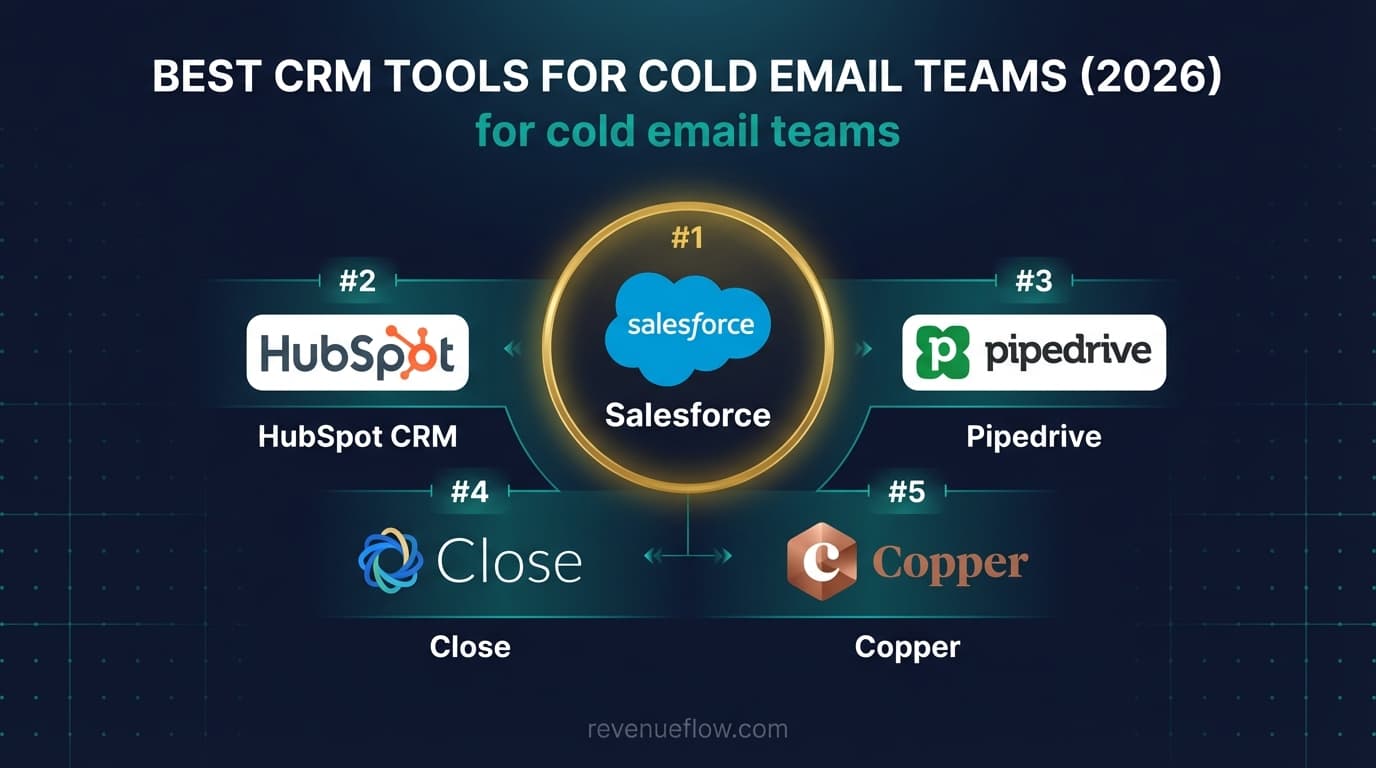
A cold email CRM is the system of record beside the sending platform: it tracks replies, holds suppression across every campaign and outlives the sending tool, and it does not send. HubSpot, Zoho CRM, Freshsales, Salesforce and Pipedrive all qualify; Freshsales Growth is the cheapest published paid seat at $9, billed annually.
Key takeaways
- The CRM in a cold email stack does not send: sending volume, deliverability tooling and A/B testing belong to the sending platform.
- Suppression that spans campaigns is the requirement that justifies the CRM, because the same person is reachable through several lists.
- Freshsales lists Growth at $9, Pro at $39 and Enterprise at $59 per user a month billed annually, with sequences on Pro and no free plan.
- HubSpot's Sales Hub Professional adds a required one-time onboarding fee of £1,310 on top of seats from £77 a month, on the pound-priced page.
Reviewed and updated September 18, 2026
A dedicated cold email team does not need its CRM to send anything, and expecting it to is how teams end up with two systems that both half-manage the same contacts. The right cold email CRM does one job the sending platform cannot: it remembers, across every campaign and every sending tool, who was contacted, what they said and who is off-limits, at the volume a dedicated cold email team sends.
Around that record sit several other jobs, and nine revenue operations products sorted by job show which ones a shopping term quietly bundles together.
What is a cold email CRM?
A cold email CRM is the system of record that sits beside the sending platform. It holds replies, meetings and the suppression list across every campaign, and it outlives the sending tool. It does not send: sending volume, deliverability tooling and A/B testing belong to the sending platform. Judged that way, HubSpot, Zoho CRM, Freshsales, Salesforce and Pipedrive all qualify, at very different prices.
What Cold Email Teams Need From a CRM Tool
- Reply tracking
- Suppression that holds across every campaign
- Activity write-back at volume
- A record that outlives the sending platform
Suppression is the requirement that justifies the CRM in this stack. At volume, the same person will be reachable through several lists, and the only durable answer to whether they have already said no is a record that spans campaigns and outlives the sending tool. That is a CRM job and nothing else in the stack does it.
Write-back at volume is the second demand and it is where CRMs quietly fail. A team sending tens of thousands of messages a month generates activity records at a rate that hits API limits and inflates storage, and the failure mode is silent: activity stops arriving, reports look thinner, and nobody knows when it started. Ask about API rate limits explicitly.
Reply tracking belongs on the list because it is a record-keeping function rather than a sending one. Sending volume, deliverability tooling and A/B testing belong to the sending platform, and asking a CRM for them produces a worse version of both tools.
The five CRM tools, priced from their own pages

HubSpot
Two HubSpot pages carry prices. Its CRM product page lists a free CRM for up to two users and 1,000 contacts, then Starter at $15 a seat a month, a price it marks as a discount for new customers only, Professional from $50 and Enterprise from $75. Its Sales Hub pricing page, which rendered in pounds for this box, lists Free for up to 2 users, Starter from £7 a seat a month, Professional from £77 and Enterprise from £135, and adds a required one-time onboarding fee of £1,310 on Professional and £3,050 on Enterprise.
It is a common pairing with a dedicated sending platform, holding the company and deal record while the sending tool handles volume. API limits differ by tier, so confirm them for the tier you intend to buy. HubSpot CRM alternatives covers the rest of that market.
Zoho CRM
Zoho CRM's pricing page is titled "Free for 3 users" and geo-serves its currency. From this box it served rupees: Standard at ₹800, Professional at ₹1,400, Enterprise at ₹2,400 and Ultimate at ₹2,600 per user a month, so read it in your own currency before budgeting. Standard lists workflows and assignment rules, which is enough automation to maintain a suppression list, and also cadences for automated multichannel follow-up sequences. For a team that already sequences in its sending platform, that second feature is one to leave switched off. The wider field is in Zoho CRM alternatives.
Freshsales
Freshsales lists Growth at $9, Pro at $39 and Enterprise at $59 per user a month, billed annually. There is no free plan on that page, only a 21-day trial, and it prices two add-ons separately: Branded documents at $19 per user a month and the Freddy AI Agent at $49 per 100 sessions. Its sales sequences sit on Pro, so for a team that already sequences elsewhere, Growth as a record-keeper is the cheaper reading. The comparison set is in Freshsales alternatives.
Salesforce
Salesforce's Sales pricing page lists Free Suite at $0, Starter Suite at $25 per user per month billed monthly or annually, Pro Suite at $100, and Core, Advanced and Max at $195, $395 and $550 per user per month, billed annually. The page runs a currency converter rather than geo-forcing one, and shows the same paid ladder in pounds at £20, £80, £156, £316 and £440. Only Starter Suite is offered monthly, so it is the one tier not asking for a year up front. For a large operation, price the API limits and sandbox availability, not the pipeline view; Salesforce alternatives covers when to leave it.
Pipedrive
Pipedrive's pricing page served pounds to a headless browser here: Lite at £14, Growth at £39, Premium at £59 and Ultimate at £79 per seat per month, billed annually, which the page also states as one payment of £168, £468, £708 and £948 per seat a year. It suits a smaller outbound team that wants deals visible without a platform, and Pipedrive alternatives lists what else sits at that size.
What the CRM Actually Has to Do With Outbound
A CRM does not send cold email and does not improve deliverability, so the reason it belongs in an outbound stack is narrower than a feature list suggests: it is the record of truth that outlives every other tool in that stack.
Sending platforms get replaced, warmup subscriptions lapse, sequences get rebuilt. What survives is who was contacted, when, and what they said, because that record stops the same person being pitched twice and settles a dispute about whether a meeting counted. So the practical test of a CRM in an outbound context is whether activity arrives intact and attributable, which is a question about the write-back path rather than about features.
Two consequences follow, both cheap now and expensive later. Decide which system is the record of truth before integrating anything, because a team treating both as authoritative reconciles them monthly. And agree the qualification criteria in writing before the first campaign, in the CRM's own fields, so a meeting is judged against a definition rather than a memory. Budget, timing and authority are never among those criteria.
The house rule follows: one message per campaign, no bumps and no thread replies. A CRM will happily record a five-touch sequence, and recording it does not make it a good idea.
Comparison Table
| Tool | Free plan on its page | Entry paid tier | Top published tier | Currency served here |
|---|---|---|---|---|
| HubSpot Sales Hub | Free for up to 2 users | Starter from £7 a seat | Enterprise from £135, plus £3,050 onboarding | GBP (CRM page: USD) |
| Zoho CRM | Free for 3 users | Standard ₹800 | Ultimate ₹2,600 | INR |
| Freshsales | 21-day trial | Growth $9, billed annually | Enterprise $59 | USD |
| Salesforce | Free Suite $0 | Starter Suite $25 | Max $550, billed annually | USD, converter to GBP |
| Pipedrive | 14-day trial | Lite £14, billed annually | Ultimate £79 | GBP |
Recommendation by Budget

The cheapest record-keeper. Freshsales publishes $9 per user a month, billed annually, on Growth, the lowest paid per-seat price here. Note the unit and the basis: per user, at the annual rate, with no free tier behind it.
The free tiers. HubSpot's Sales Hub page is free for up to 2 users, Zoho CRM is free for 3 users, and Salesforce now lists a Free Suite at $0. Any of them can hold a small team's suppression list before a paid seat is needed.
The line teams miss. HubSpot's Sales Hub Professional carries a required one-time onboarding fee of £1,310, and Enterprise £3,050, on top of the seats.
As illustrative arithmetic, five seats for a year come to $540 on Freshsales Growth, $1,500 on Salesforce Starter Suite, £2,340 on Pipedrive Growth, $6,000 on Salesforce Pro Suite, and £5,930 on HubSpot Sales Hub Professional once its onboarding fee is added. The currencies are the ones each page served. Zoho CRM is left out because its page served rupees, and converting them would put our figure in Zoho's column.
| Five seats, one year | Arithmetic | Total |
|---|---|---|
| Freshsales Growth | 5 x $9 x 12 | $540 |
| Salesforce Starter Suite | 5 x $25 x 12 | $1,500 |
| Pipedrive Growth | 5 x £468 a year | £2,340 |
| Salesforce Pro Suite | 5 x $100 x 12 | $6,000 |
| HubSpot Sales Hub Professional | 5 x £77 x 12, plus £1,310 onboarding | £5,930 |
Zoho CRM is left out because its page served rupees, and converting them would put our figure in Zoho's column.
How to Choose
Does suppression hold across every campaign and list? This is the reason the CRM is in the stack. A per-campaign opt-out is not suppression.
What are the API rate limits at your tier? High-volume write-back hits them, and when it does, activity stops arriving silently.
Where does sequencing run? Pick the sending tool or the CRM, never both. Two sequencers on one contact is a duplicate-send incident waiting to happen.
Will the record survive a platform change? You will change sending tools. The CRM is what makes that a migration rather than an amnesia event.
Does reporting lead with replies? Opens are inflated by mail security, and at volume that error compounds into a confident wrong conclusion.
Getting It Adopted
Write the stage definitions and the qualified-meeting criteria before configuring anything.
Decide what an account is and how contacts hang beneath it, before the first import.
Agree who sees what while the CRM is still empty.
Test write-back with real records and real owners, and name one system as the record of truth.
Decide the boundary first: sending platform owns delivery, CRM owns the record and the suppression state. Write it down, because at volume an ambiguous boundary becomes duplicate sends rather than a debate.
Then test write-back at something close to real volume during the trial rather than with ten records, and ask directly about API limits at your intended tier. This is the failure that arrives quietly three months in.
Hold the doctrine: one message per campaign, no bumps, no thread replies. A team with real volume has the technical means to bump, and the CRM is where the evidence of who already declined has to live.
Where the Tool Stops Mattering
The tool stops mattering at infrastructure and offer. A CRM does not affect deliverability at all, and at volume deliverability is the constraint that decides results.
The second limit is measurement discipline. More activity records do not mean more pipeline, and a CRM will happily show a rising activity count next to a flat meeting count for a full quarter.
Final Thoughts

Paired with a dedicated sending platform: HubSpot for the company and deal record. Cheapest record-keeper on a published rate: Freshsales at $9 per user a month, billed annually. Large operation needing API headroom and permissions: Salesforce. Cost-led at high seat counts: Zoho, read in your own currency. Small team wanting deals visible: Pipedrive.
Related Reading
- Best HubSpot CRM Alternatives in 2026
- Best Zoho CRM Alternatives in 2026
- Best Salesforce Alternatives in 2026
- Best Pipedrive Alternatives in 2026
- Best Freshsales Alternatives in 2026
- Email sending tools for cold email teams
If you would rather have this run for you, RevenueFlow books qualified meetings on a pay-per-meeting basis and publishes client results.
If you would rather have this run for you, RevenueFlow books qualified meetings on a pay-per-meeting basis and publishes client results.
Pricing and features are taken from the vendors' own pages. Verify current terms with the vendor before relying on them.
Frequently asked questions.
Frequently asked questions- What is the best CRM for cold email?
- The best cold email CRM is the one that holds suppression across every campaign and survives a change of sending tool, since it does not send. HubSpot suits pairing with a dedicated sending platform, Freshsales is the cheapest published paid seat at $9 billed annually, Salesforce suits large operations needing permissions, Zoho suits high seat counts and Pipedrive suits small teams.
- Is a cold CRM different from a normal CRM?
- No. A so-called cold CRM is an ordinary CRM used as the system of record beside a cold email sending platform. What changes is the job: suppression that spans campaigns, activity write-back at high volume, and a record that outlives the sending tool. Sequencing and deliverability stay in the sending platform, and one message per campaign is the rule the record enforces.
- Should the CRM or the sending tool run the sequences?
- Pick one, never both. Two sequencers on one contact is a duplicate-send incident waiting to happen. Several CRMs bundle sequencing, including Freshsales on Pro and Zoho CRM's cadences on Standard, and for a team that already sends from a dedicated platform those features are best left switched off. The CRM's job is the record and the suppression state.
- How much does a CRM for a cold email team cost?
- Published entry points differ widely. Freshsales Growth is $9 per user a month billed annually, Salesforce Starter Suite is $25, Pipedrive Lite served at £14 a seat, and HubSpot's Sales Hub starts at £7 a seat with Professional at £77 plus a £1,310 onboarding fee. HubSpot, Zoho CRM and Salesforce also list free tiers.
About the author.

B2B cold email experts helping companies generate qualified leads through done-for-you outreach campaigns.
RevenueFlow Team
Explore more.
Ready to scale your outreach?
We build GTM engines that book real meetings. See the receipts.
Related articles.
CRM Report Template: Four Reports, Field by Field
A CRM report template is four saved queries: pipeline by stage, activity by owner, conversion by source and stale deals, each with its filter, fields and formulas.
Which CRMs and Tools the Outbound Stack Connects To: Integration Data From 342 Sales Tools
HubSpot is named as an integration by 52.3% of 342 verified sales tools, Zapier by 50.3% and Salesforce by 43.3%. Here is the full map by category.
Sales Data: The Classes, and Which Ones You Can Buy
Sales data covers two collections with almost nothing in common: the account attributes a provider sells you, and the outcomes only your own sending produces.
Best CRM for Google Workspace: What Lives in Gmail
Working with Google Workspace covers four separate integrations, and most of the category ships as a browser extension. What five vendors publish about theirs.
Best Time to Cold Call: What the Studies Counted
The best time to cold call figures traced to their originals: one inbound study from six companies, three vendor call datasets, and what survives the read.
Best Time to Send a Sales Email: What Was Measured
The send time studies behind the midweek morning answer, what each one actually counted, and why a broadcast finding does not transfer to a sales email.