Best Freshsales Alternatives in 2026
Freshsales alternatives compared on integration reach, reporting depth and entry price, each price read on the vendor's own pricing page in the currency it served.
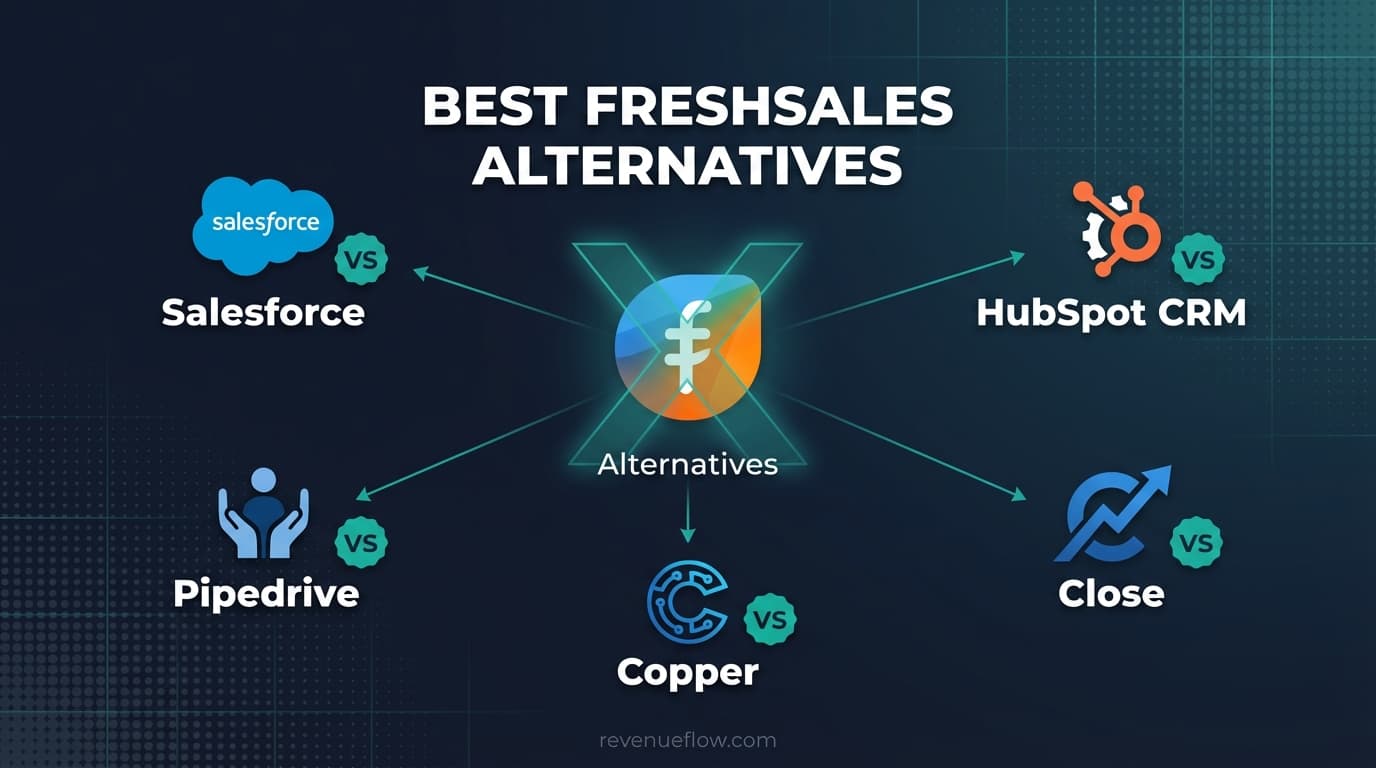
The best Freshsales alternatives are HubSpot CRM or Zoho CRM when a free tier would do, Copper for Google Workspace teams, Close for phone-first sales, Salesforce for a configurable platform and Pipedrive for a simple pipeline. Freshsales itself lists Growth at £7 per user a month billed annually on the pounds page served here.
Key takeaways
- Freshworks' pricing page served pounds here: Freshsales Growth £7, Pro £29 and Enterprise £49 per user a month billed annually, with a 21-day trial.
- HubSpot CRM is free with no credit card required and Zoho CRM is free forever for 3 users, so a small team can test both at no licence cost.
- Close now opens on annual billing, Solo at $9 per user a month or $19 monthly, and puts its power dialer on the Growth plan at $99 or $109.
- Leave Freshsales for a specific gap, such as a missing connector, shared marketing records or Google-native capture; poor activity logging moves with the team.
Reviewed and updated September 22, 2026
Freshsales alternatives usually get shortlisted for reasons other than price. Freshworks' pricing page, which served pounds to this read, lists Freshsales Growth at £7 per user a month billed annually, Pro at £29 and Enterprise at £49, with chat, email and phone in the entry plan and a 21-day trial. The reasons teams leave are rarely about that price, and almost always about the ecosystem around it.
What are the best Freshsales alternatives?
HubSpot CRM and Zoho CRM if a free tier would do, Copper if the team works inside Google Workspace, Close if the motion is phone-first, Salesforce if the process needs a configurable platform, and Pipedrive or monday CRM for a simple visual pipeline. Each is priced below from its own pricing page, in the currency the page served, and the right one depends on which gap is actually hurting.
Cheap Licences, Expensive Gaps
Licence cost is the easiest thing to compare and the least useful. What separates the CRMs in this roundup is where the gaps land once the tool is in daily use.
Freshsales lists chat, email and phone in its entry plan, so an inside sales team can call from the CRM without a second subscription. That is a genuine saving over buying a CRM and a calling tool separately, and it is the argument for the price.
The gap is the ecosystem. HubSpot and Salesforce have integration catalogues and consultant markets that mean almost any tool in a stack already has a connector somebody maintains. A shorter list is invisible right up to the day a piece of the stack has no connector, and then it is a custom integration nobody budgeted for.
The second gap is reporting across functions. Freshsales reports well on sales. A question that joins marketing consent status to a support history to a deal is a platform question, and platform is what the larger tools sell.
Neither gap is a reason to avoid it. Both are reasons to check your specific stack before the price decides the purchase.
Why Consider Alternatives to Freshsales
Freshsales is good value and the reasons to look elsewhere are specific rather than general.
The integration list is shorter. An unusual stack finds the gaps, and a custom connector costs more than several years of the licence difference.
Cross-functional reporting is the requirement. Sales reporting is solid; joining marketing, support and sales in one report is a platform job.
Google Workspace is the workplace. Copper's native Gmail and Calendar capture removes manual logging in a way an integration does not.
A free tier would do. For a small team, HubSpot CRM's free tier or Zoho CRM's free edition for three users covers contacts and pipeline at no licence cost at all.
Top Freshsales Alternatives
Seven CRMs come up most often against Freshsales. The table gives each one's entry price as its own pricing page shows it; the section after it says what each trades away, which matters more than the number.
| CRM | Entry plan | Billing basis |
|---|---|---|
| Freshsales | Growth £7 | Per user a month, billed annually |
| HubSpot CRM | Free, then Starter $15 | Per seat a month |
| Zoho CRM | Free edition | Free forever for 3 users |
| Copper | Basic $23, or $29 monthly | Per seat a month, paid annually |
| Pipedrive | Lite £14 | Per seat a month, billed annually |
| Close | Solo $9, or $19 monthly | Per user a month, 1 user only |
| Salesforce | Starter Suite $25 | Per user a month |
Reading the Roster: What Each Option Trades
The table above gives each entry price. What follows is what each one costs you in something other than money. Prices come from each vendor's own pricing page, read on the day of writing and kept as a dated snapshot; where a page carries a billing toggle both figures are given, and where a vendor localises its pricing page by region the currency is named rather than converted.
HubSpot CRM has the most generous free tier here, and its CRM product page says so plainly: free, no credit card required, with contact management, deal pipelines and a reporting dashboard. The same page puts paid Starter at $15 a month per seat, Professional at $50 and Enterprise at $75. That free tier is an on-ramp to a suite priced per seat and per hub, so budget for where the team will be in a year.
Zoho CRM publishes a free edition for up to three users, which its pricing page carries in the page title itself. Beyond that it is the value play: a deep feature set well under enterprise prices, with the Zoho suite alongside. The trade is interface density and setup effort, a real cost that never appears on the invoice.
Copper is built for teams living in Google Workspace, capturing contacts and activity out of Gmail and Calendar without manual entry. Its pricing page opens on annual billing, with Basic at $23 per seat a month paid annually, or $29 monthly, and Professional at $69 and Business at $134 a seat on monthly billing, which puts it above several rivals rather than below them. Off Google Workspace, most of the argument for it evaporates.
Monday CRM sits on the monday.com work platform, so pipelines are boards and the CRM inherits the automation and view flexibility of a general work tool. That suits teams already running projects there. It also means the CRM is a configuration rather than a finished product, and somebody has to own that configuration.
Pipedrive is the pipeline-first option, built around a visual deal board and activity-based selling, and it is the easiest tool here to adopt without training. Its pricing page lists four plans, Lite, Growth, Premium and Ultimate, and served pounds to this read, with Lite at £14 and Growth at £39 per seat a month billed annually and a 14-day free trial. The trade is scope, since marketing automation and service ticketing live somewhere else.
Close is built for inside sales teams that spend the day on the phone, with calling, SMS and email built into the team plans and a power dialer from Growth. Its pricing page opens on annual billing: Solo is $9 per user a month, or $19 monthly, limited to one user and 10,000 leads; Essentials, the first team plan, is $35, or $49 monthly; Growth is $99, or $109. A team whose motion is not calling pays for a dialer it will not use.
Salesforce is the platform answer, and its pricing page puts Starter Suite at $25 per user per month, billed monthly or annually. Teams already on it and weighing a move the other way have their own shortlist of Salesforce alternatives. That figure hides the shape of the purchase: Salesforce is a configuration surface rather than a finished product, and the depth enterprises buy it for is why implementation is a budgeted project rather than an afternoon.
What an Outbound-Led Team Actually Needs From a CRM

Most CRM comparisons are written for a team whose pipeline arrives through inbound and referral. A team running cold outbound needs a shorter list.
It needs the meeting recorded against the account with enough structure to join it back to the campaign that produced it, because a stage existing only as a word in a notes field cannot be counted later.
It needs to be the source of truth about who is off-limits: current customers, live opportunities, accounts somebody has asked you not to touch. That is what the next build suppresses against, and a CRM that cannot export it cleanly turns every list build into manual reconciliation. It also needs to deduplicate against the sending tool, so nobody is enrolled twice under two spellings of one company.
What it does not need to be is the sequencer. Several tools here bundle email sequencing, and a sequencer built around multi-step cadences is a poor fit for a programme that sends one message per campaign and never bumps. Judge the CRM on the record it keeps rather than the sending it offers.
When Moving Off Freshsales Is Worth It
The stack outgrew the connector list. One missing integration and a custom build erases years of licence saving, so check the specific tools rather than the count.
Marketing needs the same record. HubSpot CRM and Zoho CRM both put marketing and sales in one system, and both have free entry points.
Anonymous website traffic is the other record marketing wants joined up, and visitor identification vendors with a readable price ladder can be costed before a sales call.
Google Workspace is where the work happens. Copper captures activity natively rather than through a sidebar.
The process needs shaping. Salesforce is the configuration surface, at $25 per user per month for Starter Suite plus the implementation behind it.
When Staying on Freshsales Wins
If your stack's integrations are covered and the sales reporting answers the questions being asked, staying is correct. Freshsales lists chat, email and phone from its entry plan, and that combination at its entry price is the argument for staying.
Staying is also right when the complaint is that reps do not log activity. That travels with the team to the next CRM, and it arrives there with a migration bill attached.
Running the Migration Without Losing the Record
A CRM migration is a data project wearing a software purchase's clothes.
Decide what has to move before comparing tools. Accounts, contacts and open opportunities do; deep closed history usually does not, and refusing to draw that line is what turns a two-week job into a two-month one.
Check call logs and call outcome data specifically, since calls made from inside Freshsales are the hardest thing to carry across. Export a full backup while the subscription is live, custom fields and report definitions included.
Rebuild the outbound suppression export early, because the next list build depends on knowing who is a customer or in a live deal. Then run both systems in parallel for a short fixed window with one team writing to the new one, and cut over rather than letting the overlap drift.
Accounts, contacts and open opportunities; not deep closed history
Call logs and outcomes, custom fields and report definitions
Customers and live deals, before the next list build
A short fixed window, one team writing to the new system
The Short Version

If a free tier would genuinely do, HubSpot CRM and Zoho CRM both offer one and both scale into a platform. If Google Workspace is the workplace, Copper captures activity with the least manual effort, at a higher seat price. If the process needs real shaping and there is an admin to do it, Salesforce is the platform answer. If the motion is phone-first and heavy, Close is the specialist.
If the integrations you actually need are covered, staying on a full CRM with phone built into its entry plan is the sensible default.
Related Reading
- Freshsales vs Salesforce: CRM Platform Comparison
- Freshsales vs HubSpot CRM: CRM Platform Comparison
- Freshsales vs Pipedrive: CRM Platform Comparison
- Close vs Freshsales: CRM Platform Comparison
If you would rather have this run for you, RevenueFlow books qualified meetings on a pay-per-meeting basis and publishes client results.
Pricing and features are taken from the vendors' own pages. Verify current terms with the vendor before relying on them.
Frequently asked questions.
Frequently asked questions- What are the best Freshsales alternatives?
- HubSpot CRM and Zoho CRM suit teams that would be happy on a free tier, Copper suits teams that work inside Google Workspace, Close suits phone-first inside sales, Salesforce suits a process that needs a configurable platform, and Pipedrive or monday CRM suit a simple visual pipeline. Choose by the gap that is hurting, since the licence price is rarely the reason teams leave.
- How much does Freshsales cost?
- Freshworks' pricing page served pounds to this read: Growth at £7 per user a month, Pro at £29 and Enterprise at £49, each billed annually, with a monthly tab beside them. Growth lists chat, email and phone, and branded documents are an add-on at £15 per user a month. Signing up starts a 21-day trial of the full CRM.
- Is there a free alternative to Freshsales?
- Yes. HubSpot's CRM product page describes a free CRM with no credit card required, covering contact management, deal pipelines and a reporting dashboard, with Starter from $15 a month per seat. Zoho CRM's pricing page offers a free edition, free forever for 3 users. Both scale into paid plans priced per seat.
- Should I leave Freshsales if reps do not log activity?
- Usually not. Missing activity data is a habit problem, and it travels with the team to the next CRM, where it arrives with a migration bill attached. Leaving pays when there is a specific gap: a tool in the stack with no connector, marketing needing the same record, or a team that works inside Google Workspace and wants activity captured natively.
About the author.

Tim Carden is CMO / CTO at RevenueFlow, which builds and operates outbound revenue engines for B2B companies. Studied at McGill University.
Tim Carden · CMO / CTO
Connect on LinkedIn →Explore more.
Ready to scale your outreach?
We build GTM engines that book real meetings. See the receipts.
Related articles.
Agile CRM vs Copper: CRM Platform Comparison
Compare Agile CRM and Copper side by side. See pricing, features, and integrations to choose the right CRM platform for your needs.
HubSpot CRM vs Twenty: CRM Platform Comparison
Compare HubSpot CRM and Twenty side by side. See pricing, features, and integrations to choose the right CRM platform for your needs.
AroundDeal vs Salesflare: Data Enrichment Tool vs CRM Platform Comparison
Compare AroundDeal (data enrichment tool) and Salesflare (CRM platform) side by side. See pricing, features, and integrations to decide which one, or both, your stack needs.
Evaboot vs Microsoft Dynamics 365 Sales: Data Enrichment Tool vs CRM Platform Comparison
Compare Evaboot (data enrichment tool) and Microsoft Dynamics 365 Sales (CRM platform) side by side. See pricing, features, and integrations to decide which one, or both, your stack needs.
Agile CRM vs LeadIQ: CRM Platform vs Data Enrichment Tool Comparison
Compare Agile CRM (CRM platform) and LeadIQ (data enrichment tool) side by side. See pricing, features, and integrations to decide which one, or both, your stack needs.
Kommo vs Luru: CRM Platform vs Sales Engagement Platform Comparison
Compare Kommo (CRM platform) and Luru (sales engagement platform) side by side. See pricing, features, and integrations to decide which one, or both, your stack needs.