Cold Email for Investor Outreach: How Founders Reach VCs
Learn how to craft compelling cold emails that get responses from angel investors, VCs, and private equity firms. Includes proven templates and targeting strategies for founders raising capital.
Cold email allows founders to reach investors without warm introductions by demonstrating clarity, market understanding, and respect for investors' focus areas. Target investors who recently funded companies in your sector, match your funding stage, and align with your geography. Lead emails with concrete traction metrics, keep messages under 150 words, research each investor's portfolio, and include a specific ask with easy deck access. VCs spend an average of 3 minutes 44 seconds reviewing pitch decks, making a compelling cold email critical for securing attention.
Key takeaways
- VCs spend an average of 3 minutes and 44 seconds reviewing each pitch deck, making initial cold email outreach critical for capturing attention.
- Angel investors typically write checks ranging from $10,000 to $250,000 and often make investment decisions faster than institutional investors, sometimes within a single meeting.
- Top VCs see thousands of companies per year while investing in fewer than twenty, requiring cold emails that immediately communicate relevance and potential.
- Targeting investors who recently funded companies in your sector increases response rates because they've already validated interest in the space and understand market dynamics.
- Different investor types require different approaches: angels prioritize founder credibility and problem-solving, VCs focus on investment thesis fit, PE firms evaluate financial metrics and EBITDA multiples, and family offices prefer longer holding periods.
Reviewed and updated October 1, 2026
Cold Email for Investor Outreach: How Founders Connect with VCs
A well-crafted cold email helped Airbnb secure their first meeting with Sequoia Capital. The founders had no warm introduction, no prior relationship with the firm, and no track record of successful exits. What they did have was a compelling message that cut through the noise and landed on the right desk at the right time.
For founders raising capital, cold email remains one of the most effective channels for reaching investors who don't already know you. While warm introductions are valuable, they're not always available, especially for first-time founders or those building companies outside traditional tech hubs. Cold outreach levels the playing field, giving any founder with a compelling story the opportunity to connect directly with potential investors.
This guide breaks down exactly how to use cold email for investor outreach, from identifying the right targets to crafting messages that generate responses and meetings.
Why Cold Email Works for Investor Outreach
Investors receive hundreds of pitch decks and meeting requests every week. The best VCs might see thousands of companies per year while investing in fewer than twenty. Breaking through this volume requires more than a good idea. You need a message that immediately communicates relevance and potential.
Cold email works for investor outreach because it allows founders to demonstrate three critical qualities before any meeting takes place: clarity of thinking, understanding of the market, and respect for the investor's time and focus areas.
Unlike cold calling or showing up unannounced at investor events, email gives investors the ability to evaluate opportunities on their own schedule. A well-researched, concise email shows that you've done your homework and understand what makes a compelling investment thesis.
The data supports this approach. According to industry research, VCs spend an average of 3 minutes and 44 seconds reviewing each pitch deck. A strong cold email can secure those crucial minutes of attention and lead to a deeper conversation.
Cold email also scales in ways that networking cannot. While attending conferences and seeking warm introductions has value, founders can only be in one place at a time. A strategic cold email campaign allows you to reach dozens of relevant investors simultaneously while maintaining personalization.
Types of Investors and How to Approach Each
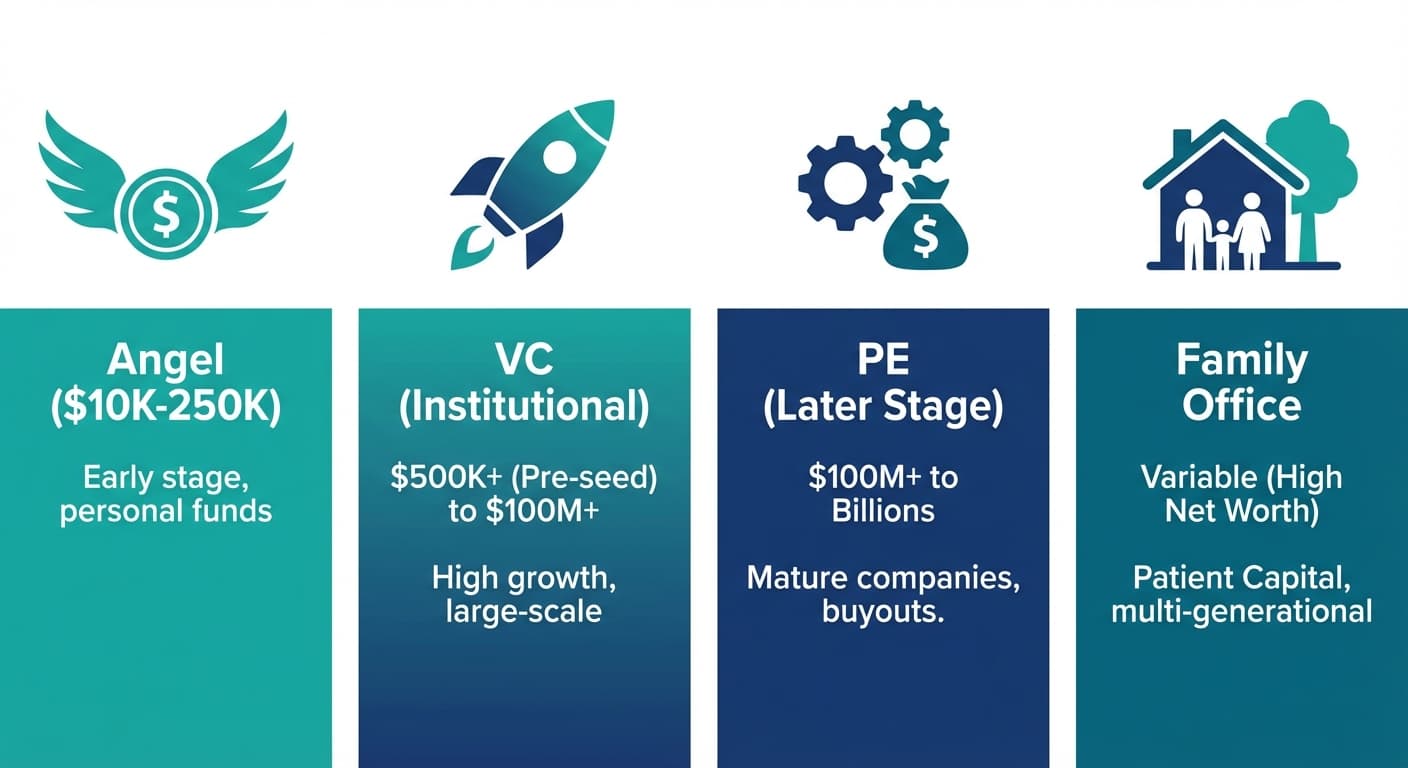
Different investor types have different priorities, check sizes, and evaluation criteria. Your outreach strategy should reflect these differences.
Angel Investors
Angel investors typically invest their personal capital in early-stage companies, often at the pre-seed or seed stage. Check sizes range from $10,000 to $250,000, though some super angels invest significantly more.
Angels often invest based on personal interest, industry expertise, or geographic proximity. Many are former founders themselves and appreciate direct, founder-to-founder communication. When reaching out to angels, emphasize the problem you're solving and why you're uniquely positioned to solve it. Angels frequently make decisions faster than institutional investors, sometimes within a single meeting.
Venture Capital Firms
VCs manage pooled capital from limited partners and invest across various stages, from seed to growth. Different partners within the same firm may focus on different sectors or stages, so targeting the right individual matters as much as targeting the right firm.
VC outreach requires demonstrating that your company fits their investment thesis. Research their portfolio companies, recent investments, and any public statements about where they see opportunity. Your email should clearly articulate why your company aligns with their stated interests and how you've achieved traction that warrants their attention.
Private Equity Firms
Private equity investors typically focus on later-stage companies with established revenue and profitability. They often take majority stakes and have longer investment horizons than VCs.
PE outreach should emphasize financial metrics, market position, and growth potential. These investors evaluate opportunities based on cash flow, EBITDA multiples, and operational efficiency. If you're reaching out to PE firms, ensure your company has the financial profile they typically seek.
Family Offices
Family offices manage wealth for high-net-worth families and often make direct investments alongside their portfolio allocations. They vary widely in their investment approach, with some operating like VCs and others taking a more passive approach.
Family office outreach benefits from understanding the family's background, industries where they have expertise, and their typical investment timeline. Many family offices prefer longer holding periods and may be more patient capital than traditional VC.
Research and Targeting Strategies
Effective investor outreach starts long before you write your first email. The research phase determines whether your messages reach receptive audiences or disappear into crowded inboxes.
Build Your Target List
Start by identifying investors who actively invest in your space. Look for:
Recent investments in your sector. If a VC just led a round in a company adjacent to yours, they've already validated their interest in the space. They understand the market dynamics and may be looking for complementary investments.
Stage alignment. An investor who focuses on Series B rounds won't be the right fit for your pre-seed raise, regardless of sector interest. Verify that each target investor's typical check size and stage focus matches your current needs.
Geographic considerations. While remote investing has become more common, many investors still prefer companies within their geographic region. Some explicitly state geographic focus areas on their websites.
Portfolio fit. Review existing portfolio companies for potential conflicts or synergies. An investor won't back a direct competitor, but they might be interested in a complementary product that could create value for existing portfolio companies.
Find the Right Contact
Large VC firms have multiple partners, principals, and associates. Your email should reach the person most likely to champion your company internally.
Teams sorting out which contact to enrich versus which sequence tool handles the send often benefit from a comparison of these two categories, since they solve different parts of the workflow.
Partners make final investment decisions but are also the most difficult to reach. Principals and senior associates often source deals and can advocate for promising companies. Junior associates typically focus on market research and may not have deal-sourcing authority.
Research individual investors through their LinkedIn profiles, Twitter accounts, blog posts, and podcast appearances. Many investors publicly discuss their investment interests and thesis areas. Use this information to personalize your outreach and demonstrate genuine alignment.
Timing Your Outreach
Investor availability fluctuates throughout the year. Many VCs slow their activity during late December and August, while others have fund cycles that affect when they're actively deploying capital.
If a VC firm recently announced a new fund, they're likely in active deployment mode and more receptive to new opportunities. Conversely, if they're approaching the end of a fund cycle, they may be more selective or focused on follow-on investments in existing portfolio companies.
What Works: Investor Email Best Practices
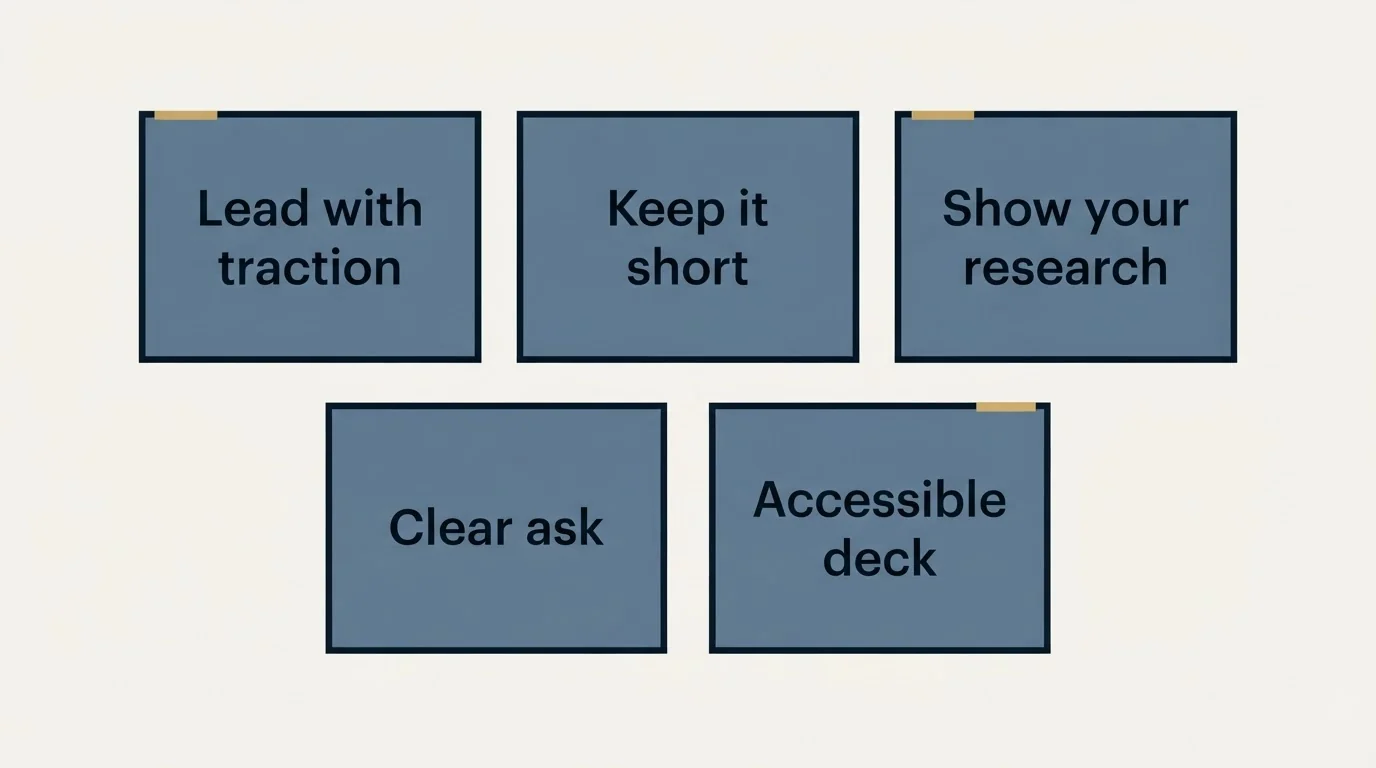
Investor emails differ from typical sales outreach. You're not selling a product. You're pitching an opportunity to generate returns.
Lead with Traction
Investors want to see evidence that your business is working. Open your email with your most compelling metric: revenue growth, user acquisition, retention rates, or notable customer logos.
Specific numbers outperform vague claims. "We've grown revenue 3x in the past six months to $150K MRR" is more compelling than "We're experiencing rapid growth."
Keep It Short
Your initial email should be readable in under 60 seconds. Investors will review your deck if they're interested, so the email's job is simply to earn that review.
Aim for 150-200 words maximum. Use short paragraphs and bullet points to improve scannability. Every sentence should either provide essential context or motivate the investor to learn more.
Show You've Done Your Research
Generic emails that could be sent to any investor signal that you haven't done the work to understand fit. Reference specific investments, public statements, or areas of focus that demonstrate why this particular investor is a good match.
Include a Clear Ask
End with a specific, reasonable request. "Would you have 20 minutes this week or next to discuss?" is actionable. "I'd love your thoughts" is vague and easy to ignore.
Make Your Deck Easy to Access
Include a link to your pitch deck rather than attaching a large file. Use a service that provides analytics so you can see who's viewing your materials. DocSend or similar platforms allow you to track engagement and see which slides investors spend time on.
Real Investor Outreach Email Examples
The following templates demonstrate effective approaches for different investor types and scenarios.
Example 1: Seed Stage VC Outreach
Subject: B2B payments - 4x growth, $80K MRR (Y Combinator W25)
Hi Sarah,
I noticed you led Finley's seed round last year and have been writing about embedded finance opportunities. We're building in an adjacent space that I think you'll find interesting.
Ledger (YC W25) is a B2B payments platform that helps mid-market companies automate vendor payments. We've grown from $20K to $80K MRR in the past four months with 95% gross retention.
Quick stats:
- 47 paying customers (avg contract: $20K/year)
- $2.1M in payment volume processed monthly
- 68% of customers from inbound/referrals
We're raising a $3M seed round to expand our sales team and build out our API platform. Several angels have committed, and we're looking for a lead investor.
Would you have 20 minutes this week to discuss? Deck here: [link]
Best, Marcus Chen CEO, Ledger marcus@ledger.com
Example 2: Angel Investor Outreach
Subject: Healthcare AI startup - would value your perspective
Hi David,
Your background scaling MedTech Solutions and your recent angel investments in healthcare AI caught my attention. We're building something that aligns closely with your experience.
CarePredict uses machine learning to identify patients at risk of hospital readmission within 30 days of discharge. We're working with three regional hospital systems (12 facilities total) and have reduced readmission rates by 23% in our pilot programs.
Given your operational experience in healthcare, I'd really value your perspective on our go-to-market strategy. We're raising a $500K angel round to expand our clinical validation work.
Could we schedule a 15-minute call this week? I can work around your schedule.
Deck and clinical results summary: [link]
Best, Dr. Rachel Torres CEO, CarePredict
Example 3: Growth Stage VC Outreach
Subject: $8M ARR vertical SaaS - Series A
Hi Jennifer,
I'm reaching out because Meridian Ventures' focus on vertical SaaS businesses aligns perfectly with what we're building at ConstructFlow.
ConstructFlow is the operating system for commercial construction companies. We've reached $8M ARR (up from $3M last year) with 140% net revenue retention. Our customers include three of the top 25 commercial construction firms in the U.S.
The opportunity: Commercial construction is a $1.4T market still running on spreadsheets and legacy software. Our platform consolidates project management, financial tracking, and workforce scheduling into a single system.
Key metrics:
- $8M ARR, 167% YoY growth
- 140% NRR, <5% logo churn
- 78 enterprise customers
- $850K average deal size (up from $450K last year)
We're raising a $25M Series A to accelerate enterprise sales and expand product capabilities. Would you have time for a call next week?
Full deck and financial model: [link]
Best, James Morrison CEO, ConstructFlow
Example 4: Following Up on a Referral
Subject: Introduction from Michael Torres - climate tech seed
Hi Amanda,
Michael Torres suggested I reach out to you directly. He mentioned your interest in climate tech and thought there might be alignment with what we're building at CarbonTrack.
We're developing software that helps manufacturing companies measure and reduce their carbon footprint. Since launching six months ago, we've signed $420K in ARR with customers including two Fortune 500 manufacturers.
Michael thought you'd appreciate our approach: we integrate directly with ERP systems to provide real-time emissions data rather than relying on annual estimates.
I'd welcome the chance to share more about our traction and roadmap. Would you have 20 minutes this week?
Deck: [link]
Best, Elena Vasquez CEO, CarbonTrack
Common Mistakes to Avoid
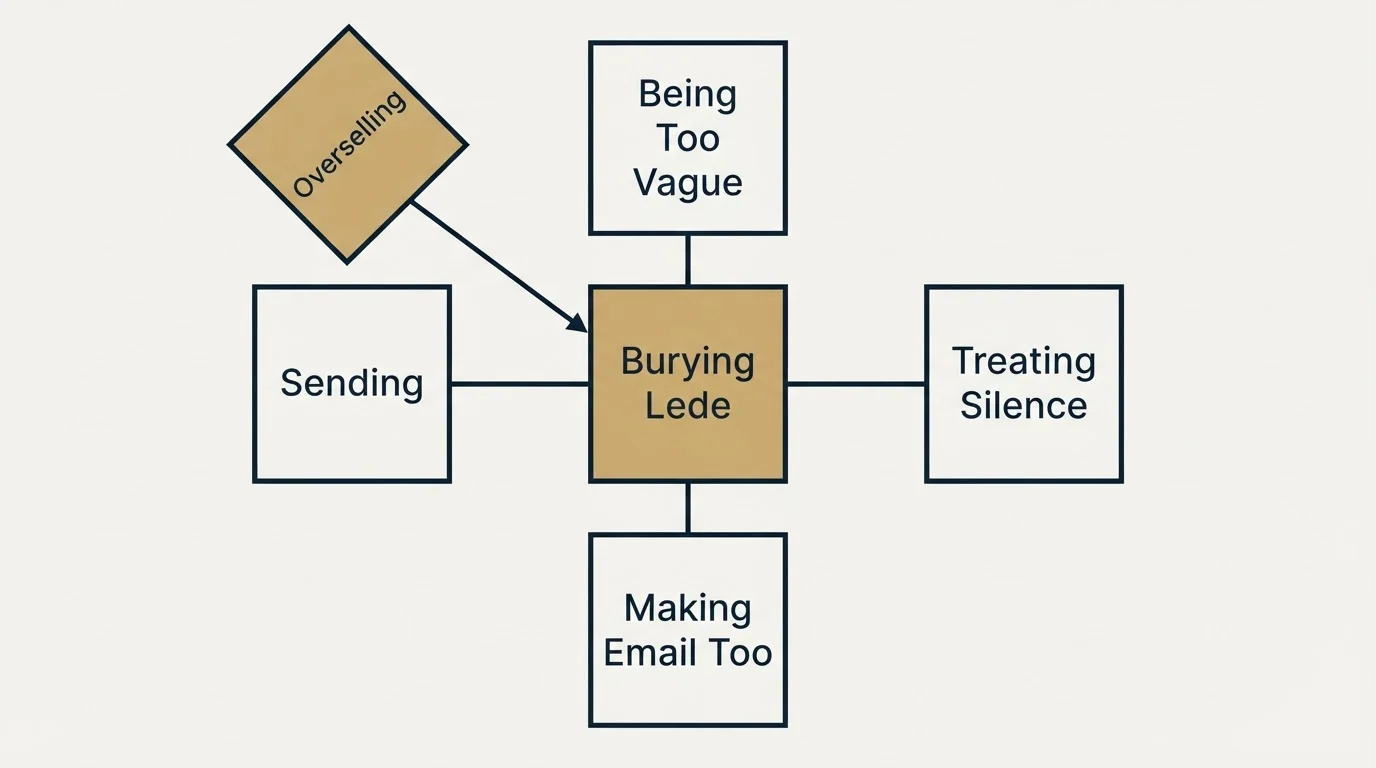
Even strong companies fail to generate investor interest when their outreach contains these common errors.
Burying the Lede
Investors don't have time to read three paragraphs of background before understanding what you do and why it matters. Lead with your most compelling information: traction, market opportunity, or unique insight.
Being Too Vague
"We're disrupting a huge market" tells investors nothing. Specificity builds credibility. Name your market size, your growth rate, and your competitive advantages with concrete evidence.
Sending to Wrong Fit Investors
Emailing a healthcare-focused VC about your fintech startup wastes everyone's time. Research each investor's thesis and portfolio before reaching out.
Making the Email Too Long
Anything over 200 words risks being skimmed or ignored. Your email should generate enough interest to warrant a deck review and meeting, not explain your entire business model.
Treating Silence As Permission To Chase
Many investors do miss emails simply because of volume, and the instinct is to send a chase into the thread. That message arrives underneath one they have already seen and passed over, so it reaches the readers least likely to want it and costs you sending reputation on the ones who might. One message per approach, and let the next approach earn its own reason to exist.
Sending reputation is a finite resource that compounds over time, and why traditional outreach backfires explains how burning contacts at scale can quietly sabotage future raises.
Overselling or Using Hype
Phrases like "the Uber of X" or "billion-dollar opportunity" trigger skepticism. Let your metrics and market analysis speak for themselves.
Ignoring the Subject Line
Your subject line determines whether the email gets opened. Include something specific and intriguing: your traction, a notable customer, or a mutual connection.
Your Investor Outreach Checklist
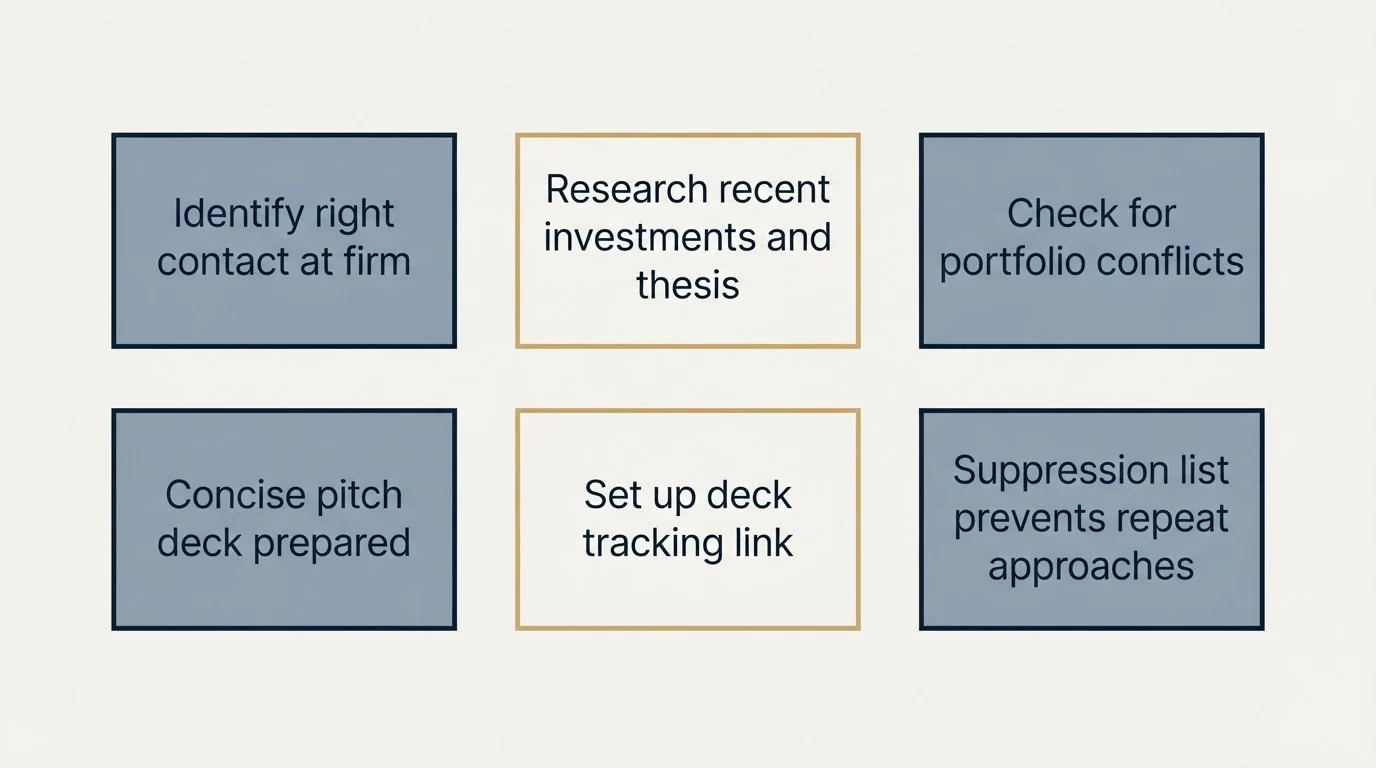
Before launching your investor outreach campaign, ensure you've completed these essential steps:
Research and Targeting
- Built a list of 50+ relevant investors based on stage, sector, and geography
- Identified the right individual contact at each firm
- Researched recent investments and stated thesis areas for each target
- Verified there are no portfolio conflicts with existing investments
Materials Preparation
- Created a concise pitch deck (10-15 slides maximum)
- Set up a tracking link for deck analytics
- Prepared a one-page executive summary for interested investors
- Organized supporting materials (financial model, customer references)
Email Composition
- Written personalized opening lines for each investor segment
- Led with your strongest traction metric
- Kept total email length under 200 words
- Included a specific, time-bound ask
- Tested all links before sending
Campaign Execution
- Scheduled sends for Tuesday through Thursday mornings
- Listed the events that would justify a fresh approach later (a fund announcement, a portfolio move, a thesis-relevant development)
- Set up reply handling and a suppression list so nobody is approached twice on the same premise
- Created a tracking system for responses and next steps
Once your tracking system needs to scale beyond a spreadsheet, comparing CRM and outreach tools can help you decide which platform fits your investor outreach workflow.
Post-Send Activities
- Monitor deck view analytics for engaged investors
- Respond to investor questions within 24 hours
- Track which messages and subject lines perform best
- Iterate on templates based on response data
Choosing which platform will manage these sequences and follow ups is a practical next step, and founders can weigh the options in this multi-channel outreach tool comparison.
Turn Investor Interest into Meetings
Cold email can open doors that seemed permanently closed. The founders who master this channel gain access to investors who would otherwise remain unreachable through traditional networking alone.
The key is combining thorough research, compelling messaging, and consistent follow-up. Every email should demonstrate that you understand the investor's focus areas, have built something worth their attention, and respect their time.
Ready to build an investor outreach campaign that generates meetings? Our team has helped founders raise over $50M in funding through strategic cold email campaigns. Get your free campaign strategy and start connecting with the investors who can fund your vision.
Related Reading
Frequently asked questions.
Frequently asked questions- Does cold email actually work for getting meetings with venture capitalists?
- Yes, cold email remains one of the most effective channels for reaching investors who don't know you. Airbnb secured their first Sequoia Capital meeting through cold email with no warm introduction or exit track record. Cold email works because it allows investors to evaluate opportunities on their schedule while demonstrating your clarity of thinking, market understanding, and research quality. It also scales better than networking since you can reach dozens of relevant investors simultaneously while maintaining personalization.
- What's the difference between reaching out to angel investors versus VCs?
- Angel investors use personal capital for pre-seed or seed investments ranging from $10,000 to $250,000, making decisions faster and often based on personal interest or industry expertise. VCs manage pooled capital from limited partners across various stages, requiring you to target specific partners who match your sector and stage. Angels appreciate direct founder-to-founder communication about problems and solutions, while VCs need clear demonstration that your company fits their investment thesis and portfolio strategy.
- How do I find the right investors to target with cold emails?
- Build your target list by identifying investors who recently funded companies in your sector, as they've already validated interest and understand market dynamics. Verify stage alignment by confirming their typical check size matches your raise, since a Series B-focused VC won't fit your pre-seed needs. Consider geographic preferences, as many investors still favor companies within their region despite increasing remote investment. Research each firm's portfolio companies, recent investments, and public statements about opportunity areas.
- What should I include in a cold email to an investor?
- Lead with concrete traction metrics in the first sentence to immediately demonstrate progress. Keep the entire email under 150 words to respect investors' time. Show you've researched their portfolio by explaining why your company aligns with their investment thesis. Include a clear, specific ask such as requesting a 20-minute introductory call. Make your pitch deck easily accessible with a direct link rather than requiring downloads. Avoid burying important information, being vague about your business, or using hype language.
About the author.

Ben Carden is CRO at RevenueFlow, which builds and operates outbound revenue engines for B2B companies. Previously at Gartner Enterprise. Studied at London School of Economics.
Ben Carden · CRO
Connect on LinkedIn →Explore more.
Ready to scale your outreach?
We build GTM engines that book real meetings. See the receipts.
Related articles.
Cold Email for Influencer Outreach: Partner with Creators
Learn how to use cold email to build authentic influencer partnerships that drive real results for your brand, with proven templates and strategies.
Cold Email for Product Feedback: Complete Strategy Guide
Learn how to use cold email to gather valuable product feedback from users and prospects. Includes proven templates, feedback frameworks, and response optimization techniques.
Cold Email for PR: How to Pitch Journalists and Get Coverage
Learn how to craft cold emails that get journalists to open, read, and respond to your pitches. Includes real templates, timing strategies, and a complete PR outreach checklist.
Cold Email for Reviews: Complete Strategy Guide
Learn how to use cold email to generate authentic product reviews on G2, Capterra, and other platforms. Includes proven templates, compliance guidelines, and review generation frameworks.
Cold Email for Link Building: How to Get Quality Backlinks
Learn how to use cold email outreach to build high-quality backlinks that improve your SEO rankings, with proven templates and strategies that get responses.
Cold Email for Focus Groups: Complete Strategy Guide
Learn how to use cold email to recruit qualified participants for focus groups. Includes proven templates, screening strategies, and group composition frameworks.