Enterprise Email Marketing and Outbound Share One Reputation
Large companies end up running two email programmes with incompatible mechanics on one domain reputation. What separates them, and what breaks first when they are merged.

Enterprise email marketing to an opted-in list and outbound to named accounts are two operations sharing one domain reputation. Separate the sending estate before either is under pressure, monitor spam rate per domain against Google's published thresholds, and enforce suppression as a live check at send time.
Key takeaways
- Mailbox providers evaluate sending domains rather than teams, so a complaint from a promotional send affects whether a salesperson reaches an inbox that afternoon.
- Google's sender guidelines put the bulk-sender threshold at more than 5,000 messages per day to Gmail accounts, which is per sending domain rather than per company.
- A suppression list applied when a list is built has already drifted by the time the send goes out, so the check has to run against live state.
- Broadcast marketing platforms are built for one design to many recipients from shared infrastructure, which is the opposite of what outbound needs.
Reviewed and updated August 28, 2026
Search for enterprise email marketing and every result is a platform. Klaviyo, Bloomreach, GetResponse and a run of listicles comparing them, all answering the same question: which system should a large company use to send campaigns to the list it already owns.
That is a real question and this page is not going to answer it better than a comparison table can. The question it does answer is the one that arrives about six months later, when the same company decides it also wants to reach accounts that are not on any list, and discovers that the two jobs share a domain reputation and almost nothing else.
Two email operations, one reputation
Large companies end up running two distinct email programmes.
The first is marketing email to people who gave you their address. Newsletters, product announcements, lifecycle messages, webinar invitations. Volume is high, the audience opted in, and success is measured in aggregate.
The second is outbound to named accounts who have never heard of you. Volume is low by comparison, nobody opted in, and success is measured one reply at a time.
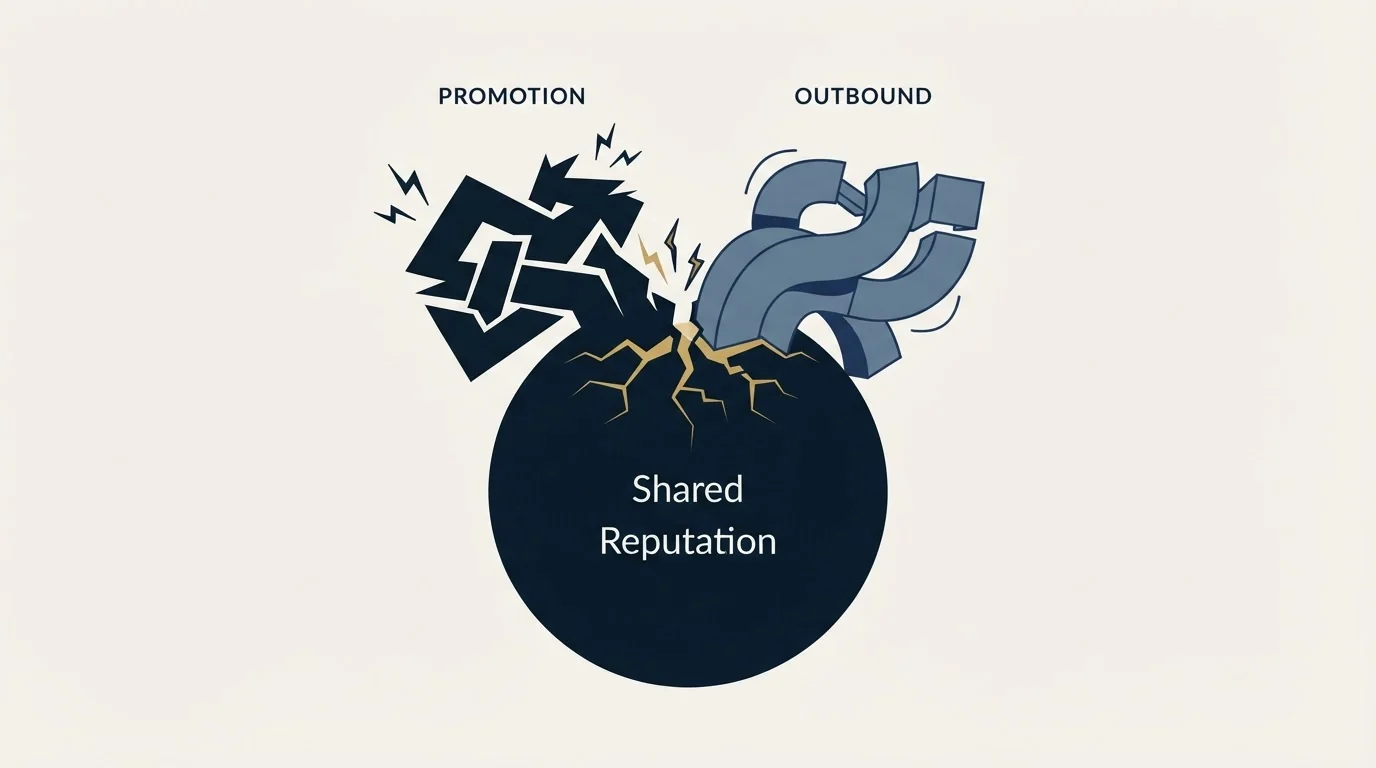
Every practice that makes the first programme work is either irrelevant or actively harmful to the second, and the reason they cannot simply be run as separate teams is that mailbox providers do not evaluate teams. They evaluate the sending domain and the infrastructure behind it. A complaint generated by a promotional send affects whether a salesperson's message reaches an inbox that afternoon.
- Templated design, brand system, images
- Success measured across the whole send
- One-click unsubscribe is mandatory
- Volume is the point
- Owned by marketing operations
- Plain text, written for one reader
- Success measured one reply at a time
- Opt-out still required, mechanics differ
- Volume is a constraint to respect
- Owned by sales or a dedicated function
Google's own thresholds are where enterprise begins
Google publishes sender requirements for anyone mailing Gmail accounts, and its documentation draws a line that maps closely onto what most people mean by enterprise scale.
Its guidance states that if you send more than 5,000 messages per day to Gmail accounts, you follow the stricter requirements set out for bulk senders. For all senders, the page says to keep spam rates reported in Postmaster Tools below 0.3%. For the bulk tier it goes further, saying to keep spam rates below 0.10% and to avoid ever reaching a spam rate of 0.30% or higher. It also states that marketing messages and subscribed messages must support one-click unsubscribe and include a clearly visible unsubscribe link in the message body.
Three things follow from reading that carefully.
The 5,000 per day threshold is per sending domain rather than per company, which means the architecture you choose determines which tier you are in. The spam-rate ceiling is a rate rather than a count, so a small outbound programme cannot hide behind a large marketing programme's denominator when the complaints are attributed to the same domain. And the one-click unsubscribe requirement is written for marketing and subscribed mail specifically, which is a decent signal that the two message types are already understood as different objects by the people running the filters.
Teams tempted to route enterprise outbound through everyday inboxes should first see the sending caps Microsoft publishes for a standard mailbox account.
Sender requirements verified as of mid-2026 against Google's Email sender guidelines. Verify current terms before relying on them.
Separate the sending identity before you need to

The structural answer is separation at the domain level. Marketing sends from one set of domains, outbound from another, and the corporate domain that carries employee mail and invoices sends neither.
This is unglamorous and it is the single decision that determines whether a bad quarter in one programme becomes a bad quarter in all three. A company that discovers this after a deliverability incident spends months rebuilding, because reputation recovers slowly and the recovery cannot be bought.
The practical shape at enterprise scale looks like a dedicated set of sending domains for outbound, warmed before they carry real volume, with capacity deliberately in excess of what the programme currently needs. Our own reasoning for holding more infrastructure than the send volume requires is that the headroom is what lets you absorb a problem without pausing the programme.
Before any of it carries traffic, the authentication has to be right, and the diagnostic side of that is worth learning in house rather than outsourcing to a dashboard you check quarterly.
- Step 1Split the estate
Corporate mail, marketing sends and outbound sends on different domains
- Step 2Authenticate each
SPF, DKIM and DMARC aligned per domain, not inherited
- Step 3Warm the outbound set
Reputation is built before volume, never during
- Step 4Hold headroom
More sending capacity than the current programme needs
- Step 5Monitor separately
Per-domain spam rate, so one programme cannot mask the other
What legal review actually needs to see
At enterprise scale outbound reaches legal, and legal asks a question marketing has never had to answer: on what basis are we contacting a person who did not ask to be contacted.
The answer differs by jurisdiction and the reviewable artefacts are consistent. Where the addresses came from and how they were obtained. Whether the message identifies the sender and their postal address. Whether an opt-out exists, works, and is honoured across every system rather than only in the tool that sent the message. Whether suppression is enforced at the point of send rather than at the point of list building.
The last one is where most enterprise programmes are genuinely weak. A suppression list maintained as a spreadsheet and applied when a list is built will drift, because the list was built in March and the send is in June. Suppression has to be a check performed against live state at the moment of sending, and that is an engineering requirement rather than a policy one.
Governance is the part that does not scale by itself
A marketing team of four can hold consistency in its head. Fifteen sales regions cannot, and enterprise outbound fails at exactly that seam.
The failure is rarely dramatic. Two regions contact the same account in the same week with different offers. A customer receives a prospecting message about a product they already own, because the outbound list was built from a data vendor and never joined against the CRM. A partner is pitched a service their own firm resells.
Each one is a governance gap rather than a copy problem, and each is fixed by the same mechanism: one place that knows who is currently being contacted, checked before anyone is added to anything. The rule we hold to is that a person is active in at most one campaign at a time, and it is enforced at the moment of upload rather than trusted to coordination between teams.
- Yes: Outbound sends from domains that carry no marketing or corporate mail
- Yes: Spam rate monitored per domain rather than per company
- Yes: Suppression checked against live state at send time
- Yes: Existing customers and open opportunities excluded by a join, not a memory
- Yes: One owner who can answer who is being contacted this week
- No: Outbound volume routed through the marketing platform because it is already procured
Why the marketing platform is the wrong tool for the outbound half

The procurement instinct is to use what is already bought. The enterprise marketing platform is paid for, secured, integrated with the data warehouse and approved by IT, so routing outbound through it looks like the efficient choice.
It is the wrong choice for a mechanical reason rather than a philosophical one. Those platforms are built to send one design to many people from shared infrastructure, and their reputation model, their throughput and their unsubscribe handling all assume that. Outbound needs many small sends from segregated infrastructure, plain bodies, and per-recipient variation. Forcing it through a broadcast platform produces mail that looks like marketing to the filters and reads like marketing to the recipient, which is the worst of both.
If you are choosing tooling for the outbound half specifically, the enterprise sending options are a separate category from the broadcast platforms the search results are full of.
The marketing metrics do not transfer
An enterprise marketing team arrives with a reporting habit built over years, and most of it measures the wrong thing once it is pointed at outbound.
Open rate is the clearest case. It was already a soft number for marketing mail and it is close to meaningless for outbound, because image-loading behaviour and privacy protection in the major mail clients break the mechanism that produces it. A team optimising subject lines against open rate at enterprise scale is optimising against instrument noise, and doing it with enough volume to feel confident about the result.
Click rate transfers badly for a different reason. Marketing mail is built to be clicked, so the click is the intended action. Outbound is built to be replied to, and a link in a first message to a stranger is a deliverability cost paid for a signal you did not need.
What does transfer is the discipline. Enterprise marketing teams are usually far better than sales teams at holding a clean denominator, segmenting a result honestly, and refusing to read a difference that the sample cannot support. Point those habits at reply rate, at meetings held, and at the spam rate per domain, and the reporting culture becomes the outbound programme's biggest advantage rather than its main source of confident wrong answers.
What we would not recommend
We do not send more than one message per campaign, and that holds at enterprise scale for the same reason it holds anywhere. A person who did not answer a message from a stranger has answered it. Approaching them again on a fresh premise is a new campaign that has to justify itself, and approaching them again on the same premise is the behaviour that raises the complaint rate the thresholds above are measuring.
At enterprise volume this matters more, not less, because the complaint arithmetic is unforgiving at scale and because the same domain estate is carrying revenue-critical marketing mail.
The short version
Enterprise email marketing and enterprise outbound are two operations that share exactly one thing, and it is the thing that can be destroyed: domain reputation. Separate the sending estate before either programme is under pressure. Monitor the spam rate per domain against Google's published thresholds rather than as a company aggregate. Make suppression a live check rather than a list. Give one function the authority to say who is being contacted.
Teams monitoring spam rate per domain rather than trusting bounce counts can see how colour-coded banner annotations show whether inbound mail is landing safely or flagged as risky.
Do that and the platform question becomes what it should be, a procurement decision with no strategic weight. Skip it and the platform choice will not save you.
If you want the outbound half run against your accounts without adding it to an already-loaded marketing team, we will run a campaign and show you the output.
Frequently asked questions.
Frequently asked questions- Can we run outbound through our existing marketing platform?
- Mechanically you can, and the result usually looks like marketing to the filters and reads like marketing to the recipient. Those platforms assume one design sent to many people from shared infrastructure. Outbound needs small sends from segregated infrastructure with plain bodies and per-recipient variation, so the procurement saving costs you the deliverability the programme depends on.
- What spam rate is acceptable at enterprise volume?
- Google's sender guidelines tell all senders to keep spam rates reported in Postmaster Tools below 0.3%. For senders above its bulk threshold the guidance is stricter, saying to stay below 0.10% and never to reach 0.30% or higher. Because it is a rate, a small outbound programme cannot hide inside a large marketing programme's denominator on the same domain.
- Do we need separate domains for marketing and outbound?
- Yes, and ideally a third estate for corporate mail that carries neither. Reputation attaches to the sending domain, so merging them means a bad quarter in one programme becomes a bad quarter in all of them. Recovery is slow and cannot be bought, which makes this the cheapest decision to get right early and the most expensive to retrofit.
- Who should own outbound in a large organisation?
- One function that can answer who is being contacted this week, whoever that reports to. The characteristic enterprise failure is not bad copy, it is two regions contacting the same account in the same week, or a prospecting message reaching an existing customer. That is a governance gap, and it is closed by a check at the point of upload rather than by coordination.
About the author.

Tim Carden is CMO / CTO at RevenueFlow, which builds and operates outbound revenue engines for B2B companies. Studied at McGill University.
Tim Carden · CMO / CTO
Connect on LinkedIn →Explore more.
Ready to scale your outreach?
We build GTM engines that book real meetings. See the receipts.
Related articles.
Sending Cold Email From the CRM You Already Pay For
A CRM sequence tool sends from your primary domain and your own mailbox, and vendor terms usually require documented consent. What a separate cold stack buys.
Mass Email From Outlook: The Limits Microsoft Publishes
Microsoft publishes the ceiling on one mailbox and, a few paragraphs later, recommends that bulk commercial mail go to a specialist provider instead.
IMAP or SMTP: One Sends, One Reads, and the Ports
A mail setup pane asks for two servers because the two protocols run in opposite directions. The RFCs define both jobs, and the ports are where providers disagree.
SMTP for Yahoo: The Settings and the Sender Requirements
Yahoo publishes its outgoing settings in six lines. It also publishes sender requirements enforced since February 2024, and refuses to name the volume that triggers them.
GMass Inbox Tester: The Public Seed List Cuts Both Ways
GMass publishes the fifteen seed addresses behind its free placement tester. That makes the test repeatable, and it also makes the absolute result pessimistic.
GMass SMTP Test: What a Passing Connection Cannot Prove
GMass publishes a free SMTP connection tester that anyone can use. What its four stages separate, why the last one gets misdiagnosed, and where the tool's boundary is.