GMass Inbox Tester: The Public Seed List Cuts Both Ways
GMass publishes the fifteen seed addresses behind its free placement tester. That makes the test repeatable, and it also makes the absolute result pessimistic.

The GMass inbox tester is a free tool that publishes fifteen seed addresses, some behind Barracuda, Mimecast or Sophos. You send your real campaign to them from any tool and watch whether each lands in inbox, spam or the promotions tab. Because the seeds are public and never engage, it reads best comparatively rather than absolutely.
Key takeaways
- The seed list is published openly, which makes the test repeatable from any sending platform and also means every seed mailbox has received test traffic from a very large number of senders.
- Seed accounts never reply, never rescue mail from spam and never add senders to contacts, so their engagement profile is unusually harsh. Absolute placement scores from any seeded test run pessimistic.
- The useful output is which accounts disagreed. Consumer Gmail versus corporate gateway points at content and reputation, uniform spam points at the domain, and a promotions placement points at content shape.
- Placement is the last thing worth testing. Confirm the connection sends, then that authentication records align, then that the domain is warmed, or a placement result describes your setup rather than your copy.
Reviewed and updated September 1, 2026
GMass publishes the fifteen email addresses its free placement tester uses, in plain text, on the page itself. You copy them, send your campaign to them from whatever tool you already use, and watch in real time which of the fifteen accounts put the message in the inbox and which filed it elsewhere. Some of those accounts run Barracuda, Mimecast or Sophos in front of them, so the result covers more than consumer Gmail behaviour.
Where this piece stays focused on placement testing, the GMass versus Gong comparison explains how GMass's cold email focus differs from a full sales engagement platform.
Publishing the seed list is an unusual choice and it is the most important fact about the tool, in both directions. It makes the test transparent and repeatable. It also means every one of those mailboxes has received test traffic from a very large number of senders, which is a thing you have to hold in mind while reading the result.
Everything below is verified against gmass.co/inbox, fetched 15 August 2026. We run Email Bison for sending, so this is a documentation read of another vendor's tool rather than an account of operating it.
How the test runs
The mechanism is deliberately simple, which is why it works from any sending platform rather than only from GMass.
The page lists its seed addresses and offers a copy-to-clipboard control. You send your real campaign to those addresses from your own tool. The page then shows each account's result as messages arrive, reporting for each one whether your email landed in the inbox, the spam folder, or, for the Gmail accounts, the promotions tab.
That third category is the reason to prefer a Gmail-aware tester when Gmail is your dominant recipient provider. Inbox and spam is a binary that hides the outcome most cold email actually suffers: delivery to a tab the recipient checks weekly, or never. A test reporting only inbox or spam will call a promotions-tab placement a success.
The seed set is also more varied than a naive list of consumer Gmail accounts. It mixes long-standing Gmail accounts with addresses on a range of custom domains, and GMass states that some of those accounts have commercial filters in front of them. That matters because Barracuda, Mimecast and Sophos are what a corporate recipient sits behind, and a message can pass consumer Gmail comfortably while a corporate gateway holds it.
- Step 1Copy the published seed addresses
Fifteen accounts across consumer Gmail and custom domains, some behind commercial filters
- Step 2Send the real campaign
From your actual sending tool, on your actual domain, with your actual copy
- Step 3Watch placement per account
Inbox, spam, or the promotions tab, reported as each message arrives
- Step 4Read the pattern, not the score
Which providers and which filters disagreed is the diagnostic; a percentage is not
- Step 5Change one variable
Copy, sending domain, or mailbox, then re-test, or the next result explains nothing
What a public seed list does to the result

This is the limitation that deserves the most honest treatment, because it is inherent to the design rather than a flaw to be fixed.
Every seeded placement test in existence works by sending to accounts that exist to receive test mail. When the addresses are published openly, those accounts have seen an enormous volume of test campaigns from every kind of sender, including senders whose mail was genuinely abusive. Their engagement profile therefore looks nothing like a real prospect's: nobody replies from them, nobody moves messages out of spam, nobody adds the sender to contacts.
Engagement is one of the strongest inputs a mailbox provider uses. A seed account with no engagement history for your domain is not a neutral observer, it is a specific and unusually harsh case. The practical consequence is that the absolute result is pessimistic and the comparative result is informative. Reading the score as the share of real recipients who will see the message is a mistake, in a way that reading it as "this version placed worse than the previous version on the same seeds" is not.
Use it as an A/B instrument. Send version one, record the pattern, change exactly one thing, send version two, compare. That is what the tool is genuinely good at, and it is a use no absolute-placement claim can spoil.
Since a placement tester only measures the outcome, a domain still needs proper preparation beforehand, a gap explored in GMass paired with a warmup tool.
There is one situation where the harshness is an advantage rather than a caveat. A brand new sending domain with no history is close to the seed accounts' own view of you, since neither has any engagement to go on. Testing a new domain against public seeds before it carries real volume is therefore a reasonable early warning, and a uniformly poor result on a fresh domain usually points at authentication or at the domain itself rather than at the message.
Teams weighing whether GMass's own sending features pair well with a dedicated warmup tool can see how the two roles divide in GMass and InboxAlly compared.
Reading the pattern rather than the count
The single number nobody should extract from a placement test is a percentage. The useful output is which accounts disagreed with each other.
If consumer Gmail accepts your message and the accounts behind commercial gateways do not, the signal points at content and reputation as a corporate filter evaluates them, and the fix lives in copy, links and domain history rather than in authentication. If everything lands in spam uniformly, the fault is almost always upstream at the domain level, which means authentication records, domain age, or an existing reputation problem, and no amount of copy editing will move it. If Gmail files you in promotions while other providers inbox you, the signal is content shape: link density, image-to-text ratio, markup that reads as a newsletter rather than as a person writing.
Those three patterns want three different responses, and a single percentage collapses all of them into a number that suggests none. The cold email deliverability guide covers the diagnostic order in full, and email deliverability audit is the deeper version when the uniform-spam pattern shows up.
- Comparing two versions of the same message on the same seeds
- Spotting a disagreement between consumer and corporate filters
- Catching a promotions-tab placement that a binary test would call a win
- Confirming a fix moved something, before a real send
- Sanity-checking a brand new sending domain
- Predicting the inbox rate real prospects will see
- Any absolute percentage quoted to a client
- Comparing your score against another company's score
- Judging a domain whose reputation is already established
- Testing engagement effects, since seeds never engage
How often to test, and what to change between tests
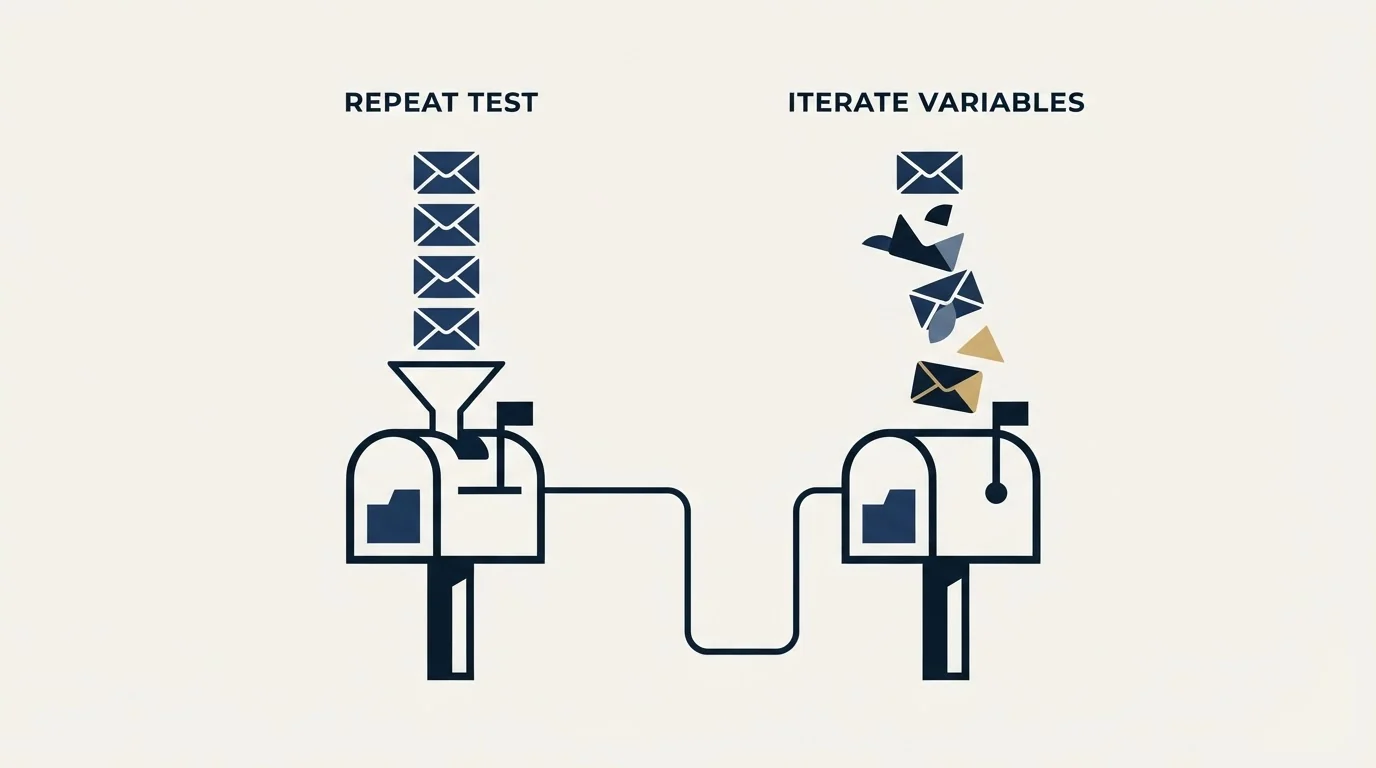
The discipline that makes placement testing useful is boring and almost nobody follows it: change one thing at a time.
A test result is a comparison instrument, and a comparison needs a controlled baseline. Teams routinely send a test, dislike the result, then rewrite the subject line, swap the sending domain, remove two links and add a plain-text version, send again, and see an improvement. That tells them the second version is better. It tells them nothing about which of the four changes did it, so the lesson does not transfer to the next campaign, and the three changes that did nothing get carried forward forever as superstition.
The sequence that produces knowledge is slower and pays compounding returns. Establish a baseline with the message you would actually send. Change exactly one variable, re-test, record the delta. Repeat. Within four or five rounds you have a small set of facts about your own domain and copy rather than a set of borrowed rules from a blog.
Three variables are worth testing in roughly this order, because they differ enormously in how expensive they are to change later. Copy first, since it is free to change and often the largest single lever, particularly link count and anything that makes a message read as a broadcast. Then the sending mailbox, because different mailboxes on the same domain can have meaningfully different histories. Then the sending domain itself, which is the most expensive variable to change and the one most likely to be the actual cause when results are uniformly bad.
Frequency matters less than consistency. Testing before each new campaign launch and after any infrastructure change is enough for most programmes. Testing daily produces noise, because placement decisions vary between individual messages for reasons no test can isolate, and a team watching daily numbers will find patterns in randomness and act on them.
Where placement testing sits in the order of operations
Placement is the last thing worth testing, and teams reach for it first because it feels like the question they care about.
The order that saves time runs upward from the layers a test cannot see. Confirm the relay or platform actually connects and sends, which the GMass SMTP test covers. Confirm the sending domain's authentication records exist, parse and align, because a message failing DMARC will be filed against you no matter what the copy says. Confirm the domain and mailboxes have a sending history appropriate to the volume, which is what warm-up is for and what email warmup services exist to provide. Only then does a placement test tell you something about your copy rather than about your setup.
Running it in the reverse order produces a week of copy rewrites against a problem that lives in a DNS record.
The house position

Our own practice keeps per-mailbox volume low and keeps every campaign to a single message, with no bumps and no thread replies. A second contact is a new campaign with a genuinely new angle rather than another step under the first. That matters for placement testing in a specific way worth naming: a single-message campaign has exactly one artefact to test, so the A/B loop above is short and its result is unambiguous. Multi-step sequences spread the placement question across several messages whose individual results interact, and the test gets substantially harder to read.
None of the above is a measurement of our own campaigns. It is a description of what the instrument can support, and the numbers quoted are the vendor's published figures about its own tool.
If the real question is what a properly warmed sending setup and a single well-aimed message do together, see what a first campaign looks like.
Features verified as of mid-2026. Verify current terms with the vendor before relying on them.
Frequently asked questions.
Frequently asked questions- How does the GMass inbox placement tester work?
- The page publishes fifteen seed email addresses with a copy control. You send your real campaign to them from whatever tool you normally use, and the page reports each account's result as messages arrive, showing inbox, spam or, for the Gmail accounts, the promotions tab. Some seed accounts sit behind commercial filters.
- Is the GMass inbox tester accurate?
- It is accurate about what it measures and easily over-read. Because the seed addresses are public and never engage with mail, they represent an unusually harsh case rather than an average recipient. Use the result to compare two versions of a message on the same seeds, and avoid quoting an absolute placement percentage from it.
- Why does the promotions tab matter in a placement test?
- Because a plain inbox-or-spam result calls a promotions placement a success. For a cold message aimed at a business recipient, landing in a tab someone checks weekly is closer to a failure than to a win. A Gmail-aware tester that separates primary, promotions and spam reports the outcome that actually matters.
- What should I do if everything lands in spam?
- Uniform spam placement across every seed points upstream of the message. Check that SPF, DKIM and DMARC records exist, parse and align on the sending domain, then check the domain's age and sending history and whether it appears on any blocklist. Copy edits will not move a uniform result caused at the domain level.
About the author.

Tim Carden is CMO / CTO at RevenueFlow, which builds and operates outbound revenue engines for B2B companies. Studied at McGill University.
Tim Carden · CMO / CTO
Connect on LinkedIn →Explore more.
Ready to scale your outreach?
We build GTM engines that book real meetings. See the receipts.
Related articles.
Proofpoint Spam Filter: Diagnosing Placement
Two different Proofpoint systems can stop a cold email, and the remedies have nothing in common. Telling them apart takes a minute and saves a month.
Office 365 Spam Filter: What Actually Triggers It
The same message lands in the inbox at one Microsoft tenant and in quarantine at the next. A setting the recipient chose decides which, and the headers say so.
GMass SMTP Test: What a Passing Connection Cannot Prove
GMass publishes a free SMTP connection tester that anyone can use. What its four stages separate, why the last one gets misdiagnosed, and where the tool's boundary is.
Sending Cold Email From the CRM You Already Pay For
A CRM sequence tool sends from your primary domain and your own mailbox, and vendor terms usually require documented consent. What a separate cold stack buys.
Mass Email From Outlook: The Limits Microsoft Publishes
Microsoft publishes the ceiling on one mailbox and, a few paragraphs later, recommends that bulk commercial mail go to a specialist provider instead.
IMAP or SMTP: One Sends, One Reads, and the Ports
A mail setup pane asks for two servers because the two protocols run in opposite directions. The RFCs define both jobs, and the ports are where providers disagree.