Gong vs Chorus: The Decision Is Not the Recording
Chorus belongs to ZoomInfo and Gong belongs to itself. Neither publishes a rate, both record the same calls, and the ownership is what the choice turns on.
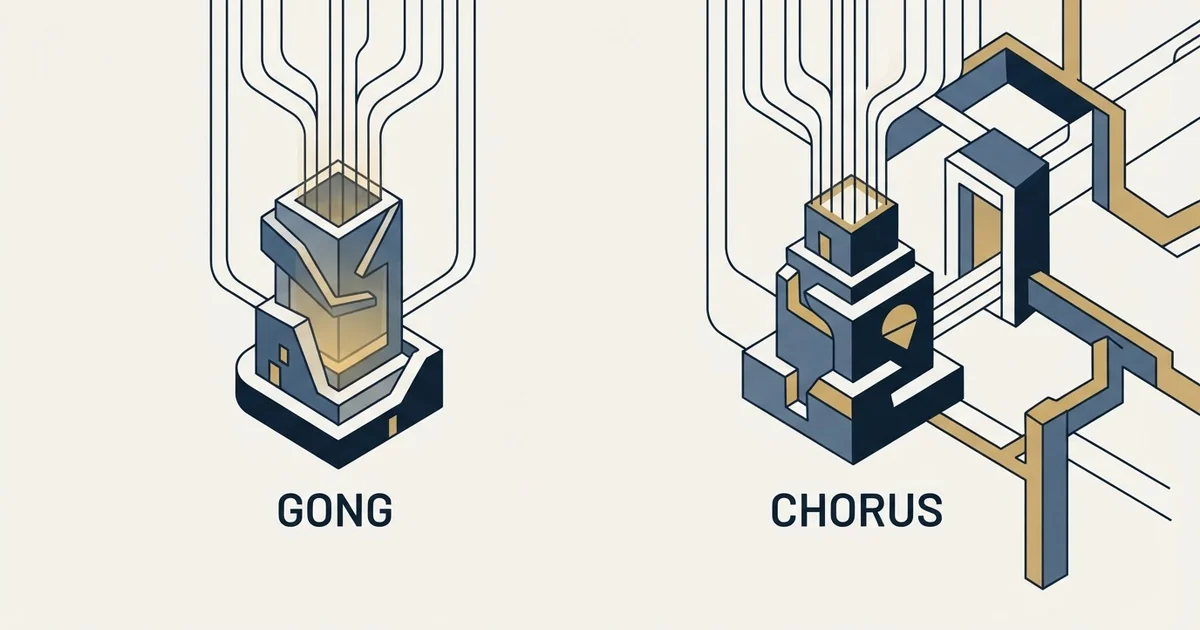
Chorus is ZoomInfo's conversation intelligence product and Gong is an independent revenue platform, and neither published a rate on 2 September 2026. Because the recording layers overlap heavily, the decision turns on whether your team already runs on ZoomInfo data and on what the contract says about retention and export.
Key takeaways
- Chorus is a ZoomInfo product, so the comparison is between a recorder inside a B2B data platform and a standalone revenue platform that also records.
- Neither vendor published a price on 2 September 2026: Gong publishes a two-part model of per-user licences plus a platform fee, and ZoomInfo's Chorus pricing page carried no figure on either a plain fetch or a headless render.
- The market share, forecast accuracy and ease of use figures that separate the two on competing comparison pages carry no stated method, and several of those pages are published by vendors selling a third product.
- The deciding question is whether the team already runs on ZoomInfo data, because that settles the integration work, the negotiation shape and the direction the roadmap is being built in.
Reviewed and updated September 2, 2026
Chorus is not an independent company, and that is the first fact to settle before comparing anything. It belongs to ZoomInfo, and ZoomInfo sells B2B contact data. Gong is its own company selling its own revenue platform. Two products that record the same sales calls sit inside two very different businesses, and that difference outlasts every feature either one ships this year.
The second fact is that neither vendor publishes a price. Read on 2 September 2026, Gong's pricing page publishes a model with no rate attached, and ZoomInfo's Chorus pricing page publishes neither. Every ranked comparison for this query is written by a company selling a competing product, and the figures they use to separate the two arrive without a method. So this page does something narrower and more useful: it sets out what each vendor states about itself, on its own pages, on a dated read, and then names the question that actually decides the purchase.
RevenueFlow runs outbound over email and LinkedIn rather than phones. We are not the right people to tell you whose transcription is more accurate, and nobody claiming to know that has shown you how they measured it. The evaluation frame is what we can offer, and it holds up better than a feature grid.
What each product is, from its own pages
Gong describes its product as the Gong Revenue AI OS and breaks it into named components. The Gong Revenue Graph is described on its product page as "the richest source of revenue context to power your AI strategy". The Gong Revenue Harness is "the execution layer that governs how AI agents plan, act, and deliver results". Gong Applications are "purpose-built surfaces where agents and revenue teams work together across every workflow". The same page states the company is "Trusted by 5,000+ customers" and offers "300+ integrations in the Gong Collective", both of which are the vendor counting its own customers and its own catalogue rather than an audited figure.
Gong's conversation intelligence page positions the recording layer as one part of that wider platform, calling the product "purpose-built AI for revenue teams" and stating that it will "Capture 99% of customer interactions automatically". The important structural point is not the percentage. It is that Gong sells conversation intelligence as an entry point to forecasting, deal execution and coaching, and prices the whole thing together.
ZoomInfo's Chorus product page names five surfaces. Sales call analysis is described as helping teams "capture and analyze all customer calls, meetings, and emails to create visibility, drive process and behavior changes, and deliver bottom line impact". Team performance is aimed at identifying winning behaviours that "reduce new hire ramp time, drive methodology adherence, and ultimately drive team performance". Deal intelligence is described as the ability to "Automatically capture and sync contacts and communications from the field to your CRM". Market intelligence is described in the words "Capture and analyze the voice of the customer to better understand the trends impacting your deals." with a promise to "Gain competitive insights". Connected intelligence is the ownership dividend, and the page puts it as "Bring the power of contact and company intelligence to your go-to-market teams courtesy of ZoomInfo."
That last surface is the one with no equivalent on the Gong side, and it is the honest reason a buyer would pick Chorus. The same page opens with the line "Backed by 14 technology patents that leverage proprietary machine-learning, Chorus is the fastest growing Conversation Intelligence product in existence." Read the patent count as a fact the vendor can substantiate and the growth claim as marketing, because no methodology accompanies it.
The overlap in the middle is real and it is large. Both record calls, meetings and emails. Both transcribe. Both surface deal risk. Both are sold as coaching surfaces. Anyone telling you the recording layers are meaningfully different has a product to sell you.
- Positioned as an operating system for revenue, with the recording layer as one component
- Named parts: a revenue graph, an execution harness and a set of applications
- Sells forecasting, deal execution and coaching inside the same platform
- Publishes its own customer count and its own integration catalogue size
- No third-party data asset attached
- Positioned as five surfaces: call analysis, team performance, deal intelligence, market intelligence and connected intelligence
- Connected intelligence joins conversations to ZoomInfo contact and company records
- Sold beside the data, workflow and enrichment products in the same nav
- Publishes a patent count and a growth claim with no method
- The contract sits with a company whose core business is compiling B2B data
Neither publishes a rate, and they decline differently
Gong's pricing page declines with structure. It states that "Licenses are priced per user", that "There is a platform fee based on the number of users supported", and that "You can integrate your existing tech stack for free." Two parts, then. A seat count you can move, and a platform fee that moves with the number of users supported. Integrations sit outside the negotiation entirely, because the page says they are already included.
ZoomInfo declines with less. Its Chorus pricing URL was read on 2 September 2026 by a plain fetch and again by a headless browser render, and both returned the same thing: site navigation, a product heading, and no currency figure anywhere on the page. The pricing index at the site root refused the request outright with an HTTP 403, which is our access failing rather than evidence about ZoomInfo, and it is recorded here as such. The narrow honest statement is that on the date checked the Chorus pricing page carried no figure, and the buying motion it points to is a conversation with a salesperson.
The practical consequence is the same on both sides and worth planning around. You cannot build a shortlist by reading. Budget the calls, and expect the Chorus number to be shaped by whatever else you buy from ZoomInfo at the same time, because a bundle is discounted across the bundle rather than per product. That is an advantage when you already buy the data and a lock-in mechanism when you later want to leave.
The figures in every other comparison
The pages competing for this query assert market share splits, forecast accuracy percentages, ease of use scores and supported language counts. Check whether any of them states a method, a sample or a period before repeating a figure; several of them are published by vendors selling a third product into the same evaluation, and several contradict each other about which of the two is cheaper. One of the ranked pages belongs to ZoomInfo itself.
No such figure appears above, and that absence is the point rather than a gap. A number without a method is not evidence, and repeating one because it is widely repeated is how a comparison page becomes another copy of the pages it was meant to improve on. Where a claim below is the vendor's own, it is attributed to the vendor and dated.
The question that actually decides it

Strip out the unverifiable and one question remains: does your revenue team already run on ZoomInfo data?
If it does, Chorus is the coherent purchase. Connected intelligence means the conversation record and the account record resolve to the same platform without an integration project, the commercial negotiation happens across a bundle you are already renewing, and the roadmap is being built toward joining conversations to contact and company data, which is the direction you want it pulled in.
If conversation intelligence is the only job you are hiring for, Gong is the coherent purchase, and the reason is optionality rather than quality. A standalone contract can be judged on its own performance and replaced in a quarter without renegotiating anything else. Gong's own positioning complicates that slightly, since it sells the recording layer as the way into a wider platform, so the second-year conversation is about expansion rather than about renewal alone. Read the platform fee shape with that in mind.
If the answer is that you do not yet know, the tie-break is not a feature list. It is what your contract says about the recordings.
- Yes: Whether you already buy ZoomInfo data, because that decides which purchase is coherent
- Yes: What is retained from recordings and transcripts, and for how long
- Yes: Whether anything derived from your conversations feeds any dataset beyond your own account
- Yes: Whether you can export recordings and transcripts in a usable format, during and after the contract
- Yes: Whether the renewal is separable from the rest of the vendor agreement
- Yes: Which consent regime applies in every jurisdiction your reps call into, and who owns the notification
- Yes: Who will review the calls each week, named, before either contract is signed
- No: Deciding on a transcription accuracy claim neither vendor lets you verify before a trial
What the ownership actually changes
Three consequences follow from Chorus sitting inside a data business, and none of them shows up in a feature comparison.
Your recordings become a file at a data company. Conversation intelligence requires you to upload the most sensitive material a revenue team produces: buyers naming budgets, describing internal politics and complaining about incumbents, and your own reps saying things they would never put in writing. That is a processing relationship whoever holds it, and it deserves a closer read when the holder's core business is compiling and selling B2B data. This is not an accusation about the vendor. It is a set of answers you should be able to point at in a contract. The full set of contract questions is worked through in our page on what changes when conversation intelligence sits inside a data platform.
The roadmap follows the parent's strengths. An acquired product gets built where the platform is strong, and ZoomInfo's own description of connected intelligence says exactly where that is. If you want deeper coaching workflow, that direction pulls away from you. If you want conversations joined to account records, it pulls toward you.
The exit gets more expensive. A standalone tool is one you drop when it disappoints. A bundled one arrives inside an agreement with a renewal cycle, and the switching cost has nothing to do with transcription quality. Ask at purchase time whether you can export historical recordings and transcripts, and whether that right survives the end of the contract.
- Step 1Settle the data question
Whether you already run on ZoomInfo data decides which purchase is coherent, and it is the only question a feature grid cannot answer for you.
- Step 2Read the retention and export terms
What is kept, for how long, what is derived from it, and what you can take with you when you leave.
- Step 3Name the reviewer
Decide who reviews calls each week and when it lands in their diary, because a recorder nobody opens is an archive with a licence fee.
- Step 4Then take the calls
Neither vendor publishes a rate, so the shortlist you can build by reading is not the shortlist you can build by asking.
What neither product fixes

Conversation intelligence pays off when somebody reviews the conversations. A tool that records everything and is opened by nobody has converted a budget line into an archive, and that outcome is far more common than a bad choice between two competent recorders. The teams that get a return have a specific habit attached: a manager reviewing a set number of calls a week, a named moment in the deal cycle where a recording gets watched, a ramp plan built on real calls. Neither vendor can sell you that habit.
Recording is regulated and the rules differ by jurisdiction. Some places require every party to consent and others require only one, and a platform that can play a notification has given you a mechanism rather than compliance. The obligation stays with you, and consent configuration is a launch task with a named owner and a written answer.
Neither one creates the conversations. A perfectly instrumented recorder pointed at too few calls is a well-measured shortfall, and the diagnosis in that case is a supply problem rather than a tooling one. If the wider category question is still open, what the recording layer misses covers the boundary, what Gong records and where it sits is the single-vendor read, the wider roster of options is worth a look before accepting a bundle price as the default, and where the evidence in a revenue intelligence product comes from sorts the category by what each product is actually reading.
Where the constraint turns out to be that there are not enough conversations to analyse, we will build the first campaign against your market and you can read what comes back. Qualification is agreed in writing before anything sends.
Gong and ZoomInfo product and pricing pages read first-hand on 2 September 2026, with dated snapshots retained. Vendor-supplied counts and growth claims are unaudited. Verify current terms with each vendor before relying on them.
Sources: Gong platform, Gong conversation intelligence, Gong pricing, ZoomInfo Chorus, ZoomInfo Chorus pricing
Frequently asked questions.
Frequently asked questions- Is Chorus the same company as Gong?
- No. Chorus belongs to ZoomInfo and is sold on zoominfo.com beside ZoomInfo's data, workflow and enrichment products. Gong is a separate company selling its own platform on gong.io. Two products recording the same sales calls therefore sit inside two very different businesses, and that difference outlasts whichever feature set is current this year.
- How much do Gong and Chorus cost?
- Neither publishes a rate. Gong's pricing page, read on 2 September 2026, publishes a model instead: licences priced per user, a platform fee based on the number of users supported, and existing integrations included at no charge. ZoomInfo's Chorus pricing page carried no currency figure on the same date, on a plain fetch and on a headless render. Both route you to a sales conversation.
- Which one is better for coaching?
- Both are sold as coaching surfaces, and no published figure separates them in a way you can check. ZoomInfo describes Chorus team performance as reducing new hire ramp time and driving methodology adherence, while Gong sells coaching inside a wider revenue platform. The variable that decides whether either pays off is whether a named person reviews calls every week.
- What should decide the choice between them?
- Whether your revenue team already runs on ZoomInfo data. If it does, Chorus resolves conversations and account records to one platform and the price is negotiated across a bundle you already renew. If conversation intelligence is the only job being hired for, a standalone contract keeps the option to replace it without renegotiating anything else.
About the author.

B2B cold email experts helping companies generate qualified leads through done-for-you outreach campaigns.
RevenueFlow Team
Explore more.
Ready to scale your outreach?
We build GTM engines that book real meetings. See the receipts.
Related articles.
Revenue Intelligence Software: Where the Evidence Comes From
Two vendors define this category on their own pages and disagree about where it starts. That disagreement decides what a given product can know.
Is Clay Free? The Free Plan, the Trial and Where Each Stops
Clay's free plan, its 14-day trial and the no-charge-on-a-miss rule are three different things. What each holds and where it stops, from clay.com on 19 September 2026.
Social Selling Tools by Job, and the Account-Risk Line
Fourteen social selling tools sorted into six jobs, split by whether each acts through your LinkedIn account or beside it, from the vendors' own pages.
Video Prospecting Tools by Job: What Each One Is For
Ten video prospecting tools sorted by the job each vendor's own page describes: record and share, personalise at volume, avatars, hosting and interactive demos.
Seamless.AI Email Finder: How It Works, What a Credit Buys
How Seamless.AI's email finder resolves a contact in real time, what one Universal Credit buys, the Total AI score on every address, and what the Chrome extension reads.
Twain Pricing: Credits per Lead, Three Research Modes
Twain sells credits, not seats, and a lead costs 1 to 14 of them depending on the research mode. The two ladders, the four expiry clocks and the cap.