Lead Generation for Hotels: Group, Corporate and RFP Demand
How a hotel sales team generates B2B demand: RFP platforms, convention bureaus, the corporate rate cycle, and the smaller travel programmes that skip the RFP.
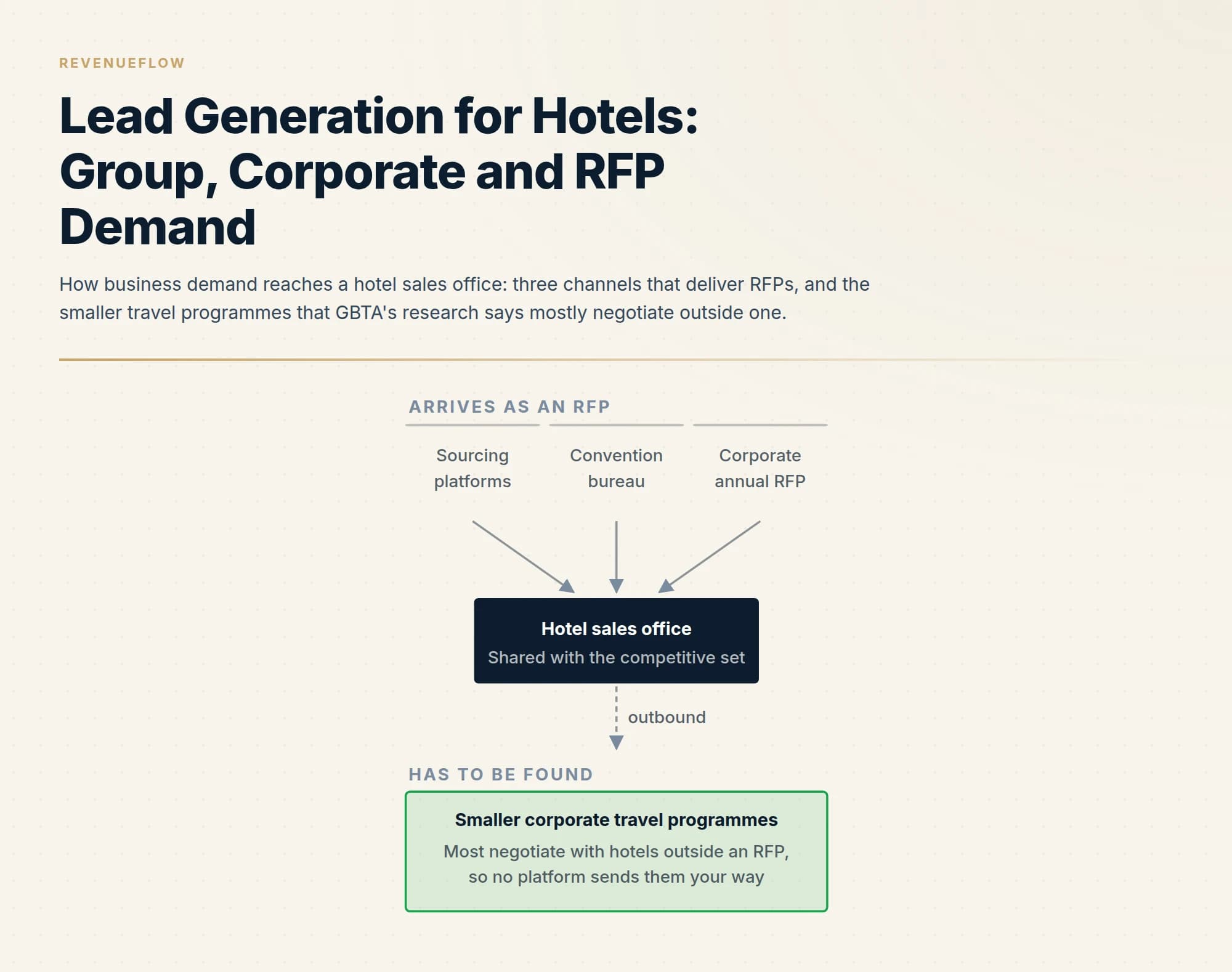
Hotel lead generation has two halves. RFPs arrive through sourcing platforms, convention bureaus and the annual corporate rate cycle, and are shared with competing hotels. The rest must be found: GBTA's 2025 research with Cvent says 69% of travel programmes at companies with 5,000 or fewer employees negotiate with hotels entirely outside an RFP.
Key takeaways
- GBTA and Cvent surveyed 278 corporate travel managers and hotel professionals in March 2025 and found 69% of smaller travel programmes negotiate with hotels entirely outside an RFP process.
- A GBTA Foundation survey with HRS found one out of six rate audits (17 percent) reveals a discrepancy between the negotiated contract and what appears in the system.
- PCMA says its magazine Convene has an audited circulation of 36,000 qualified meeting organizer subscribers, and MPI has organised meeting and event professionals since 1972.
- IMEX America lists 13 to 15 October 2026, and Cvent lists CONNECT Europe for October 20 to 22, 2026 in London and CONNECT 2027 for April 5 to 8 in Denver.
Reviewed and updated September 18, 2026
A hotel director of sales waiting for the corporate RFP to arrive is waiting for a minority of the market. In March 2025 the Global Business Travel Association and Cvent surveyed 278 corporate travel managers and hotel professionals in the United States, Canada and Europe, and reported that among travel programmes at companies with 5,000 or fewer employees, "Seven in ten (69%) of these firms negotiate with hotels entirely outside of an RFP process, compared to only about one in five at larger companies." (GBTA, published August 2025, read 18 September 2026.)
This guide is for a hotel's own sales team: the people responsible for group, meetings and events business, corporate negotiated rates and other business-to-business demand. Filling rooms with leisure guests who book direct is consumer marketing, a different discipline, and it is left out. If you sell products or services to hotels, this is the wrong page, and our hospitality cold email benchmarks cover your side. What follows is how hotel lead generation is organised in practice: the demand that arrives through the industry's own channels, the demand a property has to go and find, who the buyers are, the dated calendar, the rules that touch a hotel's outreach, and when outbound is the wrong play for a property.
Demand that arrives, and demand you go and get
Hotel sales has more built-in lead channels than almost any business, which is why the word lead means something specific here: an RFP, sent by a planner, asking for dates, space and rates.
The sourcing platforms. Cvent describes itself, in the boilerplate of the GBTA release above, as offering "a global marketplace where event professionals collaborate with venues", and its venue search promises planners "No commission, no charges, no fees." (Cvent Supplier Network, read 18 September 2026.) A planner enters dates and a city and sends the same request to several hotels at once. The lead is real and it is shared with your competitive set by design.
The destination organisation. A convention bureau markets the city to planners and takes their requests for its hotels and venues. Choose Chicago's page for meeting professionals carries the link in its main navigation, "Submit an RFP", next to tools to find hotels and venues (Choose Chicago, read 18 September 2026). Ask your own bureau how a request submitted that way is distributed, because that answer decides whether you see it.
The corporate RFP. Large travel programmes run an annual sourcing cycle for negotiated rates. Hospitality.today described it in a piece on the 2026 season: "The corporate RFP arrives, rates get submitted, terms get negotiated, a number gets locked for the year." (Hospitality.today, read 18 September 2026.) GBTA's chief executive, Suzanne Neufang, said in the research release that RFPs have "advanced beyond just securing better rates".
Every one of those channels is inbound and competitive. The GBTA figure at the top describes what they miss. Smaller programmes mostly do not run an RFP, so they never appear in a sourcing platform's feed. They negotiate directly, with whichever hotel is in the conversation. For a property near a business park, a hospital, a university or a plant, those companies are the outbound list, and nobody else is sending them a proposal template.
Who the buyers are, as their own associations describe them
Three kinds of buyer sit behind those channels, and each has a professional home that tells you how they think.
Meeting and event planner
Association: MPI, founded in 1972 for the meeting and event industry.
Sends RFPs for dates, space and rates.
Business events strategist
Association: PCMA, which serves the global business events industry.
Reads Convene, the PCMA magazine for meeting organizers.
Corporate travel manager
Association: GBTA, the business travel and meetings trade organization.
Negotiates rates, inside an RFP or outside one.
Meeting Professionals International says it "was founded in 1972 by a small group of professionals who saw the need for a dedicated community to connect and support those in the meeting and event industry" (MPI, read 18 September 2026). PCMA calls itself "the world's largest community for Business Events Strategists", and says its magazine, Convene, has "an audited circulation of 36,000 qualified meeting organizer subscribers" (PCMA, read 18 September 2026). GBTA describes itself as "the world's premier business travel and meetings trade organization".
The titles matter for a list. A planner at a company or an association owns events. A travel manager owns the transient rate. At a smaller company neither title may exist, and the person who books the quarterly sales meeting and decides where visiting staff stay is an office manager, an executive assistant or a finance lead. That is a mechanism and not a survey result, and it is the practical reason the smaller programmes are reachable: the decision sits with one person who can say yes.
Travel managers have a second concern a hotel can speak to. A GBTA Foundation survey with HRS Global Hotel Solutions found that "one out of six audits (17 percent) reveals a discrepancy between what was negotiated in the contract and what appears in the system, most often involving the rate" (GBTA, read 18 September 2026). A property that loads negotiated rates correctly, and says so, is answering a documented complaint.
The calendar, with dates
The corporate rate cycle is annual, and the Hospitality.today piece cited above is headlined "The corporate RFP season is here." It also notes the cycle is loosening, with a won rate now reviewed during the year, while fixed rates "still dominate". For outbound to smaller programmes the lesson is simple: the conversation does not have to wait for autumn, because those buyers are not running a cycle.
The industry's shows have published dates. As read on 18 September 2026:
| Show | Dates listed | Why a hotel sales team cares |
|---|---|---|
| IMEX America | 13 to 15 October 2026 | Planners meet suppliers, including through a hosted buyer programme |
| Cvent CONNECT Europe | October 20 to 22, 2026, London and virtual | The sourcing platform's own community |
| Cvent CONNECT | April 5 to 8, 2027, Denver and virtual | The same community, at the Colorado Convention Center |
IMEX America's site lists the 2026 show for 13 to 15 October and links a hosted buyer programme, through which planners meet suppliers (IMEX America). Cvent lists CONNECT 2027 for April 5 to 8, 2027 in Denver and virtual, at the Colorado Convention Center, and a London and virtual edition on October 20 to 22, 2026 (Cvent CONNECT). Those are the sourcing platform's own community events. The weeks before a show are when planners fill their appointment diaries, which makes them the right weeks to ask for a slot.
The rules that touch a hotel's outreach
A hotel emailing a company it has no relationship with is sending commercial email, and in the United States the CAN-SPAM Act applies to business recipients as well as consumers. Our explanation of what the CAN-SPAM Act requires covers the sender's duties, including a working opt-out and a physical address, and is not repeated here. If the sales team phones local companies, what cold calling is and which rules apply sets out the federal position on business calls and where it stops. Neither page is legal advice, and a hotel that is part of a brand or a management company will have its own policy on top.
One rule is specific to this industry's channels. A planner who submitted an RFP through a platform or a bureau gave their details for that request. Replying to the RFP is expected. Adding that planner to a newsletter or a prospecting list is a different act, and the platform's and the bureau's terms are the place to check before doing it.
Three reasons to write, each from a source above
None names a real person or claims a result.
To a smaller company nearby, grounded in the GBTA research.
We are the {{hotel}} on {{street}}, a few minutes from your office. GBTA's research says most companies your size arrange hotel rates directly and not through an RFP. If visiting staff or clients stay in {{area}}, would a fixed rate for {{company}} be useful? One page, no minimum.
The source shows this buyer is not being served by the platforms.
To a travel manager, grounded in the rate audit finding.
GBTA's survey with HRS found one in six rate audits turns up a mismatch between the contract and what is loaded. We load negotiated rates ourselves and send a screenshot the day they go live. If {{city}} is on your programme for next year, may we send our details for your RFP?
It answers a complaint the buyers' own association documented.
To a planner before a show, grounded in the organiser's dates.
IMEX America runs 13 to 15 October. If {{city}} is on your list for {{year}}, we have {{space}} and would like fifteen minutes in your diary there.
The date is public, and the ask fits the way planners already use the show.
When outbound is the wrong play for a property
Outbound is the wrong play for a hotel with no meeting space chasing groups, and for a property whose weeknights are already full at rate, because a negotiated account displaces better business. It is the wrong play when the RFP inbox is slow to answer: requests that arrive through platforms and bureaus are already in hand, and answering them faster is cheaper than finding new ones. And it is the wrong play for accounts a brand's national sales team already manages, where a property-level approach cuts across an existing relationship.
It fits a property with midweek gaps, local companies that travel, and nobody calling on them. RevenueFlow runs that kind of programme in writing, by email and LinkedIn, one message per campaign, with a new campaign only when there is a new reason to write. How a formal request for proposal looks from the seller's chair is covered in marketing RFPs. If you want a list of local corporate accounts and a first message built for your property, see what a first campaign looks like.
The short version
Hotel lead generation has two halves. One half arrives: RFPs through sourcing platforms, convention bureaus and the annual corporate cycle, all shared with competing hotels. The other half has to be found, and GBTA's 2025 research says it is large, because 69% of smaller travel programmes negotiate with hotels outside an RFP. The buyers are planners, business events strategists and travel managers, organised in MPI, PCMA and GBTA. IMEX America is 13 to 15 October 2026 and Cvent CONNECT is April 5 to 8, 2027. Outbound is wrong for a full hotel, a slow RFP desk or a brand-managed account, and right for a property with midweek gaps and unworked local companies.
GBTA, Cvent, association, show organiser and trade press pages quoted above were read on 18 September 2026. Dates and figures change. Confirm them on the source's own page before relying on them.
Frequently asked questions.
Frequently asked questions- How do hotels generate group and corporate leads?
- Most arrive as RFPs through venue sourcing platforms such as the Cvent Supplier Network, through convention bureaus that take planners' requests for a city, and through large companies' annual corporate rate cycle. Those leads are shared with competing hotels. The remainder has to be found by outbound, mainly among smaller local companies that arrange hotel rates directly.
- Which companies can a hotel reach with outbound sales?
- Smaller corporate travel programmes. GBTA's 2025 research with Cvent, a survey of 278 travel managers and hotel professionals, found that 69% of programmes at companies with 5,000 or fewer employees negotiate with hotels entirely outside an RFP process, compared with about one in five at larger companies. Those buyers never appear in a sourcing platform's feed.
- Who are the B2B buyers a hotel sales team sells to?
- Meeting and event planners, who are organised in Meeting Professionals International, founded in 1972. Business events strategists, who are organised in PCMA, whose magazine Convene reaches 36,000 meeting organizer subscribers. And corporate travel managers, organised in GBTA, who negotiate rates. At smaller companies the same decisions often sit with an office manager or finance lead.
- When should a hotel not run outbound lead generation?
- When the property has no meeting space but is chasing groups, when weeknights are already full at rate, when the RFP inbox is slow to answer, since faster replies to existing requests cost less than new leads, and for accounts a brand's national sales team already manages. Outbound fits a property with midweek gaps and unworked local companies.
About the author.

B2B cold email experts helping companies generate qualified leads through done-for-you outreach campaigns.
RevenueFlow Team
Explore more.
Ready to scale your outreach?
We build GTM engines that book real meetings. See the receipts.
Related articles.
Lead Generation for Food Distributors: Finding New Operators
How a food distributor finds new operator accounts: public licence and inspection lists, who controls the purchase, the DSR model, show dates and FDA traceability.
Lead Generation for Trucking Companies: Three Routes
How a motor carrier finds freight customers: the load board, the broker relationship and the shipper's annual bid, with the calendar and the rules on outreach.
Lead Generation for Telecommunications Companies: Four Lead Sources
For carriers, ISPs, UCaaS providers and MSPs: the installed base, the advisor channel, dated outbound and the funded network map as lead sources, with FCC rules.
B2B Lead Lists for Collection Agencies: Fields and Sources
What a creditor prospect list needs for a collection agency: the fields that matter, the FDIC, NCUA, CMS and court sources behind them, and the rules that apply.
Outbound Sales for Food and Beverage Companies: Who to Reach
Outbound sales for food and beverage brands: the four buyers behind a yes, the public show calendar, what a message may claim, and when outbound is the wrong play.
Outbound Sales for Higher Education Vendors: Which Door to Use
Outbound for higher education vendors, built on universities' own purchasing policies: three doors, the ask that fits each one, and a dated accessibility review.