Lemlist Review: Read the Sender Cap Before the Feature List
Lemlist's feature list runs past seventy items and none of them decides the purchase. The senders-per-user question does, and the pricing page states it twice.
Lemlist is a multichannel outbound platform priced per user, and the number that decides whether it suits you is how many sending mailboxes one paid user may hold. Its pricing page prices the entry tier from $55 per user per month while also listing unlimited email senders as a feature, so confirm the basis before buying.
Key takeaways
- The pricing page prices the Email tier from $55 per user per month while listing unlimited users and email senders as an included feature, and a buyer cannot resolve that from the page.
- Data is metered outside the subscription at one cent per credit: five credits for a verified email, twenty for a phone number, and from 400 for a LinkedIn engagement signal.
- Inbox rotation and per-mailbox sending limits are the deliverability features that change what you can safely run; rotating IPs matter far less for mailbox-based cold sending.
- The fourteen-day trial gives full Multichannel access with no card, and afterwards you keep the account, campaigns and leads but cannot send new campaigns.
Reviewed and updated August 28, 2026
Lemlist's pricing page lists somewhere north of seventy features across six categories, and labels every one of those categories "Included in all plans". It also prices the entry tier at "From $55 /user /mo". Both statements are on the page at the same time, and a reader cannot tell from it alone which capabilities are gated by tier.
That is the honest starting point for a review of this product, because the feature list is not where the decision lives. The decision lives in one structural question: how many sending mailboxes one paid user is allowed to hold. Everything about whether lemlist is cheap or expensive for you follows from that, and it is the question the feature grid is least helpful about.
Everything below comes from lemlist's own pricing page as it rendered on 16 August 2026, and from a second fetch of the same page made five days earlier for our lemlist pricing breakdown.
The product itself lives at app.lemlist.com, and the marketing site and the application are separate surfaces, which is why the pricing questions below have to be settled before signup rather than inside the app.
lemlist documents a HubSpot integration configured from its own settings, so CRM sync is available without a middleware layer, though the scope of what syncs is worth confirming for your object model.
Lemlist publishes a public cold-email template library and a separate in-product campaign-template feature, so a search for lemlist templates lands on marketing copy in one case and on a saved campaign shell in the other. Video is a personalisation surface rather than a plan feature here: lemlist's own documentation covers adding video to a LinkedIn message, and the third-party video tools that rank alongside it exist because the campaign editor embeds a thumbnail and hosts the playback elsewhere.
What you are actually buying
Lemlist is a multichannel outbound platform rather than an email sender with extras bolted on. The published feature set spans a 650 million-plus lead database with an email and phone finder, sequences that mix email with LinkedIn profile visits, invites, text messages and voice notes, SMS, in-app calling with VoIP integrations, a WhatsApp add-on, a unified inbox, and a layer of AI agents for enrichment, reply-intent detection and out-of-office handling.
Data is metered separately from the subscription, and lemlist publishes the rates plainly. Credits cost a cent each. A verified email costs 5 credits, a phone number costs 20, and the page states the arithmetic itself: a thousand credits buys 200 emails or 50 phone numbers for $10. Buying-intent signals are priced on the same meter and considerably higher, at 20 credits for a website visit, from 100 for hiring and job-change signals, 100 for a fundraise, and from 400 for a LinkedIn engagement signal, which is $4 each time one fires.
Five cents, and the page states 1,000 credits buys 200 emails
Twenty cents, four times the cost of an email
From $4 each time the signal fires
Full Multichannel access, no card, sending stops afterwards
The trial terms are unusually clear and worth knowing before you start it. Fourteen days of full Multichannel access with no credit card, after which you cannot send new campaigns but keep access to the account, campaigns and leads. So the trial is a genuine evaluation rather than a countdown to data loss, and the work you do inside it survives.
The sending architecture, which is the interesting half
For a cold-outbound buyer, the deliverability block on lemlist's page is the part that decides whether the tool can carry the motion at all. It names thirteen things, and they are not equally load-bearing.
- Inbox rotation, spreading volume across mailboxes
- Smart sending algorithm, pacing the send
- Sending limits management per mailbox
- In-app domain and mailbox purchase
- Custom tracking domain
- DNS setup test
- Deliverability testing and alerts
- Unsubscribe link handling
- Rotating IPs, which matter less than domain and mailbox reputation
- The Deliverability Hub as a dashboard rather than a mechanism
- Google, Microsoft and SMTP connections, which every competitor has
Inbox rotation is the one that genuinely changes the shape of what you can run, because cold volume is limited by what each individual mailbox can send without attracting attention rather than by what the platform can push. The mailboxes and domains themselves are bought outside the subscription on every platform in this category, including this one, and they are usually the larger line item. The provider sending limits that govern all of it apply regardless of tool.
Rotating IPs deserve the demotion. Shared sending IP reputation matters for bulk marketing mail; for cold outbound running through connected Google and Microsoft mailboxes, the reputation that decides placement attaches to the sending domain and the individual mailbox. A feature list that gives equal billing to inbox rotation and rotating IPs is describing two very different sizes of thing, and our cold email deliverability guide covers which layer actually moves the number.
The pricing contradiction, still on the page
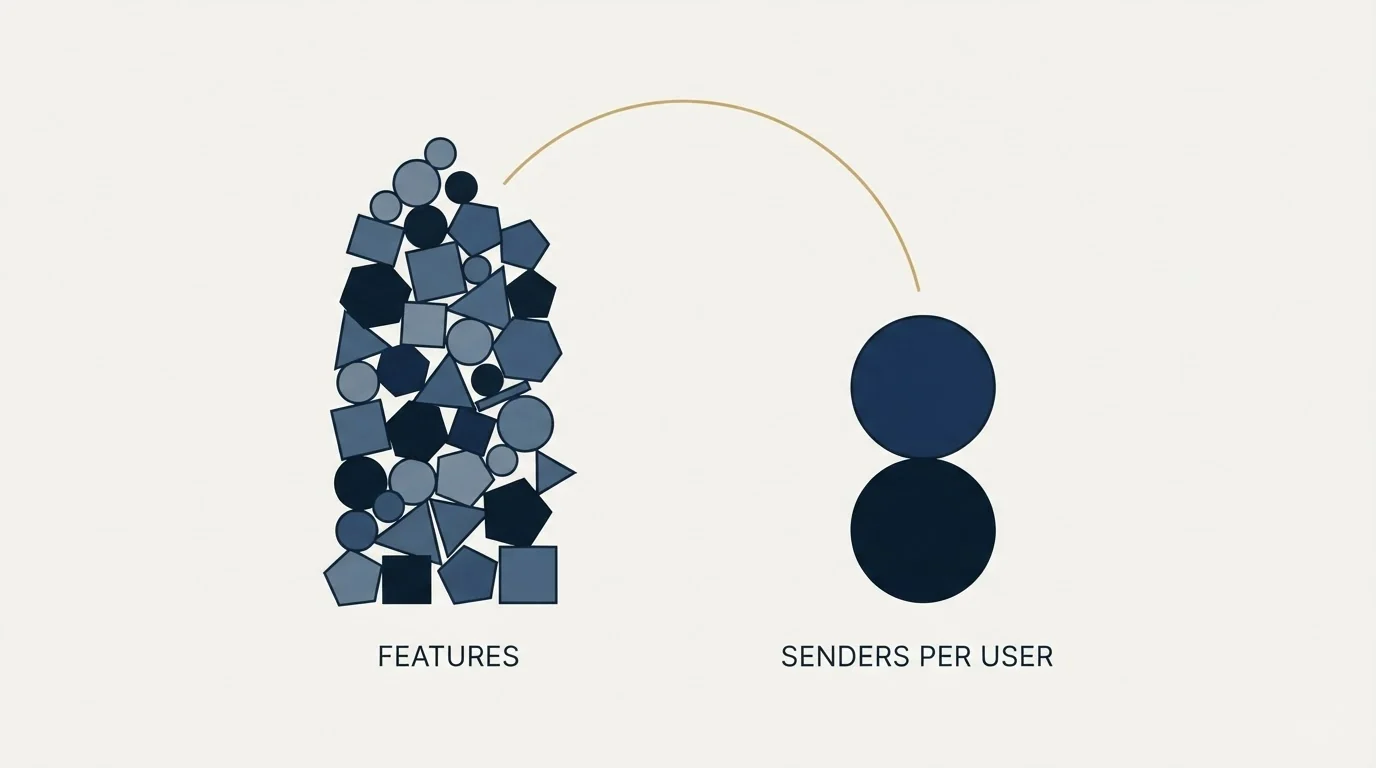
Two fetches five days apart both show the same unresolved statement. The comparison table prices the Email plan "From $55 /user /mo" while listing "Unlimited users and email senders" as a feature under Operations and Scaling, in a block headed "Included in all plans".
Those cannot both describe the same tier without qualification. On a team of five, the difference between a flat plan and a per-user one at that rate is the difference between $55 and $275 a month, which is arithmetic on lemlist's own figure rather than a quoted price, and it is not a rounding question. Our reading is that the plan cards and the feature grid are describing different things and that the grid is not showing per-tier gating in the served page, but the honest position is that a buyer cannot resolve it from the page and should get the per-user basis and the senders-per-user cap confirmed in writing before purchase. The full ladder, including the Multichannel tier at "From $87 /user /mo" and how it lands against Instantly, is in our lemlist pricing breakdown.
The pivot underneath the contradiction is the senders-per-user cap, and it is what makes this product cheap for one shape of team and expensive for another. A five-person sales team each working from two or three mailboxes is a natural fit. One operator running a large mailbox estate is not, and that operator is better served by a platform that meters volume rather than people, which is the model Instantly and Smartlead both use.
How to test it in the fourteen days you get
The trial is long enough to answer the questions that matter and short enough that spending it on the wrong ones is expensive. Three tests are worth the time.
Connect the mailboxes you would actually send from, not one test inbox, and watch what the sending-limits management does with them. A platform that paces per mailbox behaves very differently from one that treats your estate as a single pipe, and the difference only shows up at more than one mailbox.
Run a real list through the finder and count credits rather than results. At five credits a verified email, a thousand-row list is $50 of data on top of the subscription if every row resolves, and considerably more if you turn on intent signals. That number is your recurring data cost, and it belongs in the comparison alongside the plan price rather than after it.
Then write one message and try to send it. Not a sequence: one message, to a small segment, with the tracking settings you would use in production. What you learn is how much of the platform you need to touch to do the simplest possible thing, which is a fair proxy for how much of it you will still be using in six months.
What the rating on the page does not tell you

Lemlist displays a G2 score of 4.7 out of 5 from 1,396 reviews on its own pricing page, alongside a claim that more than 20,000 sales teams run their outbound in the product. Both are vendor-presented figures, which is not an accusation, it is a description: the number is real and the surface it appears on is a sales page, so it has been selected for.
A rating aggregated across every kind of buyer also answers a question you are not asking. Agency operators, solo founders and five-person sales teams want different things from this product, and the shape that determines your answer, mailbox count against headcount, is invisible in a single average. The useful version of the same research is to read the reviews written by people whose team shape matches yours and ignore the score entirely.
- Depends: Whether the Email plan is priced per user, which the page states inconsistently
- Depends: How many sending mailboxes one paid user may connect
- Yes: What your realistic monthly credit burn is at 5 credits per verified email
- Yes: Which currency your region is billed in, since the page offers dollar, euro and pound billing
- Yes: Whether the mailboxes and domains are inside the quote or bought separately
- Yes: Whether you need the LinkedIn, SMS and calling channels at all, since they carry the per-user tier
Where our practice differs from the product's defaults
Multichannel sequencing is the reason most buyers pay for the expensive tier, and it is also the part of the product that would sit switched off in a campaign built the way this one describes.
One message per campaign is how we run outbound. No thread replies, no bumps, and a non-responding audience becomes a new campaign with a genuinely different premise rather than another step attached to the first. On LinkedIn the constraint is stronger still: a message thread is permanent and visible, so a second message lands directly underneath the one the recipient already ignored, whatever the campaign structure says. We do not run LinkedIn no-reply retargets for that reason, and a platform's ability to automate the follow-up is not an argument for running one. The account-level limits that apply regardless of tooling are in LinkedIn automation tools.
None of that is a criticism of lemlist, which is unusually good at the multichannel workflow it is built for. It is a note that the priciest half of the product is the half a RevenueFlow campaign would use least, and that is exactly the kind of judgement a review should make explicit rather than average away.
The verdict

Lemlist fits a team of humans running considered, personal outreach across email and LinkedIn, where the per-user model matches how the work is actually done and the channels justify the tier. The trial is honest, the credit pricing is transparent, and the deliverability tooling is real rather than decorative.
A different limitation worth weighing is category fit itself, which the Apollo.io versus Lemlist comparison frames as two tools built for adjacent jobs rather than direct substitutes.
It fits poorly where one operator runs a large mailbox estate, because per-user pricing with a sender cap charges you for the resource you have least of. And it carries one unresolved statement about its own pricing basis that a buyer should settle in writing before signing, because the answer moves the bill by a multiple rather than a margin. If you are comparing the field rather than this product, our lemlist alternatives roundup covers it.
If what you want is booked meetings rather than a platform to run them from, see what a campaign would look like for your market.
Plan prices, credit rates, trial terms, feature names and the displayed G2 figure verified against lemlist's own pricing page as of mid-2026, cross-checked against a fetch of the same page five days earlier. Lemlist offers billing in dollars, euros or pounds; the figures above are the US view. Verify current terms with the vendor before relying on them.
Sources: lemlist pricing
Frequently asked questions.
Frequently asked questions- Is lemlist worth it?
- It depends on your team shape rather than on the feature list. A team of several people each sending from two or three mailboxes, using LinkedIn and calling alongside email, gets a genuinely multichannel workflow for the per-user price. One operator running a large mailbox estate pays for headcount they do not have and should compare volume-priced platforms.
- How much does lemlist cost?
- Its pricing page lists the Email plan from $55 per user per month and Multichannel from $87, with Enterprise quoted. Data sits on a separate meter at one cent per credit, so a verified email is five cents and a phone number twenty. Mailboxes and domains are bought outside the subscription, as they are on every platform in this category.
- Does lemlist help with deliverability?
- It ships the usual apparatus: inbox rotation, a smart sending algorithm, per-mailbox sending limits, a custom tracking domain, a DNS setup test and deliverability alerts. Inbox rotation and sending limits are the two that change what you can safely run. Rotating IPs get equal billing on the page and matter far less for mailbox-based cold sending.
- What should I test during the lemlist trial?
- Connect the mailboxes you would really send from rather than one test inbox, because per-mailbox pacing only shows up across several. Run a real list through the finder and count credits rather than results, since that is your recurring data cost. Then send one simple message and see how much of the platform you had to touch.
About the author.

Ben Carden is CRO at RevenueFlow, which builds and operates outbound revenue engines for B2B companies. Previously at Gartner Enterprise. Studied at London School of Economics.
Ben Carden · CRO
Connect on LinkedIn →Explore more.
Ready to scale your outreach?
We build GTM engines that book real meetings. See the receipts.
Related articles.
Email Tracking Software: Six Tools, Priced and Capped
Streak, Mailsuite, Right Inbox, Mixmax, Yesware and HubSpot compared on free-tier caps and published prices, plus what an open event still proves.
Yesware Email Tracking: What the Open Notification Proves
Yesware tracks opens, clicks and attachment views from inside Gmail and Outlook. What each event proves, what every tier costs, and why an open is not a trigger.
Lemlist Pricing: Plan Tiers and Credit Costs vs Instantly
Lemlist prices per user with a sender cap where Instantly gives unlimited mailboxes. Which is cheaper depends on whether your constraint is headcount or mailboxes.
No-Reply Email Address: What It Costs a Sender
A no-reply address is defensible on a receipt and indefensible on a cold message, because the reply is the entire product of a first contact.
SMTP Reply Codes: What Each Class Instructs
The digits are a verdict and the text is the reason. Separating an address failure from a policy refusal before reacting is what decides whether the fix works.
SURBL Blacklist: What It Lists and How to Get Removed
SURBL tests the domains inside your message rather than your sending IP. Which of its six lists fired, what the bitmask means, and the fix that works.