Martal Group: What the Pricing Page Publishes
No rate card, and a stated contract shape, three named onshore roles, a full scope list and an average production funnel. Enough to judge the model.
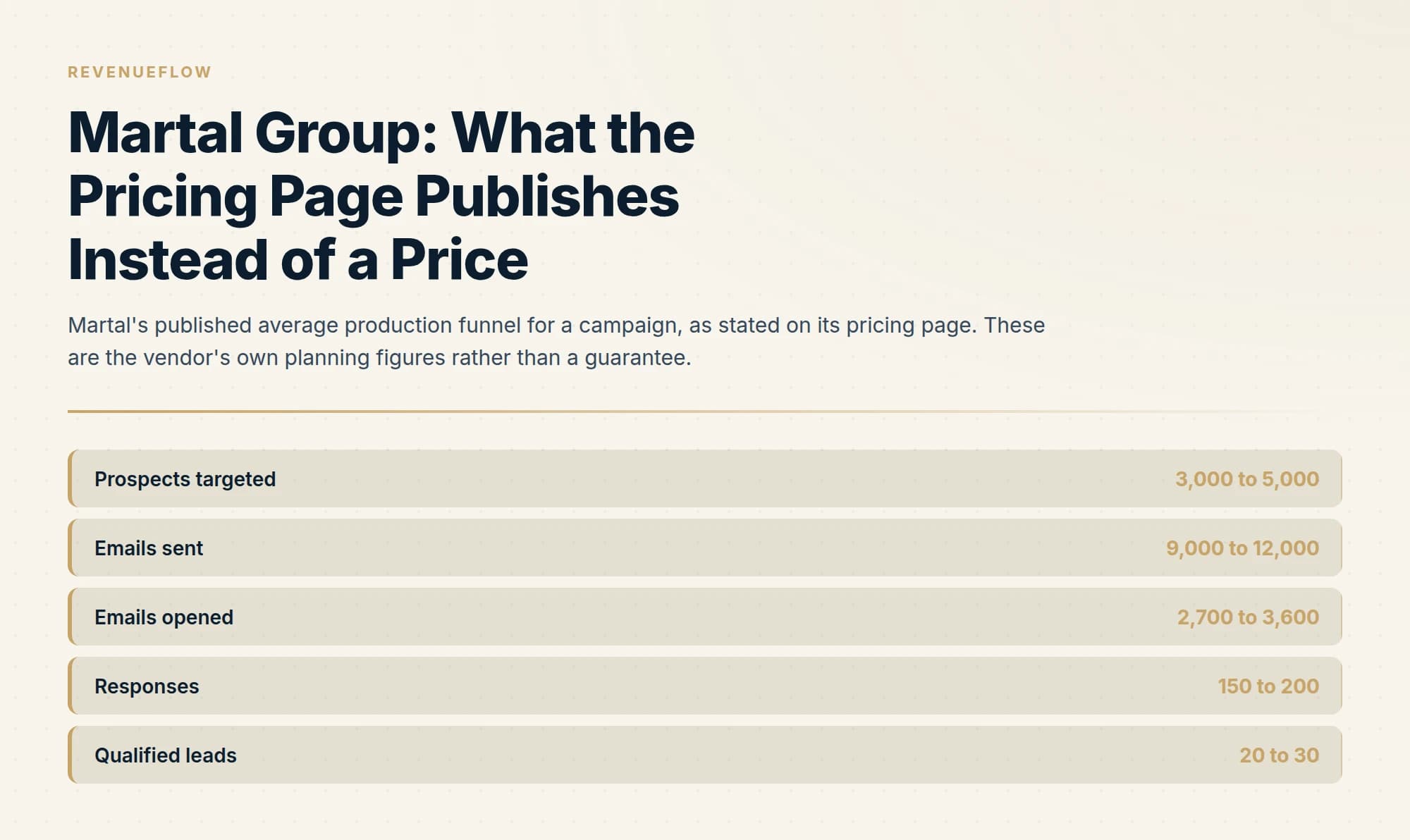
Martal publishes no fixed price for its outsourced lead generation service. Its pricing page states a three-month pilot followed by a monthly subscription at a flat fee quoted on inquiry. A separate AI platform pricing page runs a self-serve estimator for a different product, so a figure from it does not price the service.
Key takeaways
- Martal's pricing page carries no rate card for the outsourced service, and states instead a three-month pilot followed by a rolling monthly subscription at a flat fee.
- A second pricing page covering the AI Sales Platform runs an interactive estimator from 1,000 to 30,000 monthly prospects, which prices a different product entirely.
- The published average production funnel runs from 3,000 to 5,000 prospects targeted through 9,000 to 12,000 emails to 20 to 30 qualified leads.
- The scope section states 5 to 7 touch points per prospect across email, LinkedIn and calls, so the programme is multi-touch by design and says so.
Reviewed and updated September 1, 2026
Martal Group's pricing page is titled "Outsourced B2B Lead Generation Pricing" and contains no prices. What it contains instead is more useful than most agencies publish: a stated contract shape, the roles on the team, the scope of work line by line, and an "average production funnel" giving the volumes a campaign is built around. You cannot budget from it, and you can work out precisely what you would be buying.
A disclosure before going further. RevenueFlow is an outbound agency and competes with Martal for some of the same buyers. We are paid on attended qualified meetings rather than a monthly fee, and we run a different channel philosophy, which we set out plainly below. Everything here comes from Martal's own pages rather than from third-party roundups, and where our approaches differ we have described the trade-off both ways.
What Martal publishes instead of a price
The commercial terms are stated as a shape rather than a number: a three-month pilot campaign, then a monthly subscription after the pilot, with pricing described as a flat fee per month and a prompt to inquire.
That is worth reading carefully, because a three-month pilot followed by a rolling subscription is a genuinely different commitment from a twelve-month minimum, and it is different again from month-to-month. You are committing to a defined trial period rather than an open-ended term, which caps your downside at the pilot while giving the programme enough runway to be judged fairly.
Third-party sites list monthly figures for Martal. We are not repeating them, because they are not on Martal's own pages and we could not verify them at source. Pricing roundups in this category are wrong often enough that the discipline matters: ask Martal directly and get the number in writing.
One qualification, because "this vendor publishes no pricing" is a claim that has to be checked across a site rather than on a single page. Martal runs a second pricing page, at /ai-pricing/, covering its AI Sales Platform rather than the outsourced SDR service described here. That page carries no rate card either, and it does offer something the main pricing page does not: an interactive estimator where you set a monthly prospect volume, from 1,000 up to 30,000, and it returns an estimated monthly investment.
So the accurate statement is narrower than it first looks. Martal publishes no fixed price for its outsourced lead generation service, and it will generate a self-serve estimate for its AI platform product if you use that calculator. They are different products with different commercial shapes, and a number from one tells you nothing about the other. Worth knowing before someone quotes you a "Martal price" they got from the wrong page.
The published funnel
This is the most substantive thing on the page and the part worth studying.
The top of the list a campaign is built around
Roughly two to three sends per prospect
Around 30% of sends on the published figures
Across email, calls and LinkedIn combined
The output the programme is measured on
Bar widths are equal here because these stage values are not a single comparable measure.
Alongside those, the page lists 250 to 450 calls, 600 to 700 LinkedIn follow-ups, and 5 to 15 "flipped" leads.
Do the arithmetic on the top two rows, because it tells you the model. Nine to twelve thousand emails across three to five thousand prospects is roughly two to three sends per person, and the scope section confirms it: outbound outreach across email, LinkedIn and calls "targeting prospects with 5 to 7 touch points". Martal is running a multi-touch, multi-channel programme by design, and it says so.
Twenty to thirty qualified leads from three to five thousand prospects is a conversion of well under one percent, which is normal for cold outbound and worth seeing written down. Any agency promising dramatically better from a cold list is either working a much narrower list or defining "qualified" more loosely.
Scope, stated in full

The page lists what a Tier 1 engagement covers: a curated list of pre-qualified leads built weekly, persona-based messaging templates with A/B testing, outbound outreach across email, LinkedIn and calls at 5 to 7 touch points, conversion tracking and KPI analytics, LinkedIn invites and messaging, appointment booking and discovery calls led by a North American team, and weekly meetings covering reports, goals, quota setting and reporting processes.
The named onshore roles are a Sales Executive, a Research Manager and a Sales Operations Manager.
Two things stand out. The weekly list build means the audience is treated as a rolling input rather than a fixed upload, which suits markets where new companies keep entering your criteria. And discovery calls led by a North American team is a specific commitment about who your prospect actually speaks to, which matters more than most buyers realise when the alternative is an offshore rate card.
Martal also sells inbound and SEO packages on the same page, built around guest posts, backlinks, organic traffic and LinkedIn sponsored messaging. Those are a different product from the outbound tiers and should be priced separately in any comparison.
Why the pilot structure is the most important term
The three-month pilot is easy to skim past and it is the term that most determines how the engagement goes.
A pilot period does two useful things. It caps your exposure at a known quantity, so a decision that turns out badly costs three months rather than a year. And it creates a natural review point where both sides expect to reassess, which is materially easier than trying to exit a twelve-month contract in month four because the numbers disappointed.
It also creates a trap worth naming. Cold outbound has a genuine ramp: domains warm, lists get built, messaging gets tested and rewritten, and the first month is usually the worst month the programme will have. A three-month pilot spends roughly a third of its life in that ramp, so judging the whole pilot on its average understates what the steady state looks like. The fair read is the trend across the three months rather than the total, and the questions worth asking at the review are whether reply quality improved and whether the messaging converged, not simply how many meetings landed.
Agree before the pilot starts what would count as success at the end of it. Both sides benefit from that conversation happening while everyone is optimistic rather than after the numbers are in and the interpretation is contested.
Where our model differs, in both directions

The honest comparison is a difference in philosophy, and each side has a real argument.
- 5 to 7 touch points per prospect
- Email, LinkedIn and calls combined
- Two to three emails per person on the published funnel
- Persistence surfaces prospects whose timing was wrong
- More total contact from a given list
- A single message, then the prospect is left alone
- No thread bumps and no LinkedIn no-reply retargets
- A new angle means a new campaign, not another step
- Effort moves from repetition into targeting
- Fewer people contacted, more work per person
We do not run follow-up sequences and we do not send a second LinkedIn message to someone who ignored the first, on the view that it lands directly beneath the message they already declined and reads as a bump whatever the campaign calls it. That is our position and it costs us reach.
Martal's approach costs something different: more total contact per prospect, and a programme whose results depend on the sequence rather than on any single message being right. Buyers who have seen replies arrive on touch four will find our model leaves value on the table. Buyers who worry about how their brand is experienced in a crowded inbox will prefer it. Both are defensible readings of the same evidence.
The other structural difference is who carries outcome risk. A flat monthly fee is paid whether the funnel above materialises or not. We invoice on attended qualified meetings against criteria agreed in writing before launch, so a quiet month costs us rather than you. In exchange, a retainer buys a named team and a weekly operating rhythm that a per-meeting arrangement does not oblige anyone to provide.
What to ask, since the number is not published
- Yes: The flat monthly fee in writing, for the pilot and for the subscription after it
- Yes: Whether the pilot fee differs from the ongoing rate, and what happens at the three-month mark
- Yes: What counts as a qualified lead, defined in writing before launch
- Yes: Whether the 20 to 30 figure is a target, a forecast or an average
- Yes: Who sends from which domains, and whether they are separate from your primary company domain
- No: Treating the published funnel as a commitment
That last one is the important restraint. An average production funnel is a planning illustration, not a guarantee, and reading it as one is how buyers end up disappointed by a programme that performed exactly as described.
The domain question applies to every agency in this category including us. Outbound sending belongs on domains separate from your primary company domain, so a reputation problem in the prospecting programme cannot reach the address your invoices come from.
The short version

Martal publishes no prices and a lot of structure: a three-month pilot then a monthly subscription, a flat fee per month quoted on inquiry, an onshore team of three named roles, a weekly-refreshed list, and an average production funnel running from 3,000 to 5,000 prospects down to 20 to 30 qualified leads via 5 to 7 touch points per person. Judge it on the funnel arithmetic and the multi-touch philosophy rather than on a number you will have to ask for. If you want persistence across three channels and a weekly operating rhythm, it fits. If you want a single well-targeted message and the outcome risk carried by the agency, it does not.
SalesBread's guarantee-based pricing model shows a different way vendors avoid publishing rates, tying its offer to a money-back guarantee instead of a fee schedule.
For the category view, the five delivery models and what each costs sets the shapes out, what a lead generation agency actually costs covers the published ranges, and how to compare providers on pricing and risk covers the diligence. If you are weighing this against hiring, outsourced SDR versus in-house has the arithmetic.
You can also see what a campaign would look like for your market.
The contract shape, team roles, scope of work and production funnel are from Martal Group's own pricing page at https://martal.ca/pricing/, read from the rendered page. The AI Sales Platform estimator is at https://martal.ca/ai-pricing/. Both were re-fetched with cache-busting and verified as of mid-2026, and neither carries a fixed rate card; the service pages for appointment setting and cold email were checked separately and carry no figures either. Monthly rates quoted elsewhere on the web are not from Martal's own site and are not repeated here. Verify current terms with the vendor.
Frequently asked questions.
Frequently asked questions- How much does Martal Group cost?
- Martal publishes no figure for its outsourced lead generation service. The pricing page describes a three-month pilot campaign followed by a monthly subscription, charged as a flat fee per month and quoted on inquiry. Monthly rates circulating on third-party roundup sites are not from Martal's own pages, so ask the company directly and get the number in writing.
- Does Martal have a pricing calculator?
- It runs one on a separate page covering its AI Sales Platform, where you set a monthly prospect volume between 1,000 and 30,000 and receive an estimated monthly investment. That estimator prices the platform product rather than the outsourced lead generation service described on the main pricing page. The two are different purchases with different commercial shapes.
- What does Martal's published funnel show?
- Its stated average production funnel targets 3,000 to 5,000 prospects a month, sends 9,000 to 12,000 emails, opens 2,700 to 3,600 of them, produces 150 to 200 responses and yields 20 to 30 qualified leads. The page also lists 250 to 450 calls and 600 to 700 LinkedIn follow-ups. These are planning figures rather than guarantees.
- Is the three-month pilot a good term or a bad one?
- It caps exposure at a known quantity and creates a natural review point, which is easier than exiting a twelve-month contract in month four. The trap is that cold outbound ramps, so a three-month pilot spends roughly a third of its life below steady state. Judge the trend across the months rather than the average, and agree success criteria before starting.
About the author.

Ben Carden is CRO at RevenueFlow, which builds and operates outbound revenue engines for B2B companies. Previously at Gartner Enterprise. Studied at London School of Economics.
Ben Carden · CRO
Connect on LinkedIn →Explore more.
Ready to scale your outreach?
We build GTM engines that book real meetings. See the receipts.
Related articles.
Unbounce Alternatives: Two Boundaries, Four Meters
Teams leave Unbounce at two published boundaries: the 500 visitor entry ceiling and testing starting on the third tier. Each alternative moves one, both or neither.
Blue Zebra Appointment Setting: The Vendor's Pages Are Gone
Search results still describe a B2B appointment setting firm at this address. The pages themselves return 404 and the domain now serves something else entirely.
Goldcast Belongs to Cvent Now: The Buying Question
Cvent announced its Goldcast acquisition in December 2025 and completed its ON24 acquisition in April 2026. Two shortlist names, one owner, one live contract question.
Belkins Pricing: What the Service Page Publishes
Belkins publishes a starter price and four figures on its service page, and no price at all on its pricing page. Which page a number came from decides what it means.
What Is Callbox? The Campaign Pod Model
Callbox sells outbound in units it calls Campaign Pods, and it is one of the few agencies in the category that puts a monthly price band on its own pricing page.
Lead Generation as a Service: What the Service Part Changes
Most vendors selling lead generation as a service have productised the scope and kept the price bespoke. What that trade buys you, and how to tell which half is fixed.