NeverBounce Under ZoomInfo: What Buying Verification Changes
NeverBounce serves no pricing page to automated requests, so here is what its own surfaces do show, and what changes when your verifier belongs to a data platform.
NeverBounce is published on its own LinkedIn company page as NeverBounce by ZoomInfo. Its website returned HTTP 403 to every automated request made in mid-2026, including the pricing page, so no rate card is quoted here. Buying verification from a data platform changes the data relationship, the roadmap and the contract shape more than it changes the verification itself.
Key takeaways
- The neverbounce.com host refused automated requests on both the apex and www names, so any NeverBounce price you see on a comparison page was reconstructed by a third party rather than read off the vendor's rate card.
- The vendor's LinkedIn company page is published as NeverBounce by ZoomInfo, and a post there announces AI Scoring described as powered by ZoomInfo data.
- The GitHub organisation and developer documentation name maintained API wrappers for PHP, Ruby, Node.js, Python, Go, .NET and Java plus a JavaScript form widget, which is the integration breadth you can still audit from outside.
- Ownership does not move the catch-all wall: no verifier can confirm a mailbox on an accept-all server, whoever owns the verifier.
Reviewed and updated September 2, 2026
NeverBounce Under ZoomInfo: What Buying Verification From a Data Platform Changes
Four requests to neverbounce.com on 13 August 2026 returned HTTP 403 every time: the apex host, the www host, the pricing page and the integrations page. Not a redirect, not a slow load, not an empty body. A flat refusal to serve anything to an automated client. That is the first practical fact about evaluating this vendor from the outside, and it shapes everything below.
It also explains why almost every page ranking for "NeverBounce pricing" is a third party reconstructing numbers rather than quoting a rate card. Those pages are guessing, and several of them sell competing products. This piece stays with what can be read directly off surfaces the vendor controls, says plainly where the evidence stops, and then answers the question that actually matters for a B2B outbound team: what changes when your email verifier belongs to a data platform.
Published rate cards make that reconstruction unnecessary, and Kickbox's published verification ladder sits on one page with no subscription and no quote gate.
What the vendor's own surfaces say
Two NeverBounce surfaces answered a plain fetch, and both belong to the company.
The NeverBounce LinkedIn company page is published under the name NeverBounce by ZoomInfo. The same page lists the company as founded in 2014, headquartered in Vancouver, Washington, categorised under Information Technology and Services, with specialties given as email validation, data hygiene, email verification, email cleaning, lead verification and deliverability. A post on that page announces AI Scoring, described in the vendor's own words as "powered by ZoomInfo data", positioned as a way to see which addresses are most likely to engage before you send.
The NeverBounce GitHub organisation is the other one. It lists Cleveland, Ohio as its location and shows API wrapper repositories for PHP, Node.js, Python and Ruby. The Python wrapper's readme states that the SDK interacts with the verification API at version 4 and shows account tokens carrying a secret_ prefix.
Those two locations are worth noticing together. The developer organisation still carries the original Cleveland address; the marketing surface carries ZoomInfo's Washington headquarters. That is the ordinary shape of an acquired product: engineering artifacts keep their old provenance while the brand surface moves.
- Step 1neverbounce.com
HTTP 403 on the apex host and the www host, and on /pricing and /integrations. No content of any kind.
- Step 2developers.neverbounce.com
Returns bytes, but the documentation renders in JavaScript. A raw fetch gets the navigation and no prose.
- Step 3LinkedIn company page
Published as NeverBounce by ZoomInfo. Founded 2014, Vancouver Washington, specialties listed, product posts readable.
- Step 4GitHub organisation
Cleveland Ohio, four API wrapper repositories, readmes citing API version 4 and secret_ prefixed tokens.
Why no price appears in this article
There is no NeverBounce price here, and that is deliberate. A price is only worth publishing when it can be read out of bytes the vendor served. Those bytes were refused. A 403 is a failed fetch, never evidence that a figure is gone or that pricing is unpublished, so the honest statement is narrow: NeverBounce's pricing page did not serve its contents to an automated request on the date checked.
The gap gets filled by third parties, and that is the trap. Comparison pages, software directories and rival verifiers all publish NeverBounce numbers. Some of those numbers are stale, some describe a plan that no longer exists, and the ones on a competitor's comparison page are written by someone with a commercial reason for the figure to look bad. Open the vendor's own pricing page in a browser and read the current rate card. It takes fifteen seconds and it is the only version that is definitely current.
Teams that still need a comparison baseline before trusting any third-party number will find pricing the ZeroBounce bundle a useful check on what an alternative verifier really costs against actual usage.
What can be said about the commercial motion, without a number attached: the pattern in this category is that platform-owned tools are quoted rather than listed, because the verifier is one line on a larger platform agreement. Plan for a conversation with a salesperson rather than a checkout page, and plan for the timeline that implies.
Integration breadth is the one thing you can still audit from outside

The marketing integrations page refused the same way everything else on that host did, so the number of named CRM and sending-platform connectors is not something to take from a directory listing. The developer surfaces are readable, though, and they answer a narrower version of the same question.
The developer documentation renders its prose in JavaScript, so a raw fetch returns the navigation and nothing else. That navigation is still informative. It names API wrappers for PHP, Ruby, Node.js, Python, Go, .NET and Java, plus a JavaScript widget for validating an address in a form at the point of entry. Four of those wrappers are visible as repositories on the GitHub organisation, which means you can check their commit history yourself rather than trusting a "maintained" badge.
That is a genuinely wide language surface, and it matters more than a connector count for most teams. A named connector to a platform you do not use is worth nothing; a maintained client in the language the pipeline is written in is worth a week. If you are wiring verification into your own enrichment flow rather than clicking it together, check the repository for the language you actually use, look at when it was last touched, and treat that as the integration answer.
What actually changes when your verifier belongs to a data platform
Verification looks like a commodity from the outside. Four checks in sequence, a status code back, a per-address price. The ownership question sits underneath that and changes three things that a price comparison will never surface.
Before any of those checks, the string itself needs normalising, and casing that turns one person into two rows is where a suppression list quietly fails.
Your list becomes a file at a data company. Verification requires you to upload your addresses. When the verifier is a standalone tool, that is a processing relationship and the vendor's contract usually says so. When the verifier belongs to a company whose core business is compiling and selling B2B contact data, the same upload deserves a closer read of the data-processing terms: what is retained, for how long, whether anything derived from your file feeds a shared dataset, and what happens on termination. This is not an accusation about any specific vendor. It is a question you should be able to answer in writing, and the answer lives in the contract rather than on the pricing page.
The product roadmap follows the platform's strengths. AI Scoring, announced on the vendor's LinkedIn page as powered by ZoomInfo data, is a good illustration. That feature is only possible because a large contact dataset sits behind it, and it points the product toward engagement prediction rather than toward, say, cheaper bulk throughput. If what you want is a fast, cheap, boring bulk cleaner, a roadmap oriented around data enrichment is pulling away from you. If you want signals layered onto verification results, it is pulling toward you.
The commercial relationship stops being small. A standalone verifier is a tool you buy on a card and drop if it disappoints. A platform-owned verifier tends to arrive inside a larger agreement, with a renewal cycle, an account manager and a switching cost that has nothing to do with the verification itself. That is not automatically bad. It is worth knowing before you sign, because it determines how easy it is to leave.
- You already buy contact data from the same vendor and want one contract
- You want engagement or intent signals attached to verification results
- Procurement is comfortable with an annual agreement and a named account manager
- Your volume is large enough that a negotiated rate beats a public one
- You want to read a public rate card and pay without a sales call
- Your volume moves around and you want credits rather than a subscription
- You want the option to leave in an afternoon
- Verification is the only job you are hiring the tool to do
The catch-all wall is the same wherever you buy

One thing ownership does not change. A catch-all server accepts the recipient probe for every address at the domain, whether the mailbox exists or not, so no verifier can confirm a mailbox there. Any vendor returning a confident verdict on a catch-all domain is inferring from pattern data or historical signal, and any claim to have solved the SMTP layer on accept-all servers is describing a guess as a fact.
That constraint is a property of how mail servers work, not of any vendor's technology, and it lands hardest on exactly the enterprise accounts a B2B team most wants to reach. The industry-standard responses are to drop those contacts, to send to them in a walled-off segment on separate infrastructure and measure that segment on its own, or to source the address again through waterfall enrichment so the address comes from a record rather than from a guessed pattern. In our own email-finding waterfall a MillionVerifier check is a required stage on every address before upload, which is a policy about what is allowed to reach a sending domain rather than a claim about any vendor's accuracy.
The comparison of how the main verification tools handle this sits in our email verification tools guide, which covers the category rather than this one vendor.
The questions worth asking before you sign
Because the public surface is thin, the evaluation has to happen in the sales conversation. These are the ones that change a decision, and each has a right answer that is a specific sentence rather than a reassurance.
- Depends: What is the per-address price at my actual monthly volume, in writing, with the volume band named
- Depends: Do credits expire, and what happens to unused credits at renewal
- Depends: Am I charged for unknown and catch-all results, or only for definitive verdicts
- Depends: What is retained from an uploaded list, for how long, and is anything derived from it reused
- Depends: Can I export my suppression and result history on termination, in a usable format
- Depends: Is verification priced separately, or bundled into a platform agreement I cannot unbundle
- Depends: What is the contract term, and what is the notice period to leave
The first three decide your real cost, which is rarely the headline rate. A verifier that charges for unknowns and expires credits at renewal can cost more at a lower advertised rate than one that refunds uncertain results and lets credits roll. The middle two decide how comfortable you should be uploading your list. The last two decide how expensive it is to change your mind.
Who this vendor suits
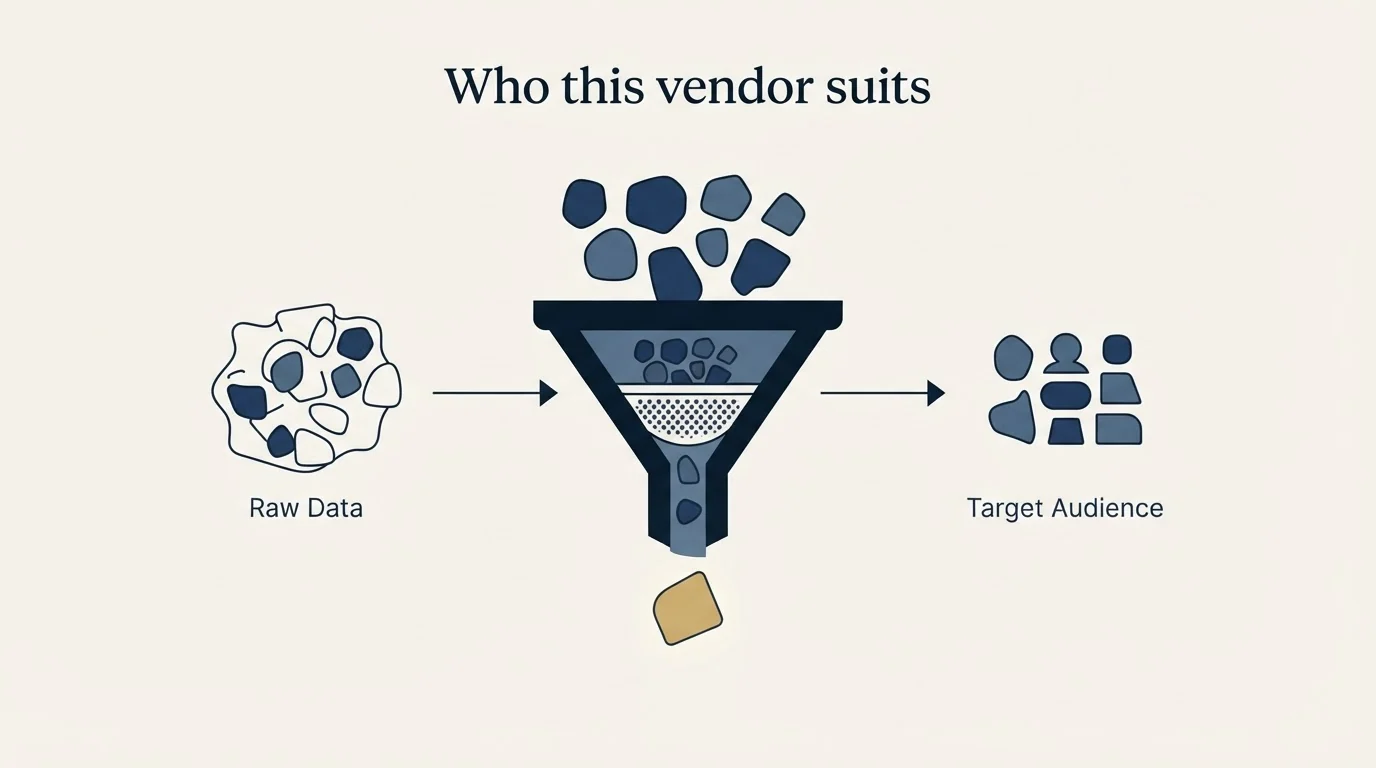
If you already buy contact data from ZoomInfo, a verifier inside the same platform removes a vendor relationship, a contract and an integration, and the AI Scoring direction gives you something a standalone verifier structurally cannot: a signal layered on top of the verification result. That is a real advantage and it is worth paying for if you will use it.
If verification is the only job you need done, and you want to compare a per-credit rate and buy it this afternoon, the friction is going the wrong way. A quote-gated motion, an annual agreement and a pricing page that will not serve itself to a script are all costs you pay before you have verified a single address. Several verifiers in this category publish a rate card you can read without talking to anyone, and for a team cleaning a few thousand addresses a month that is usually the deciding factor.
Teams that want a published credit ladder instead of a sales call can compare that structure against the DeBounce pricing ladder and guarantee.
Verification protects one thing: your bounce rate, and through it your domain reputation. It sits alongside authenticated sending, list hygiene and sane volume, all of which are covered in the cold email deliverability guide. Buying the most expensive verifier will not rescue a list built from the wrong source, and buying the cheapest one will not sink a good one.
Want the verification path built into your outbound rather than bolted onto it? Get a free campaign plan and we will map it against your list.
Pricing and features verified as of mid-2026. Verify current terms with the vendor before relying on them.
Frequently asked questions.
Frequently asked questions- Why does this article not list NeverBounce pricing?
- Because the pricing page did not serve its contents. Requests to the apex and www hosts, the homepage, the pricing page and the integrations page all returned HTTP 403 in mid-2026. A blocked fetch is not evidence a figure is gone, and quoting a number from a comparison site run by a competing vendor is not verification. Read the vendor's own page.
- Is NeverBounce owned by ZoomInfo?
- The vendor's own LinkedIn company page is published under the name NeverBounce by ZoomInfo, lists ZoomInfo's Vancouver, Washington location, and carries a product post describing AI Scoring as powered by ZoomInfo data. That is what the vendor's own surface says. Confirm the current corporate structure with the vendor before it matters contractually.
- Does a platform-owned verifier handle catch-all domains better?
- No, because the limit is in the mail server rather than the tool. An accept-all domain accepts the recipient probe for every address, existing or not, so no verifier can confirm a mailbox there. A confident verdict on such a domain comes from pattern data or historical signal, which is an inference rather than a check of the mailbox itself.
- What should I ask before signing with any verifier?
- Get the per-address price at your real volume in writing, ask whether credits expire and whether unknown or catch-all results are billed, and ask what is retained from an uploaded list and for how long. Then ask about the contract term and the notice period, because those decide how expensive it is to change your mind later.
About the author.

Tim Carden is CMO / CTO at RevenueFlow, which builds and operates outbound revenue engines for B2B companies. Studied at McGill University.
Tim Carden · CMO / CTO
Connect on LinkedIn →Explore more.
Ready to scale your outreach?
We build GTM engines that book real meetings. See the receipts.
Related articles.
ZeroBounce Pricing: The Three Things Buyers Miss
What the ZeroBounce pricing page actually publishes, which billing state it shows by default, and the credit rules that decide what a buyer really pays.
BriteVerify: What It Verifies and the Price to Ask For
BriteVerify checks email, phone and postal address under Validity, and publishes no rate card on any surface that returns a page. What that means for buyers.
The ZeroBounce API: Auth, Rate Limits and What to Store
ZeroBounce publishes three different answers to its own rate-limit question. Here is which one to build against, plus the statuses no API can decide for you.
Choosing a NeverBounce Alternative: Name Your Reason
Three reasons teams leave NeverBounce, each pointing at a different replacement, plus how to run a two-vendor split test on your own list that actually settles it.
The NeverBounce API: What It Automates and Hands Back
NeverBounce refuses automated requests on its marketing pages and renders its docs in JavaScript. Here is the v4 API, read from surfaces that answer a fetcher.
Email Address Capitalization: What It Changes for Senders
Capitalization in an email address does not decide delivery. It decides whether two rows are one person, and that is where a suppression list quietly fails.