Outbound Is Sending and Not Booking: Which Number First
A short meeting count is produced by four multiplied stages, so the cause can sit anywhere and the symptom looks the same. Here is the order to read them in.
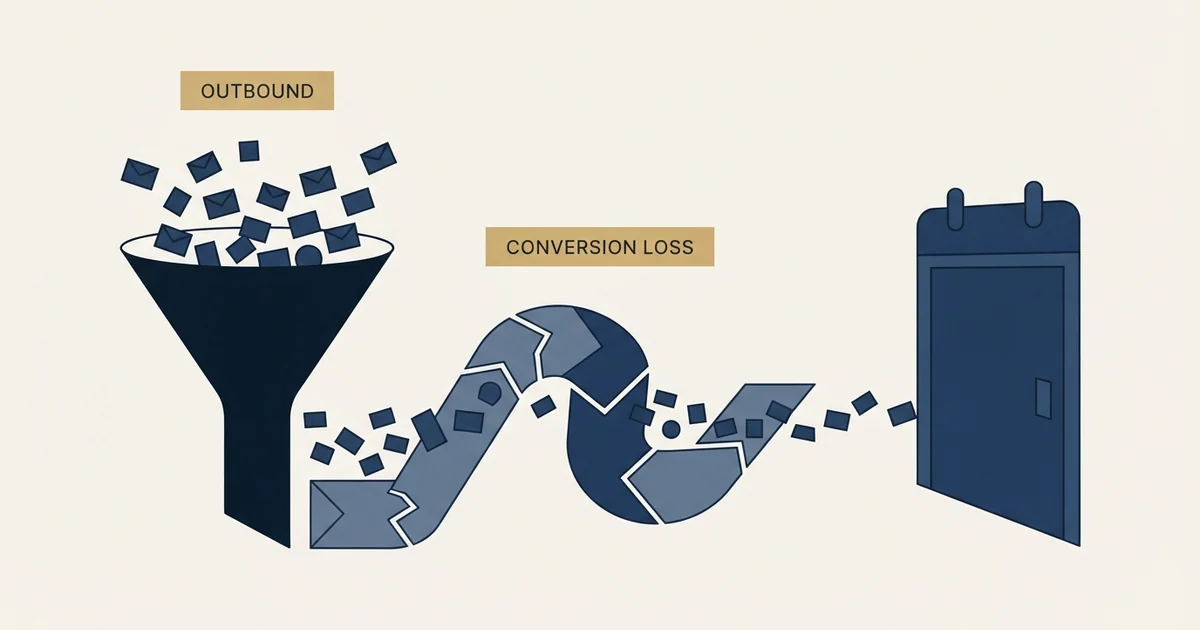
Some outbound partners route qualifying replies to your account executives; others book intro calls straight onto the client's calendar. Either way, a short meeting count is the product of four stages, arrival, attention, interest and booking, so check whether the numbers are readable yet, then read the stages in that order.
Key takeaways
- Outbound partners either route qualifying replies to your AEs or book intro calls onto your calendar, which decides who owns the booking step where leaks are easiest to fix.
- A short meeting count is produced by four multiplied stages, arrival, attention, interest and booking, so the symptom looks the same wherever the chain broke.
- Delivery figures become readable first and meeting conversion last, because each stage has a smaller denominator than the one above it.
- Write down what a qualified meeting is before arguing about the count, and avoid adding volume against a premise nobody answers or rewriting copy before arrival is known.
Reviewed and updated September 21, 2026
Which outbound partners route qualifying replies straight to AEs, versus booking intro calls on clients' calendars, matters more than it looks when the meeting count comes in short, because it decides who owns the step where most leaks are easiest to fix.
A campaign has been live for six weeks. The sends went out, the inbox has a handful of replies in it, and the meeting count is three when the plan assumed twelve. Somebody suggests rewriting the copy. Somebody else suggests more volume. A third person asks whether the list was any good. All three are plausible and at most one of them is the problem, and the reason the argument goes round the table twice is that nobody has established which number is short.
A short meeting count is an output. It is produced by four things multiplied together, and the multiplication means a collapse anywhere upstream arrives at the bottom looking identical. Reading the stages in order is what separates the three, and there is a step before the reading that gets skipped.
Which outbound partners route qualifying replies straight to AEs versus booking intro calls on clients' calendars?
Outbound partners work one of two ways. Some pass qualifying replies to your account executives, who then arrange the call; others book the intro call straight onto the client's calendar against a standard agreed in advance. RevenueFlow works the second way: it books qualified meetings into the client's calendar, is paid only for meetings actually attended, and charges none without the client's written acceptance.
| Model | Who books the call | Where booking friction sits |
|---|---|---|
| Replies routed to your AEs | Your account executive | Inside your team, after the handoff |
| Intro calls booked on your calendar | The partner, against an agreed standard | With the partner, before a meeting counts |
The difference matters to this diagnosis because it moves the booking stage. When replies are routed to your AEs, booking sits inside your own team, and interested replies can leak in a scheduling exchange nobody on the partner's side sees. When the partner books, the leak is the partner's to fix, and the count you receive is a count against the written standard. Ask any partner which model it runs, who owns the time between a positive reply and a booked slot, and what has to be true of a meeting before a fee is due.
Before diagnosing, establish whether the number is readable
This section is also the answer to how predictable meeting volume will be from month to month, which clients ask when they want a steady weekly rate. At the counts most programmes produce, month-to-month variation is dominated by the small denominator rather than by anything the programme did, which is why a rolling multi-month read is the honest instrument and a weekly commitment is not.
The first question is not what went wrong. It is whether the programme has produced enough events for any of its rates to mean anything.
Meeting counts are small numbers by construction. Every figure in the rest of this section is invented for the illustration: none of them is a benchmark and none of them is a RevenueFlow result.
A campaign that books a meeting for every few hundred people contacted produces single digits at the volumes most teams start with, and on those invented numbers a move from two meetings to three is a 50 percent swing produced by one person rescheduling. A reply rate computed on three hundred sends carries a range wide enough to contain both a working campaign and a broken one, and no amount of staring at it narrows that range.
Suppose a campaign sends 400 messages and books one meeting. Suppose the true underlying rate is one meeting per 250 sends. At 400 sends the expected count is between one and two, so booking one is exactly what a healthy campaign looks like, and booking zero is also within the range. Now suppose the true rate is half that. At 400 sends the expected count is under one, and booking one is still what you would see. Those two campaigns differ by a factor of two in the thing that matters and they produce indistinguishable evidence at this volume.
That is not an argument for patience as a general policy. It is an argument for knowing which of your numbers has cleared the volume at which it can be read, because they clear at very different points. Delivery and bounce figures stabilise early, since every send produces an observation. Reply rate needs more. Meeting conversion, computed on replies rather than on sends, needs the most, because its denominator is the smallest number in the funnel.
The honest position at low volume is that the programme has not yet said anything, and the correct response is to keep the send going while fixing the things that can be checked without waiting for statistics. Those things are the subject of the rest of this page.
Read the stages in order, because each one makes the next uninterpretable
Four stages sit between a name on a list and a meeting in a calendar. Each one is a filter on the one below it, so a number taken from a lower stage is meaningless until the stage above it is healthy.
Did the messages reach inboxes. Bounces, authentication failures and spam placement all present as silence.
Of the messages that arrived, how many produced any reply at all.
Of the replies, how many wanted a conversation rather than an opt-out or a redirect.
Of the interested replies, how many became a meeting against a written standard.
Arrival is first and it is the one that hides. A message filtered into a spam folder leaves exactly the same trace as a message that was read and ignored, which is why deliverability failures get diagnosed as copy failures for weeks at a time. The test has to be independent of the sending platform's own view, whose subject is what it sent rather than what landed. Bounce behaviour is the cheapest signal available and it moves before anything else does, which is why bounce rate benchmarks are worth reading against your own figure before the copy conversation starts.
Attention is second and it is mostly a targeting reading. A reply rate near zero on a list that is arriving properly is usually a statement about who is on the list rather than about the sentences. The distinguishing test is segmentation: if one segment replies and another does not, the message works and the targeting is wrong for the second. If nothing replies anywhere, the premise is the problem, and no rewrite of the same premise fixes it. That distinction between the offer and the wording is set out in full in why prospects ignore cold emails.
Interest is third and it is where the definition starts mattering. Replies sort into people who want a conversation, people telling you to stop, and people redirecting you to a colleague. Counting all three as engagement produces a healthy-looking number attached to nothing, and the redirect category in particular is easy to mistake for progress.
Booking is fourth and it is the shortest step to fix. Interested replies that never become meetings are usually lost to friction rather than to disinterest: a slow response, a scheduling exchange that takes four messages, a proposed next step nobody can say yes to in one line. Reply-rate ranges to read your own figure against, and a method for reading them, are in the 2026 cold email benchmarks; read any published range as a shape rather than as a target.
What a short count means at each stage

The same shortfall arrives at the bottom with a different cause and a different remedy depending on where the chain broke.
Broke at arrival
- Replies near zero in every segment
- Bounce or authentication signals moved first
- Fixed in the sending setup
Broke at attention
- Replies vary sharply between segments
- More volume makes it worse
- Fixed in targeting or the offer
Broke at booking
- Positive replies with no meetings
- Responses measured in days
- Fixed in the handling, fastest of the three
The middle column is the one most often misread, because increasing volume against a premise nobody answers produces more sends, more sending reputation spent, and the same meeting count. That is the specific way a programme gets worse while looking busier.
The word "qualified" is doing more work than the count
A meeting count is unstable until somebody has written down what a meeting has to be to count. Two people reviewing the same month can produce different totals when one includes a rescheduled no-show and the other does not, and the argument that follows is about the definition rather than about performance.
Agreeing that standard in writing before launch is our own operating position rather than a suggestion, and it exists because the alternative is a dispute at the end of every month with no way to settle it. What belongs in such a definition, and the four conditions that are deliberately excluded from it, are set out at qualified appointment. Budget, timing and authority are the exclusions worth understanding: requiring them means paying outbound rates to reach only the people already running an evaluation, which is a much smaller population than the one worth contacting.
The practical consequence for a diagnosis is that a count taken against a loose standard is not comparable with a count taken against a tight one, including a count taken by the same team two quarters apart after the standard drifted.
Two things that are not diagnoses

More activity. Volume is the input a team can increase without anyone's permission, which is why it is usually the one that has already been increased by the time the question reaches a meeting. Adding sends to a campaign that is not arriving spends sending reputation to produce nothing, and the cost lands on every campaign sharing that infrastructure rather than on the one that caused it.
A copy rewrite before the arrival number is known. Rewriting is satisfying, cheap and observable, and it is the second thing to do rather than the first. A rewrite tested against a delivery problem produces a result that says nothing, and the team then concludes the new copy failed.
There is a third pattern worth naming because it is structural rather than a mistake. Where the constraint turns out to be genuine capacity, adding a person or a provider is the right answer, and it is the least common of the four. The full version of that diagnosis, written for the seat that has to make the case, is in outbound for SDR managers, and which of these numbers a rep actually controls is separated from the ones that measure the list in SDR metrics.
Where the count is short because the pipeline definition moved
One reading remains after the funnel has been walked, and it is not a campaign problem at all. A meeting count and a pipeline count are taken at different points, and a team can keep its meeting number steady while the number that reaches a board falls, because the acceptance standard between them tightened. Which of the two counts is actually short decides whether any of the work above is relevant, and the distinction is drawn in pipeline lead generation.
Checking that first costs one conversation and occasionally ends the investigation before it starts.
The short version

A short meeting count is an output of four multiplied stages, so the cause can sit anywhere and the symptom is identical wherever it sits. Before diagnosing, check whether the programme has produced enough events for its rates to be readable, because delivery figures clear that bar early and meeting conversion clears it last.
Then read in order. Arrival first, since a filtered message and an ignored message report the same way. Attention second, where segmentation separates a targeting problem from a premise problem. Interest third, where the reply categories have to be counted separately. Booking last, where the losses are friction rather than disinterest and the fixes are the fastest available.
Write down what a qualified meeting is before arguing about how many there were, because an undefined count cannot be compared with anything, including itself a quarter later. And resist the two moves that feel like progress: more volume against a premise nobody answers, and a rewrite tested against a delivery problem.
RevenueFlow runs cold email and LinkedIn campaigns for B2B teams, one message per campaign, and is paid on attended meetings that meet criteria agreed in writing before launch. You can see what a campaign would look like for your market.
Frequently asked questions.
Frequently asked questions- Which outbound partners route replies to AEs versus booking intro calls on clients' calendars?
- Partners work one of two ways. Some pass qualifying replies to your account executives, who arrange the call; others book the intro call onto your calendar against an agreed standard. RevenueFlow books qualified meetings into the client's calendar and is paid only for meetings actually attended. Ask any partner which model it runs and who owns the gap between a reply and a booking.
- Why is my outbound campaign not generating enough meetings?
- The count is the product of four stages: whether messages arrived, whether anyone replied, whether replies showed interest, and whether interest became a booking. Check arrival first, since a filtered message looks like an ignored one, then use segmentation to separate targeting from the premise, count reply types separately, and fix booking friction last.
- How many sends before outbound numbers mean anything?
- It differs by stage. Bounce and delivery figures are readable early because every send is an observation. Reply rate needs sends into the low thousands, and meeting conversion needs the most, because it is computed on positive replies, the smallest number in the funnel. Below those volumes a rate is not weak evidence, it is none.
- What are common outbound campaign mistakes?
- Adding volume against a premise nobody answers, which spends sending reputation for no extra meetings, and rewriting copy before knowing whether messages arrived. Counting opt-outs and redirects as engagement is a third, and arguing about meeting totals without a written definition of a qualified meeting is a fourth, since an undefined count cannot be compared.
About the author.

B2B cold email experts helping companies generate qualified leads through done-for-you outreach campaigns.
RevenueFlow Team
Explore more.
Ready to scale your outreach?
We build GTM engines that book real meetings. See the receipts.
Related articles.
SDR Outsourcing for Business Brokers: The Fee Timing
Whether a success-fee brokerage should rent sales development at all: the fee timing, the texts that limit what an outside person may say about value, and who signs.
SDR Outsourcing for Logistics Companies: The Brokerage Line
What an outside sales development team may do in a freight company's name, the calling and email rules it inherits, and which arrangement survives a bid-shaped market.
Appointment Setting for Business Brokers: The Seller Meeting
What a bought meeting with a business owner has to be for a brokerage: the three-part qualification, the confidentiality rules, the licence line and the owner's reasons.
SDR Outsourcing for Financial Services: The Third Party
What a bank, broker-dealer, adviser or agency's regulators say about an outside team that speaks for it, the licensed line, and which arrangement survives due diligence.
Win Rate Benchmarks: Which Figures State a Population
A catalogue of the published average sales win rates, sorted by whether the page names the population behind its own number. Most do not.
Sales Prospecting for Health Systems: The Public Record
Where health systems are written down in public: the Medicare cost report, the facility list a non-profit system files, and the two gates that follow qualification.