Is RocketReach Legal? The Lawful Basis and the Opt-Out
RocketReach names legitimate interest as its legal basis, admits some addresses are inferred, and publishes how many people had records deleted last year.
RocketReach's privacy policy names legitimate interest as its legal basis and describes collection from public sources, with some email addresses inferred from company naming patterns. It publishes a removal route and 2025 request metrics. The vendor states it is not responsible for how the data is used once found, so your own basis and suppression duty remain yours.
Key takeaways
- RocketReach's privacy policy, fetched 16 August 2026, states it processes personal data on the legitimate interests of the company and its customers, and commits to honouring rights requests made under that basis.
- The same policy discloses that some professional email addresses are inferred from common formats used at a company rather than observed, which is an argument for an independent verification pass before sending.
- For 2025 the policy reports 3,367 opt-out or deletion requests from California residents and 20,321 where the location was unknown, all complied with, mean response under one day.
- The knowledge-base privacy FAQ states that RocketReach is not responsible for individual usage of the data once found, so lawful basis, notice and suppression for your send are yours to hold.
Reviewed and updated September 1, 2026
RocketReach's privacy policy states, in one sentence, the thing that decides whether buying its data is defensible: the company processes personal data "based on our, and our customers', legitimate interests in providing, maintaining and accessing the Services." That is a legal basis with conditions attached, and the conditions land on the buyer as much as on the vendor. Reading it properly answers most of what people mean when they ask whether RocketReach is legal, and it raises a question the vendor answers less comfortably.
Legality here is not one question. It is three: whether the database may lawfully exist, whether your use of a record from it is lawful, and what happens to the person in the record. The vendor's own surfaces answer the first cleanly, hand the second to you in writing, and answer the third in more detail than most data vendors publish.
The question most people arrive with is how RocketReach got their information in the first place, and the vendor answers it directly: the records are assembled from public web pages, professional profiles, company sites and third-party data partners, with matching and prediction filling the gaps, which means nobody was ever asked and there is no account to close, only a record to contest. What is considered inside that basis, and how much of it you inherit as a sender, is the rest of this page.
Where the records come from, stated by the vendor
The privacy policy describes the collection method directly. "Our search technology scans the web and collects publicly available information from third party websites, such as, social media sites, corporate websites and public records." That is the standard business-contact-data model and it is not, by itself, unlawful anywhere we operate.
The next sentence on the same page is the one worth reading twice. "Our technology may also infer Personal Data about you by making assumptions based on publicly available information, such as inferring professional email addresses based on common formats used at a particular company."
An inferred address is a pattern guess. The vendor is telling you plainly that some of what you receive was never observed anywhere; it was constructed from a company's naming convention. The knowledge-base article on accuracy says a credit is only spent when RocketReach returns a verified result, a mechanic covered in full alongside the other email finders worth comparing on your own list, so the verification step sits between the inference and your export. What that combination means in practice is that a record can be pattern-derived and then validated, which is a legitimate method and a different thing from a contact who published that address themselves. It is also the mechanism behind a particular failure: a valid catch-all domain accepts a guessed address that belongs to nobody, and the mailbox never bounces.
The legal basis, and the half of it you inherit
Legitimate interest is not a free pass. It is a balancing test the controller has to be able to defend, and it comes with an obligation to honour objections. RocketReach's own policy commits to that: "When relying on legitimate interest as a legal basis, we ensure we comply with any request you make to exercise your rights."
The knowledge-base privacy FAQ then draws the line at your end of the transaction. It states that the company has built "a feature to filter them out of search results" for users trying to avoid contacting individuals in the EU, recommends reading the GDPR guidelines, and adds: "Please note that RocketReach is not responsible for the individual usage of the data once found."
That sentence is the whole compliance boundary in one line. The vendor's lawful basis covers the vendor's processing. Your send is your processing, with your own basis, your own notice obligation, and your own suppression duty. A vendor's compliance page is not a defence for what you do with the export, which is exactly why the GDPR position for B2B outbound and the CCPA position for cold outreach are worth understanding before the first campaign rather than after a complaint.
- A legitimate-interest basis for building and serving the index
- Handling access, correction, deletion and opt-out requests
- A one-time data-processing and opt-out notice to listed people
- An optional filter that removes EU individuals from search results
- Your own lawful basis for contacting the person
- Your own notice and objection handling once you make contact
- Suppression of anyone who objects, across every future campaign
- Everything the vendor calls individual usage of the data once found
Whether the person finds out
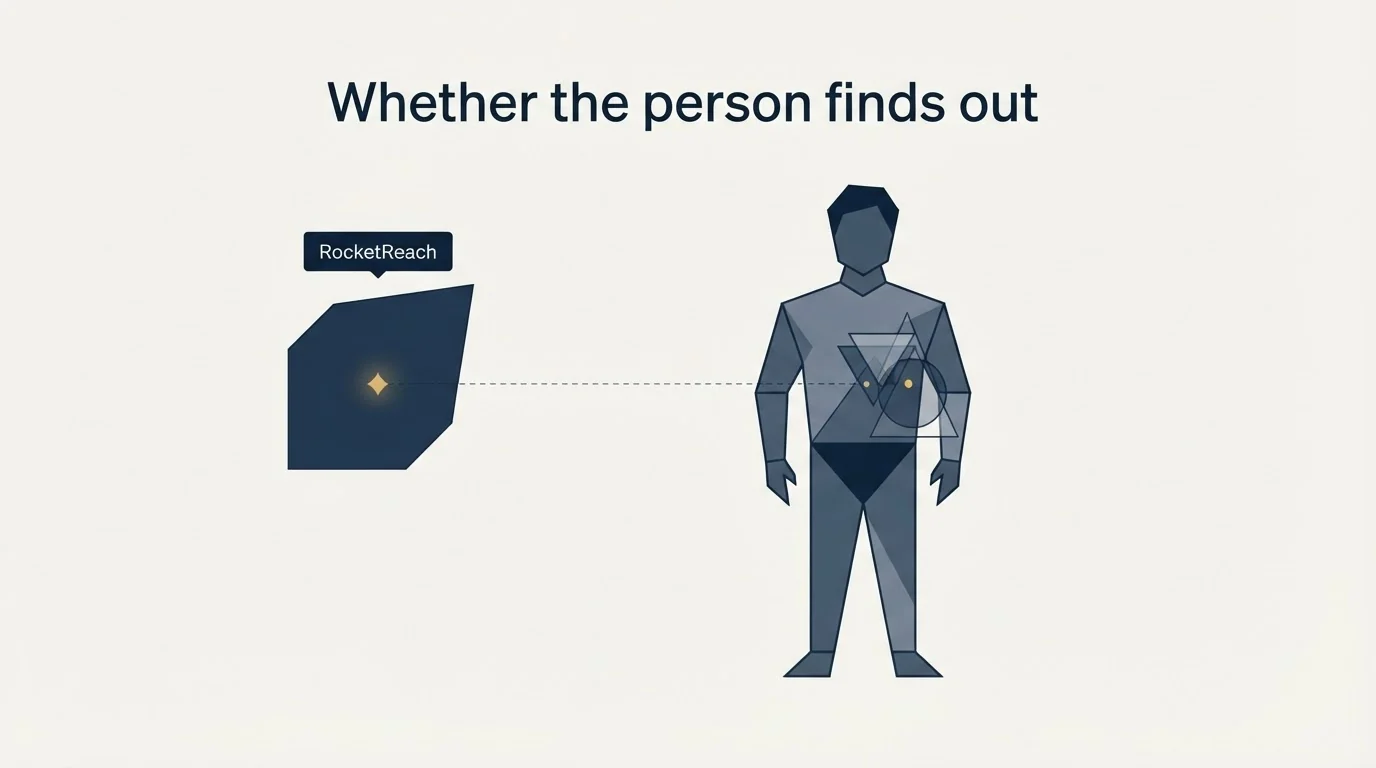
The question people actually type is narrower than the legal one: if a prospect is looked up, do they get told? Two vendor surfaces answer it, and they answer different halves.
Nothing RocketReach publishes describes a notification to the person when a specific user runs a lookup. The knowledge-base article on account creation deals with the searcher rather than the searched, and says the information you register with "is kept confidential and is never shared or displayed within search results on our site."
The listed person is contacted, though, by the vendor rather than by you. RocketReach publishes a knowledge-base article for people who have received what it calls a "One-Time Data Processing and Opt-Out Notification," telling them the database holds information that identifies them and pointing them at the removal route. That is the notice a data broker owes a data subject, sent once, on the vendor's schedule.
So the practical answer has two parts. Your individual lookup is not announced. The existence of the record may well have been announced already, by the vendor, before you ever saw it. A prospect who replies asking how you got their details is not necessarily guessing.
What removal actually does, and how often it happens
The removal route is a form at rocketreach.co/remove-profile/. The knowledge-base article describing it makes two points that matter to a buyer rather than to a data subject. Submitting it is not an account signup, the supplied data is used only to authenticate profile ownership, and, "depending on your jurisdiction, you may also use this option to opt-out of the 'sale' of your personal data." The privacy policy confirms the two paths converge: "RocketReach processes both opt-out requests and deletion requests in the same manner by removing the consumer's personal information from our database." A US resident using the Do Not Sell or Share My Info tool, or sending a Global Privacy Control signal, is deleted rather than flagged.
Because California law requires it, the policy publishes the volume. For the 2025 calendar year, RocketReach reports 3,367 opt-out or deletion requests from California residents and 20,321 more where the requester's location could not be determined, alongside 190 and 2,056 correction requests respectively and 71 and 419 requests to know. Every category is reported as complied with in whole or in part, none denied, with a mean response time of under one day.
3,367 California residents plus 20,321 location unknown
Across all six reported categories
The figure stated for every category
Read that as a buyer rather than as a privacy officer. Roughly twenty-four thousand people left this database in a single year by asking, and the vendor is legally obliged to keep letting them. Any list exported in January is a slightly different list by December, and the difference is invisible from your side: the record you bought does not update itself, and a person who has exercised a deletion right is precisely the person you least want to email next quarter. This is data decay with a legal engine behind it rather than the usual job-change churn, and it is an argument for enriching close to send time rather than warehousing exports.
The Texas notice, and what it signals
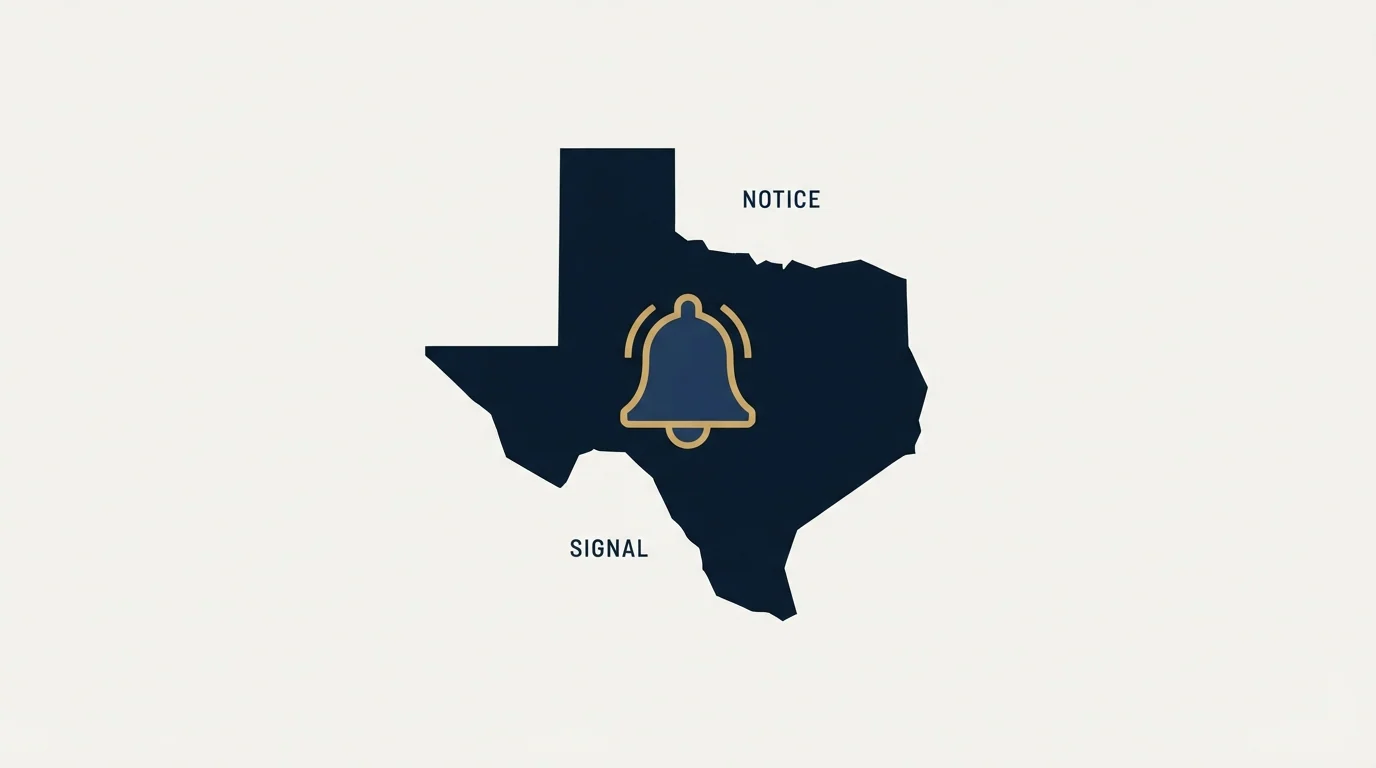
At the foot of the state-specific disclosures the policy carries a line that many competitors do not: "The entity maintaining this website is a data broker under Texas law. To conduct business in Texas, a data broker must register with the Texas Secretary of State."
Self-identifying as a data broker is a compliance posture rather than a confession. It tells you the company expects to be regulated as one, which is the correct expectation for this category, and it tells you which register to check. It also sets the frame for procurement: a vendor that names its regulatory status, publishes request metrics and documents a working removal path is easier to defend in a data protection impact assessment than one that publishes none of the three. ZoomInfo's equivalent surfaces make for a useful comparison on exactly this axis.
What stays your problem
Three things, in order of how often they bite.
Suppression is the first. A person removed from RocketReach is not removed from the CSV you exported last quarter, so the only durable defence is a suppression list that outlives any single campaign and any single vendor. Anyone who objects goes on it permanently, and every future send is checked against it before it is built.
Notice is the second. Your first message is where the person learns who you are, where the data came from in general terms, and how to make it stop. That is a one-message obligation, and it happens to align with how we run campaigns anyway: one message per campaign, no bumps, no thread replies, and re-entry only as a new campaign on a new signal.
Verification is the third. Inferred addresses are disclosed in the policy, so an independent verification pass before send is not paranoia, it is the documented shape of the product. The same applies to any provider in a waterfall, which is why provider order in a waterfall and a final verification step matter more than any single vendor's accuracy claim.
The short version

RocketReach's data collection is lawful on its face, the vendor documents its basis and its removal machinery in more detail than most, and it says in writing that what you do with an exported record is yours alone. The legality question a buyer should actually be asking is not about the vendor at all. It is whether your own sending process has a lawful basis, a real suppression list, and a verification step, because those three are what an objection, a regulator or an unhappy prospect will test. If that is the part you would rather not build, we run the whole motion on a pay-per-qualified-meeting basis and carry the compliance work with it.
The ContactOut versus RocketReach comparison weighs each vendor's data sources, integrations and pricing tiers for buyers deciding which enrichment tool to trust.
The Copper versus RocketReach comparison explains why the two tools are not rivals at all, since one manages pipeline and the other sources contacts.
Pricing and features verified as of mid-2026. Verify current terms with the vendor before relying on them.
Sources: RocketReach Privacy Policy, RocketReach and Privacy, How accurate is RocketReach's data, How is a contact lookup counted, the profile removal form. The vendor's knowledge-base articles on the one-time data collection and opt-out notice, on profile removal, and on the confidentiality of a registered account address were also read in full and are cited in the body.
Frequently asked questions.
Frequently asked questions- Is it legal to buy contact data from RocketReach?
- Buying it is the easy half. RocketReach states a legitimate-interest basis for building and serving its index and registers as a data broker under Texas law. Your send is separate processing with its own basis, notice and objection handling, and the vendor says in writing that it is not responsible for how the data gets used once you have it.
- Does RocketReach tell someone when I look them up?
- Nothing the vendor publishes describes a notification tied to an individual lookup. Separately, RocketReach sends listed people what it calls a one-time data processing and opt-out notification, telling them the database holds their information. So the person may already know they are in it, without knowing that you searched.
- How do I get my own information removed from RocketReach?
- Use the removal form the knowledge base points to at the remove-profile page. It is not an account signup and the details you supply only authenticate that the profile is yours. The privacy policy states that opt-out and deletion requests are handled the same way, by removing the record. Google may still show a cached copy for a while.
- Are RocketReach email addresses guessed?
- Some are pattern-derived. The privacy policy says the technology may infer professional addresses from common formats at a company, and the knowledge base says a credit is only charged when a verified result comes back. Inference plus validation is a legitimate method, and it is still a reason to verify independently before a catch-all domain absorbs a bad address.
About the author.

B2B cold email experts helping companies generate qualified leads through done-for-you outreach campaigns.
RevenueFlow Team
Explore more.
Ready to scale your outreach?
We build GTM engines that book real meetings. See the receipts.
Related articles.
Firmographic Data Providers: What Six of Them Publish
Six firmographic data providers read from their own pages: the fields each sells, the coverage each states, how the data is delivered, and who prints a price.
Salesgear Pricing: Two Ladders Under One Plan Title
Salesgear's page is titled as one plan and carries a Data ladder and an Outreach ladder. Both at both billing states, what each meters, and the two vendor-side conflicts.
Zeliq Pricing: One Seat Rate and a Credit Meter
Zeliq prices one self-serve seat in dollars with a credit meter that never expires. Both billing states, the three credit rates, the top-up ladder and the Custom floor.
Bookyourdata Pricing: 25 Packs, Priced Per Contact
Bookyourdata sells credits in twenty-five packs with no subscription. The dated ladder, the per-contact rates rendered in the browser, the guarantee rule and BeSpoke.
Social Selling Tools by Job, and the Account-Risk Line
Fourteen social selling tools sorted into six jobs, split by whether each acts through your LinkedIn account or beside it, from the vendors' own pages.
Is Clay Free? The Free Plan, the Trial and Where Each Stops
Clay's free plan, its 14-day trial and the no-charge-on-a-miss rule are three different things. What each holds and where it stops, from clay.com on 19 September 2026.