Sales Strategy for Cloud Companies: Choosing the Route
How an MSP, reseller or cloud software company sells: the buyer's six FinOps personas, the hyperscalers' partner programmes, co-sell, and what counts toward a commitment.
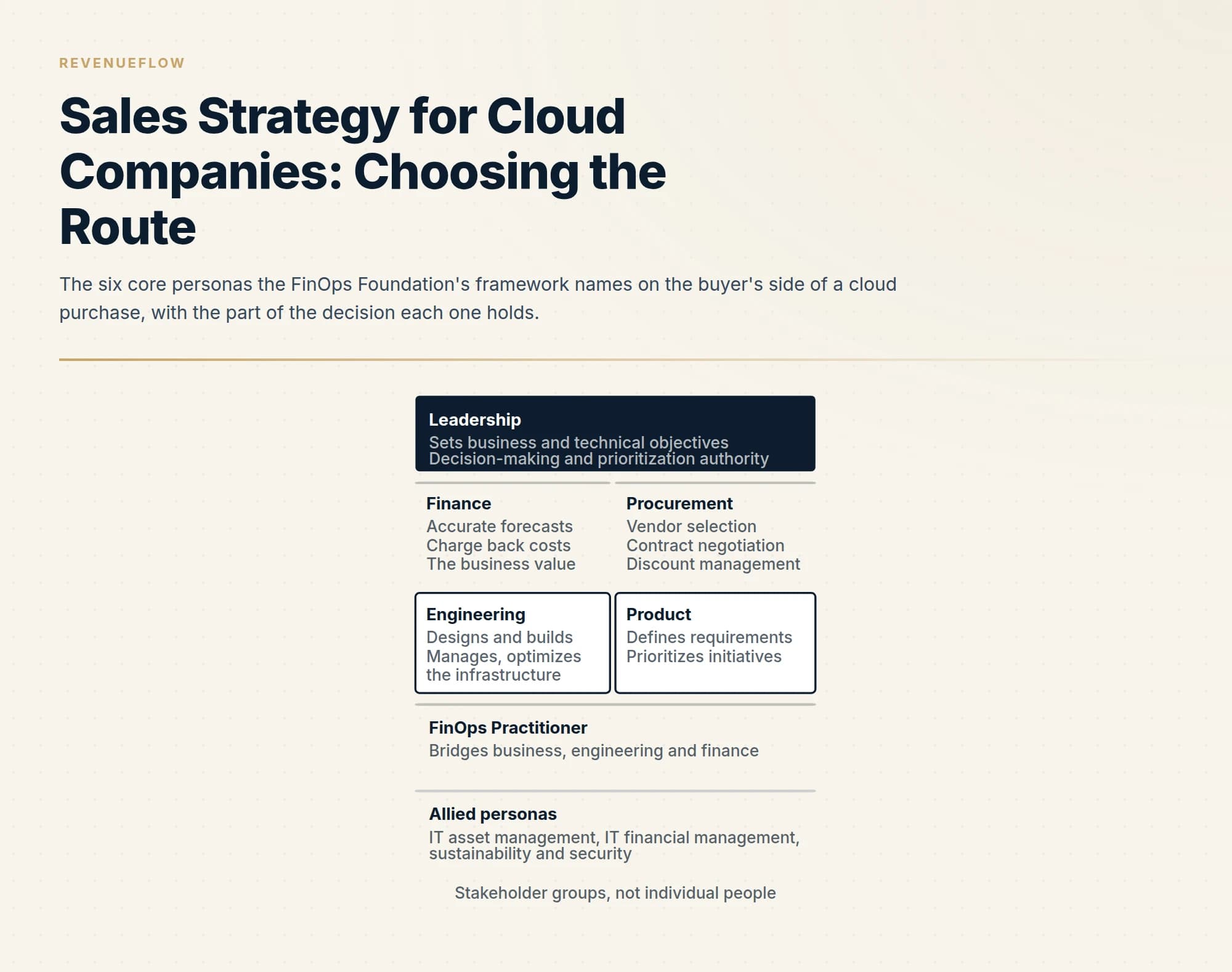
A cloud company's sales strategy is a choice of route. AWS groups its partner programmes by business model, its co-sell page says AWS sellers are compensated more to sell with ISV Accelerate partners, and Microsoft counts eligible marketplace purchases toward a buyer's Azure commitment. The buyer is six FinOps personas, from Engineering to Procurement, not one title.
Key takeaways
- The FinOps Foundation's framework names six core personas on the buyer's side, the FinOps Practitioner, Engineering, Finance, Product, Procurement and Leadership, and says they are groups that must collaborate, not individual people.
- AWS groups partner programmes by business model: reseller, services, managed services and technology solutions, and a managed service provider is validated only after a third-party audit of its technical skills and business health.
- Microsoft's commitment benefit page counts an Azure benefit eligible partner offer in full toward a consumption commitment when bought in the Azure portal, and excludes prepayment, credit card checkouts and hybrid or on-premises licences.
- In a multiparty private offer the channel partner sells to the customer, Microsoft invoices and collects, and Microsoft pays the channel partner with no agency fee and the software company with the agency fee applied.
Reviewed and updated September 18, 2026
Microsoft's own documentation for marketplace publishers carries a forecast most cloud sales leaders have not priced in: "The market estimates that 60 percent of cloud business on Microsoft Marketplace will rely on channel-led sales by 2030," a figure the page credits to a source it spells Omida, inside an ecosystem it puts at "more than 500,000 partners" (Microsoft Learn, Multiparty private offers overview, read 18 September 2026). Read as a strategy question, that sentence says the route to a cloud customer is increasingly somebody else's contract and seller, and that the strategy is mostly a choice of route.
This page is for the cloud company itself: the managed service provider, the reseller, the migration and services firm, and the software company that sells on a hyperscaler's cloud. It is not about selling to cloud companies; that reader is served by cold email for cloud services. Here the reader is the seller of cloud, and the sources are the hyperscalers' own partner pages, the FinOps Foundation's framework and the compliance bodies a buyer will name.
Who buys cloud, in the buyer's own operating model
The clearest published description of a cloud buying group comes from the buyers. The FinOps Foundation defines FinOps as "an operational framework and cultural practice which maximizes the business value of technology, enables timely data-driven decision making, and creates financial accountability through collaboration between engineering, finance, and business teams" (FinOps Foundation, What is FinOps?, updated March 2026). Its framework names the people involved as personas and is explicit that they "represent broad stakeholder groups that must collaborate, not individual people" (FinOps Foundation, FinOps Personas, read 18 September 2026).
There are six core personas. The FinOps Practitioner bridges business, engineering and finance teams. Engineering is responsible for designing, building, managing and optimizing technology infrastructure. Finance works to quantify the business value of technology spending, support accurate forecasts, and budget and charge back technology costs. Product defines requirements and prioritizes initiatives. Procurement is responsible for procuring technology, and its listed responsibilities include vendor selection support, vendor contract management and negotiation, and vendor negotiation and discount management. Leadership sets business and technical objectives and holds decision-making and prioritization authority. Around them the framework lists allied personas, among them IT asset management, IT financial management, sustainability and security.
For a cloud seller this is the account map. A deal that reaches only Engineering has reached one of six groups, although in very small organizations "a single person may perform the duties of multiple FinOps Personas." The foundation also corrects the most common seller assumption about this buyer: "If it seems that FinOps is about saving money, think again. FinOps is about getting the most value out of technology to drive efficient growth."
Three business models, three sets of programmes
What a cloud company sells decides which programmes it sells through. Amazon Web Services groups its partner programmes by business model (AWS Partner Programs, read 18 September 2026). Reseller programmes, which the page describes as generating "predictable revenue opportunities by selling AWS services and solutions to customers," are Resell with AWS Distributors, the AWS Solution Provider Program and Channel Partner Private Offers. Services programmes, for a partner selling its own value-added services with AWS solutions, include the AWS Migration Acceleration Program. Managed services programmes, for partners managing the customer's technology, centre on the AWS Managed Service Provider Program. Technology solutions programmes, for intellectual property turned into products on AWS, include the AWS Marketplace List & Sell Program and the AWS ISV Workload Migration Program.
Entry to the managed services tier is audited, not self-declared: "To become a validated AWS MSP Partner, you must complete a rigorous third-party audit that assesses your technical skills and business health per enterprise standards" (AWS Managed Services Provider Program, read 18 September 2026). Google runs the same idea as tiers: its partner network describes three levels, Select, Premier and Diamond, based on proven success, and says of what it rewards: "We reward real-world efforts like co-selling and technical innovation, instead of manual business plans" (Google Cloud Partner Network, read 18 September 2026).
| Business model | What the partner sells | Programmes the page names |
|---|---|---|
| Reseller | AWS services and solutions to customers | Resell with AWS Distributors, AWS Solution Provider Program, Channel Partner Private Offers |
| Services | Its own value-added services with AWS solutions | AWS Migration Acceleration Program |
| Managed services | Managing the customer's technology for them | AWS Managed Service Provider Program, validated by third-party audit |
| Technology solutions | Intellectual property turned into products on AWS | AWS Marketplace List & Sell Program, AWS ISV Workload Migration Program |
Co-selling: the hyperscaler's seller is a channel
The second strategic decision is whether the hyperscaler's own sales force sells with you. AWS defines the motion plainly: "Co-selling is a collaborative approach between AWS and Partners to deliver comprehensive cloud solutions that drive customer success," and adds a figure it attributes to Canalys: "Eighty percent of Partners identify AWS Marketplace as integral to their co-sell strategy" (AWS, Co-sell with AWS, read 18 September 2026; the page does not state the survey's sample or year). The page says that sharing opportunities makes a partner eligible for its customer engagements programme, and that "Being ACE-eligible offers Partners a way to request support from AWS and receive AWS referrals." It also states the incentive on the other side of the table: "AWS Sellers are compensated more to co-sell with AWS ISV Accelerate Partners."
That last sentence is a sales strategy in one line: a software company in that programme sells into accounts where another company's seller is paid to help.
The commitment is the budget, and it decides what counts
Cloud buyers at scale buy against a commitment. Microsoft's description is the clearest: "The Microsoft Azure Consumption Commitment (MACC) is a contractual agreement where your organization commits to spending a specific amount on Azure over a defined period. Eligible Microsoft Marketplace purchases automatically count toward fulfilling this commitment" (Microsoft Learn, Azure Consumption Commitment Benefit, last updated 25 September 2025). For an eligible partner offer, the page says, "100% of the pretax purchase amount also contributes toward your commitment."
The exclusions are the part a seller has to know. Purchases using Azure prepayment are not eligible, nor is a licence deployed in a hybrid environment or on-premises. An offer can carry the Azure benefit eligible badge and still fail to count: "purchases made directly on Microsoft Marketplace via credit card do not contribute to your MACC," so the buyer has to complete the purchase inside the Azure portal. The fiscal timing of a commercial cloud deal is therefore the buyer's commitment period, a date the seller has to ask for.
- Eligible marketplace purchases, counted automatically
- An Azure benefit eligible partner offer bought in the Azure portal, in full
- The same offer bought on the marketplace by credit card
- Purchases using Azure prepayment
- A licence deployed in a hybrid environment or on-premises
How a channel-led deal transacts
Microsoft documents the channel route step by step. "Multiparty private offers function similarly to private offers, but channel partners sell them to the customer." The software company creates the offer and sends it to the channel partner. The channel partner finalizes it and extends it to the customer. The customer accepts it in the private offer management section of the Azure portal and buys each included product through the marketplace. Microsoft invoices and collects payment from the customer according to the customer's billing terms with Microsoft. The page adds one line at that step: "If co-sell eligible, purchase of software counts towards cloud commitment." Then the money moves the other way: "Microsoft pays the channel partner (no agency fee). Microsoft pays the software company (agency fee applied)."
The consequence is that the customer's paper is Microsoft's paper, so a cloud company selling this way is not negotiating payment terms with the buyer. How a marketplace listing itself works is covered in Google Cloud Marketplace, which this page does not repeat.
The compliance regimes a buyer names, and the rule on your outreach
Three regimes come up in cloud selling. For United States federal buyers it is FedRAMP, whose site describes the FedRAMP Marketplace as "a searchable database of FedRAMP certified cloud services, authorizing agencies, and FedRAMP recognized assessors" and on 18 September 2026 displayed two totals, 531 FedRAMP certified services and 30 FedRAMP 20x certified services, with consolidated rules for 2026 updated on 13 September (FedRAMP).
For commercial buyers the usual asks are a SOC 2 report and ISO/IEC 27001. The AICPA describes its SOC offerings as "a suite of service offerings CPAs may provide in connection with system-level controls of a service organization," and its SOC 2 guide covers controls relevant to security, availability, processing integrity, confidentiality or privacy (AICPA and CIMA, SOC suite of services, read 18 September 2026). ISO/IEC 27001, in its third edition published in 2022, is the international standard that defines the requirements an information security management system must meet (ISO, ISO/IEC 27001:2022).
The rule on the outreach itself is the ordinary one. In the Federal Trade Commission's compliance guide the CAN-SPAM Act "makes no exception for business-to-business email"; the guide puts the penalty for each separate email in violation at up to $53,088 and requires a valid physical postal address and a clear way to opt out in every commercial message (FTC, CAN-SPAM Act: A Compliance Guide for Business, read 18 September 2026). Whether a specific practice is compliant is a question for counsel, not for this page.
The objections, from the vertical's own pages
The first objection is that the pitch is about cost. The FinOps Foundation answers it in the buyer's voice: the practice exists so that engineering and business teams can make "trade-offs between speed, cost, and quality," and a seller who leads with savings has picked one of three.
The second is that the purchase will not count. Microsoft's exclusions (prepayment, hybrid deployment, a credit card checkout) are that objection written down in advance, and an offer that is not benefit eligible asks Procurement to spend outside the commitment Finance is tracking.
The third is proof. AWS audits its managed service providers through a third party, Google tiers partners on proven success, and FedRAMP publishes who is certified: a seller's own description of itself is not evidence.
Channel reality for this play, and when it is the wrong play
A cloud company has three routes to a customer: its own direct selling, co-selling with the hyperscaler's sellers, and the channel. Written outreach by email and LinkedIn belongs to the first route and supports the other two, because it also reaches the channel partners who can carry an offer. RevenueFlow runs email and LinkedIn and does not cold-call.
Direct outbound is the wrong play in three cases. It is wrong where the buyer has a consumption commitment and your offer does not count toward it, because the objection arrives before the conversation does. It is wrong for a federal agency when you are not in the FedRAMP Marketplace, because the database is public and the buyer reads it. And it is wrong as a substitute for the programmes: a managed service provider that has not passed the audit is writing into accounts where a validated competitor has the platform's seller beside it. There the work is the listing, the audit and the shared opportunities, and outreach comes after. How a supplier should think about the vendor assessment that follows a first meeting with an IT buyer is in information technology lead generation.
Three openers, each grounded in a page the buyer can check
Three sample first lines a cloud company could send, each tied to one fetched source. They claim no result, address no real person and give no contact details.
To a head of procurement at a company with an Azure commitment. Microsoft's commitment benefit page says an Azure benefit eligible offer bought through the Azure portal counts in full toward a consumption commitment, and that the same offer bought by credit card does not. Ours is benefit eligible. If you are planning how the rest of this commitment period is spent, a short conversation about the purchase route is the ask. The rule is Microsoft's own and the ask is a conversation about a route the buyer already has.
To a channel partner's alliances lead. Microsoft's publisher documentation describes multiparty private offers as private offers that channel partners sell to the customer, with Microsoft paying the channel partner directly. We are a software company looking for two partners to carry our offer that way. If your customers buy through the marketplace, we would like to show you what the offer looks like. The ask is a partnership, not a purchase.
To an engineering leader at a company that runs on AWS. AWS says a managed service provider is validated only after a third-party audit of its technical skills and business health. We have passed that audit. If running the platform is taking your engineers away from the product, a conversation about what we would take over is the ask. The claim is checkable against the programme.
To: Head of procurement, a company with an Azure commitment
Microsoft's commitment benefit page says an Azure benefit eligible offer bought through the Azure portal counts in full toward a consumption commitment, and that the same offer bought by credit card does not. 1
Ours is benefit eligible. If you are planning how the rest of this commitment period is spent, a short conversation about the purchase route is the ask. 2
Postal address and opt-out line in the footer. 3
- 1A rule from Microsoft's own commitment benefit page.
- 2Written for the Procurement persona and timed to the commitment period; offers a conversation, not a result.
- 3The postal address and opt-out line the FTC's CAN-SPAM guide requires of every commercial email.
What the strategy has to decide
Put the sources together and a cloud company's sales strategy is four decisions: which business model it sells as; whether the hyperscaler's seller is beside it; whether its offer counts toward the buyer's commitment; and which of the buyer's six personas each message is written for. The five decisions a go-to-market plan has to fit on one page, of which the route is one, are in go-to-market strategy.
What RevenueFlow runs is the written part: email and LinkedIn, one message per campaign, criteria agreed in writing before launch, payment on attended meetings that meet them. If the written side of your direct and partner outreach is the part you would rather have run, you can see what a campaign would look like for your market.
The partner programme pages, Microsoft's documentation, the FinOps Foundation's framework, the compliance bodies' pages and the FTC guide were fetched on 18 September 2026 from the pages linked. The analyst figures on the Microsoft and AWS pages are quoted as those pages present them; neither page states the underlying sample. Programmes and rules change; confirm them at the source. Nothing here is legal advice.
Sources: Microsoft Learn, Multiparty private offers overview, Microsoft Learn, Azure Consumption Commitment Benefit, AWS Partner Programs, AWS, Co-sell with AWS, AWS Managed Services Provider Program, Google Cloud Partner Network, FinOps Foundation, What is FinOps?, FinOps Foundation, FinOps Personas, FedRAMP, AICPA and CIMA, SOC suite of services, ISO, ISO/IEC 27001:2022, FTC, CAN-SPAM compliance guide
Frequently asked questions.
Frequently asked questions- Who is involved in a cloud purchase on the buyer's side?
- The FinOps Foundation's framework names six core personas: the FinOps Practitioner, Engineering, Finance, Product, Procurement and Leadership, plus allied personas such as IT asset management, IT financial management, sustainability and security. It says personas are broad stakeholder groups that must collaborate, not individual people, and that in a very small organization one person may perform the duties of several. A seller who reaches only Engineering has reached one of six groups.
- What does co-selling with a hyperscaler mean for a cloud company's sales strategy?
- AWS describes co-selling as a collaborative approach between AWS and partners, and its co-sell page states that AWS sellers are compensated more to co-sell with ISV Accelerate partners. The published sequence is registration in AWS Partner Central, a linked AWS Marketplace account, shared opportunities and then programme enrolment. Sharing opportunities makes a partner eligible to request support from AWS and to receive AWS referrals.
- Does a marketplace purchase count toward a customer's Azure commitment?
- Microsoft's Azure Consumption Commitment Benefit page, last updated 25 September 2025, says eligible marketplace purchases count automatically and that the full pretax amount of an Azure benefit eligible partner offer contributes. It also lists what does not count: purchases using Azure prepayment, a licence deployed in a hybrid environment or on-premises, and a purchase made directly on the marketplace by credit card, which has to be completed inside the Azure portal instead.
- When is direct outbound the wrong play for a cloud company?
- When the buyer has a consumption commitment and the offer does not count toward it, because that objection arrives first. When the target is a federal agency and the company is not in the public FedRAMP Marketplace, which the buyer can search. And when it is used as a substitute for the platform programmes, such as the managed service provider audit or a co-sell programme, where a validated competitor already has the hyperscaler's seller beside it.
About the author.

B2B cold email experts helping companies generate qualified leads through done-for-you outreach campaigns.
RevenueFlow Team
Explore more.
Ready to scale your outreach?
We build GTM engines that book real meetings. See the receipts.
Related articles.
Sales Strategy for Logistics Companies: Segment, Seat, Cycle
How a broker, forwarder, carrier or 3PL sets its sales strategy: Armstrong's segments and contract terms, the four provider seats shippers keep, and the rate cycle.
Sales Strategy for Manufacturing Companies: Direct or Reps
How a manufacturer decides whose salespeople carry its line: the published definition of a representative, MANA's agreement clauses and the split commission problem.
Lead Generation for Telecommunications Companies: Four Lead Sources
For carriers, ISPs, UCaaS providers and MSPs: the installed base, the advisor channel, dated outbound and the funded network map as lead sources, with FCC rules.
Lead Generation for Trucking Companies: Three Routes
How a motor carrier finds freight customers: the load board, the broker relationship and the shipper's annual bid, with the calendar and the rules on outreach.
Sales Prospecting for Cloud Services: Dated Triggers
How a cloud services company builds a prospect list: co-sell with platform sellers, partner-to-partner routes, and the end-of-support dates Microsoft publishes.
MEDDIC vs BANT: What Each Qualifies and When to Use Which
MEDDIC and BANT from the originators' own text: IBM's BANT form as a gate after the first call, PTC's six themes as an audit of a live deal, and when to run each.