Dedicated IP: What It Means and Why the Textbook Definition Misleads
A dedicated IP is an outbound address used by one sender, so reputation at that address is built entirely from their own behaviour. With sustained regular volume that isolation is valuable. Below a volume floor it is a liability, because a receiver forming a judgment has almost no evidence to work from.
Key takeaways
- The phrase far more often names a consumer VPN product, which is unrelated to email.
- Reputation is inference from evidence, so a quiet dedicated address is treated cautiously.
- Most cold outbound sends through provider mailboxes, where the address is not yours to choose.
- For separating clients or campaigns, the practical unit is the sending domain, not the address.
A dedicated IP, in email sending, is an outbound IP address used by one sender only, so that the reputation built at that address reflects that sender's behaviour and nobody else's. The contrast is a shared pool, where many senders leave through the same addresses and each inherits some of the standing the others create.
Two warnings before anything else, because both cause real confusion. The phrase is used far more often for a consumer VPN product, an entirely unrelated thing, and searches for it return that first. And in the email sense it is frequently discussed as though it were an upgrade, when for most senders it is a trade with a real downside.
What owning an address actually changes
Reputation at a receiver is built from observed behaviour over a rolling window: volume and its consistency, bounces, complaints, engagement, and whether the address has hit addresses that exist to catch bad list practice. On a dedicated address, every one of those observations is yours.
That cuts both ways, and the direction it cuts depends almost entirely on volume.
With sustained, regular volume, isolation is an asset. Receivers accumulate a picture of a sender who behaves consistently, and that picture is not diluted or damaged by anybody else. A large sender with good practice is measurably better off owning the address.
With low or irregular volume, isolation is a liability. A receiver forms a view from evidence, and an address that sends a few hundred messages a week in bursts provides very little. It is not judged badly so much as not judged at all, which in practice means being treated cautiously. A shared pool with an established history carries a new sender past exactly that problem, which is the part of the trade that rarely appears in the sales conversation.
The awkward implication is that the senders most tempted by a dedicated address, small teams worried about who else is on the pool, are usually the ones it serves worst, while the senders who benefit are the ones already sending enough to have stopped worrying.
There is no way around this by waiting. Standing is built by sending, so an idle dedicated address accrues nothing, and a period of inactivity lets the window empty and the standing decay. A programme that sends in campaign bursts with quiet weeks between them is therefore working against the mechanism, whatever the total annual volume looks like on a spreadsheet.
- Your behaviour is the only input to your reputation
- No exposure to a neighbour's bad campaign
- Requires consistent volume to establish standing at all
- You own the warmup, the monitoring and any delisting
- Inherits an established history from day one
- Exposed to other senders on the same addresses
- Works at volumes too low to warm an address
- The provider owns the operational burden
Where the framing misleads

Most cold outbound never touches this decision. Campaigns typically send through Google Workspace or Microsoft 365 mailboxes, whose outbound addresses belong to the provider and are shared across an enormous number of tenants. In that architecture there is no dedicated IP to buy and the question does not arise. Reasoning about dedicated addresses while sending from provider mailboxes is reasoning about an asset you do not have.
The domain matters more than the address. Modern receivers attach a great deal of judgment to the sending domain and the identity its DKIM signature establishes, because that identity survives a change of infrastructure. A programme worrying about IP-level isolation while running unauthenticated or newly registered domains is optimising the wrong layer.
A new dedicated address starts from nothing, and that period is expensive. Warmup is not waiting; it is a controlled ramp of real mail that recipients accept and engage with. During it, placement is worse than it would have been on an established shared pool, and cutting the ramp short to hit a campaign deadline is the standard way to spoil the asset at the outset.
Isolation only isolates what actually runs on it. If several clients or campaigns share one dedicated address, they share its reputation with each other, and the address is dedicated to your organisation rather than to any of them. The unit of separation is whatever sends through the address, so an inventory built for isolation has to be designed that way rather than described that way.
The consumer product with the same name is genuinely unrelated. A dedicated IP sold with a VPN subscription is a static address for the user's own connections. It has no bearing on email sending, and material about it will not answer any question in this article.
- Step 1Where does mail leave from?
Provider mailboxes mean the addresses are not yours and the question does not apply.
- Step 2Is the volume sustained?
Consistent, regular sending is what builds standing. Bursty low volume does not.
- Step 3Is the domain layer done?
Authentication, domain history and list quality carry more of the judgment than the address.
- Step 4Who owns the operations?
Warmup, monitoring and delisting become your job the moment the address is yours.
What this means when you are running outbound
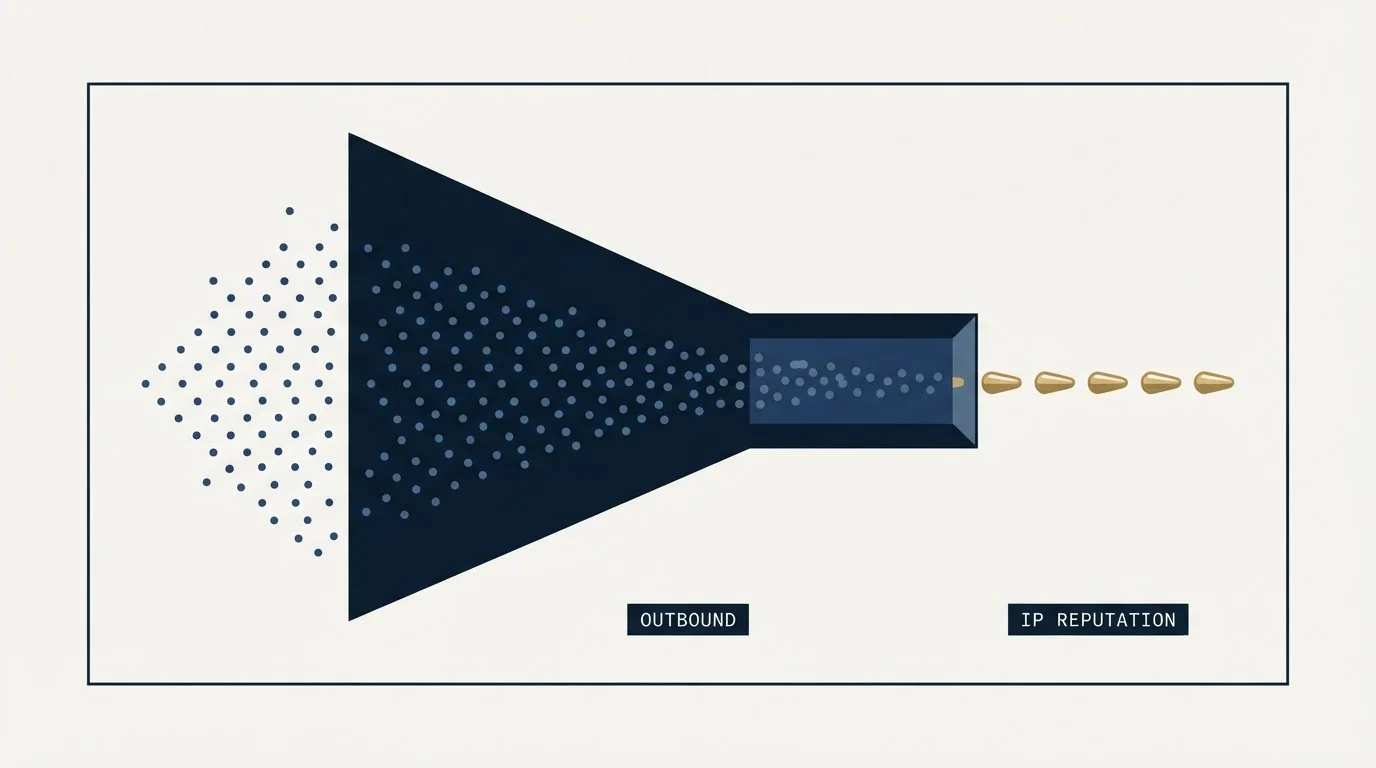
The honest guidance is that a dedicated address is a tool for a specific shape of sending, and that shape is not what most B2B cold outbound looks like.
If you send from provider mailboxes, put the effort into the layers you control: authentication on every sending domain, domains with real history behind them, a list verified close to the send, and volume per mailbox that stays inside the provider's limits. Those decide your outcomes, and none of them involves an IP address.
If you send high, steady volume through your own infrastructure or a relay, a dedicated address is reasonable, provided the volume is genuinely sustained rather than campaign-shaped. Ask the provider what monthly volume they consider the floor, and treat an answer well above your actual sending as a reason to stay on the pool.
If you are separating clients or campaigns, note that the separation people usually want is at the domain level. Sending domains are cheap, they carry the identity receivers judge, and they can be allocated per client without any infrastructure change. That is the practical isolation mechanism for agency-shaped work, and it is available immediately rather than after a warmup period, which is the other reason to prefer it.
What an address can and cannot be blamed for
A useful discipline when something goes wrong is to ask whether the address could plausibly be the variable, because the answer is usually no and the check is quick.
Reputation attaches to whatever identity a receiver can observe, and there are two: the connecting address and the authenticated domain. If a problem is address-level, it affects every domain sending through that address at once. If it is domain-level, it affects that domain wherever it sends from. Those two patterns look different in your own data, and separating them takes one comparison.
The reason this matters practically is that the address-level explanation is the one people reach for and the domain-level one is usually correct. Domains carry the identity that survives an infrastructure change, they are the thing DKIM signs, and they are what a receiver has been accumulating a view of. A team that moves to a new address and sees no improvement has usually just demonstrated that the address was not the problem, at the cost of a migration and a warmup period.
There is a third possibility worth keeping in view, which is that neither is the problem and the list is. A campaign that generates bounces and complaints degrades whatever identity it sends under, so a fresh address inherits the same outcome within days. Changing infrastructure while leaving the list alone reliably reproduces the original result on new equipment.
What a shared IP pool actually is, and when it is the better asset
The other half of this decision deserves stating on its own terms rather than as the thing a dedicated address is not.
A shared IP pool is a set of outbound addresses that a provider routes many customers' mail through. Every sender on the pool contributes to, and inherits, the standing those addresses carry at each receiver. Providers manage them actively: customers are grouped by sending profile, addresses are added and retired, and a sender behaving badly is usually moved off or throttled, because their behaviour is the provider's problem before it is yours.
The property that matters is that a pool arrives with history already on it. A new sender joining an established pool is judged partly on years of accumulated behaviour from senders who came before, which is exactly the evidence a lone new address cannot supply. That is why a pool frequently outperforms a dedicated address for the same sender at the same volume, and why the move to dedicated so often reads as a downgrade for the first several weeks.
The cost is the obvious one: you are exposed to people you did not choose. A pool neighbour running an unverified list degrades an asset you are also using, and you will experience it as an unexplained decline you did nothing to earn. How much that matters depends entirely on how well the provider curates the pool, which is a fair question to ask them directly and one whose answer is more informative than any feature list.
Two practical notes. Some providers offer several pools segmented by sending type or by customer tier, so "shared" is not one thing and it is worth asking which pool you are on. And on the mailbox-based architecture most cold outbound actually uses, you are already on the largest shared pool there is, since Google's and Microsoft's outbound addresses serve an enormous number of tenants at once.
Why the volume floor is real
The floor exists because reputation is inference from evidence, and there is a minimum quantity of evidence below which a receiver cannot form a useful view. An address sending a few hundred messages a week, unevenly, looks statistically like almost anything, so the receiver defaults to caution.
This produces the outcome that surprises people who buy the upgrade: placement gets worse, not better, and stays worse for weeks. Nothing is misconfigured. The sender has simply exchanged an established shared history for an empty individual one, at a volume too low to fill it. It is the same reason a brand new sending domain performs poorly before it is warmed properly, arriving one layer down.
If you take a dedicated address anyway, plan the ramp before the campaign that needs it, keep the volume regular rather than campaign-shaped, and watch bounce rates closely during the period when there is nothing else holding you up.
- Yes: Mail leaves from infrastructure where the address is actually yours to choose
- Yes: Volume is sustained and regular, not bursty and campaign-shaped
- Yes: Authentication and domain history are already in order
- Yes: A warmup ramp is planned before the campaign that depends on it
- Yes: Someone owns monitoring and any future delisting
- No: Taking one to fix placement at low volume
The short version

A dedicated IP means your sending reputation is built from your behaviour alone. That is an asset at sustained volume and a liability below it, because reputation is inference from evidence and a quiet address supplies none.
For most B2B cold outbound the question does not arise, since mail leaves through provider mailboxes on addresses nobody is choosing. The layer that decides outcomes there is the domain: correct authentication, real sending history, a verified list, and volume that matches what the domain has earned. If placement is the problem, that is where to look, and a deliverability audit will find it faster than an infrastructure change. If the underlying worry is separating one client's sending from another's, allocate domains rather than addresses.
RevenueFlow runs cold email and LinkedIn outreach for B2B teams on sending infrastructure we build and monitor ourselves. See how the campaigns work.
Frequently asked questions.
Frequently asked questions- Do I need a dedicated IP for cold email?
- Usually the question does not arise. Campaigns typically send through Google Workspace or Microsoft 365 mailboxes, whose outbound addresses belong to the provider and are shared across an enormous number of tenants, so there is no address to buy. In that architecture the domain is the identity you control.
- Why did my placement get worse after moving to a dedicated IP?
- Because you exchanged an established shared history for an empty individual one, probably at a volume too low to fill it. Reputation is inference from evidence, and an address sending unevenly at low volume supplies very little, so the receiver defaults to caution. Nothing is misconfigured; the ramp is simply unfinished.
- What is a shared IP pool, and is it worse?
- A shared IP pool is a set of outbound addresses a provider routes many customers through, so every sender contributes to and inherits the standing those addresses carry. It is frequently the better asset, because it arrives with history already on it, which is exactly the evidence a lone new address cannot supply. The cost is exposure to senders you did not choose.
- Does a dedicated IP isolate one client from another?
- Only from senders outside it. If several clients or campaigns run through one dedicated address they share its reputation with each other, so the address is dedicated to your organisation rather than to any of them. Domain-level allocation is the practical isolation mechanism, and it is available immediately.