Open Profile: The LinkedIn Setting That Lets Strangers Message for Free
Open Profile is a LinkedIn Premium setting that a subscriber switches on to let any member message them for free, without an InMail credit and without being connected. The subscription belongs to the recipient, not the sender. LinkedIn documents a monthly limit for basic and free sending accounts without publishing the figure.
Key takeaways
- The Premium subscription belongs to the person being messaged, not the person messaging. This inverts the usual model of LinkedIn paid features and is the most misunderstood part of the setting.
- LinkedIn states that basic and free accounts can send only a limited number of Open Profile messages each month, and does not publish the number on that help page. Specific caps quoted elsewhere are unverified.
- A member who opted into being messaged by any stranger receives a lot of messages, so the saved credit buys entry to a more crowded inbox.
- It is a per-recipient property that decays silently. A lapsed subscription or a flipped toggle removes it with no notice, so a stored Open Profile flag goes stale between list build and send.
Open Profile: The LinkedIn Setting That Lets Strangers Message for Free
Open Profile is a LinkedIn Premium setting. A Premium subscriber can switch it on, and doing so allows other LinkedIn members to message them for free, without spending an InMail credit and without being connected first. LinkedIn documents it as a Premium subscriber control over who can send you messages, describing the effect as letting members "contact you directly for free, even if they aren't connected" (LinkedIn Help: manage your Open Profile settings). It is a toggle, owned by the recipient, and it can be switched off again at any time.
The term exists because LinkedIn's messaging economy is built on scarcity and Open Profile is the documented hole in it. Ordinarily, reaching a stranger costs you either a connection request they have to accept or an InMail credit you have to buy. Open Profile removes both requirements, at the recipient's own choosing. It matters to anyone doing outreach because it is one of the very few properties of a target that changes the cost of contacting them, and because it is set by the person you want to reach rather than by your own subscription.
The related question of whether this amounts to unlimited InMail has its own worked answer, including how credits and refunds actually behave, in is there unlimited LinkedIn InMail. That page owns the volume question and the credit arithmetic. This entry defines the setting.
How Open Profile actually works
Three mechanics are worth getting exactly right, because most descriptions of Open Profile get at least one of them wrong.
It is a Premium feature, and the Premium subscription belongs to the recipient. The person who has to be paying is the one being messaged, not the one messaging. A free account cannot switch Open Profile on for itself. This inverts the usual mental model of LinkedIn's paid features, where your own plan determines what you can do, and it is the single most misunderstood thing about the setting.
The message costs the sender nothing in credits. A message to an Open Profile member does not consume an InMail credit, which is the whole point of the feature from the sender's side. LinkedIn's help page is explicit that the setting allows members to message you "without using InMail messages".
There is a documented limit, and LinkedIn does not publish the number. The same help page states that "members with basic or free accounts can only send a limited number of open profile messages each month". That is the extent of what LinkedIn documents on that page: a limit exists, it applies to basic and free accounts, and the figure is not given. Numbers you will find quoted for it come from third-party write-ups rather than from LinkedIn, so treat any specific monthly cap you read elsewhere as unverified. Check your own account against LinkedIn's current help pages before planning volume around it.
- Costs nothing but requires the recipient to accept
- Weekly invitation limits apply to your account
- A note, where allowed, is very short
- Acceptance is the real bottleneck, not the sending
- You are building a permanent connection, not just a message
- Consumes a credit from your Premium or Sales Navigator allocation
- No connection or acceptance required
- Credit volume is set by your subscription tier
- Cost per message makes targeting worth doing properly
- Credit and refund mechanics have their own rules
- No credit spent and no connection needed
- Only possible because the recipient pays for Premium and opted in
- A monthly limit applies to basic and free sending accounts
- The recipient can switch it off at any moment
- Availability is a property of them, not of your plan
How a sender recognises one
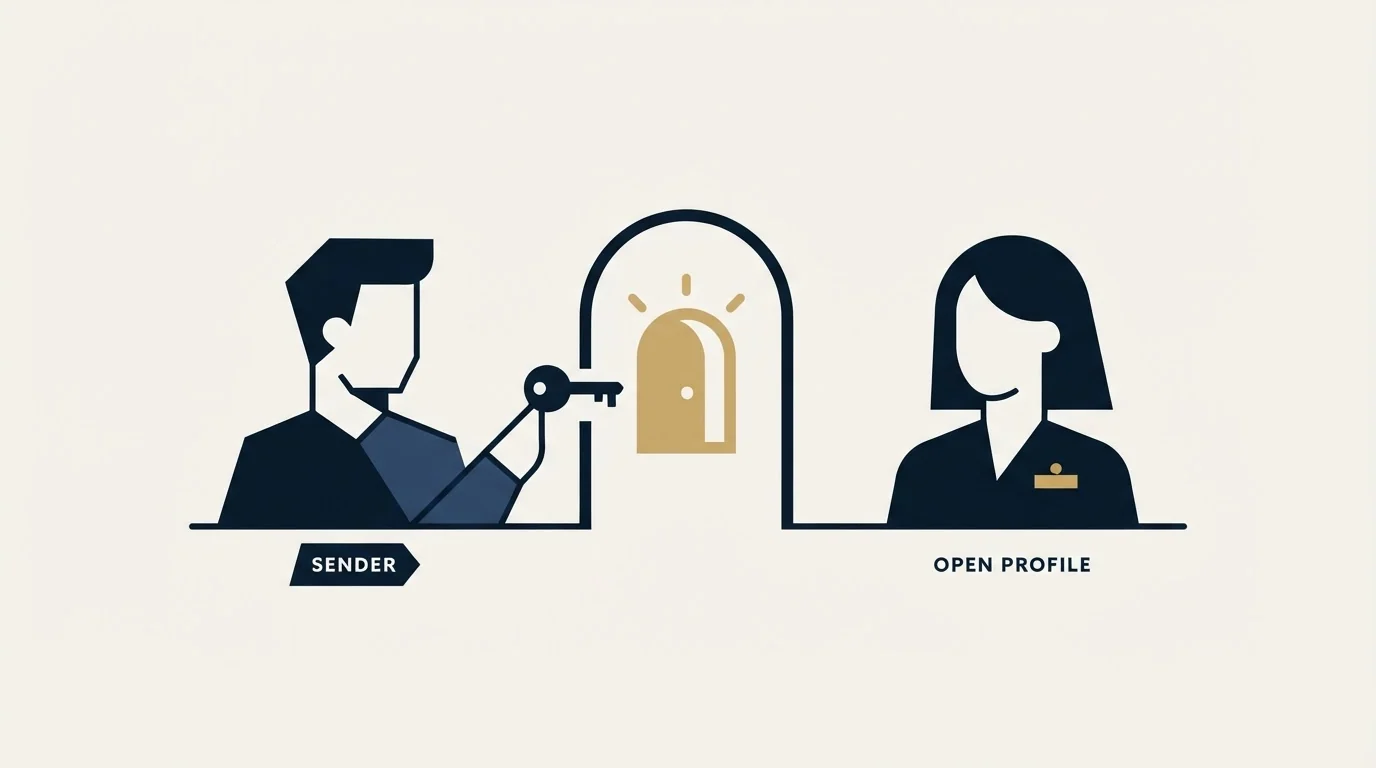
The affordance is visible before you send, which is unusual and useful. When a member has Open Profile switched on, the message option presented to a non-connected visitor is a free message rather than an InMail prompt, and LinkedIn surfaces the ability to write to them without asking for a credit. In practice a sender identifies an Open Profile by what the profile offers them, not by a badge on the person.
That visibility is what makes it interesting operationally: it is one of very few pre-send signals that costs nothing to check. Everything else you might want to know about a prospect before contacting them, whether they are in market, whether they read LinkedIn, whether they are the actual decision maker, requires research or a guess. Whether their profile will accept a free message is observable directly.
It is worth being clear about the limits of that observation, though. Seeing the free-message option tells you the setting is on right now, for you, on this profile. It does not tell you how long it has been on, whether the member is aware they enabled it, or whether they read what arrives through it. Some Premium subscribers switch Open Profile on during a job search and forget about it entirely once they land somewhere. The setting persists, the attention behind it does not, and nothing on the profile distinguishes the two cases.
Who tends to have it on follows from who benefits from inbound. Independent consultants, recruiters, coaches, fractional executives, founders raising money, people building an audience and people looking for their next role all have a reason to invite unsolicited contact. Salaried operators inside larger companies, which is a large share of most B2B target lists, generally have no reason to want more strangers in their inbox and mostly do not pay for Premium in the first place. So the population of Open Profile members is not a random sample of your market. It skews towards people whose own work involves being found, which is worth knowing before you treat the setting as a targeting filter.
Where the textbook definition breaks
The free part is the least interesting part of the feature. Every write-up on Open Profile leads with the saved credit. That is the wrong end of the trade.
Think about what the setting reveals. A member who has deliberately opted into being messaged by any stranger on the platform is, by revealed preference, a member who is willing to receive a high volume of unsolicited messages. Many of them turned it on precisely because they want inbound: recruiters, consultants, coaches, people selling something, people looking for work, creators building an audience. The setting is a public invitation, and public invitations get taken up.
So the saved credit buys entry to a more crowded inbox. You have paid nothing and you are competing with everyone else who also paid nothing. Compare that with an InMail, where the credit cost forces a degree of selection on every sender, so the recipient's InMail volume is bounded by other people's budgets. The scarcity that makes InMail expensive is the same scarcity that makes it visible on arrival.
Built on fit: role, company, market. The only part you control
Open Profile is unavailable to everyone else, whatever their fit
An opt-in, made for their own reasons, revisable at any time
A lapsed subscription or a changed mind removes it with no notice to you
The population that opted into being messaged receives a lot of messages
The second break is that it is a per-recipient property that decays. Open Profile is not a durable attribute of a person. It depends on an active Premium subscription and on a toggle the member can move whenever they get tired of the volume. Both of those change without any notification to you.
A list segmented on Open Profile therefore starts going stale the moment it is built. Somebody's Premium trial ends, somebody switches the setting off after a bad week of recruiter messages, somebody changes jobs and drops the subscription their old employer paid for. Nothing tells you. Your file still says the row is free to message, and the row quietly stopped being free at some point you cannot identify.
This matters more than the usual data-decay problem, because the field is being used to make a spending decision. A stale industry tag produces a slightly worse message. A stale Open Profile flag produces a plan that assumed no credit cost and now has one, or a message that does not go at all.
What to do with it

Treat it as a live check rather than a stored field. Verify the affordance at the moment of sending, not from a file assembled weeks earlier, and never let a plan depend on a stored Open Profile flag surviving until send day.
Do not build targeting on it. Fit comes first: the right person at the right company with a real reason to hear from you. Open Profile is a cost property, and letting a cost property drive who you contact means writing to people who are cheap to reach rather than to people worth reaching. Optimising a prospect list for the absence of a credit charge is optimising the wrong variable, particularly given what the setting reveals about the inbox on the other end.
Where it is genuinely useful is as a tiebreaker and as a budget stretcher. Two prospects of equal fit, one reachable free and one costing a credit: reach the free one first and keep the credit for a target you could not otherwise contact. That is a sensible use of an observable signal, and it does not distort the list.
Our own position on LinkedIn outreach makes the setting less decisive than it looks. We build one message per campaign on one premise and send it once, so the question is never how many messages we can extract from a saved credit. It is whether this specific person is worth one good message, and the answer to that does not change based on what their messaging setting happens to be this week.
Related terms and guides
The volume question, whether Open Profile amounts to a route to unlimited messaging and how the credit mechanics actually behave, is answered in is there unlimited LinkedIn InMail. Start there if that is what brought you here.
For the paid message type itself, what LinkedIn InMail is covers the format and where it appears, LinkedIn InMail credits covers the allocation and how the balance behaves, and how to send a LinkedIn InMail walks the mechanics.
The strategic choice sitting behind all of this is whether to spend a credit at all or to open with an invitation instead, which is worked through in InMail versus connection request. What the credits cost in the first place, and which subscription tier supplies them, is set out in LinkedIn Sales Navigator pricing.
If the underlying problem is getting qualified conversations rather than finding cheaper ways to send messages, see what a first campaign looks like.
Frequently asked questions.
Frequently asked questions- Do you need Premium to message an Open Profile member?
- No. The Premium subscription is held by the recipient, who switches the setting on. Any LinkedIn member can then message them for free, without a connection and without spending an InMail credit. LinkedIn does note that basic and free accounts can send only a limited number of these messages each month, without publishing the figure on that page.
- How can you tell if someone has Open Profile turned on?
- You see it before sending. When the setting is on, a non-connected visitor is offered a free message rather than an InMail prompt, so the affordance is visible on the profile itself. That makes it one of very few pre-send signals that costs nothing to check, though it tells you only that the setting is on right now.
- Is Open Profile a good way to build a prospect list?
- It is a poor primary filter. The population skews heavily towards people whose work involves being found: recruiters, consultants, coaches, job seekers and audience builders. Segmenting on the setting means writing to people who are cheap to reach rather than people worth reaching. Use it as a tiebreaker between prospects of equal fit.
- Does Open Profile mean unlimited free LinkedIn messaging?
- No. LinkedIn documents a monthly limit on Open Profile messages for basic and free accounts, and the setting only ever applies to Premium subscribers who have chosen to enable it, which is a small and self-selecting slice of any market. The volume question and the credit mechanics behind it are worked through in our guide to unlimited LinkedIn InMail.