AI Lead Generation: When Writing a Message Costs Nothing
Producing a personalised message now costs almost nothing. The recipient's willingness to read did not change, and every consequence worth knowing follows from that gap.

AI collapsed the cost of producing outreach while leaving the cost of a buyer's attention untouched. That makes volume worthless as an advantage and moves the scarce inputs to judgment about who to contact, information the model cannot retrieve, and verification of what it generates. Point the capability at reading and grounding rather than at throughput.
Key takeaways
- Generation became nearly free and attention did not, so the returns to volume went negative faster than most teams noticed.
- An advantage everyone can buy at the same price is not an advantage, and market-wide volume increases tighten delivery for everybody.
- Verification did not get cheap at the same rate as generation, and that gap is where the confident, specific, wrong message comes from.
- The personalisation that is easiest to automate now signals machine authorship, while personalisation that requires understanding the business works exactly as well as it always did.
Reviewed and updated September 1, 2026
AI Lead Generation: What Changes When Writing a Message Costs Nothing
Until recently, the binding constraint on outbound was a person's day. A good researcher could understand maybe twenty accounts properly. A good writer could produce maybe forty messages worth reading. Everything about how teams were staffed, how targets were set, and how outbound was budgeted followed from that ceiling.
That ceiling is gone. Producing a competent, personalised-looking message about a company now costs a fraction of a cent and takes under a second. This is the whole of what AI changed in lead generation, and almost every consequence worth understanding is downstream of it.
The category is written both ways, artificial intelligence lead generation and AI lead generation, and they are the same thing: using models to do the researching and writing that used to cost a person's day.
The mistake is assuming the constraint simply moved upward. It did not move. It moved somewhere else entirely, and teams that pointed their new capacity at the old bottleneck have mostly made things worse.
The cost of attention did not fall
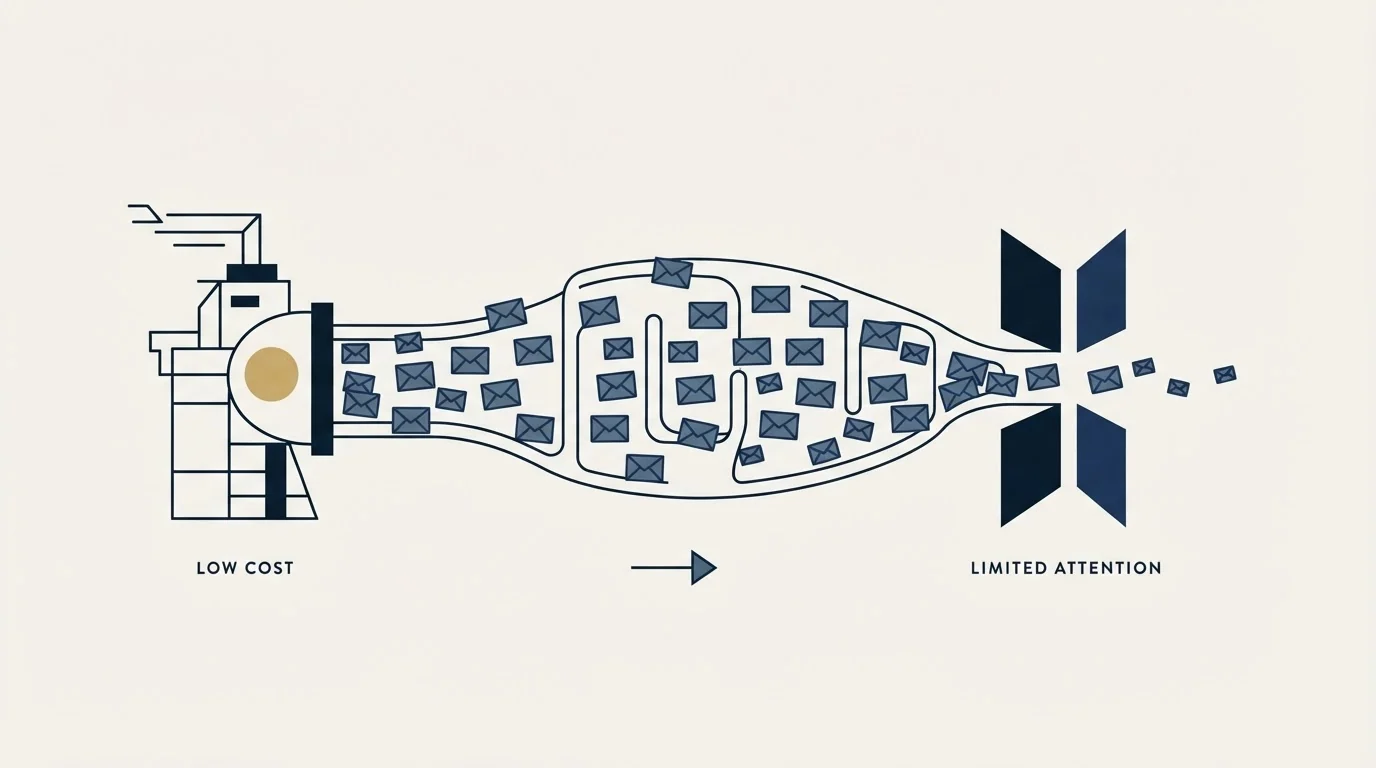
Generation got cheap. The recipient's willingness to read did not change at all, and there is no mechanism by which it could. The same finite population of buyers has the same finite number of minutes, and they are now receiving substantially more mail than they were.
That asymmetry is the single most important fact in the category, because it means the returns to volume went negative faster than most teams noticed.
- Drafting a message
- Summarising a company from public pages
- Extracting structured fields from messy text
- Producing a hundred variants of anything
- Classifying inbound replies
- A buyer's attention and patience
- Sending reputation, and the weeks to rebuild it
- Knowing something true that is not published
- Judgment about which accounts are worth contacting
- Verifying that a generated claim is correct
Read the right-hand column as a list of what is now scarce, because scarcity is defined against what is abundant. When drafting was expensive, having a good writer was an advantage. Now that drafting is free, having a good writer is not, and the advantage has moved to whoever holds the things that stayed expensive.
Volume stopped being a moat the moment everybody had it
Buyers asking whether cold email written by AI still works, negging hooks and all, are asking this question, and the answer does not turn on the tactic: the returns to a message anybody can generate fell because everybody generated one.
An advantage that everyone can buy for the same price is not an advantage. Every competitor in your market now has access to the same generation capability at roughly the same cost, which means any strategy whose core is more messages has been fully commoditised.
Worse, that strategy has a shared cost. As market-wide volume rises, mailbox providers tighten. The practical experience of that tightening is that a sending setup which worked comfortably a year ago now needs more care, more domains, and lower per-address volume to achieve the same delivery. Everyone pays for the aggregate behaviour, including the teams who did not contribute to it.
So the honest reading of the last two years is that AI made the cheap half of outbound cheaper and the expensive half slightly more expensive. Any plan that only accounts for the first half is going to disappoint.
The scarce input is information the model cannot get

If generation is free and public information is available to everyone equally, then a message built entirely from public information carries no advantage. Your competitor's model read the same About page.
What still differentiates is information that is genuinely hard to assemble. Some of it is public but expensive to collect, which means somebody has to do the work of watching for it: a facility opening, a regulatory filing, a leadership change, a job posting that implies a project, an incumbent contract that is visibly ending. Some of it is a product of your own operation: which segments answered, which propositions were rejected and with what reason, which accounts a partner already owns.
- Step 1Decide who
The judgment that determines most of the outcome, and the least automatable step
- Step 2Find what is true
Retrieve real evidence about the account, and keep the source
- Step 3Generate
Now nearly free, and the least valuable step in the chain
- Step 4Verify
Check the claim against the retrieved source before it can be sent
- Step 5Learn
Record what happened per segment so the next round starts better informed
Notice that generation, the step the whole category is named after, is the third of five and the cheapest. Teams that reorganised around it built a fast pipe to the wrong output. Teams that reorganised around the first, second and fourth steps got the benefit.
The mechanics of assembling account information reliably are covered in waterfall enrichment, and the question of which observable events actually predict a purchase in B2B intent data.
Verification did not get cheap at the same rate
Here is the uncomfortable structural point. Generating a claim about a company costs almost nothing. Checking whether that claim is true still costs roughly what it always did, because it requires retrieving a source and comparing.
That gap is where the damage in this category lives. A system that generates a thousand personalised observations a day and verifies none of them will produce a substantial number of confident, specific, wrong statements about real companies, delivered to people at those companies who are uniquely well placed to notice.
The cost of that is not evenly distributed either. A dull message is forgotten. A message that confidently describes a product line the company discontinued is remembered, forwarded, and occasionally posted publicly. It also spends that account permanently, and in a narrow market the addressable population is small enough that spending accounts carelessly is a strategic error rather than a tactical one.
The containment is mechanical rather than clever. Ground every factual sentence in a retrieved page and store the reference. Refuse to send when the evidence is thin, and accept that the correct output in that case is a shorter message that claims less. Read a sample of rendered output against real records before any campaign goes out, because a template that reads well can render badly against actual values.
What AI does well here, stated plainly
None of the above says the technology is oversold. It says the value is in different places than the marketing suggests.
It is genuinely excellent at reading. Turning a hundred messy pages into a comparable structured field is work that used to consume a researcher's week, and it is now reliable and fast. It is genuinely excellent at classification, which makes reply handling and routing much better than it was. It is good at producing a first draft against a tight brief with real evidence attached, which is a meaningfully different task from writing a message from nothing.
It is not good at deciding who to contact, because that decision encodes commercial context that is usually written down nowhere the system can read. It is not good at knowing when it does not know, which is the property that would make autonomous sending safe. And it does not make a weak proposition land, because the reason a weak proposition fails has nothing to do with how it was written.
For which parts of the workflow can be handed over stage by stage, agent lead generation works through that specific question, and AI sales agents covers the category boundary between an agent and a workflow with a chat interface.
The market adapted, and it adapted against you
There is a second-order effect that rarely appears in vendor material, and it changes the calculation.
Buyers have learned the tells. A first line that references a recent funding round or a LinkedIn post, followed by a pivot to an unrelated pitch, now reads as machine-written to a large share of recipients, because it usually is. The pattern that signalled effort three years ago signals the opposite today, and the signal flipped faster than most playbooks were updated.
That produces a genuinely awkward result. Personalisation of the kind that is easiest to automate has become close to worthless, and in some segments actively negative, while personalisation that requires understanding the business still works exactly as well as it always did. The gap between those two is not visible in the message length or the apparent specificity. It is visible in whether the observation could only have been made about that company by somebody who thought about it.
The practical test is unforgiving and quick to apply. Take the first two sentences of a message, change the company name, and see whether they still make sense. If they do, the personalisation was decoration. If they collapse, it was real.
- Yes: Names a decision the company made, and says why it matters to them
- Yes: References something only findable by reading past the homepage
- Yes: Would be wrong if applied to their closest competitor
- Yes: Traces to a specific page the system actually retrieved
- No: Congratulates them on a funding round or a recent post
- No: Describes their industry back to them
- No: Compliments the company in terms their competitors would also accept
Where to start if you are adding this to an existing motion

The order that works is the reverse of the one most teams run.
Start by applying the capability to reading rather than writing. Point it at the accounts already on your list and ask it to establish, from retrieved sources, which of them show a specific condition you care about. That produces a shorter, better list with sources attached, and it is entirely safe because nothing generated reaches a recipient.
Then apply it to the research layer of messages you were going to send anyway, keeping a human in the path and reading the rendered output. This is where you find out how often the grounding is thin, which is the number that should govern everything after.
Only then consider widening. If the honest answer is that a third of your accounts have enough public footprint to support a grounded message, that is a useful finding and it tells you the other two thirds need a different motion rather than a better prompt.
What this means for how a team is built
The staffing implication is the one most teams get to last and it is fairly stark. The role that got less valuable is the one producing volume. The roles that got more valuable are the one deciding what the system should be pointed at, and the one building the plumbing that keeps its output grounded and measurable. That shift, and how the seats compare on cost and output, is worked through in SDR vs AI SDR vs GTM engineer.
Teams building that grounding plumbing on HubSpot will eventually need to understand how HubSpot's webhook journal system works, since it replaces receiver hosting with a polled event log.
Our own position follows directly from the attention asymmetry at the top of this piece. One message per campaign, built on one premise, sent once. When the constraint was production, sending more was a rational response to having capacity. Now that production is free and attention is the scarce side, the discipline that pays is having something genuinely worth saying and saying it once. A team operating under that constraint has to spend its cheap generation capacity on being right about the account rather than on being present in the inbox repeatedly, which happens to be where the technology is actually strong.
If you would rather see a grounded list and a single message built against your own market before deciding what to automate, see what a first campaign looks like.
Frequently asked questions.
Frequently asked questions- Does AI actually improve lead generation results?
- It improves the parts where output can be checked against a source: reading messy pages into structured fields, resolving people to roles, classifying replies, and drafting against real evidence. It does not improve targeting judgment, and it does not make a weak proposition land, because the reason a weak proposition fails has nothing to do with how it was written.
- Why has AI personalisation stopped working?
- Buyers learned the tells. A first line referencing a funding round or a recent post, followed by an unrelated pitch, now reads as machine-written because it usually is. The pattern that signalled effort a few years ago signals the opposite today. The test is to change the company name and see whether the first two sentences still make sense.
- What is the scarce input now that generation is free?
- Three things. Judgment about which accounts are worth contacting, which encodes commercial context written down nowhere the system can read. Information that is genuinely hard to assemble, whether expensive-to-collect public signals or your own operating history. And verification, because checking a generated claim still costs roughly what it always did.
- Where should a team start when adding AI to outbound?
- With reading rather than writing. Point it at accounts already on your list and ask it to establish from retrieved sources which show a condition you care about. Nothing generated reaches a recipient, so it is entirely safe, and it tells you how often the grounding is thin, which is the number that should govern everything after.
About the author.

B2B cold email experts helping companies generate qualified leads through done-for-you outreach campaigns.
RevenueFlow Team
Explore more.
Ready to scale your outreach?
We build GTM engines that book real meetings. See the receipts.
Related articles.
CRM Setup: The Objects, Stages and Write-Back Loop
A vendor neutral CRM setup for an outbound team: the object model, stage exit criteria, the required field set, ownership rules and the campaign write-back loop.
Cold Outreach Automation: Where the Line Sits
Cold outreach automation is seven decisions, not one purchase. Four stages automate cleanly, two produce confident nonsense, and one is the feature we decline.
The Pipedrive API: A Daily Token Budget
Pipedrive prices API calls rather than counting them. The published token budget, the cost of each endpoint type, and the two ceilings a sync has to respect.
Pipedrive Sequences: A 250-Item Cap and What the Tool Is For
Ten steps, 250 items and a per-sequence sending authorisation. Pipedrive's caps describe the audience the feature was designed for more clearly than its feature list.
HubSpot Power Dialers: Pooled Minutes Are the Real Cap
HubSpot's calling minutes are pooled across the whole account rather than granted per seat. That changes the arithmetic of a calling programme more than the dialer does.
Outbound AI Calling Agents: Four Pricing Models
A rate ladder, a hosting fee with the model billed separately, a $30,000 annual floor, and pure pay as you go. The shape decides which number to read.