BATNA in Sales Negotiation: The Alternative on Both Sides
BATNA from its Harvard origin and the sales-training publishers who apply it: the seller's alternative, the buyer's, the reservation point, and when to walk.
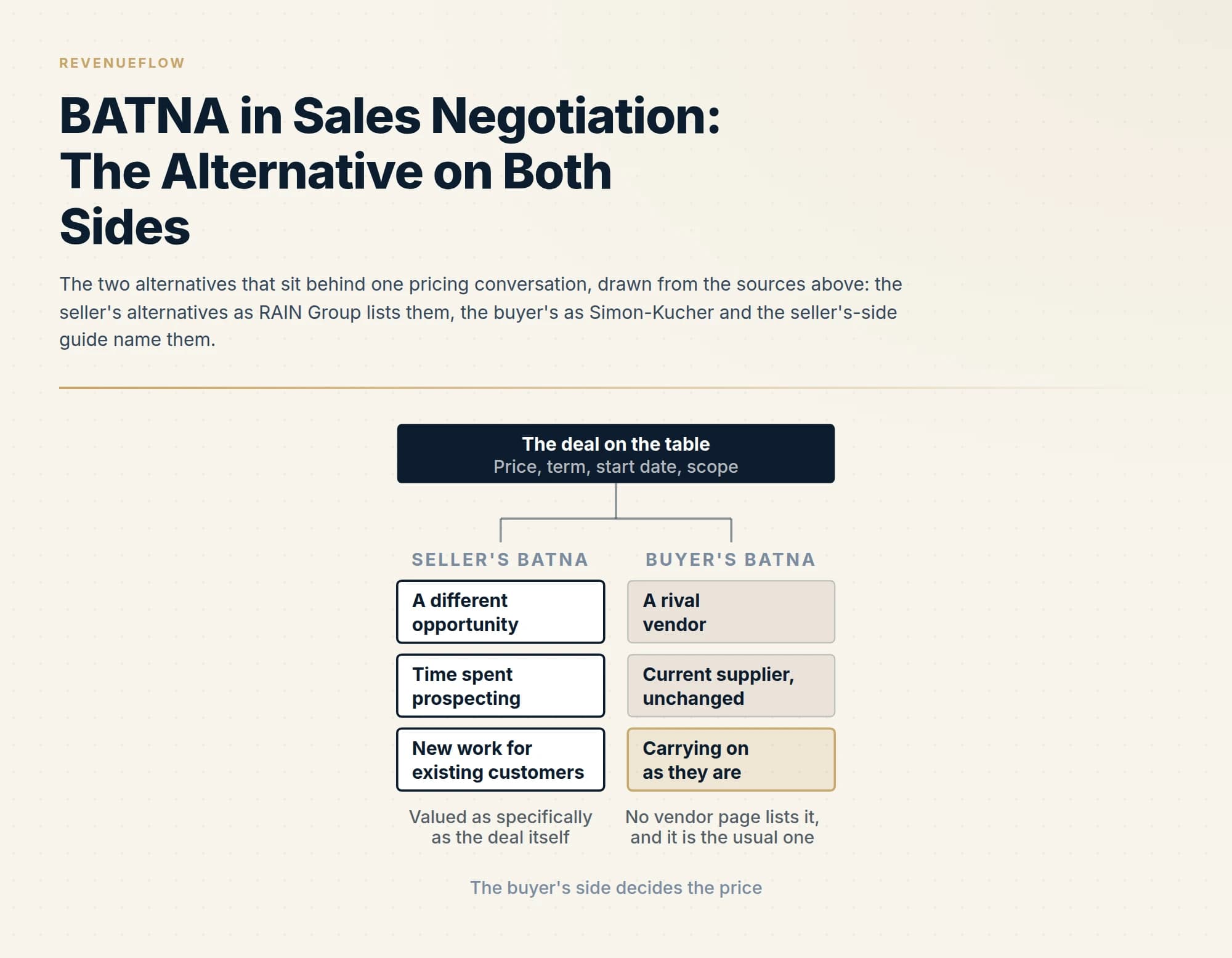
BATNA is Fisher, Ury and Patton's term for what a party will do if no agreement is reached. Both sides of a sales negotiation have one: the seller values an alternative and sets a reservation point, the buyer's is read from discovery and usually includes carrying on unchanged, and a deal proceeds only when it beats no deal for both.
Key takeaways
- The Program on Negotiation at Harvard Law School defines BATNA as what you will do if you do not reach a deal, a concept Fisher, Ury and Patton introduced in Getting to Yes, first published in 1981.
- The reservation point is derived from the alternative, never the same thing: Karrass calls it the breaking point below which a deal is no longer profitable, and says great negotiators never reveal it.
- RAIN Group and MTD both say the buyer's alternative matters as much as the seller's, and for a B2B seller it usually includes carrying on as they are, which is priced in discovery from the buyer's own numbers.
- PON's warnings cluster around disclosure: never reveal a weak alternative, never fabricate one, do not show a strong one too early, and do not let the other side talk you out of it.
Reviewed and updated September 21, 2026
A seller who has run a deal cleanly for two months reaches the pricing conversation with one number in mind, the buyer's, and no number for what happens if the deal does not close. That missing number has a name. BATNA is the term Roger Fisher and William Ury gave it, and it belongs to both sides of the table: the negotiation is largely decided by which of the two parties has looked at theirs honestly. This page takes the term from its origin at Harvard, then from the sales-training publishers who apply it to a seller, and sets both sides' alternatives out. The wider seller's-side conversation, the terms that can be traded and the preparation before the number, is on sales negotiation; this page stays on the one concept that page assumes.
What the term means, from the people who coined it
The Program on Negotiation at Harvard Law School publishes the definition in its own words. Its page on the concept, published on 27 May 2026 and fetched on 21 September 2026, states: "BATNA stands for Best Alternative to a Negotiated Agreement. In plain terms, it is what you will do if you do not reach a deal." The Harvard Negotiation Project's own page, published on 7 November 2018, dates the book itself: first published in 1981, and now in its third edition. PON's examples page (published 9 June 2026) names the authors and the edition it works from: "Roger Fisher, William Ury, and Bruce Patton (Penguin, 1991) described BATNA" as the course of action a negotiator takes when no agreement is reached.
PON lists three consequences on the same page: whether to accept a proposed agreement, how much leverage a negotiator brings, and when to walk away. The power reading is on a separate PON page (published 17 August 2026, originally 2014): "By cultivating a strong outside alternative, you gain the power you need to walk away from an unappealing deal."
A BATNA is a course of action, something the party will actually do, and the same PON examples page is explicit that it protects against both errors at once: "Understanding your BATNA protects you from accepting a deal that's worse than what you could achieve elsewhere" and, in the same sentence, from rejecting an agreement that improves on the alternatives.
Both sides have one, and the buyer's usually matters more
The sales-training literature mostly teaches the seller's BATNA. RAIN Group's post, published 22 September 2021 and updated 27 June 2024, opens on it: "You know when you should walk when you know your BATNA, or best alternative to a negotiated agreement." Its list of a seller's alternatives is concrete: "As a seller, your alternatives might include pursuing a different opportunity", working on prospecting, or developing new work for existing customers.
The same post then turns the concept round: "Don't just analyze your BATNA; consider the buyer's as well." MTD Sales Training's post (last modified 13 March 2026) says the same in its own words: "Understanding your BATNA is critical, but so is understanding the BATNA of the other side."
For a B2B seller the buyer's alternative is the more consequential of the two, because it is the one that decides the price. A buyer's alternatives are not only rival vendors. Simon-Kucher's post (published 12 September 2025) uses a supply negotiation where the alternative is staying with the current supplier; Sales Training International's post (published 4 April 2023, modified 7 August 2025) frames the buyer's side as a worst case above which the buyer walks: "If the seller offers a price that is higher than the buyers worse case scenario, then the buyer is better off with an alternative solution, unless compromise can be made." And the alternative a buyer most often holds is the one no vendor page lists: carrying on as they are, which the live sales negotiation guide describes as the shortlist entry that is not a company at all.
BATNA, reservation point and the zone between them
Three terms travel together and are routinely confused, so each is taken here from a publisher that defines it.
The BATNA is the alternative itself: a course of action with a value. The reservation point is the number derived from it. Karrass's guide (published 6 May 2026) defines it: "The meaning of a reservation point is it being the breaking point of the negotiation where a deal will no longer be profitable for you." Simon-Kucher gives the procedure for arriving at it: "To answer these questions, calculate the lowest-valued deal you will accept in the negotiation." So the reservation point is what the BATNA is worth once it has been translated into the currency of the deal at hand.
The zone of possible agreement, ZOPA, is what is left between the two sides' reservation points. Sales Training International defines it as the term that "Stands for zone of possible agreement and is the overlap between the buyer and sellers settlement range." If the seller's floor sits above the buyer's ceiling, there is no zone, and no technique at the table produces one.
One more of Karrass's lines settles a question sellers ask: "Great negotiators never reveal their reservation point." The BATNA can sometimes be shown; the number derived from it is kept.
Working out the seller's alternative honestly
The publishers agree on the procedure and differ on the step count. Karrass attributes a three-move outline to the book itself: coming up with possible actions as alternatives when no agreement is reached, "Improving the promising options to make them more practical", and carefully selecting the best option. RAIN Group compresses it to identify, select, improve; MTD expands it to six, adding a written list of concessions and a warning against bluffing.
The step every one of them stresses is valuation. RAIN's instruction is "To estimate a BATNA, analyze the value of the alternative as specifically as possible." Its worked illustration is two consultants offered the same month of work at a third of their fee. The first, who has no other work, takes the reduced fee; the second values a month of selling at what it usually produces, sets her floor above the offer, adds a trade, and lets the buyer decline. The point is the method rather than the figures: an alternative that has not been valued is a feeling, and a feeling loses to a number every time.
PON adds the caution that makes valuation harder than it looks. Its page on taking the concept further (published 8 July 2026) says: "In truth, your best alternative to agreement is rarely, if ever, apples-to-apples comparable with the deal at hand." A month of prospecting is not a signed contract, and a different opportunity has its own odds of closing. The same page names the trap of doing the opposite and planning around the worst case, where "some focus instead on their worst alternative to a negotiated agreement (WATNA)", and recommends instead a probability-weighted view of what happens if the talks fail.
The honest version of the exercise usually lands between the optimistic number and the anxious one, which is the reason to write it down before the conversation rather than feel it during one. The table below sets the steps beside the mistake each one prevents, with an invented worked column that shows the shape of one seller's answers and describes no real deal.
| Step, and who states it | The mistake it prevents | Invented example |
|---|---|---|
| List the alternatives (Karrass, RAIN, MTD) | This deal read as the only deal | Two other open opportunities; a month of prospecting; an expansion at a current customer |
| Value each one specifically (RAIN) | A feeling standing in for a number | Each alternative given a probability and a value, then compared |
| Translate it to this deal (PON) | A signed contract set against a maybe | The probability-weighted value, not the best case |
| Set the reservation point (Karrass, Simon-Kucher) | Negotiating toward wherever the buyer stops pushing | A floor written down and agreed with whoever carries the number |
| Improve the alternative (RAIN, MTD) | The alternative you happen to have, unimproved | The second opportunity moved along before the pricing call |
Reading the buyer's alternative from the outside
The buyer's BATNA is never handed over, so the seller estimates it. MTD lists four questions to ask about the other side: what are their alternatives to this deal, "What are their costs if they walk away?", "How much do they need this deal?", and what the consequences are of not making a deal with you.
Those questions are answered in discovery, long before the pricing stage. A buyer who described in their own words what the problem costs them each quarter has priced their carry-on alternative for you; a buyer who named the other vendors on the shortlist has shown the shape of the rival-vendor one; a buyer who can describe neither holds a claimed alternative rather than a real one, which is what the live discovery call guide is built to surface early.
RAIN adds the move that follows the estimate: "You may also be able change the buyer's perception of their BATNA." PON's page on going beyond the basics (published 30 December 2019) says the same from the other direction, as one of three tactics: "Research your counterpart's likely BATNA, then explore ways to deepen their dependence on you." For a seller this is mostly the work of making the carry-on option look like what it is, and competitive positioning treats the incumbent and the do-nothing option as the shortlist entries that need answering.
RAIN's decision rule is stated for both parties at once: move forward when the value of agreement exceeds the value of no agreement for each side, and "If the value of no agreement is greater for either of you, you won't." A seller who has done the arithmetic on both sides knows which case this is before the call.
What the publishers warn against
The mistakes cluster around disclosure, and PON's examples page carries the clearest set. Do not reveal a weak alternative, and do not invent one: "Resist the temptation to exaggerate or fabricate a BATNA to increase your leverage." MTD repeats the warning for sellers: a threatened walk-away the seller will not carry out damages their reputation for every negotiation after. Timing matters too: "Revealing a strong BATNA too early in a negotiation can backfire.", because it reads as a threat and shuts down the trading of terms that a good agreement is made of.
The mirror-image mistake is letting the other side do the disparaging. PON: "If your counterpart disparages your BATNA, recognize the tactic for what it is." A buyer who says the seller's other opportunities will never close is guessing at a number they cannot see.
The last warning is Simon-Kucher's, and it is about the seller's own position rather than the buyer's tactics: "A weak BATNA forces you to accept unfavorable terms to make the deal happen, but a strong BATNA allows you to negotiate from a place of strength." A pipeline with one deal in it has no alternative to that deal. The alternative is built earlier, by the number of conversations a seller has open, which is a supply question rather than a negotiating one.
Where our own practice differs
Everything above assumes a negotiation exists; our work sits before that point, getting a qualified conversation onto the calendar, and two positions on that side touch the concept.
The first is that a buyer who has not replied is not being negotiated with, and is not chased. Our campaigns send one message per person, on one premise, with nothing scheduled behind it; a later approach is a separate campaign on a separate premise, and on LinkedIn no second message is sent at all. The reasoning, and the fifteen-touch design it declines, is on the Agoge sequence. Silence says nothing about anyone's alternative, so it is not treated as a position to be moved.
The second is that our own walk-away is written before any campaign runs. A meeting we book is qualified against criteria agreed in writing before launch, and budget, timing and authority are never conditions of a meeting having counted. That written definition is our reservation point on the one thing we sell, and it is agreed with the client rather than discovered in a conversation about price.
The short version
BATNA is Fisher, Ury and Patton's term from Getting to Yes, first published in 1981, for what a party will actually do if no agreement is reached. Both sides have one. The seller's is a valued alternative, translated honestly into the terms of the deal at hand and written down as a reservation point that is never disclosed. The buyer's is estimated from discovery, and it usually includes carrying on as they are. RAIN Group's rule decides the rest: proceed when the deal beats no deal for both parties, walk cleanly when it does not for either, and never manufacture an alternative you would not act on.
If the deeper problem is that a seller's own alternative is empty because too few conversations are open, that is fixed upstream of any negotiation: a first campaign shows what the market returns before any single deal has to be walked away from.
Every quotation above is from the named page as fetched on 21 September 2026: the Program on Negotiation at Harvard Law School's What is BATNA page (published 27 May 2026), its BATNA examples page (published 9 June 2026), its Take Your BATNA to the Next Level page (published 8 July 2026), its Beyond the Basics page (published 30 December 2019), its sources-of-power page (published 17 August 2026) and the Harvard Negotiation Project page (published 7 November 2018); RAIN Group (published 22 September 2021, updated 27 June 2024); MTD Sales Training (modified 13 March 2026); Karrass (published 6 May 2026); Simon-Kucher (published 12 September 2025); Sales Training International (published 4 April 2023, modified 7 August 2025). Publishers revise these pages; confirm the current text before relying on it.
Frequently asked questions.
Frequently asked questions- What does BATNA mean in a sales negotiation?
- BATNA stands for best alternative to a negotiated agreement, the course of action a party will actually take if no deal is reached. For a seller it is the next best use of the same time, such as another open opportunity, a month of prospecting or expansion work at a current customer, valued as specifically as the deal itself. For the buyer it is another vendor, the current supplier or carrying on unchanged.
- What is the difference between BATNA and a reservation point?
- The BATNA is the alternative course of action; the reservation point is the number derived from it, the value below which the deal is no longer worth doing. Karrass calls it the breaking point of the negotiation, Simon-Kucher describes calculating the lowest-valued deal you will accept, and both say the number stays private even when the alternative itself is discussed.
- How does a seller work out the buyer's BATNA?
- By listening in discovery rather than asking at the pricing stage. MTD's questions are what the buyer's alternatives to this deal are, what walking away costs them, how much they need the deal, and what happens if they do not make one with you. A buyer who has described what the problem costs them each quarter has priced their carry-on option; one who cannot has a claimed alternative, not a real one.
- When should a seller walk away from a deal?
- RAIN Group's rule covers both parties at once: move forward when the value of agreement exceeds the value of no agreement for each side, and walk when no agreement is worth more to either of you. If the seller's floor sits above the buyer's ceiling there is no zone of possible agreement, and the honest move is a clean ending rather than a discount that teaches the buyer the number was soft.
About the author.

B2B cold email experts helping companies generate qualified leads through done-for-you outreach campaigns.
RevenueFlow Team
Explore more.
Ready to scale your outreach?
We build GTM engines that book real meetings. See the receipts.
Related articles.
Mirroring in Sales: What the Research Measured, Where It Misfires
Mirroring in sales is two techniques: Voss's verbal mirror and the guides' matching of tone and posture, with the peer-reviewed research behind both read at the source.
Sales Prospecting for Consulting Firms: Find the Event
Prospecting for a consulting firm: where triggers are published by practice, who inside the firm reads them, why alumni and referrals come first, when to skip it.
Physician Email Lists: The Row, Its Sources and Its Gaps
The anatomy of a physician email list: the six field groups, which CMS, AMA and state board records hold each, what vendors claim, the rules, and the order to verify.
Telemarketing Laws by State: 13 Statutes, Read
Thirteen states' own telemarketing statutes and agency pages, read first-hand: what each one keys on, and which of them reach a business to business call.
B2B Lead Lists for Utilities: Three Registries, One Gap
The anatomy of a utilities lead list: the EIA-861 census, PHMSA annual reports and SDWIS enumerate electric, gas and water utilities; vendors sell the field they lack.
Sales Prospecting for Utilities: Read the Filings First
Prospecting utilities from the proceedings that announce their spend: rate cases, resource plans and procurement decisions, who owns each, and the supplier gate.