Best Data Enrichment Tools for Insurance (2026)
Renewal dates are not an enrichment field, and no tool here carries them. Clay, Lusha, UpLead, LeadIQ and Apollo.io priced from their own pricing pages.
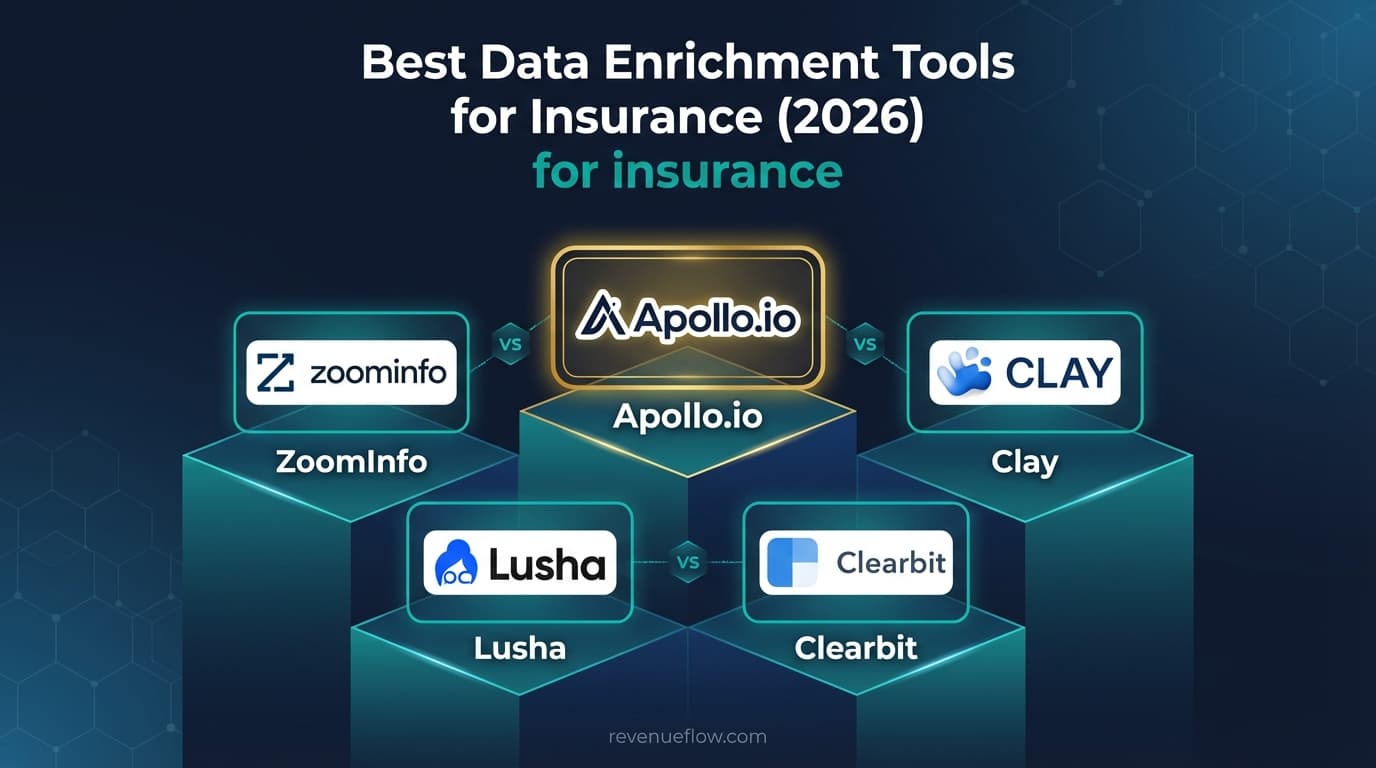
Insurance data enrichment fills firmographic and contact fields, not renewal dates, carrier or claims history, which come from your own book. Among Clay, Lusha, UpLead, LeadIQ and Apollo.io, entry paid tiers run from $15 a month on LeadIQ to $167 on Clay, and all five offer a free plan or trial.
Key takeaways
- No enrichment tool carries policy renewal dates, current carrier or claims history; a renewal-timed campaign is built on your own book with enrichment attached.
- Entry paid tiers on the vendors' own pages run from LeadIQ Pro at $15 a month on annual billing to Clay Launch at $167, with Lusha, Apollo.io and UpLead between.
- UpLead suits commercial lines built on firmographic qualification, Clay suits renewal-timed work that joins your book to enriched records, and Apollo.io suits one-subscription agencies.
- Test any tool on 100 rows you know before committing, enrich only qualified accounts, and track cost per usable record rather than cost per credit.
Reviewed and updated September 21, 2026
An agency builds a renewal-timed campaign, and the enrichment tool it bought turns out to know nothing about when anyone's policy renews. That gap is the first thing to understand about insurance data enrichment. Every requirement that makes insurance outreach work is a first-party or industry-specific record, and the tools in this category supply the general contact layer underneath it rather than the layer that matters.
Insurance data enrichment: what it covers and what it does not
Insurance data enrichment fills in firmographic and contact fields: headcount, industry, revenue band, location and verified details for named roles. It does not supply renewal dates, current carrier or claims history, which come from your own book or a carrier feed, and it does not settle compliance. The five tools below sell that general layer in different ways.
Renewal timing, which is not an enrichment field. Policy renewal dates come from your own book, from a carrier feed, or from the prospect telling you. No general B2B database carries them, so a renewal-timed motion is built on first-party data with enrichment attached to it, not the other way round.
Qualification attributes that are genuinely available. Headcount, industry classification, revenue band and location decide which lines of coverage are relevant, and these are standard firmographic fields with reasonable coverage. This is the part enrichment does well and it is worth building the qualification logic on it.
Compliance that belongs to your process, not to a vendor. None of the five tools published a compliance posture for insurance-regulated outreach on the pages checked. Contact-permission rules, recording obligations and what may be said in a solicitation are your compliance function's decisions, and a roundup that implied otherwise would be selling reassurance it cannot back.
Broker and owner titles at small commercial accounts. Much of the market is owner-operated businesses where the decision-maker carries no standard title. Expect a lower match rate than a corporate ICP, and test it before assuming the volume is there.
Top 5 Data Enrichment Tools for Insurance
1. Clay
A data enrichment and workflow automation platform that buys from 150+ providers, runs them as waterfalls and adds AI research (Claygent).
From Clay's pricing page: a Free plan with 500 actions and 100 data credits a month and unlimited seats and tables, then Launch from $167 a month and Growth from $446 a month on annual billing ($185 and $495 month to month), each the sum of an actions allowance and a data-credit allowance, and Enterprise on request.
Key features: 150+ data providers, multi-provider waterfalls, Claygent AI research, unlimited seats and tables.
2. Lusha
A B2B contact database with a browser extension for LinkedIn prospecting, bulk and CSV enrichment, and intent signals.
From Lusha's pricing page: Free at 40 credits a month, then Starter at $49.90, Pro at $69.90 and Premium at $399.90 a month billed monthly, or $37.45, $52.45 and $299.95 a month billed yearly at 25 percent off. Starter carries 400 credits a month and one seat, Pro 600 credits with two free seats, API access and CSV enrichment.
Key features: the browser extension, bulk enrichment, CSV enrichment and signals from Pro, buying intent topics from Starter.
3. UpLead
A B2B prospecting platform whose pricing page says it verifies email addresses "with a data accuracy rate of 95%", with mobile direct dials and technographic search.
From UpLead's pricing page: a Test Drive free trial at $0 for 7 days with 5 credits, then Essentials at $99 a month for 170 credits and Plus at $199 a month for 400 credits, with Professional sold through a demo. One credit unlocks one contact.
Key features: verified emails, mobile direct dials, search across over 16,000 technologies, a Chrome extension.
4. LeadIQ
A B2B prospecting platform built around capture from LinkedIn into the CRM, job-change tracking and AI-drafted outreach.
From LeadIQ's pricing page: Free at $0 for one user and 50 credits, then Pro from $15.00 a month on annual billing, 25 percent below monthly, with 5 users included, and Enterprise through a conversation. An email costs 1 credit and a phone number 10.
Key features: one-click capture into the CRM, job-change tracking, verified work emails and mobile numbers, CRM and webform enrichment.
5. Apollo.io
An all-in-one sales intelligence platform with a contact database, sequencing, a dialer and analytics.
From Apollo's pricing page: Free at $0 with 900 credits per seat a year, then Basic at $49, Professional at $79 and Organization at $119 per seat a month, billed annually, with Organization at a three-seat minimum. Each paid seat carries 30,000, 48,000 or 72,000 credits a year granted upfront, and annual billing saves 24 percent.
Key features: the contact database, sequencing, a dialer, credits granted per seat.
Comparison table
| Tool | Free option, then paid | Metered on |
|---|---|---|
| Clay | Free plan; Launch $167 and Growth $446 on annual billing | Actions and data credits |
| Lusha | 40 credits a month free; $37.45 to $299.95 billed yearly | Credits and seats |
| UpLead | 5-credit, 7-day trial; $99 and $199 a month | Credits, one per contact |
| LeadIQ | 50 credits for 1 user; Pro from $15 on annual billing | Credits: email 1, phone 10 |
| Apollo.io | Free plan; $49 to $119 a seat billed annually | Seats and credits per seat |
Reading the Roster: What Each Tool Is Actually For
The five tools above get compared as if they were interchangeable. They are not, and the differences matter more than the pricing table suggests.
Clay is a workflow platform rather than a database. It buys from 150+ providers, runs them in a waterfall so a miss at one provider falls through to the next, and lets an AI agent research whatever the providers leave blank. That is the most capable option here and the one with the steepest setup. Its pricing page lists a free plan, then Launch from $167 a month and Growth from $446 on annual billing, with Enterprise on request, and above those entry points the cost scales with actions and data credits rather than seats.
Lusha is the browser-extension option: work a LinkedIn profile or a company page, reveal contacts, push them to the CRM. It suits people who prospect by hand and want the data where they already are. Its pricing page renders prices only in a browser, behind a monthly and yearly toggle, which is why figures quoted second-hand for it so often disagree: Starter is $49.90 a month or $37.45 billed yearly.
UpLead sells accuracy over volume. Its pricing page states a 95 percent accuracy rate for email verification, and lists Essentials at $99 a month for 170 credits and Plus at $199 a month for 400 credits. Credit-metered pricing rewards a small, well-chosen list and punishes a scattergun one.
LeadIQ is built around the prospecting motion rather than bulk export: capture from LinkedIn into the CRM in one click, track when a known contact changes job, and draft outreach from what it found. Its pricing page lists a free tier at 50 credits for one user and Pro from $15 a month on annual billing with five users included.
Apollo.io is the all-in-one: a contact database with sequencing, dialer and analytics on top, priced per seat from $49 a month on annual billing, and a Starter plan its own pricing FAQ calls free forever. Buying one subscription instead of three is the appeal, and the trade is that each layer is adequate rather than best in class.
Which of These Fits Insurance

UpLead is the natural fit for commercial lines. Qualification in insurance runs on firmographics, its filters are built for exactly that, and credit-metered pricing rewards a carefully qualified list over a broad one. Verification at export also matters when the follow-up is a phone call.
Clay is the right answer when the motion is renewal-timed, because that requires joining your own book or a carrier feed to enriched company data, which is a workflow rather than a lookup. It is more tool than a small agency needs and exactly the right tool for a carrier or a large brokerage.
Apollo.io suits an agency that wants sourcing and sequencing in one subscription and is working standard commercial segments.
Lusha fits producers who prospect individually and want contacts where they already work. LeadIQ's job-change tracking has a specific use here: a risk manager changing employers is a legitimate reason to make contact at the new company.
Enrichment supplies
- Headcount, revenue band and industry
- Location and company identifiers
- Verified contact details for named roles
- Job-change events on tracked contacts
You supply
- Policy renewal dates
- Current carrier and coverage history
- Claims and loss-run context
- Existing-relationship suppression
Nobody supplies
- Whether a solicitation is permitted
- What may be said about coverage
- Which accounts compliance excludes
- Producer licensing by state
Where Enrichment Stops
Enrichment tools fill in fields. That is genuinely useful and it is a narrower job than the category's marketing implies, so it is worth naming the boundary before the selection criteria.
They do not decide who is worth contacting. A tool that returns a verified address for every row on a badly chosen list has done its job perfectly and produced nothing, because the list was the problem. Enrichment quality and targeting quality are separate decisions, and the second one is where results actually move.
They do not make a message land. Merge fields are not personalisation, and a paragraph assembled from enriched attributes reads exactly like a paragraph assembled from enriched attributes. What earns a reply is a relevant offer, and no data provider supplies one.
They do not fix deliverability. A verified address means the mailbox exists, not that mail reaches it. Sender reputation, authentication and sending volume decide that, and they sit in a different part of the stack entirely.
And they are not a substitute for a defensible campaign structure. RevenueFlow sends one message per campaign, with no bump sequences and no thread replies, so re-contacting a non-replier is a fresh campaign rather than step two of a cadence. Under that structure the enrichment budget goes into getting the list right the first time rather than into finding more ways to touch the same people.
Choosing for Insurance
What is the timing signal, and where does it live? If the campaign is renewal-timed, the tool question is secondary to the data question, and the answer is a workflow platform that can join your book to enriched records. If the campaign is firmographic, a straightforward database is enough.
Commercial or personal lines? Everything in this category is B2B. Personal lines outreach is a different market with different data sources, and these tools are the wrong shelf entirely.
How small are the target businesses? Owner-operated accounts match at a lower rate and often carry no standard title. Test on a sample of your actual target size before committing to a volume plan.
Who owns the compliance review? Decide before the first send which team approves the audience and the copy. That is a process decision and no tool substitutes for it.
Does it suppress your existing book? Contacting a current policyholder as a cold prospect is the most avoidable error in this industry, and it requires a clean export from your own systems rather than anything a vendor provides.
Getting It Running Without Burning Credits
Every tool here meters something, so the first month is where the money goes wrong.
Start with a sample. Take 100 rows you know well, run them through the free tier or the trial, and check the results against reality rather than against the tool's own confidence score. Coverage varies enormously by segment, and a provider that is excellent on one population can be thin on the next. That check costs an afternoon and it is the only thing that tells you whether the tool works on your list.
Enrich late, not early. Pulling a full record for every company in a target market before anybody has decided who is worth contacting is the most common way a credit balance disappears. Qualify first, enrich the survivors.
Verify at the point of use. A record enriched six months ago is not a current record, and stale addresses turn into bounces, which cost deliverability rather than credits. Re-verify before a send rather than trusting the export date.
Then track cost per usable record instead of cost per credit. The credit price is the number on the pricing page; the number that matters is what you paid for each contact that turned out to be real, current and worth contacting.
How This Comparison Was Put Together
Prices, plan names and capability claims come from each vendor's own pricing or product page, read on the day of writing and kept as a dated snapshot. Where a vendor's page no longer renders its prices, that is said rather than filled in from a third-party roundup, because a figure copied from another article is not a source.
No tool here was ranked by measured match rate or data accuracy, and nothing in this guide is presented as a test result. Enrichment coverage depends on the segment, the geography and the seniority of the people being looked up, so a league table built on somebody else's list would not predict yours. That is why the setup section above leads with a 100-row sample: the only accuracy figure worth acting on is the one you measure on your own data.
The Short Version

For commercial lines built on firmographic qualification, UpLead is the efficient choice and its credit pricing rewards a well-qualified list. For renewal-timed outreach at a carrier or a large brokerage, Clay is the only tool here that can join your own book to enriched company data. Apollo.io is the practical single subscription for an agency working standard segments, and Lusha fits producers who prospect one account at a time.
The requirement that no tool on this list meets is the timing one. Renewal dates, current carrier and claims history come from your book or a carrier feed, and the enrichment layer sits underneath that rather than replacing it.
Related Reading
- Best Apollo.io Alternatives in 2026
- Best ZoomInfo Alternatives in 2026
- Best Lemlist Alternatives in 2026
- Best Salesforce Alternatives in 2026
- Best Pipedrive Alternatives in 2026
- Best SalesLoft Alternatives in 2026
If you would rather have this run for you, RevenueFlow books qualified meetings on a pay-per-meeting basis and publishes client results.
Pricing and features are taken from each vendor's own pricing page, read as served and rendered in a browser, with Lusha's monthly prices read by switching its toggle. Prices are US dollars. Verify current terms with the vendor before relying on them.
Frequently asked questions.
Frequently asked questions- What is insurance data enrichment?
- It is adding firmographic and contact fields to a list of prospects: headcount, industry, revenue band, location and verified contact details for named roles. It does not provide policy renewal dates, current carrier or claims history, which come from your own book, a carrier feed or the prospect. Compliance decisions also stay with your own team.
- Which data enrichment tool is best for insurance agencies?
- For commercial lines qualified on firmographics, UpLead's credit pricing rewards a well-chosen list. For renewal-timed outreach at a carrier or large brokerage, Clay can join your book to enriched company data. Apollo.io suits an agency wanting sourcing and sequencing in one subscription, and Lusha suits producers who prospect one account at a time.
- How much do data enrichment tools cost?
- On the vendors' own pricing pages, entry paid tiers run from LeadIQ Pro at $15 a month on annual billing, through Lusha Starter at $37.45 billed yearly, Apollo.io Basic at $49 a seat and UpLead Essentials at $99 a month, to Clay Launch at $167 on annual billing. All five offer a free plan or trial.
- Can enrichment tools find policy renewal dates?
- No. None of the five tools here carries renewal dates, and no general B2B database does. Renewal timing comes from your own book of business, a carrier feed or the prospect telling you. Enrichment then attaches firmographics and verified contacts to that first-party timing, which is why a workflow tool like Clay suits renewal-timed campaigns.
About the author.

B2B cold email experts helping companies generate qualified leads through done-for-you outreach campaigns.
RevenueFlow Team
Explore more.
Ready to scale your outreach?
We build GTM engines that book real meetings. See the receipts.
Related articles.
Is Clay Free? The Free Plan, the Trial and Where Each Stops
Clay's free plan, its 14-day trial and the no-charge-on-a-miss rule are three different things. What each holds and where it stops, from clay.com on 19 September 2026.
Seamless.AI Email Finder: How It Works, What a Credit Buys
How Seamless.AI's email finder resolves a contact in real time, what one Universal Credit buys, the Total AI score on every address, and what the Chrome extension reads.
Autobound Pricing: One-Time Credit Packs, Not Seats
Autobound's pricing page sells one-time credit packs for a signal data API, not seats. The six packs, the per-endpoint meter, and what a company costs.
Snitcher Pricing: The $49 Table Is the Annual Rate
Snitcher's visible price table is the annual-billing ladder. The ten bands at both billing states, the unique-company meter, and the rules on a help page.
Firmographic Data Providers: What Six of Them Publish
Six firmographic data providers read from their own pages: the fields each sells, the coverage each states, how the data is delivered, and who prints a price.
Airscale Pricing: Three Plans, One Credit, Four Rates
Airscale prints a different credit cost on every plan, and its advertised per-email price belongs to the custom one. The dated ladder and the rollover rules.