How Long Before Outbound Campaigns Generate Meetings
Four separate clocks run between a signature and a held meeting, and only one belongs to the vendor. What each one is, and the two dates worth agreeing.
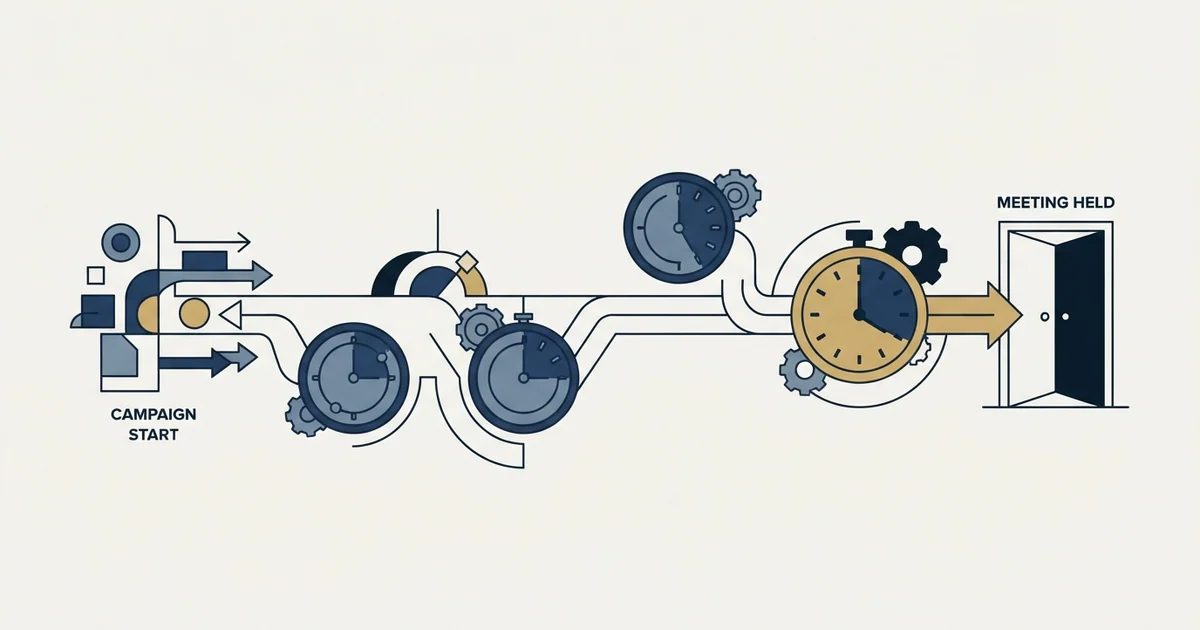
Expect a first meeting shortly after the first real send, and a readable reply rate only once enough people have been contacted for the number to be stable. Four clocks sit between signature and meeting: buyer setup, domain warmup, list drain and the prospect's own calendar. Compute both dates before launch rather than settling them later.
Key takeaways
- Four clocks run between signature and a held meeting, and buyer setup is the one that varies most between engagements.
- Warmup has a floor measured in weeks that no budget shortens, and it costs nothing extra if it starts on day one in parallel with the audience work.
- On a one-message-per-campaign motion, sends and people contacted are the same count, so the date a rate becomes readable is list arithmetic rather than a judgement call.
- A thirty-day review can settle whether the machinery works and cannot settle whether the premise is right, which is why those two questions need different dates.
Reviewed and updated September 1, 2026
How Long Before Outbound Campaigns Generate Meetings: Four Clocks, Not One
A programme is signed off in the first week of March and somebody asks for a read on it at the end of the month. The question is fair, it is the one every buyer asks on the first call, and it is usually answered with a single number that turns out to be a guess dressed as an estimate.
The reason a single number is unreliable is that four separate clocks run between a signature and a held meeting, and only one of them belongs to whoever is running the campaign. Collapse them into one and you get an answer that is either optimistic enough to be useless or vague enough to be unfalsifiable. Separate them and the question becomes a set of dates you can put in a calendar and hold both sides to.
The four clocks
The same four clocks answer the two forms of this question buyers ask. How long until qualified appointments start arriving is clocks one, two and three added together, and how long to optimise a programme is a different measurement entirely, because optimisation cannot begin until enough contacts have been reached for a rate to be readable.
They run partly in parallel, they are gated by different parties, and the one people forget is the first.
- Clock oneSetup, gated by the buyer
Audience definition, exclusion list, meeting criteria, copy approval. None of this can be done for you, and it is the interval that varies most between engagements.
- Clock twoInfrastructure, gated by the mailbox providers
Sending domains, authentication and warmup. Runs in parallel with clock one if it is started on day one, and it has a floor that no amount of budget shortens.
- Clock threeSending, gated by capacity
How fast the list drains, set by how many mailboxes are attached and how many sends a day each one carries.
- Clock fourReply to held, gated by the prospect
Replies land within days of a send. The meeting lands whenever the prospect had a free slot, and a proportion of booked meetings are rescheduled or not attended.
Clock one is the buyer's, and it is the one that slips. Somebody has to agree who the audience is, hand over the exclusion list covering existing customers, live opportunities and partners, write down what a meeting has to look like to count, and approve the copy that goes out under their name. Each of those is an afternoon of work and a fortnight of calendar if nobody owns it. A vendor cannot start clock two properly until the audience is settled, because the sending estate is sized against the list, and cannot start clock three at all until copy is approved. The full set of inputs that stay on the buyer's side, whoever executes, is worked through in done for you lead generation.
Clock two has a floor measured in weeks. New domains have no sending reputation, and building one is a process of low-volume sending that no amount of budget shortens. Duration, what warmup is actually doing to a mailbox, and the volume ramp that follows it are worked through in how long to warm up a cold email domain. The property that matters for planning is that this clock runs in parallel with clock one, so an engagement that starts infrastructure on day one loses nothing to it, while one that waits for the audience to be agreed before buying domains has added the whole interval to the end.
Clock three is arithmetic. With one message per campaign, a campaign of two thousand leads is two thousand sends rather than a multiple of it, so daily send volume and new people contacted per day are the same number. That makes drain time a division: list size over daily capacity. It is the only clock that a vendor can genuinely accelerate, and the way to accelerate it is more mailboxes rather than more sends per mailbox, because the per-mailbox rate is the thing protecting the domains.
Clock four belongs to the prospect. A reply that agrees to a conversation is at its highest value on the day it arrives, and every day between then and the meeting is decay. If the only free slot is two weeks out, that fortnight is added to every meeting in the programme, and it is invisible in any report that counts bookings rather than held conversations.
The first meeting and the first readable number are different dates
Buyers asking what campaign yield to expect are usually asking two questions at once, how much and by when, and the four clocks separate them: the first meeting and the first readable number arrive on different dates.
Two dates matter and they are usually conflated, which is what turns a normal early month into an argument.
The first date is the earliest a meeting could plausibly happen. It sits shortly after the first real send, because replies to cold email arrive fast when they arrive at all. A first meeting inside the first fortnight of sending is ordinary and it is not evidence of anything, in either direction.
The second date is when enough people have been contacted for a rate to mean something, and it is a function of volume rather than of time. This is where a single-message motion is unusually easy to plan, because sends and contacts are the same count.
The arithmetic below is invented for illustration and describes no real campaign. Substitute your own figures.
Chosen so a low-single-digit reply rate can be told apart from half of itself
Invented for the example
Ten mailboxes at a conservative daily rate each
800 divided by 200, before the setup and warmup clocks are added in front of it
Run that division on your own numbers before the programme starts, and the answer to when you may judge it stops being a matter of temperament. A team whose capacity produces forty contacts a day needs a month of sending for the same count, and a team sending two hundred a day needs a working week. Those two teams should not be having the same conversation at the same point in the calendar, and they usually are.
The discipline of writing both dates down before funding anything is set out in lead generation channels, where the general failure is judging a slow channel on a fast channel's calendar. What the single-message constraint adds is that the second date is computable rather than estimated.
Why a thirty-day verdict usually measures the setup
Buyers asking about typical success rates for booking meetings are asking for a number that only becomes readable at a particular point on the clocks above, which is why a rate quoted in month one is describing the setup rather than the programme.
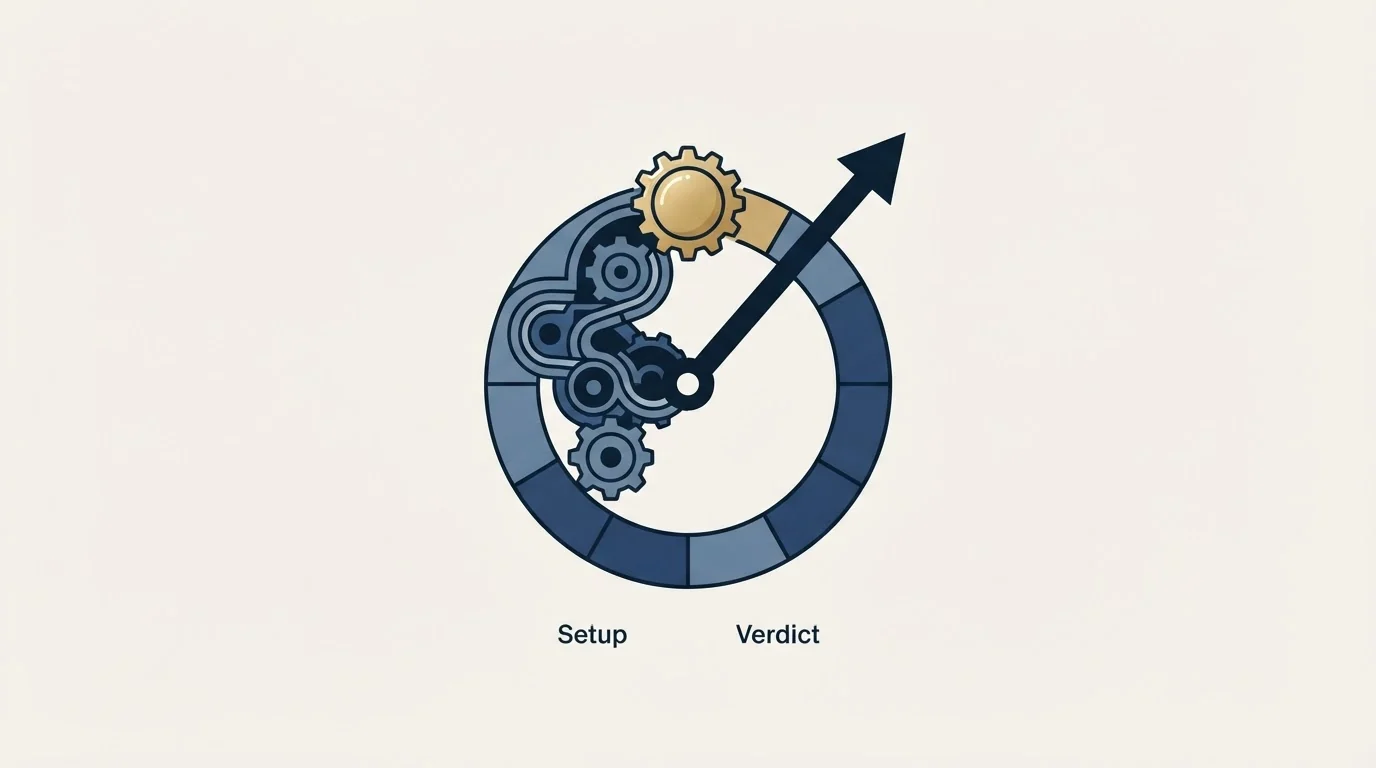
A month after signature, a well-run engagement has typically spent the first two weeks on clock one and clock two, and has been sending for the remainder. The number available at that point is drawn from a fraction of the list, and it is dominated by whatever the first segment happened to be.
That is why a review at thirty days answers a different question from the one people think they are asking. It is a good moment to check that the machinery works: are messages being delivered, is the list draining at the planned rate, are the replies coming from the kind of company the audience definition described. Those are checkable and they are worth checking early, because each has a fix that takes days.
What thirty days cannot tell you is whether the premise is right. That verdict needs the volume from the arithmetic above, and it needs enough held conversations for the pattern in them to be a pattern rather than an anecdote.
A two-month window is the shortest one that usually contains both, and it is worth being precise about what it contains rather than treating it as a round number. It holds the setup interval, the warmup floor, several weeks of real sending, and enough of clock four for booked meetings to have actually happened. A buyer who says they need two months before judging outbound performance is describing that structure, and the useful response is to agree the two dates inside it rather than to argue about the total.
- Is mail being delivered rather than filtered
- Is the list draining at the planned daily rate
- Are replies coming from companies inside the agreed audience
- Are booked meetings being attended
- Is the exclusion list holding
- Whether the offer lands with this segment
- Whether the reply rate is good or bad for this market
- Whether the meetings convert at a useful rate
- Whether a different angle would do better
- Whether outbound works for this business
Separating a slow start from a stalled one
The reason the timing question matters commercially is that "it is too early" and "this is not working" look identical for several weeks, and only one of them should be waited out. Three checks separate them, and all three are available before any rate is readable.
Is the list actually draining. A campaign that has sent a quarter of what the plan implies by now has a capacity or an approval problem rather than a market problem, and it will not be fixed by waiting. Ask for sends against plan rather than for a reply rate.
Are the messages arriving. Delivery and bounce behaviour are visible immediately and they are the single most common cause of a quiet first month. A list with a high invalid rate produces a bounce spike on a domain with no history to absorb it, which then suppresses everything sent afterwards.
Are the replies the right shape. A small number of replies from exactly the right kind of company is a healthy early signal. A larger number from companies outside the audience definition is a targeting finding available in week two, and it is more useful than any rate would be in week eight.
If all three are healthy and the count is simply low, the programme is early. If any of the three is unhealthy, the clock is not the explanation and waiting will not produce one.
What to agree before launch so the question never needs asking

Every argument about timing traces back to something that was not written down at kickoff. The list is short and each item takes minutes.
- Yes: The date by which the audience, exclusions and copy will be approved, with a named owner on the buyer side
- Yes: Whether infrastructure starts on day one in parallel, rather than after the audience is agreed
- Yes: Daily contact capacity, stated as a number, and the drain time it implies for the list
- Yes: The earliest plausible first meeting, written as a date
- Yes: The contact count at which a rate becomes readable, and the date that count is reached
- Yes: What a meeting has to satisfy to count, agreed in writing before outreach starts
- Yes: A review at the readable-rate date with a stated figure that would change the plan
- No: A monthly meeting target with no supporting arithmetic behind it
The sixth line is the one that prevents the worst version of this conversation. If what counts as a qualified meeting is settled after meetings start landing, the timing argument becomes a definition argument, and both sides now know which specific meetings the wording will accept or reject. The written test a booked meeting has to pass, and the dispute mechanics that follow from having one, are in qualified appointment.
The build case, which is a different question with a different answer
Everything above assumes somebody is running the motion for you on infrastructure that already exists. Building the engine yourself adds a substantial interval in front of clock one, most of it invisible because none of the early stages produce a visible output. The stage-by-stage version of that build, with the honest timeline attached, is in building an outbound engine from scratch.
The practical consequence is that the two options are rarely comparable on speed at all. A buyer choosing between them is choosing between an interval that starts at clock one and an interval that starts several weeks earlier, which is usually the deciding factor when a quarter is already underway.
The short version

Four clocks run between a signature and a held meeting. Setup is gated by the buyer and is the interval that varies most. Infrastructure has a floor measured in weeks and can run in parallel if it is started on day one. Sending is arithmetic, and on a single-message motion the list drain is list size over daily capacity. The last interval belongs to the prospect and their calendar.
The earliest plausible meeting and the earliest readable rate are different dates, and the second one is computable rather than a matter of judgement. A review at thirty days can settle whether the machinery works and cannot settle whether the premise is right, which is why a two-month window is the shortest one that contains both questions.
Write both dates down at kickoff, agree the meeting definition before anything sends, and check drain, delivery and reply shape rather than reply rate while the count is still small.
We run outbound on a per-qualified-meeting basis with the criteria agreed in writing before launch, so both of those dates are part of the arrangement rather than a conversation held later. You can see what a campaign would look like for your market.
Frequently asked questions.
Frequently asked questions- How long does it take to get the first meeting from outbound?
- Usually shortly after the first real send, because replies to cold email arrive quickly when they arrive at all. What sits in front of that is the setup interval and the warmup floor, which together are measured in weeks rather than days. A first meeting inside the first fortnight of sending is ordinary and is not evidence of anything either way.
- Is thirty days long enough to judge an outbound campaign?
- It is long enough to judge the machinery and not the premise. At thirty days a well-run engagement has spent part of the month on setup and warmup and has sent to a fraction of the list. Delivery, drain rate and the shape of the replies are all readable. Whether the offer lands with the segment is not.
- How do I work out when the reply rate becomes meaningful?
- Divide the contact count you need for a stable rate by your daily contact capacity, then add the setup and warmup intervals in front of it. With one message per campaign, daily sends and new people contacted are the same number, so the division is straightforward. Two teams with different capacity reach that point weeks apart.
- What should I check while it is still too early to read a rate?
- Three things, all available immediately. Whether the list is draining at the planned daily rate, whether messages are being delivered rather than bouncing or filtered, and whether replies are coming from companies inside the agreed audience. A healthy reading on all three with a low count means early. An unhealthy reading on any of them means something other than time.
About the author.

B2B cold email experts helping companies generate qualified leads through done-for-you outreach campaigns.
RevenueFlow Team
Explore more.
Ready to scale your outreach?
We build GTM engines that book real meetings. See the receipts.
Related articles.
SDR Outsourcing for Business Brokers: The Fee Timing
Whether a success-fee brokerage should rent sales development at all: the fee timing, the texts that limit what an outside person may say about value, and who signs.
SDR Outsourcing for Logistics Companies: The Brokerage Line
What an outside sales development team may do in a freight company's name, the calling and email rules it inherits, and which arrangement survives a bid-shaped market.
Appointment Setting for Business Brokers: The Seller Meeting
What a bought meeting with a business owner has to be for a brokerage: the three-part qualification, the confidentiality rules, the licence line and the owner's reasons.
LinkedIn Lead Generation for Financial Services Firms
A LinkedIn message from a regulated firm is a communication the rulebook already defines, and the definition turns on how many people receive it within thirty days.
SDR Outsourcing for Financial Services: The Third Party
What a bank, broker-dealer, adviser or agency's regulators say about an outside team that speaks for it, the licensed line, and which arrangement survives due diligence.
LinkedIn Outreach for Banks: A Regulated Message
How a bank's relationship managers use LinkedIn to reach business owners: what the FFIEC guidance, FINRA's notices and LinkedIn's own rules require, and where to stop.