Lemlist vs Reply.io: Multichannel Sales Engagement Platforms
Lemlist vs Reply.io compared on what each one meters: lemlist charges for users, Reply.io for active contacts. Prices, channels and who should pick which.
Reply.io vs lemlist comes down to what each one meters. Lemlist charges for users, and its Email plan is a flat $69 a month with unlimited users. Reply.io charges for active contacts, from $59 per user. Pick lemlist for several senders, and Reply.io for agencies or for adding one channel at a time.
Key takeaways
- Lemlist's Email plan is $69 a month, or $55 on yearly billing, with unlimited users and 50,000 emails a month, so headcount does not change the price.
- Reply.io's Email Volume plan starts at $59 per user a month, or $49 billed annually, for 1,000 active contacts, and covers unlimited users only from 10,000 contacts.
- The Multichannel plans flip with the billing toggle: lemlist is $87 against Reply.io's $89 per user on yearly billing, and $109 against $99 on monthly.
- Both pricing pages now list email, LinkedIn, calls, SMS and WhatsApp, so the difference is packaging: Reply.io sells LinkedIn at $69 and calls and SMS at $29 per account as add-ons.
Reviewed and updated September 18, 2026
Lemlist's cheapest plan costs the same whether one person logs in or ten: $69 a month, unlimited users, 50,000 emails. Reply.io's cheapest plan is $59 a month, charged per user, and capped at 1,000 active contacts. Put Reply.io vs lemlist side by side and the entry prices sit $10 apart while metering completely different things, which is why the cheaper tool depends on the shape of the team and hardly at all on the sticker.
This comparison reads both pricing pages as they stand, works out which meter each kind of team trips first, and says who should pick which.
Reply.io vs Lemlist: The Quick Answer
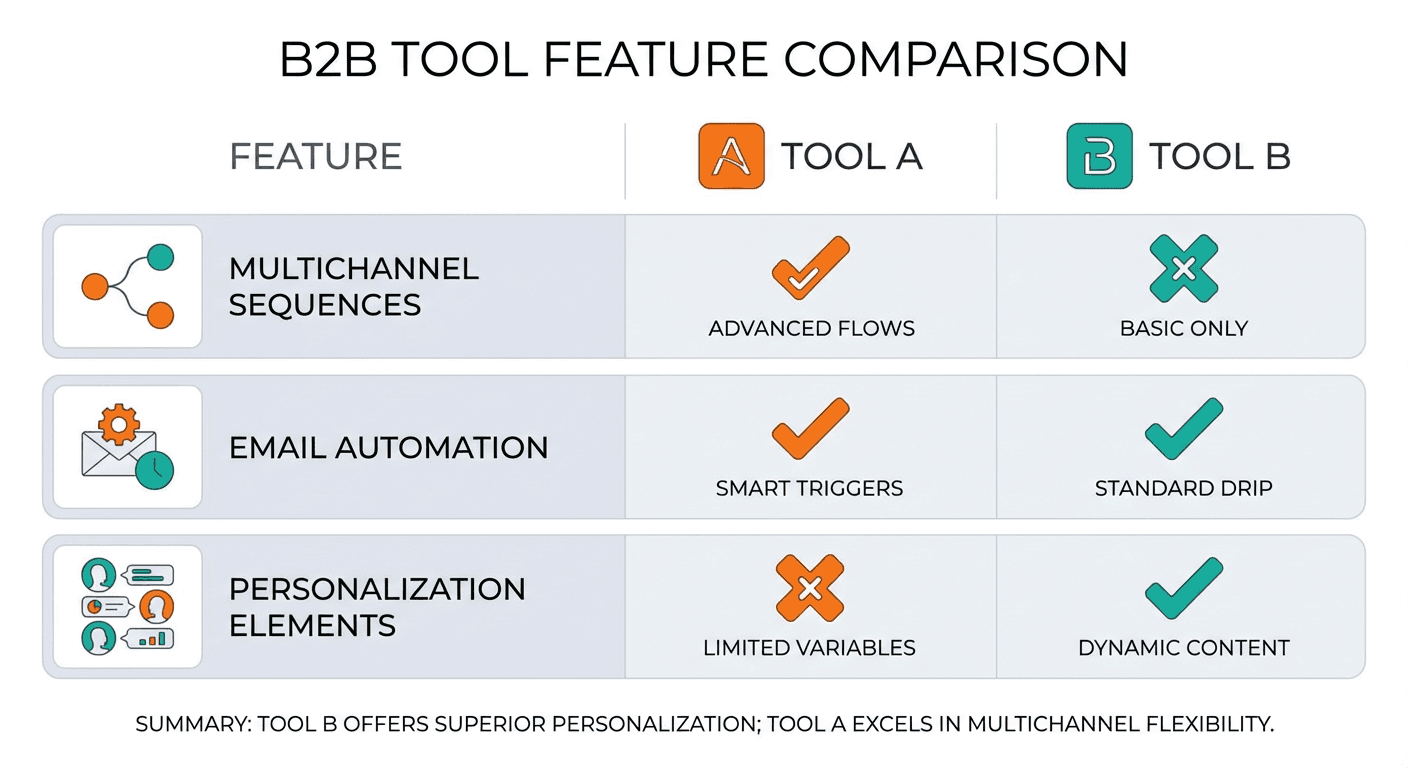
Pick lemlist if several people will send email from one account, because its Email plan is one flat price with unlimited users, and if you want a lead database and lemwarm included. Pick Reply.io if you run client accounts, since it has a dedicated agency plan, or if you want LinkedIn, SMS and calls bundled at one per-user price on monthly billing.
On the two Multichannel tiers, the plans that sit closest to each other, the gap is small enough that the billing toggle decides it: lemlist is $2 cheaper per user on yearly billing and Reply.io is $10 cheaper on monthly.
Understanding the Core Difference
Both platforms run multichannel sequences across email and LinkedIn, and both now list calls, SMS and WhatsApp. The real difference is what each one counts when it bills you.
Lemlist counts users and senders. Its Email plan card reads unlimited users and 50,000 emails a month. Its Multichannel plan is priced per user, with 5 senders per user and unlimited emails and messages. Nothing on the page meters how many prospects you hold: both plans list unlimited contacts.
Reply.io counts active contacts. Its pricing page defines the term: "Active contacts is the number of unique contacts you can send 1 first-step email and an unlimited number of follow-ups per month." The Email Volume plan is a slider on that number. The first four steps, 1,000 to 5,000 contacts, are charged per user. From 10,000 contacts upward the price covers unlimited users.
That definition matters more than it looks for anyone sending one message per prospect. On a programme like that, every send is a first-step email, so the active contact ceiling is simply the number of new people you can reach that month.
Pricing Comparison
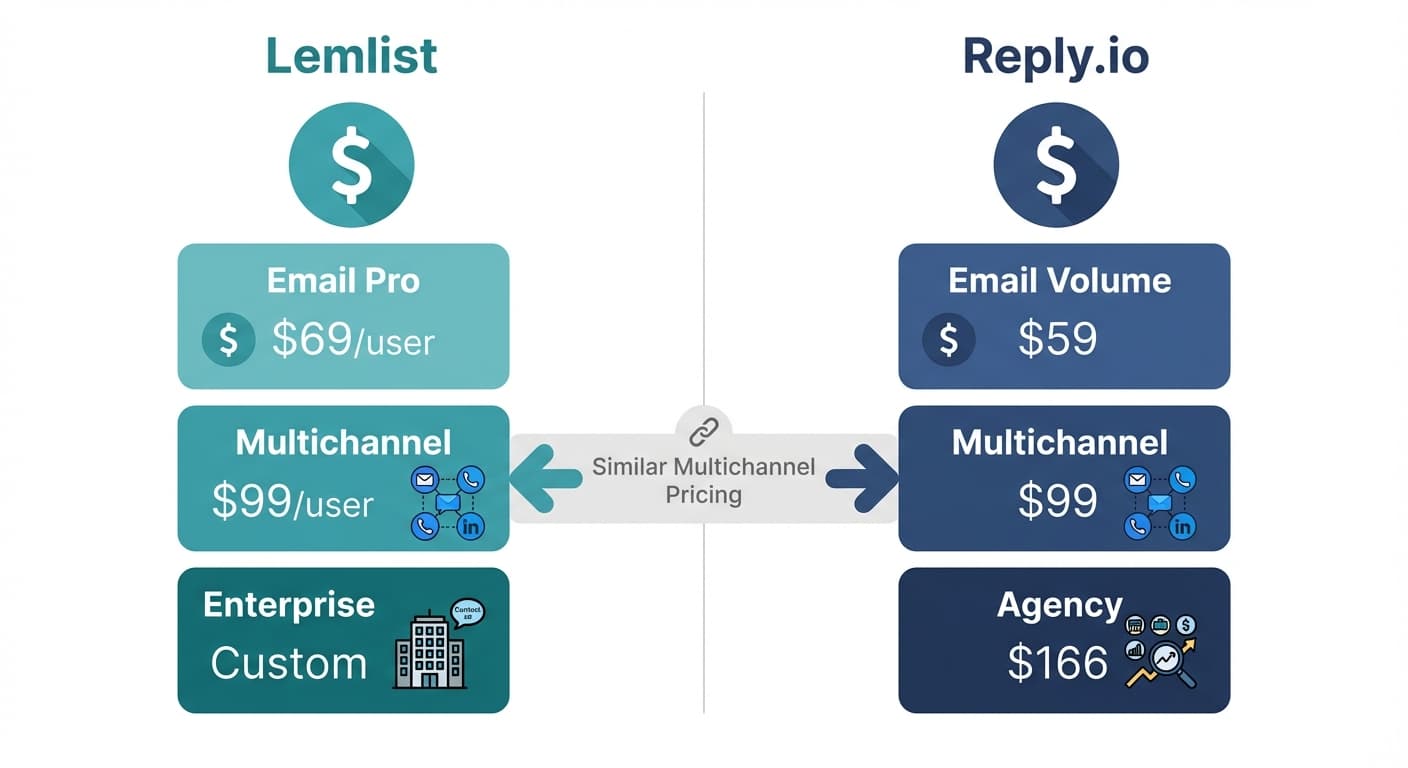
Lemlist Pricing
| Plan | Billed monthly | Billed yearly | What the card lists |
|---|---|---|---|
| $69 a month | $55 a month | Unlimited users, 50,000 emails a month | |
| Multichannel | $109 per user | $87 per user | 5 senders per user, LinkedIn, SMS, call dialer |
| Enterprise | Custom | Custom | Teams of 5+ users, 5 or more senders per user |
The page offers three billing states and says quarterly billing saves 10% and yearly saves 20%. The lead database of 650M+ contacts, lemwarm and the deliverability tools are listed as included in all plans. Finding contact details is metered separately in credits, at 1 credit to $0.01: a verified email costs 5 credits and a phone number 20. The 14-day free trial gives full access to the Multichannel plan with no credit card.
Source: lemlist.com/pricing
Reply.io Pricing
| Plan | Billed monthly | Billed annually | What the card lists |
|---|---|---|---|
| Email Volume | from $59 per user | from $49 per user | 1,000 active contacts on the first step, unlimited mailboxes |
| Multichannel | from $99 per user | from $89 per user | Email, LinkedIn, SMS and calls; unlimited active contacts on annual billing |
| Agency Core | from $210 a month | Unlimited clients and users, multiple client workspaces | |
| AI SDR Starter | from $800 a month | from $500 a month | 1,000 active contacts, Jason AI |
On Email Volume the other channels are add-ons: LinkedIn automation at $69 per account a month, and calls and SMS at $29 per account. Email warmup is included with every mailbox, and every plan lists 50 live data credits a month. The Multichannel card lists 10 mailboxes on annual billing and 5 on monthly.
Deciding whether Reply.io's flexible contact pricing fits your budget gets easier after seeing how it stacks up against a single flat price in the comparison with GMass.
Source: reply.io/pricing
What The Entry Price Does Not Include
Lemlist's Email plan is email only. LinkedIn automation, SMS and the call dialer start at Multichannel, WhatsApp is an add-on, and enrichment is paid in credits on every plan.
Reply.io's $49 entry is one user and 1,000 active contacts. A second person doubles it, LinkedIn adds $69 per account, and calls and SMS add $29 per account, so an Email Volume seat with both add-ons costs more than a Multichannel seat.
Two Worked Examples
The arithmetic below is illustrative, built on invented teams and the list prices above on yearly billing.
A five-person team sending email only, each reaching 1,000 new prospects a month, pays lemlist $55 in total, because the Email plan does not count users. The same team on Reply.io's Email Volume plan pays five times $49, which is $245. A three-person team that needs email and LinkedIn for everyone pays 3 times $87, or $261, on lemlist Multichannel and 3 times $89, or $267, on Reply.io Multichannel. Building the same thing on Reply.io from Email Volume seats plus three LinkedIn add-ons costs $147 plus $207, which is $354, so the bundle wins as soon as every rep needs LinkedIn.
| Team | lemlist | Reply.io |
|---|---|---|
| Five people, email only 1,000 new prospects each a month | Email plan: $55 flat, unlimited users | Email Volume: 5 x $49 = $245 charged per user |
| Three people, email and LinkedIn | Multichannel: 3 x $87 = $261 | Multichannel: 3 x $89 = $267 or Email Volume plus three LinkedIn add-ons: $147 + $207 = $354 |
Channels
Older comparisons, an earlier version of this one included, gave channel breadth to Reply.io. That no longer holds on the published pages. Lemlist's site describes reaching leads via email, LinkedIn, calls, WhatsApp and SMS from one workflow, and its Multichannel card lists LinkedIn automation, SMS automation, a WhatsApp automation add-on and a built-in call dialer. Reply.io's Multichannel card describes all-inclusive outreach via email, LinkedIn, SMS and phones at one fixed price, and lists WhatsApp as semi-automation.
lemlist
- Email on both plans
- LinkedIn automation in Multichannel
- Call dialer and SMS in Multichannel
- WhatsApp as an add-on
- No extra channels on the Email plan
Reply.io
- Email on both plans
- LinkedIn, SMS and calls inside Multichannel at one fixed price
- LinkedIn on Email Volume for $69 an account
- Calls and SMS on Email Volume for $29 an account
- WhatsApp as semi-automation
The practical difference is packaging. Reply.io lets an email-first team bolt one channel onto one account. Lemlist makes the jump all at once, from the Email plan to Multichannel.
Deciding whether Reply.io fits your stack may also depend on how it stacks up against a Salesforce-native alternative, so see this comparison of Groove and Reply.io for enterprise orchestration needs. One update to that page: Clari and Salesloft completed their merger on December 3, 2025, and Groove is now sold through Salesloft rather than as a separate vendor.
Neither platform can guarantee immunity from LinkedIn restrictions, and LinkedIn automation always carries some account risk whichever tool runs it.
Deliverability
Lemlist's pricing FAQ is direct about this: lemwarm and built-in deliverability protections are included in all plans. The plan comparison lists rotating IPs, a custom tracking domain, a DNS setup test, deliverability testing, sending limits management, inbox rotation and deliverability alerts under the heading included in all plans.
Reply.io's cards say email warmup is included with every mailbox and list an anti-spam and deliverability suite, described as a set of features to ensure your emails reach the primary inbox. Its Email Volume plan lists unlimited mailboxes, subject to a fair usage policy.
Since deliverability prep and outreach execution are separate concerns, see how warmup and cold email tools complement each other before building a sequence.
Both vendors include warmup in the price, so neither page gives a reason to buy a separate warmup tool on day one. What neither page publishes is an inbox placement figure, so treat the two lists as equivalent until your own seed tests say otherwise.
Data And AI
Lemlist bundles a lead database it sizes at 650M+ contacts, and charges credits only when it finds a contact detail. It lists lemAgent, intent signal agents, AI reply intent detection and an MCP server under AI-powered outbound, included in all plans.
Reply.io includes 50 live data credits a month, drawn from what it describes as 1 billion B2B contacts, and sells its AI as a separate product. Jason AI SDR starts from $500 a month on annual billing for 1,000 active contacts, or $800 on monthly billing. That is an autonomous outreach agent priced on its own ladder, so it belongs in a different budget line from the sequencer.
Integrations
Lemlist's plan comparison names its connectors: HubSpot, Salesforce and Pipedrive as CRMs, Zapier, Make, n8n and Clay for automation, and Aircall and Ringover for calling, plus an API. Reply.io's pricing page lists any channel via a Zapier step, and its site has a separate integrations directory that this comparison did not enumerate.
CRM integrations often work best alongside clean contact data, and this data enrichment tool comparison explains which provider remains directly purchasable today.
Agencies
This is the clearest split on either page. Reply.io sells Agency Core from $210 a month, described as multiple client workspaces under one agency umbrella, with unlimited clients and users, an agency dashboard, role-based access control and white-label as an option. LinkedIn is optional on it at $69 per LinkedIn account. Lemlist's pricing page lists no agency plan. Its unlimited-user Email plan suits one company with many senders, which is a different thing from many clients kept apart.
Who Picks Which
- Several senders, email only: lemlist Email. One price covers everyone.
- An agency with client workspaces: Reply.io Agency Core.
- A small team that needs LinkedIn for every rep: the Multichannel tiers are within $2 on yearly billing, so choose on the bundle. Lemlist includes the lead database and lemwarm. Reply.io includes SMS and calls at the same price.
- An email-first team that wants LinkedIn for one person: Reply.io Email Volume with one $69 add-on.
- Anyone wanting an autonomous AI SDR: only Reply.io prices one, from $500 a month.
Switching Between Them
Both trials run 14 days, and lemlist's needs no credit card, so a side by side test costs nothing. Three things deserve care in a real migration. Export the contacted history first, because it is your suppression list and neither tool can rebuild it. Reconnect and re-warm mailboxes in the new tool before moving volume, since warmup history does not travel. And check the meter before importing: a lemlist list of any size drops into Reply.io only as fast as the active contact allowance lets you start new people.
Where These Sit In A Cold Outbound Programme
Both products are built around multi-step sequences, and that is worth stating plainly against how RevenueFlow runs outbound: one message per campaign, with no bumps and no thread replies, and no LinkedIn message sent under one a prospect ignored. A team working that way uses one step of a sequence builder, so the deciding numbers are the meters. Reply.io's active contact count equals the new prospects you can reach in a month. Lemlist's Email plan allows 50,000 emails a month whoever sends them. Size the plan against the wave, and agree what counts as a qualified meeting in writing before launch.
Feature Comparison Summary
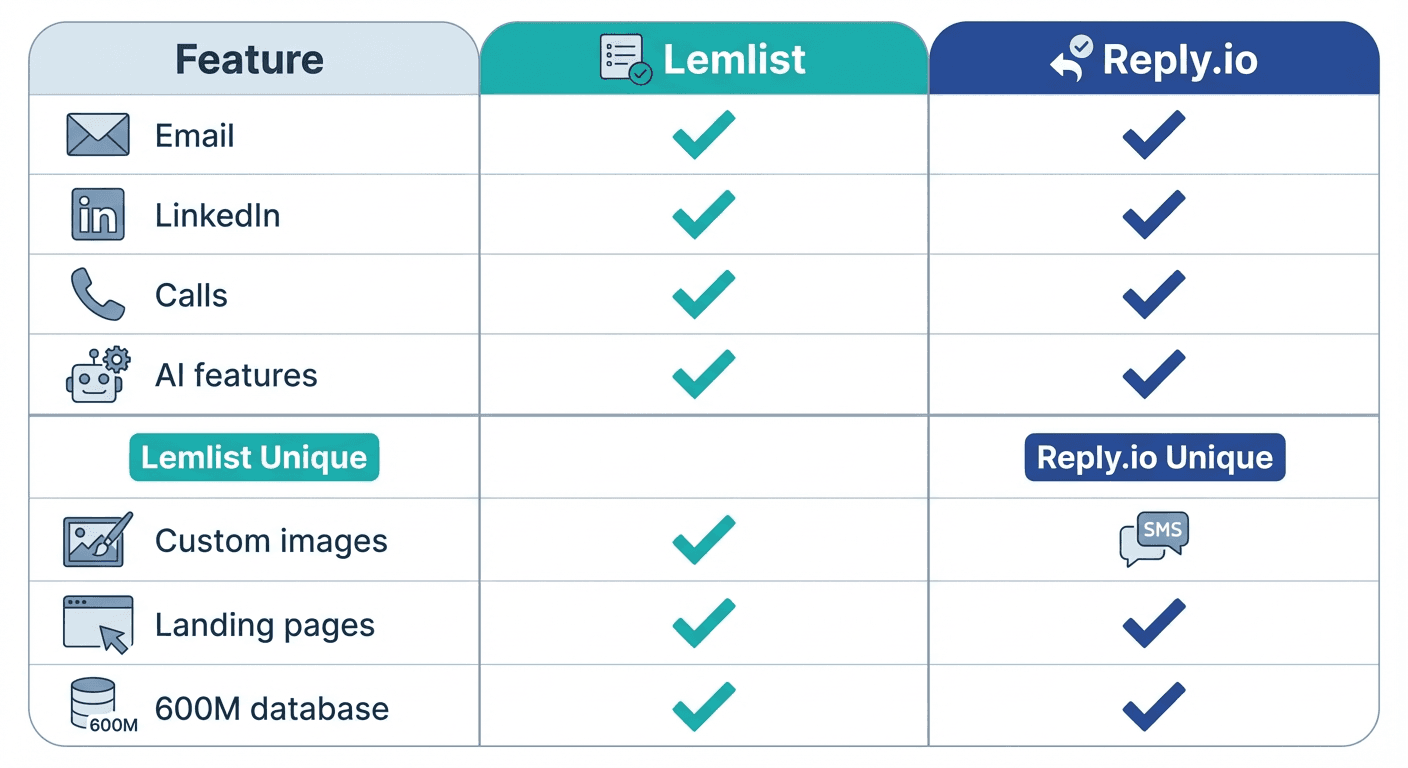
| Feature | Lemlist | Reply.io |
|---|---|---|
| Entry price, monthly billing | $69 a month, unlimited users | $59 per user a month |
| Entry price, yearly billing | $55 a month | $49 per user a month |
| What it meters | Users and senders | Active contacts |
| Multichannel, yearly billing | $87 per user | $89 per user |
| Email warmup | lemwarm, all plans | Included with every mailbox |
| LinkedIn automation | In Multichannel | In Multichannel, or a $69 add-on |
| SMS and calls | In Multichannel | In Multichannel, or a $29 add-on |
| Add-on | Semi-automation | |
| Lead data | 650M+ database, credits per find | 50 live data credits a month |
| Agency plan | Not listed on the pricing page | Agency Core from $210 a month |
| Free trial | 14 days, no credit card | 14 days |
Final Thoughts
Lemlist and Reply.io have converged on channels, so the old shorthand of personalization against breadth no longer separates them. The meters do. Lemlist charges for users and gives one plan to everybody at a flat price. Reply.io charges for active contacts, gives agencies their own plan, and lets a team add one channel at a time. Work out which meter your team trips first, check the billing toggle, and the choice mostly makes itself.
Related Reading
- Lemlist vs Smartlead: Which Cold Email Platform Fits Your Outreach Strategy?
- Instantly vs Lemlist: Complete Cold Email Platform Comparison for 2026
- Reply.io vs Smartlead: Which Cold Email Platform Fits Your Outreach Strategy?
If you would rather have this run for you, RevenueFlow books qualified meetings on a pay-per-meeting basis and publishes client results.
Pricing and features are taken from the vendors' own pages. Verify current terms with the vendor before relying on them.
Frequently asked questions.
Frequently asked questions- Is Reply.io or lemlist cheaper?
- It depends on headcount and billing. For several people sending email, lemlist is cheaper, because its Email plan is a flat $69 a month with unlimited users while Reply.io charges $59 per user. On the Multichannel plans lemlist is $87 against $89 per user on yearly billing, and Reply.io is $99 against $109 on monthly billing.
- What is an active contact on Reply.io?
- Reply.io's pricing page defines it as the number of unique contacts you can send one first-step email and an unlimited number of follow-ups per month. The Email Volume plan is a slider on that number, starting at 1,000 contacts. For a team that sends one message per prospect, it is simply the number of new people you can reach each month.
- Does lemlist have SMS and WhatsApp like Reply.io?
- Yes. Lemlist's pricing page lists SMS automation, a WhatsApp automation add-on and a built-in call dialer on its Multichannel plan, alongside LinkedIn automation. Reply.io's Multichannel plan bundles email, LinkedIn, SMS and calls at one fixed price and lists WhatsApp as semi-automation. Older comparisons that give channel breadth to Reply.io alone are out of date.
- Which is better for agencies, lemlist or Reply.io?
- Reply.io, on the published pages. It sells an Agency Core plan from $210 a month with multiple client workspaces, unlimited clients and users, an agency dashboard, role-based access control and optional white-label. Lemlist's pricing page lists no agency plan. Its unlimited-user Email plan suits one company with several senders rather than separate client accounts.
About the author.

Tim Carden is CMO / CTO at RevenueFlow, which builds and operates outbound revenue engines for B2B companies. Studied at McGill University.
Tim Carden · CMO / CTO
Connect on LinkedIn →Explore more.
Ready to scale your outreach?
We build GTM engines that book real meetings. See the receipts.
Related articles.
Mailshake vs Pipedrive: A Sender and a CRM, Side by Side
Mailshake sells per-user sending with a two-way Pipedrive sync from its middle tier; Pipedrive is a per-seat CRM with sequences from Growth. Both read 18 September 2026.
Chili Piper vs LeanData: Form-First Against CRM-First
Chili Piper publishes a seat floor and bundles scheduling and chat; LeanData prices by Salesforce object and sells scheduling separately. Both read 18 September 2026.
Zoom Revenue Accelerator vs Gong: An Add-On vs a Platform
Zoom's support centre documents Revenue Accelerator as a licence on a Zoom account in two classes; Gong sells a platform per user plus a platform fee. Neither has a rate.
Cognism vs Upcell: A Data Provider Against a Data Layer
Cognism sells compliance-first contact data by quote and credit; Upcell sells a layer that runs your providers, Cognism included, through one record. Read 18 Sep 2026.
PromptLoop vs ZoomInfo: Web Research Against a Database
PromptLoop builds a dataset from the live web in credits it publishes; ZoomInfo sells access to a maintained database by quote. Both pages read 18 September 2026.
Metadata vs 6sense: Paid Media Execution vs Intent
Metadata runs paid B2B campaigns through seven AI agents; 6sense ranks accounts on intent and sells contact data by credit. Neither publishes a rate. Read 18 Sep 2026.