Pipedrive vs Infusionsoft: One of Them Is Now Keap
Infusionsoft is sold as Keap, and the two products meter on different units. One charges by the seat, the other by the contact, and that decides it.

Pipedrive vs Infusionsoft is now Pipedrive vs Keap, and the two meter different things. Pipedrive prices per user across Lite, Growth, Premium and Ultimate, with add-ons. Keap sells one platform from $299 a month with two user licences and 1,500 contacts to start, plus required implementation and metered text and voice.
Key takeaways
- Infusionsoft is sold as Keap: keap.com's copy never uses the old name, though its log in link still points at an infusionsoft address and its header reads Keap, A Thryv, Inc. Brand.
- Keap's pricing page sells one platform starting at $299 a month billed monthly, or $2,988 a year, with two user licences included and further users at $39 a month each.
- Pipedrive bills per user across four plans, so its bill moves with headcount; Keap's contact meter moves with the size of the database.
- Keap's page adds required implementation, metered text and voice above 500 messages and 100 minutes, and a $299 early termination fee on annual contracts.
Reviewed and updated October 1, 2026
Type keap.com into a browser and read the page carefully. The word Infusionsoft appears nowhere in the copy, and the header now reads Keap, A Thryv, Inc. Brand. The log in link still points at accounts.infusionsoft.com, and the partner portal link at an address that carries the infusionsoft name too. The brand left the marketing and stayed in the plumbing, which is a fair summary of where Pipedrive vs Infusionsoft starts.
That matters because the search itself is out of date. Anyone comparing Pipedrive with Infusionsoft is comparing a current product against a name its owner retired, and most of the pages answering that search quietly swap in the new name and carry on as though nothing changed. Something did change, and it is not only the name.
Pipedrive vs Infusionsoft: The Short Answer
Infusionsoft is sold as Keap now, and the two products meter different things. Pipedrive prices per user across four plans, Lite, Growth, Premium and Ultimate, with add-ons on top. Keap sells one platform from $299 a month, with two user licences and 1,500 contacts in its opening configuration, plus required implementation. A team that grows by hiring suits Pipedrive; a business whose list outgrows its payroll suits Keap.
What Infusionsoft refers to now
Keap sells one product. Its pricing page on keap.com opens with the line "Say goodbye to feature-based plans." and offers to "Get the entire Keap software platform starting at one low price". There is no tier ladder to compare against Pipedrive's, because there is only one edition.
The price on that page starts at $299 a month billed monthly, or $2,988 a year on the annual state of the same toggle, and the page's own default configuration is 1,500 contacts and two user licences. Its billing questions state that "Keap starts you off with 2 user licenses." The same page puts the rate for each further user licence at $39 a month. That is not a seat-priced product with a generous entry tier. It is a platform sold as one line item to a business, with a small seat allowance attached.
Pipedrive sells the opposite shape. Its own comparison page for this pair lists four plans, each priced per user per month: Lite from $14, Growth from $39, Premium from $49 and Ultimate from $79 billed annually, or $24, $49, $79 and $99 billed monthly, with LeadBooster, Web Visitors, Campaigns, Projects and Smart Docs sold as add-ons. The pricing page itself sets the currency by location and served pounds when this page was checked: the same four monthly numbers (£24, £49, £79 and £99) and one annual figure that differs, Premium at £59 a seat rather than the comparison page's $49. Read the rate in your own browser before you sign. The same pair under Keap's current name is compared in Pipedrive vs Keap.
So the comparison is not two CRMs at different price points. It is a per seat subscription with a modular catalogue against a single bundled platform metered on contacts.
The meter is the difference
Almost every published comparison of these two products argues about features. The features overlap heavily, and both vendors admit as much on their own pages: both build a visual pipeline, both automate follow-up, both carry a mobile application, both import from a spreadsheet. Pipedrive's own comparison page for this pair, published on its blog, gives Keap a fair reading on contact management, pipeline, mobile access and customisation, and the honest conclusion is that neither is missing anything the other treats as basic. It is out of date on Keap's price, though: it still describes Keap Pro, Max and Ultimate at $159 to $229 a month with two or three users included, while Keap's own pricing page now opens with "Say goodbye to feature-based plans." and one platform from $299.
What actually diverges is what each vendor counts.
Read that table as a statement about who each vendor thinks it is selling to. A seat meter is a bet that the buyer is a sales team that will grow by hiring. A contact meter is a bet that the buyer is a business whose list grows faster than its headcount, which is the shape of a coaching practice, an agency, a franchise or any operation that markets to a large audience and sells with two or three people.
That single distinction resolves most of the confusion in this comparison. A five person sales team with 40,000 contacts and a four person marketing operation with 900 contacts are pointed in opposite directions by the same two rate cards, and no feature grid will tell them so.
The two things Keap's page adds to the bill
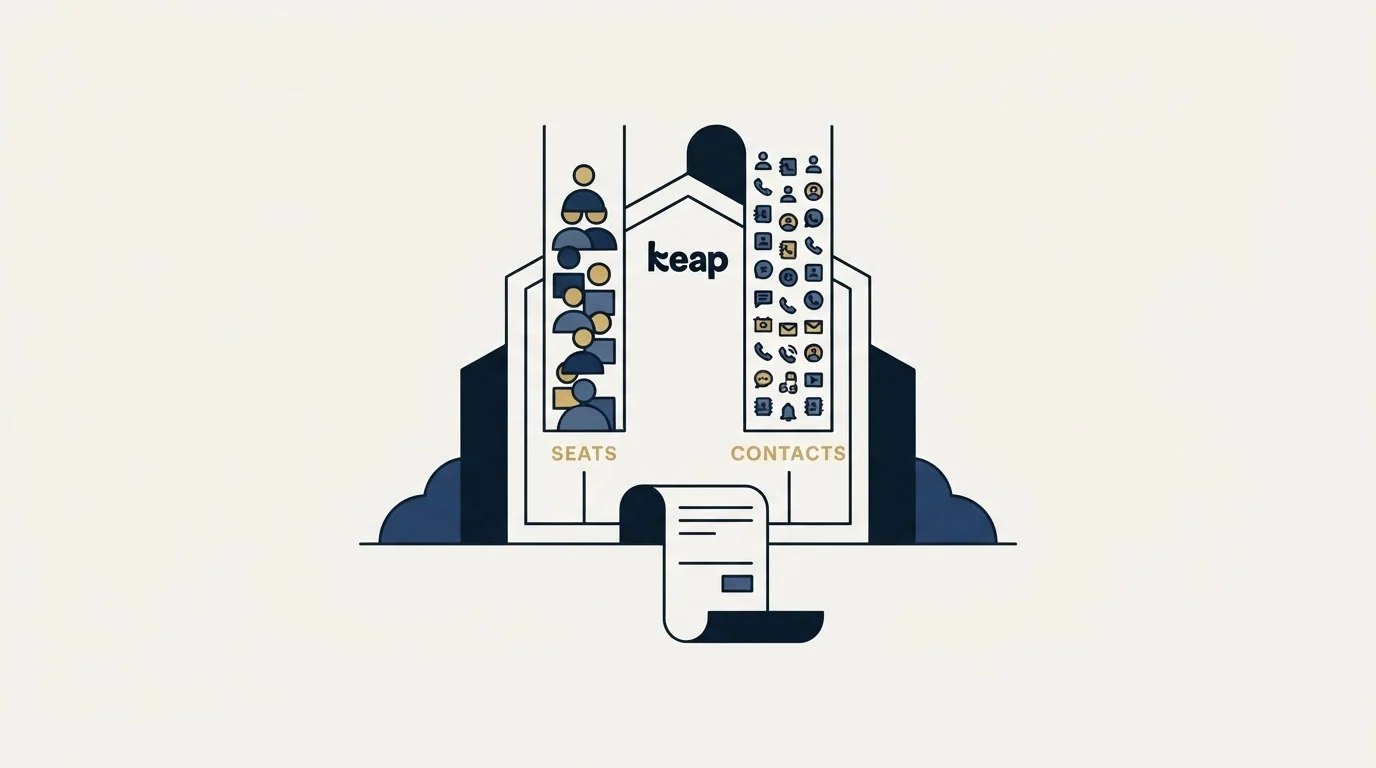
Two entries on Keap's pricing page belong in any budget built from it, and neither is a plan price.
The first is implementation. The page carries the line "Required implementation services help you achieve faster results" above a description covering strategy consulting, data import, migration and done-for-you services. A vendor that describes onboarding as required is describing a purchase with a second invoice attached, and that invoice is not on the rate card. Ask for it in writing before comparing the monthly figure to anything.
The second is metered usage. Keap's own page states that text and voice are included at a first tier of 500 messages and 100 voice minutes, and that usage over the plan allotment is charged at $0.015 per text message and $0.01 per voice minute, with five priced tiers above the included one, running from $24 a month to $279 a month. A platform that sends on your behalf will meter the sending, and a business that switches on text marketing has added a variable line to a bill it chose for predictability.
A third line applies only on the way out. The same page states a $299 early termination fee for cancelling an annual contract before the end of its one-year term.
Keap · what the pricing page adds up to
Platform, starting at $299 a month billed monthly, or $2,988 a year 1
Further user licences at $39 a month each, after the two included 2
Required implementation services, quoted separately 3
Text and voice above 500 messages and 100 minutes: tiers from $24 to $279 a month 4
On an annual contract, a $299 early termination fee 5
- 1The opening configuration is 1,500 contacts and two user licences; the contact meter moves this line.
- 2The only line that tracks headcount.
- 3A second invoice that is not on the rate card: ask for it in writing.
- 4Overages run $0.015 per text message and $0.01 per voice minute.
- 5Applies only if you cancel before the one-year term ends.
Pipedrive's version of the same problem is different in kind rather than in size. Its subscription is priced per user, its add-on catalogue is where a plan comparison usually goes wrong, and its comparison page says usage limits increase by plan. The mechanics of all three, including the audit almost nobody runs before renewal, are worked through in what actually decides a Pipedrive bill.
Working out which shape you are
The arithmetic below is invented to show how the two meters behave. It uses the published figures attributed above: Keap's from its pricing page, and Pipedrive's in dollars from its comparison page, so the two are never added across currencies. Every quantity in the example is invented.
Take an invented six person team with 1,200 contacts. On Keap that sits inside the opening configuration, so the platform price is the price, plus four additional user licences at the per user rate attributed above, plus whatever implementation is quoted: $299 plus 4 × $39 is $455 a month billed monthly, as illustrative arithmetic on Keap's published figures. On Pipedrive it is six seats at the plan rate, so on Growth billed monthly 6 × $49 is $294 a month, plus any add-on the team actually needs. Both are legible, and the seat count is what moves the Pipedrive total.
Now take an invented two person team with 60,000 contacts. On Pipedrive nothing changes: two seats is two seats, and the contact volume affects the bill only where a usage limit binds. On Keap the contact meter is doing the work, and the platform price at that database size is a different conversation entirely.
That is the whole comparison, and it is why a shortlist that includes both products usually means the shortlist was built before anybody counted either number.
| Invented team | Pipedrive | Keap |
|---|---|---|
| Six people, 1,200 contacts | 6 × $49 = $294 a month on Growth | $299 plus 4 × $39 = $455 a month, before implementation |
| Two people, 60,000 contacts | Two seats, whatever the list size | The contact meter decides the platform price |
Where either one sits in a cold outbound stack
Both products are the system of record at the end of an outbound stack, and neither is the thing that should send cold volume. Cold sending belongs on dedicated mailboxes and separate sending domains, because a CRM that sends it sends it from the company's own addresses and puts the reputation of everything else on the same line.
Keap is the one where that boundary is easiest to cross by accident. It bundles marketing automation, campaigns and text broadcasts into the same subscription as the CRM, so switching them on takes no procurement decision at all. The convenience is real and the risk is that the sending decision gets made by whoever is configuring the automation rather than by anyone thinking about deliverability.
Pipedrive's comparison page describes its Growth plan as adding "full email sync with tracking, automations and nurturing sequences". That is standard practice in this category and it is not how campaigns run here. This site sends one message per campaign, with no bumps and no thread replies. The reasoning is set out in why one message beats a sequence, and the practical consequence is that the sequencing depth both vendors sell hardest is the part of either product that matters least to a programme run this way.
What does matter from either CRM is narrower and easy to test in a trial. The meeting has to be recorded against the account with enough structure to join it back to the campaign that produced it. The record has to be exportable as the list of accounts that are off limits, because that is what the next build suppresses against. And meetings are qualified against criteria agreed in writing before launch, so whichever system holds that definition should hold it as a field rather than as a note.
What to check before switching either way
Moving off Pipedrive to Keap is a change of unit as well as a change of tool. The contact database becomes the thing that costs money, so the migration is the moment to decide which of those records deserve to move rather than importing the lot and discovering the meter afterwards.
Moving off Keap to Pipedrive is the reverse trade. The automation, campaigns and payment collection that lived in one subscription have to find homes, and some of them will not have one. That decision belongs before the migration date rather than after it, and the wider question of which of those jobs is a separate purchase is priced out in the four things sold as sales automation software.
In both directions, export a full backup while the subscription is still live, custom fields and report definitions included. Reports are what teams forget and cannot rebuild from memory.
Pipedrive and Infusionsoft integration
Neither page fetched for this comparison names a direct connector between the two. Keap's pricing page lists a native Zapier integration for connecting thousands of software tools and open API endpoints with webhooks, and Pipedrive's comparison page lists 500+ integrations in its Marketplace plus Zapier and Make automations. A team running both would join them through Zapier or the two APIs, and should decide which system owns contacts and which owns deals before switching the sync on, because a two-way sync with no owner writes the same record back and forth.
The short version
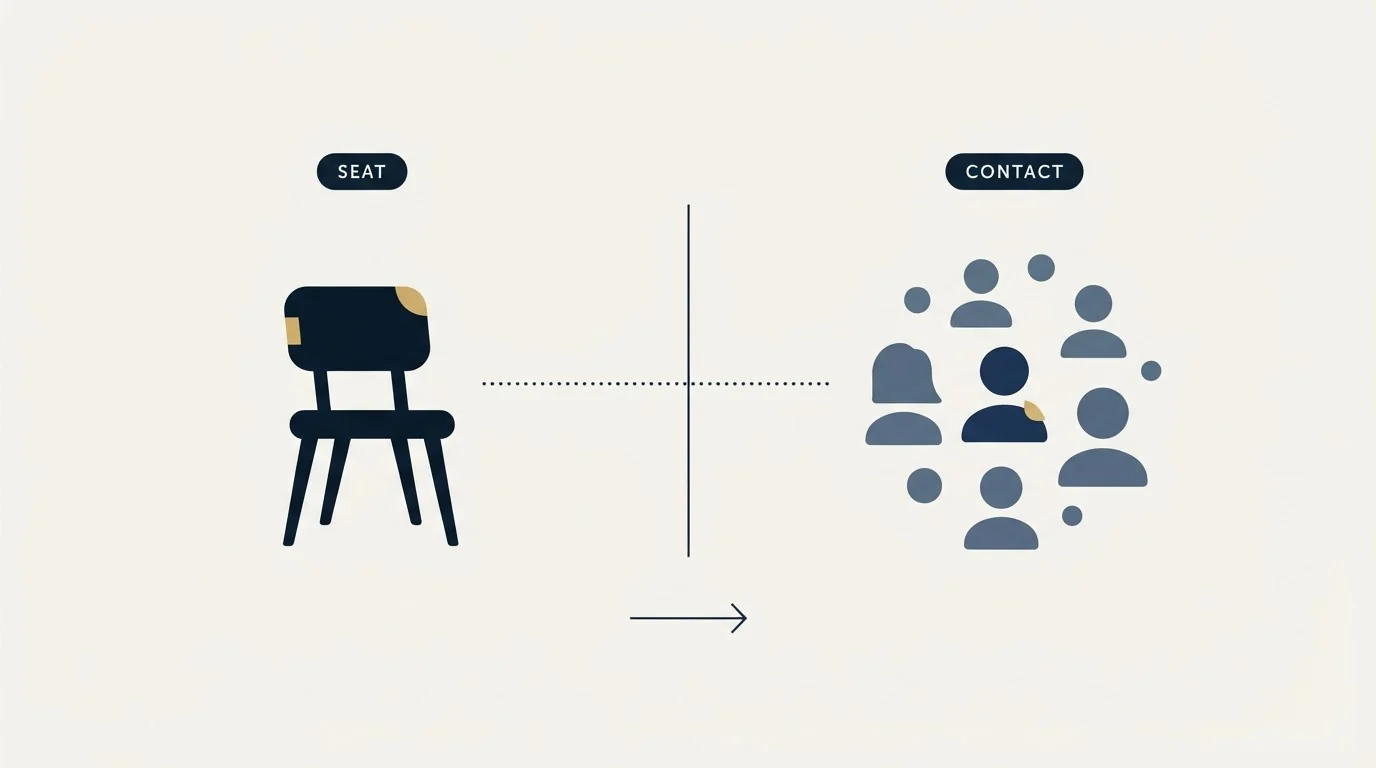
Infusionsoft is sold as Keap now, and Keap sells one platform priced on contacts with two user licences included, implementation described on its own page as required, and text and voice metered above an included allowance. Pipedrive sells four per seat plans and a catalogue of add-ons, and its bill moves with headcount rather than with database size.
Compare the meters before the features. A sales team that grows by hiring is a seat-priced buyer. A business whose list grows faster than its payroll is a contact-priced buyer. Where the honest answer is that the pipeline is thin rather than badly recorded, see what a campaign built for your market produces before choosing either one. If the pipeline tool itself is the question, the wider field is in the alternatives to Pipedrive worth a look.
Pricing and features are taken from the vendors' own pages. Both pricing pages carry billing toggles and can render regional currencies, so verify current terms in your own browser before relying on them.
Sources: Keap pricing, Keap, Pipedrive pricing, Pipedrive on Pipedrive vs Infusionsoft
Frequently asked questions.
Frequently asked questions- Is Infusionsoft the same as Keap?
- Yes. Keap is the product Infusionsoft became, and keap.com's copy no longer uses the old name, though its log in link still points at accounts.infusionsoft.com. The header now reads Keap, A Thryv, Inc. Brand. Keap sells one platform rather than the Pro, Max and Ultimate tiers older comparison pages still describe.
- Is Pipedrive or Keap cheaper?
- It depends which unit grows. Keap starts at $299 a month with two user licences and 1,500 contacts, adding $39 a month per extra user, so an invented six-person team with a small list pays $455 a month before implementation. Pipedrive charges per user on every plan and ignores list size, so a two-person team with a large list is buying two seats there and a large contact tier on Keap.
- Does Pipedrive integrate with Keap?
- Neither vendor's page fetched for this comparison names a direct connector. Keap's pricing page lists a native Zapier integration and open API endpoints with webhooks, and Pipedrive's comparison page lists 500+ Marketplace integrations plus Zapier and Make. A team running both would connect them through Zapier or the APIs, with one system owning contacts and the other deals.
- What does Keap charge on top of the monthly price?
- Keap's pricing page describes implementation services as required and quotes them separately, meters text and voice above an included 500 messages and 100 voice minutes with tiers from $24 to $279 a month and overages of $0.015 per text and $0.01 per minute, and charges a $299 early termination fee on annual contracts.
About the author.

B2B cold email experts helping companies generate qualified leads through done-for-you outreach campaigns.
RevenueFlow Team
Explore more.
Ready to scale your outreach?
We build GTM engines that book real meetings. See the receipts.
Related articles.
Best CRM for Google Workspace: What Lives in Gmail
Working with Google Workspace covers four separate integrations, and most of the category ships as a browser extension. What five vendors publish about theirs.
Which CRMs and Tools the Outbound Stack Connects To: Integration Data From 342 Sales Tools
HubSpot is named as an integration by 52.3% of 342 verified sales tools, Zapier by 50.3% and Salesforce by 43.3%. Here is the full map by category.
Social Selling Tools by Job, and the Account-Risk Line
Fourteen social selling tools sorted into six jobs, split by whether each acts through your LinkedIn account or beside it, from the vendors' own pages.
Video Prospecting Tools by Job: What Each One Is For
Ten video prospecting tools sorted by the job each vendor's own page describes: record and share, personalise at volume, avatars, hosting and interactive demos.
Is Clay Free? The Free Plan, the Trial and Where Each Stops
Clay's free plan, its 14-day trial and the no-charge-on-a-miss rule are three different things. What each holds and where it stops, from clay.com on 19 September 2026.
Seamless.AI Email Finder: How It Works, What a Credit Buys
How Seamless.AI's email finder resolves a contact in real time, what one Universal Credit buys, the Total AI score on every address, and what the Chrome extension reads.