Recruiter Cold Calling: You Are Making Two Different Calls
Calling a candidate and calling a hiring manager share only the handset. Different buyers, objections, success criteria, and regulatory footing.

Recruiters make two cold calls that share nothing but the phone. The candidate call offers a person something for themselves and succeeds as a conversation. The client call asks a business to buy and succeeds with a defined next step. Running both off one script, one metric and one policy gets both wrong.
Key takeaways
- The register that works on a candidate reads as pressure on a hiring manager, which is why sourcers moving into business development sound like they are selling excitement rather than solving a staffing problem.
- The FTC's business-to-business telemarketing exemption plainly covers a call to a hiring manager and does not obviously cover a call to a candidate's personal mobile, so one internal policy cannot be correct for both.
- The strongest business development opening is a specific real candidate for a visible real need, and it only works if the candidate exists and has agreed to be represented.
- Reporting both calls against one activity target shifts effort toward the client call and quietly stops the bench being replenished, which surfaces months later as a sourcing problem.
Reviewed and updated August 28, 2026
A recruiter's week contains two kinds of cold call that share nothing except the handset. One is to a person who might want a job. The other is to a company that might pay a fee. They have different buyers, different objections, different definitions of success, and, in the United States, a different regulatory footing.
Almost all published advice on recruitment cold calling treats them as one activity. That is the single most expensive assumption in the discipline, because a recruiter who has internalised the candidate call and then applies it to a hiring manager will sound, accurately, like someone selling a job to a person who is not looking for one.
If you are reading this as one of the recruiters it is written for, the persona-specific version of this playbook lives in our guide to outbound for recruiters.
Two calls, and what actually separates them
The candidate call offers the recipient something for themselves. Whatever else is happening, the proposition is personal: more money, better work, a shorter commute. The recipient's decision is made alone, is emotionally weighted, and carries a confidentiality risk that belongs entirely to them.
The client call asks a business to spend money on a service. The proposition is commercial, the decision may involve other people, and the person answering has no personal upside beyond solving a problem they are accountable for.
- Offers the recipient something personal
- Decision made alone, often emotionally
- Confidentiality is the recipient's risk
- Success is a conversation, not a commitment
- Usually to a personal mobile
- Asks a business to spend money
- Decision may involve others
- Risk is commercial and reputational
- Success is a defined next step
- To a business line, about a business problem
The tone that works on the first reads as pressure on the second. Enthusiasm about an opportunity is appropriate when you are describing someone's potential next job and inappropriate when you are asking a hiring manager to change supplier. Recruiters who came up through sourcing and moved into business development frequently carry the first register into the second without noticing, and the tell is that their client calls sound like they are selling excitement rather than solving a staffing problem.
The regulatory difference nobody mentions
This one is genuinely worth knowing and is almost absent from recruitment sales content.
Business-to-business calling in the United States sits in a relatively permissive position. The Federal Trade Commission's Telemarketing Sales Rule exempts "Telephone calls between a telemarketer and any business to induce the purchase of goods or services", with carve-outs that keep its misrepresentation prohibitions in force (16 CFR 310.6).
A business development call to a hiring manager is squarely that kind of call. A call to a candidate's personal mobile about a job is not obviously that kind of call at all, and reasoning from one to the other is exactly the mistake the shared-script habit encourages.
Separately, any calling that uses an autodialer or an artificial or prerecorded voice falls under the Federal Communications Commission's delivery restrictions, which prohibit initiating such calls to the enumerated line types without the required consent (47 CFR 64.1200). Recruitment technology increasingly includes dialling automation, and adopting it moves the activity into that regime.
The general calling-hours provision, where it applies, prohibits calls outside "8:00 a.m. and 9:00 p.m. local time at the called person's location" (16 CFR 310.4). Recruiters call candidates outside office hours by necessity, since that is when candidates can talk, which makes the local-time part worth reading carefully on a national desk.
None of this is legal advice, states impose stricter rules, and data protection law outside the United States changes the analysis substantially. It belongs here because the two calls are usually governed by one internal policy, and one policy cannot be correct for both.
The candidate call, in one section

Three things separate a candidate call that works from one that irritates.
Being specific about why this person. A recruiter who has read the profile and can name the reason for calling gets a different reception from one working alphabetically through a search result. This is the same principle that governs any cold call and it applies with more force here, because the recipient is being asked to consider a personal decision.
Handling the confidentiality question before it is asked. The person may be at their desk, may have colleagues nearby, and has a real interest in nobody knowing. Naming that and offering to talk later removes the largest reason a good candidate ends a call early.
Being honest about the stage. Whether the role is live, retained, or a speculative approach changes what the person is agreeing to, and recruiters who blur it lose the relationship permanently the first time it becomes obvious.
The client call, which is ordinary B2B selling
Business development for a staffing firm is a normal outbound motion with one unusual advantage: the strongest possible opening is available and most firms do not use it properly.
That opening is a specific candidate. Not a description of your process, not your fill rate, not your sector coverage. A person you have actually met who could do a job that company actually has. It works because it is checkable, immediately relevant, and puts something concrete on the table before asking for anything.
- Step 1Find the real need
A posted role, a departure, an announced expansion. Something visible and current
- Step 2Match a real person
Somebody on your bench who could genuinely do it, not a category
- Step 3Lead with the person
The candidate is the reason for the call and the reason it is worth four minutes
- Step 4Ask for the specific next step
A conversation about that person, not a meeting about your capabilities
The discipline this requires is that the candidate has to be real. A speculative call built on a candidate who does not exist, or who has not agreed to be represented, is the fastest way to end a client relationship before it begins, and hiring managers have heard enough of them to test the claim within two questions.
The other failure is calling companies with no visible need at all. This is a targeting problem rather than a calling problem, and it is the recruitment version of the point our cold call appointment setting page makes generally: the opening line is largely determined by who you selected.
The measurement problem specific to recruitment

Staffing firms usually report calling activity as one number, which hides the fact that the two calls have incompatible success criteria.
A good candidate call ends with a conversation, and frequently with nothing else. The person is not looking right now, they were pleasant, and they will remember you when they are. That is a successful call with no recordable outcome for months, which means any scoreboard built on immediate conversion punishes exactly the behaviour that builds a bench.
A good client call ends with a defined next step, and if it does not, something went wrong that is diagnosable this week.
Reporting both against the same target produces a predictable distortion: recruiters shift effort toward whichever call scores better under the shared metric, usually the client call, and the bench quietly stops being replenished. Six months later the firm has business development activity and nobody to present, which presents as a sourcing problem and originated in a reporting decision.
Splitting the two is straightforward and rarely done. Count candidate conversations and bench additions on one side, client conversations and defined next steps on the other, and never sum them into a single activity figure. The point of separating them is that they answer different questions, and a combined number answers neither.
Where the phone runs out, and what covers the rest
The evidence-led approach above is strong and it is also slow. Finding a real need, matching a real person and preparing a specific opening is work, and it caps how many companies a recruiter can approach in a week. That ceiling is the same one every calling motion runs into, worked through in our page on cold calling as a prospecting motion.
A different limitation appears when firms hand that ceiling to marketplace freelancers, where defining the gig deliverable determines whether the work matches what was actually bought.
For a staffing firm, the ceiling bites hard, because the addressable market is usually every company in a sector that hires the roles you place, which is a large number. Covering that at any depth is a written-outreach problem rather than a calling one, and the same evidence-led structure transfers directly: name the real role, name the real candidate, ask for a specific next step. Our guides to cold email for staffing and the recruiting cold email benchmarks cover what that looks like in practice and what response rates the sector actually sees.
The sensible division is the one the arithmetic implies. Written outreach covers the market and finds the companies with a live need. The phone goes to the ones where a need is visible and a specific candidate is ready, because that is where four minutes of a person's attention is genuinely the best available use of it.
The short version
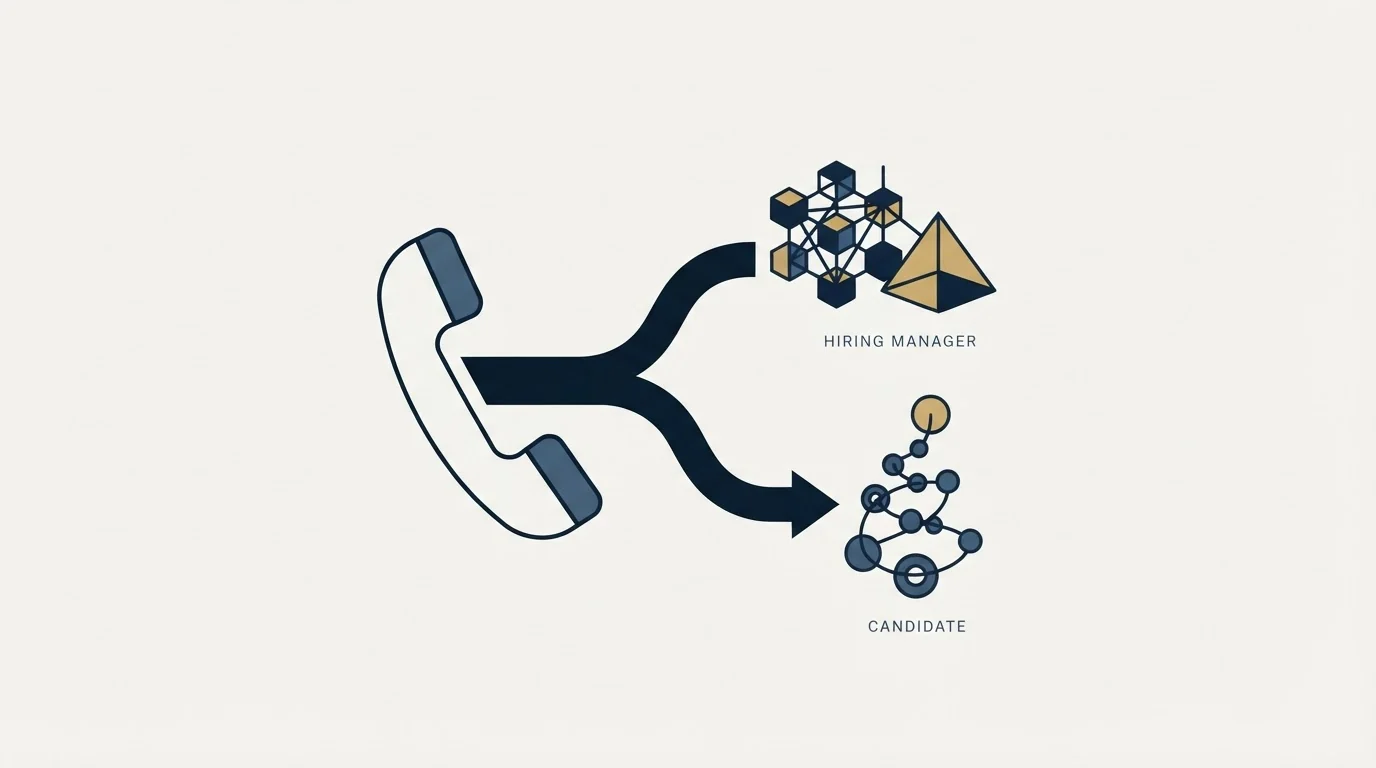
Recruitment cold calling is two jobs. The candidate call offers a person something for themselves and turns on specificity, confidentiality and honesty about the stage. The client call asks a business to buy a service and turns on leading with a real candidate for a real, visible need. They differ in tone, in objection set, in what success means, and in the rules that govern them, so running them off one script and one policy gets both wrong.
If covering an entire sector is the constraint rather than call quality, that is the problem we solve, and the candidate-led structure works in writing as well as it does on the phone.
Regulatory citations verified against the current eCFR text as of mid-2026. Rules change, vary by state, and differ substantially outside the United States; confirm current requirements before relying on them.
Frequently asked questions.
Frequently asked questions- What is the best opening for a recruitment business development call?
- A specific candidate for a role that company visibly has. Not your fill rate, not your sector coverage, not your process. A real person who could do a real job is checkable, immediately relevant, and puts something on the table before you ask for anything. Hiring managers test the claim within two questions, so the candidate has to be real.
- Is cold calling candidates governed by the same rules as calling clients?
- Not necessarily, and treating them the same is the common mistake. The FTC's Telemarketing Sales Rule exempts calls between a telemarketer and a business to induce a purchase, which plainly describes a call to a hiring manager. A call to a candidate's personal mobile about a job is a different act. State law and non-US data protection change the analysis further.
- How should recruiters measure cold calling activity?
- Separately for the two calls. A good candidate call often ends with a conversation and no recordable outcome for months, so scoring it on immediate conversion punishes bench building. A good client call ends with a defined next step. Count candidate conversations and bench additions on one side, client next steps on the other, and never sum them.
- Should recruiters call or email for new business?
- Both, split by what each is good at. The addressable market for a staffing firm is usually every company in a sector that hires your roles, which is far more than a caller can cover. Written outreach covers the market and surfaces live needs; the phone goes to companies where a need is visible and a specific candidate is ready.
About the author.

B2B cold email experts helping companies generate qualified leads through done-for-you outreach campaigns.
RevenueFlow Team
Explore more.
Ready to scale your outreach?
We build GTM engines that book real meetings. See the receipts.
Related articles.
Cold Calling for Food and Beverage Companies: Three Doors
Cold calling for a food or beverage company: who picks up at a chain, a distributor and an independent grocer, where each publishes its door, and when the phone is wrong.
Win Rate Benchmarks: Which Figures State a Population
A catalogue of the published average sales win rates, sorted by whether the page names the population behind its own number. Most do not.
LinkedIn Outreach for Banks: A Regulated Message
How a bank's relationship managers use LinkedIn to reach business owners: what the FFIEC guidance, FINRA's notices and LinkedIn's own rules require, and where to stop.
Cold Calling for PPC Agencies: What You Can See First
A paid media prospect is partly readable before the call and has already been told by the platform what to do when a stranger rings about its ads.
Cold Calling for Consulting Firms: The Partner's Hour
Cold calling for a consulting firm: who it dials and who picks up, why partner-led economics argue against the phone, the client's fiscal year, and when to skip it.
Sales Kickoff Agendas: Five Published, Session by Session
Five publishers print a sales kickoff agenda. They agree on four blocks and disagree on session length, rehearsal and where the agenda comes from.