Sales Prospecting for 3PL Companies: Reading Public Records
Sales prospecting for 3PL and fulfilment companies: what the public import record shows and hides, which job postings signal a need, titles and the show calendar.
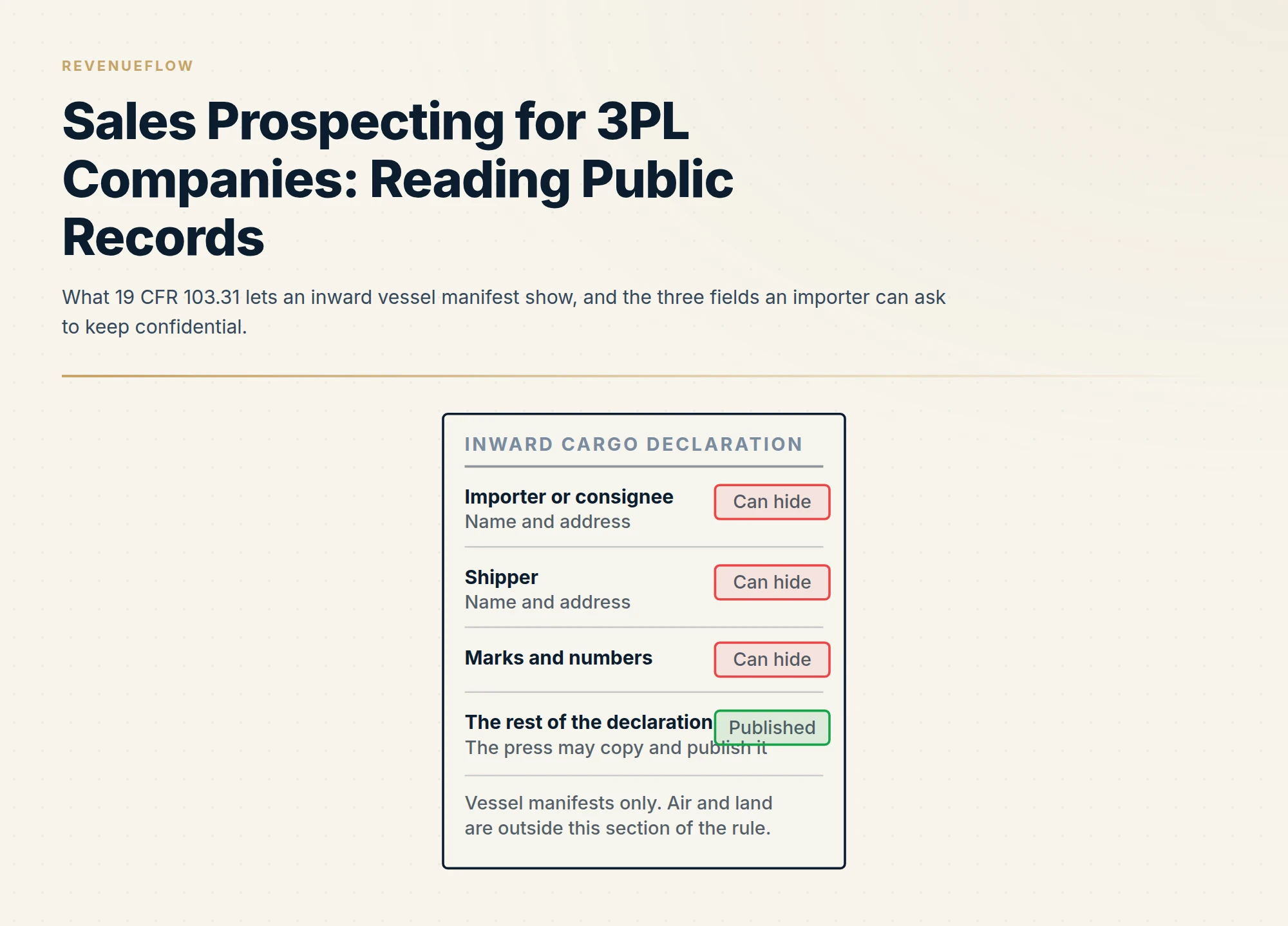
A 3PL can prospect from public records of physical goods. Under 19 CFR 103.31 the inward vessel manifest's cargo declaration may be published, linking consignees to shippers and cargo, though importers can request confidentiality. For accounts that do not import by sea, read facility news and logistics job postings. Pick one or two verticals first.
Key takeaways
- 19 CFR 103.31 says all information on the cargo declaration of the inward vessel manifest may be copied and published by the press.
- The same rule lets an importer or consignee request confidential treatment of its name and address, so import records are strong but incomplete.
- A practitioner on r/sales notes that titles run from warehouse manager up to vice president of operations depending on the size of the account.
- Manifest Vegas lists its next event for February 8 to 10, 2027, which gives a 3PL sales team a dated reason to write in the weeks before.
Reviewed and updated September 18, 2026
A new sales rep at a five-person 3PL has a shared login to a contact database, a colleague building lists remotely, and a target of small companies that need box trucks and less-than-truckload freight. Three months in, he posts to a sales forum: "My only issue is lead generation is terrible and there is no sales pitch." He describes the segment he has been given as "extremely saturated". (r/sales thread, August 11, 2022, fetched September 18, 2026.)
This guide is for 3PL companies, meaning third-party logistics, warehousing and fulfilment providers, whose sales teams prospect shippers and brands. It is about where a 3PL's accounts are listed in public, what those records hold and hide, which titles to look for, and how the trade calendar shapes the year. It is not a guide to selling software to 3PLs; that reader wants our page on cold email for warehousing and 3PL. The generic method is on sales prospecting. The case that every logistics buyer already has a provider, and the public windows when they review one, is made on logistics lead generation, and this guide adds the account layer underneath it.
The rep's problem is a list problem
Look again at what that rep was given: a size band and a service. That is a filter, and as our page on filter and signal prospecting argues, a filter returns the same companies every quarter and gives nobody a reason to reply this week. In logistics the weakness is sharper, because every company on the list already moves its goods somehow.
A 3PL has one advantage most service sellers lack. A large share of what its prospects do is physical, and physical goods crossing a border leave a public record.
The import record, and what the rule lets it contain
When goods arrive in the United States by sea, the vessel's manifest is filed with Customs and Border Protection. Federal regulation decides how much of it can be seen.
The rule is 19 CFR 103.31. For the press, it says: "All the information appearing on the cargo declaration (CBP Form 1302) of the inward vessel manifest may be copied and published." For everyone else it is narrower: "Members of the public shall not be permitted to examine vessel manifests. However, they may request and obtain from CBP, information from vessel manifests". (19 CFR 103.31, eCFR, fetched September 18, 2026.) For outbound cargo the same section lists what may be published: the name and address of the shipper, the general character of the cargo, the number of packages and gross weight, the vessel or carrier, the port of exit, the port of destination and the country of destination.
For a 3PL that is a remarkable thing to have. An inward cargo declaration connects a consignee, the company receiving the goods, to a shipper, a description of the cargo and a vessel. A brand that receives containers every month is a brand that stores, picks and ships product, and the record dates each arrival.
The same rule is also the reason the record is incomplete. It provides that "An importer or consignee may request confidential treatment of its name and address contained in inward manifests, to include identifying marks and numbers", and may ask the same for the name and address of its shippers. CBP's own page on the subject says that while it "cannot guarantee that the identity of parties to importation and exportation will never be published", it "strives to afford confidentiality based on the information furnished", and it offers an online application for making the request. (CBP, Electronic Vessel Manifest Confidentiality, fetched September 18, 2026.)
Three consequences follow for prospecting. The record covers vessel manifests, so goods that arrive by air or over a land border are outside this section. Importers who have asked for confidentiality will not appear by name. And nothing in the record says whether the consignee owns the goods or is an intermediary acting for the company that does, so the name you find is a lead to research. Whatever trade data product you buy, the regulation sets the outer limit of what could be in it. A freight broker reads the same record for a different row, and our page on freight broker lead lists sets out that version: lanes and commodity rather than storage and throughput.
The accounts that never touch a port
Plenty of a 3PL's best prospects import nothing, or import through someone else. For them the account sources are the ones our logistics lead generation page calls the public windows: a new distribution centre or warehouse lease, and hiring for logistics roles. We will not restate that page. What a fulfilment seller adds is the reading.
A brand that posts jobs for warehouse staff of its own is still doing fulfilment in-house, and the number of postings is a rough gauge of strain. A brand that posts for a logistics coordinator or a transportation manager has volume that is outgrowing whoever handles it now. A brand whose careers page goes quiet on warehouse roles while its product range grows may already have outsourced, which makes it a displacement sale and a slower one.
Which titles to look for
The forum thread is useful here too, because a former carrier rep answers the new rep with the question every 3PL seller should be able to answer about an account: "Titles can vary from warehouse manager up to vp of operations depending on the size of the business/opp." The same reply asks whether he has "identified titles you should be calling on", and what his ideal opportunity size is, because the two move together.
That matches the functions our logistics lead generation page describes, from the transportation manager who knows which lanes hurt to the supply chain director who decides whether to run a review at all. For a fulfilment seller the practical split is by size. At a small brand the owner or an operations lead holds the decision, and the record that found the account usually names the company only. At a larger shipper the person who feels the problem and the person who convenes the review are different people, and the message for each is different.
Pick a vertical before you pick accounts
Extensiv, which sells warehouse software to 3PLs, published sales advice for them on July 16, 2026, and its second step is the one that bears on prospecting: "Choosing one or two verticals will allow you to determine a more refined value proposition, providing a more focused approach for your sales team." It is blunt about why: "No one can be everything to everyone." (Extensiv, fetched September 18, 2026.)
Both account sources reward that choice. The cargo description on a manifest says what is in the container, so a 3PL that handles, say, apparel or supplements can read for it. Job postings name the product too. A list built inside one or two verticals is shorter than the size-band list the forum rep was handed, and every row on it comes with a reason.
| Trace | Where it is published | What it suggests |
|---|---|---|
| Monthly containers | Inward vessel manifests, within 19 CFR 103.31 | The brand stores, picks and ships product. |
| Own warehouse hiring | The brand's careers page | Fulfilment is still in-house, and may be straining. |
| Logistics coordinator role | Job postings | Volume is outgrowing whoever handles it now. |
| New facility or lease | Company announcements | New routes the incumbent may not serve. |
The trade calendar
Logistics buys on a calendar, and the contract cycle and peak season windows are set out on our logistics lead generation page. The part a prospecting team can plan around to the day is the show circuit, because the organisers publish it.
Manifest Vegas, which describes itself as bringing together "the most comprehensive ecosystem of those innovating and transforming end-to-end supply chain and logistics", lists its next event for February 8th to 10th, 2027 at The Venetian in Las Vegas (Manifest, fetched September 18, 2026). The materials handling shows run on their own published cycle, and each organiser dates its next event on its own site, which is the only place to take a date from.
Shows matter to prospecting in two ways. Exhibitor and speaker lists are public statements of who is investing in their supply chain this year. And the weeks before a show are when a message offering to meet there has a natural reason to exist.
Three reasons to write, each from a source
Each of these is one email, sent once. The companies are unnamed and the senders are invented. None claims a result.
Invented example. Subject: your containers into Savannah. Containers have been arriving through the year, going by the vessel manifests, all of it the same product line. We run a warehouse forty minutes from the port that handles that category for two other brands. If storage near the port is ever on your list, we can send our rate card for that route.
The source is the inward manifest record. The opener says where the fact came from, which keeps it on the right side of attentive.
Invented example. Subject: the logistics coordinator role. Your posting from last week reads like a team whose order volume has outgrown its process. Before you hire, it may be worth pricing the alternative. Would a one-page comparison for your current volume be useful?
The source is the company's own job posting, which it published deliberately.
Invented example. Subject: Manifest in February. We will both be in Las Vegas on February 8. We handle fulfilment for brands in your category and we would like fifteen minutes at the show to compare notes on peak. If the timing is wrong, ignore this and enjoy the week.
The source is the organiser's published date, and the message ends the contact itself.
Reply behaviour for email into this market is on our logistics cold email benchmarks page.
When cold prospecting is the wrong play for a 3PL
When the warehouse is full. A fulfilment business sells space and labour it has to have. Prospecting into a quarter with no capacity produces conversations you cannot serve, and the prospect remembers.
When you have not run the numbers. Extensiv's first step, before any selling, is to know your unit economics, because an asset-heavy business has little room to discount its way into an account. A list is no use to a team that cannot quote.
When the segment is the saturated one. The forum rep's complaint is the warning. If the only thing defining your list is company size and a commodity service, every competitor is writing to the same people with the same message, and a better list inside a vertical will do more than more volume.
When the account is large enough to run a tender. Procurement will compare bids on its own format and timetable. The work there is being on the bid list before the review is called, which is relationship work over months.
The short version
A 3PL can see more of its market than most sellers, because goods that cross the water leave a record. Under 19 CFR 103.31 the inward cargo declaration can be published, and importers can ask for their names to be withheld, so treat the record as strong and incomplete. For everyone else, read facility news and job postings the way a fulfilment operator would. Choose one or two verticals first, find the title that matches the size of the account, and time the message to a dated reason.
If you want that list built and a first campaign run against it, see what a first campaign looks like.
Frequently asked questions.
Frequently asked questions- Where can a 3PL find companies that need fulfilment?
- Start with public traces of physical goods. Ocean imports are filed on vessel manifests, and 19 CFR 103.31 allows the cargo declaration to be published, which connects a consignee to a shipper, a cargo description and an arrival. For brands that do not import by sea, read facility announcements and job postings for warehouse staff or logistics coordinators.
- Are US import records really public?
- Partly. The regulation says members of the public may not examine vessel manifests but may request information from them, and that the press may copy and publish the inward cargo declaration. An importer or consignee may ask Customs and Border Protection to keep its name and address confidential, and CBP offers an online application for that. The section covers vessel manifests only.
- Who is the right contact when prospecting for a 3PL?
- It depends on the size of the account. A former carrier rep answering a new 3PL seller on r/sales put it as warehouse manager up to vice president of operations. At a small brand the owner or an operations lead decides. At a larger shipper the transportation manager feels the problem and a supply chain director decides whether to run a review.
- When should a 3PL not run cold prospecting?
- When the warehouse has no capacity to sell, when the team cannot quote because it has not worked out its unit economics, when the list is defined only by company size and a commodity service that every competitor also targets, and when the account is large enough to run a formal tender on its own timetable, which calls for relationship work over months.
About the author.

B2B cold email experts helping companies generate qualified leads through done-for-you outreach campaigns.
RevenueFlow Team
Explore more.
Ready to scale your outreach?
We build GTM engines that book real meetings. See the receipts.
Related articles.
Sales Prospecting for Health Systems: The Public Record
Where health systems are written down in public: the Medicare cost report, the facility list a non-profit system files, and the two gates that follow qualification.
B2B Lead Lists for Travel Agencies: Registers and Gaps
The travel trade is written down in state consumer protection registers, not industry directories, and an exemption inside one decides who is missing from your file.
Cold Calling for PPC Agencies: What You Can See First
A paid media prospect is partly readable before the call and has already been told by the platform what to do when a stranger rings about its ads.
LinkedIn Lead Generation for Financial Services Firms
A LinkedIn message from a regulated firm is a communication the rulebook already defines, and the definition turns on how many people receive it within thirty days.
Cold Calling for Chemical Companies: Who Picks Up
A chemical cold call rarely arrives first. It reaches a formulator who has already been comparing suppliers on a screen, for one of three published reasons.
Sales Prospecting for Consulting Firms: Find the Event
Prospecting for a consulting firm: where triggers are published by practice, who inside the firm reads them, why alumni and referrals come first, when to skip it.