Inbox Rotation: Distributing Volume Without Distributing Reputation
Inbox rotation distributes a campaign's sending volume across multiple mailboxes so no single mailbox carries all of it. The platform cycles through connected accounts, assigning each outgoing message to the next one. It spreads volume reliably, and it spreads reputation only to the degree that the underlying domains are genuinely separate.
Key takeaways
- The receiving side never sees the rotation. It sees one message from one address at one domain, and judges that identity alone.
- Isolation is a function of how many distinct domains sit underneath a campaign, not how many mailboxes are connected to it.
- Mailboxes on a shared domain pool their reputation completely, so rotating across them lowers per-mailbox volume while concentrating every signal on one name.
- Rotation is sold as a way to send more and its honest function is to send a given amount more safely, so adding mailboxes to raise totals spends the benefit.
Inbox Rotation: Distributing Volume Without Distributing Reputation
Inbox rotation is the practice of distributing a campaign's sending volume across multiple mailboxes so that no single mailbox carries all of it. The sending platform cycles through the mailboxes connected to a campaign, assigning each outgoing message to the next one in turn, so a campaign that would have run through one account instead runs through many.
It is the default architecture of every serious cold email programme, and it is routinely bought for a benefit it only partially delivers.
How the rotation actually works
The mechanism is unglamorous. You connect a set of mailboxes to the platform, attach some or all of them to a campaign, and the platform maintains a pointer. When a message is due to go out it picks the next eligible mailbox, sends through that account's own connection, advances the pointer, and repeats. A mailbox becomes ineligible when it has hit its configured ceiling for the day, when it is in a warming state, or when the platform has flagged it as unhealthy.
Two consequences follow from that description and they are the ones people miss.
The message is sent by that mailbox in full. It carries that account's address in the From header, its domain in the envelope, and its authentication. The receiving side has no idea a rotation exists. It sees an individual message from an individual sender at an individual domain, and everything it decides about that message is decided against that identity.
The reply comes back to that mailbox. A rotated campaign is therefore a campaign whose replies are scattered across every connected account, which is a real operational cost and the reason platforms build unified inbox views. If your reply handling depends on someone watching a mailbox, rotation quietly multiplies the number of mailboxes that need watching.
- Step 1The platform picks the next eligible mailbox
Skipping any account at its daily ceiling, still warming, or flagged as unhealthy.
- Step 2The message is sent as that account
That address in the From header, that domain in the envelope, that domain's authentication records.
- Step 3The receiving side judges that identity
It sees one sender at one domain. Nothing in the message discloses that other mailboxes exist.
- Step 4The outcome accrues to that domain
Placement, complaints and refusals attach to the sending domain, which every mailbox on it shares.
- Step 5The reply returns to that mailbox
Answers land wherever the message went out from, so reply handling has to cover every connected account.
Why per-mailbox ceilings exist at all
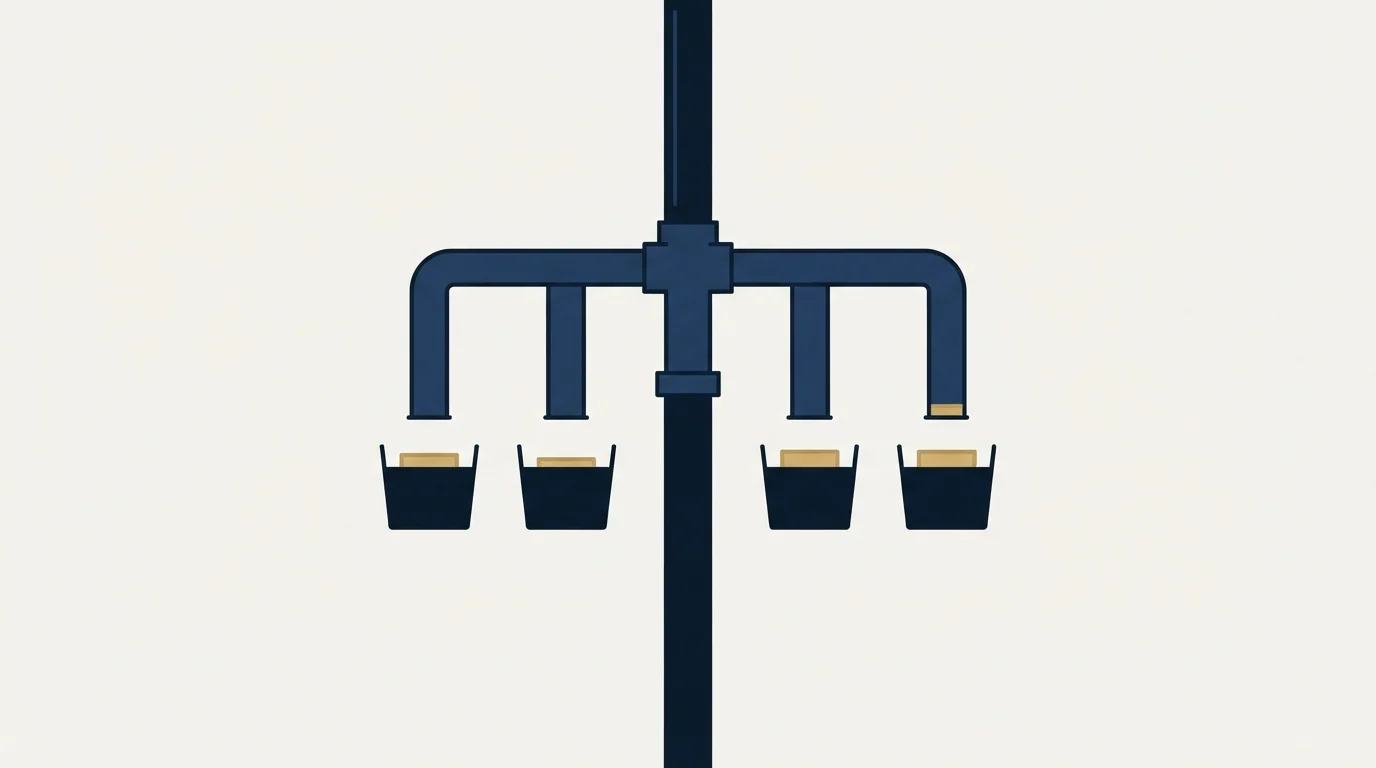
Mailbox providers publish limits on how much a single account may send in a day, and those limits exist for reasons that have nothing to do with cold outbound. They protect the provider's own infrastructure, they cap the damage a compromised account can do, and they draw a line between an individual's mail and a bulk mailing platform, which the provider would rather you used a different product for.
Those published figures vary by provider and by plan, they change, and most of the numbers circulating in cold email content are either out of date or were never the published figure in the first place. The current published limits, and what they mean for a real sending programme, are set out in email sending limits by provider. Check them against the provider's own documentation for your plan rather than against anything an outbound tool tells you.
Separately from the published ceiling there is a practical one, which is lower and unpublished. A brand-new mailbox on a brand-new domain sending at its full allowance on its first day is a recognisable pattern, and receiving providers respond to it. The gap between what a provider permits and what a specific account can send without consequence is what warming exists to close, and how long that takes is covered in how long to warm up a domain.
The arithmetic of the programme falls out of those two ceilings. Total daily capacity is the number of mailboxes multiplied by whatever per-mailbox rate you have decided is safe, and the per-mailbox rate is the variable you should be least aggressive about. Adding mailboxes is the cheap lever. Raising the per-mailbox number is the expensive one, and it is expensive in a currency you cannot easily buy back.
Where it breaks
Rotation distributes volume. It does not automatically distribute reputation, and the gap between those two sentences is where most rotated programmes get into trouble.
Buyers set up rotation expecting isolation: the sense that if something goes wrong, it goes wrong in one place. You get that isolation only to the degree that the underlying mailboxes are genuinely independent identities, and mailboxes are not independent simply because they are separate accounts.
Every mailbox on a domain shares that domain's reputation completely. The domain is what the receiving side is forming a view about, so a campaign rotating across a dozen mailboxes that all sit on one domain has spread the per-mailbox send count while concentrating every reputational signal onto a single name. Complaints from all twelve accumulate against that one domain. A refusal aimed at that domain refuses all twelve at once. The per-mailbox ceiling has been respected and nothing has been isolated.
- Per-mailbox send counts stay comfortably low
- Every complaint accrues to the same domain reputation
- A refusal against the domain stops every mailbox at once
- Authentication and history are shared, so there is one story being told
- Isolation is close to zero
- Per-mailbox send counts stay equally low
- Complaints attach to whichever domain sent the message
- A refusal against one domain leaves the others sending
- Each domain carries its own authentication and its own history
- Isolation is real and proportional to the domain count
So the isolation you actually get is a function of how many distinct domains sit underneath the campaign, not how many mailboxes are connected to it. That is the single most useful sentence in this entry. When someone describes their setup by naming a mailbox count, they have told you about their capacity and nothing at all about their exposure. The follow-on question is always how many domains those mailboxes sit on, and whether those domains are independent of each other in registration, authentication and history rather than merely different strings.
Independence is worth being precise about, because different strings are easy and genuine separation is not. Domains that were registered together, that resolve through the same records, that were warmed on the same schedule and that have only ever sent the same campaign are separate names attached to one history. A receiving provider that has decided against one of them has a good deal of material for deciding about the rest. Genuine separation means the domains differ in the things a receiver can observe: their age, their authentication setup, their sending pattern, and the path the mail arrives by.
That last one is the layer people forget. Mailboxes hosted with the same provider frequently share outbound infrastructure, so the network your mail leaves from may be common to every domain you own and to a great many senders you have never heard of. Rotation across domains does nothing about a problem at that layer. It is usually the smaller risk, since major providers work hard to keep that infrastructure in good standing, and it is worth knowing about because it sets a floor on how much isolation any rotation setup can produce.
Buying more domain surface than the volume strictly requires is a deliberate choice with a cost, and the reasoning behind running that much spare capacity is set out in why we buy more email infrastructure than we need and why we maintain spare sending capacity for every client campaign.
The second break: what rotation is for

Rotation is sold as a way to send more. Its honest function is to send a given amount more safely.
The distinction sounds academic and it decides the outcome of a programme. Take a campaign that needs a fixed number of messages delivered this month. Rotation lets you spread that fixed requirement across enough mailboxes and domains that no individual identity is doing anything unusual. Every account looks like a person sending a normal amount of business mail, because that is what each one is doing.
Now take the other reading. The programme wants more volume, so it adds mailboxes and raises the target to match. Per-mailbox load stays exactly where it was, the domain count often does not move at all because the new mailboxes are added to existing domains, and total volume climbs. The mechanism has been used to defeat its own purpose. The programme is sending more mail from the same reputational surface, and the rotation is now decoration.
The diagnostic is simple and worth applying to any rotation setup, including your own. When mailboxes were last added, did the per-mailbox send rate go down or did the total go up? If the answer is the total went up, rotation is being used as a capacity multiplier rather than as a safety mechanism, and the safety benefit that justified building it has already been spent.
- Yes: Keeping each individual account inside its provider's published sending limit
- Yes: Keeping each account's daily volume below the level that looks unusual for a person
- Yes: Keeping one unhealthy mailbox from carrying an entire campaign
- No: Isolating a reputation problem, when every mailbox sits on the same domain
- No: Making a poorly targeted list acceptable to receiving providers
- No: Safely raising total volume without adding domain surface underneath it
Rotation says nothing about how often a person hears from you
These are two separate decisions and they are regularly confused, because both involve counting things.
Rotation is a sending-capacity decision. It governs which mailbox a given message leaves from, and it exists to manage the load any one identity carries.
How many times a person hears from you is a decision about the person. Our own practice is one message per campaign, written on one premise and sent once. A later approach to the same person is a separate campaign with its own premise, built and judged on its own merits.
Rotation changes which mailbox sends that one message. It never changes how many messages the person receives. A programme that adds mailboxes has not thereby earned the right to contact anyone more often, and a programme that contacts people once still needs the same domain surface underneath it if it is sending at any real volume.
In a live programme

Three habits carry most of the value.
Count domains, not mailboxes, when you are assessing exposure. The mailbox number tells you what you can send. The domain number tells you what happens when something goes wrong.
Treat the per-mailbox rate as the thing you protect. If the volume requirement grows, add domain surface underneath it rather than asking each existing account to work harder. Where rotation lives inside the wider tool decision is covered in cold email platforms compared, since platforms differ considerably in how much control they give you over eligibility and pacing.
Plan the reply side before you scale the send side. A campaign rotating across many accounts scatters its replies across all of them, and a reply that nobody sees for a day is a meeting you did not get. That operational cost grows with the mailbox count and it is the one people consistently forget to budget for.
Sizing an inventory and keeping it healthy is the unglamorous half of outbound, and our pay-per-qualified-meeting outbound is where we carry that half.
Frequently asked questions.
Frequently asked questions- What is inbox rotation in cold email?
- Distributing a campaign's sending volume across multiple connected mailboxes so no single account carries all of it. The platform keeps a pointer, picks the next eligible mailbox for each outgoing message, and skips accounts that are at their daily ceiling, still warming, or flagged unhealthy. Each message is sent as that account, with its own address and domain.
- Does inbox rotation protect sender reputation?
- Partly. It reliably keeps per-mailbox volume low, which is what provider limits and behavioural patterns respond to. It does not isolate reputation on its own, because every mailbox on a domain shares that domain's standing completely. Rotating across many mailboxes on one domain spreads the send count and concentrates every reputational signal.
- How many mailboxes and domains do I need?
- Total capacity is the mailbox count multiplied by whatever per-mailbox rate you have decided is safe, and that rate should be conservative rather than maximal. The domain count is the separate question, and it is the one that determines exposure. When assessing a setup, count domains for risk and mailboxes for capacity.
- Does inbox rotation mean contacting people more often?
- No. These are separate decisions that get confused because both involve counting. Rotation governs which mailbox a given message leaves from, and exists to manage the load any one identity carries. How often a person hears from you is a decision about that person, and rotation changes neither the premise nor the number of messages they receive.